Showing posts with label salal. Show all posts

Sunday, March 22, 2026

Spiny, Noxious, Beautiful

I pass Echo Lake often, on my way to points west (Sundew Bog, Buttle Lake ...). I don't usually stop: the two parking spots, each allowing access to a sort of small skiff launch, if you don't mind getting your feet muddy, allow for one car at a time. And they're often occupied.

There was nobody there the other day, and the water level was higher than I've ever seen it; it looked as if the lake had grown overnight. And it was green, so green.

Upside-down forest. The red bushes are hardhack. They retain their reddish-brown, dried flower spikes all winter.

Salal at the water's edge.

There's a small clump of gorse beside the access to the water; I saw it first 6 years ago, and have checked it every year since. It's an introduced species, and has been designated as a Provincial Noxious Weed, partly because it's a fire hazard, and partly because, in other locations (not here on the shore of Echo Lake) it displaces forage plants and stops the growth of conifer seedlings on logged-off areas. Here, it is growing slowly, but is partly limited by the highway and parking area and surrounded, so far, by well-established salal.

Gorse, Ulex europaeus.

It does have pretty flowers, blooming in spring and fall.

Leaves on new plants are trifoliate, like clover, but soon turn themselves into sharp, stiff spines.

I have reported this to the Invasive Species Council.

~~~~~~~~~~~~~~~

La carretera que me lleva a la costa opuesta de la isla pasa por el lago Echo. Casi siempre paso sin detenerme; los dos lugares donde se puede estacionar, cada uno permitiendo entrar al lago con una canoa, si no te importa llenarte los pies de lodo, solamente tienen sitio para un coche a la vez. Y muchas veces, ya están ocupados.

No había nadie anteayer, y el agua estaba a un nivel más alto que antes había visto.  Y el agua estaba ¡tan verde!

    1. Reflejo del bosque. Los arbustos rojos son Spiraea douglasii. Retienen sus flores, secas, color rojo tabique, todo el invierno.

    2. Salal, Gualtheria shallon, crece en el borde del agua.

Hay una mata de retamo espinoso, Ulex europaeus, al lado del acceso al agua; lo vi por primera vez hace 6 años. Es una especie introducido, y lo han determinado ser una Hierba Invasora y Nociva en la Provincia, en parte porque constituye un riesgo de incendio, y en parte porque en otros sitios (pero aquí en el lago, no) elimina las plantas de forraje y no permite la regeneración de árboles coníferos después de una tala. Aquí, está creciendo lentamente, estando limitado por la carretera y el estacionamiento, y rodeado, hasta ahora, por el salal.

    3. Ulex europaeus.

    4. Las flores son bellas; fue por esto que alguien trajo la planta a Canadá. Florece en la primavera y por segunda vez en el otoño.

    5. Las hojas de plantas nuevas se parecen a las del trébol, pero luego se convierten en espinas fuertes y agudas.

He reportado la presencia de esta planta al Comité de Especies Invasoras.


Wednesday, February 04, 2026

Colourful

Not much to see, I said. Fog and rain and half-hidden trees. Grey overhead, dark shadows around me. Not much to look at.

I was mistaken. As long as I was driving, eyes mostly on the road ahead, trees sliding by in the mist, I was really half blind. To see more, you have to slow down. Better still, stop.

I was eating my lunch beside the logging road turnoff (cold boiled eggs, pepperoni, cucumber with chili powder and lime juice, lukewarm coffee) and looking through the windshield. A typical roadside forest, logged off, torn up by road builders, weedy. But look! On this dim, grey day, look at all the colours! Warm, cheerful colours!

The view from my driver's seat.

It was barely raining now, a mere sprinkle. I wrapped the camera in plastic and went colour shopping.

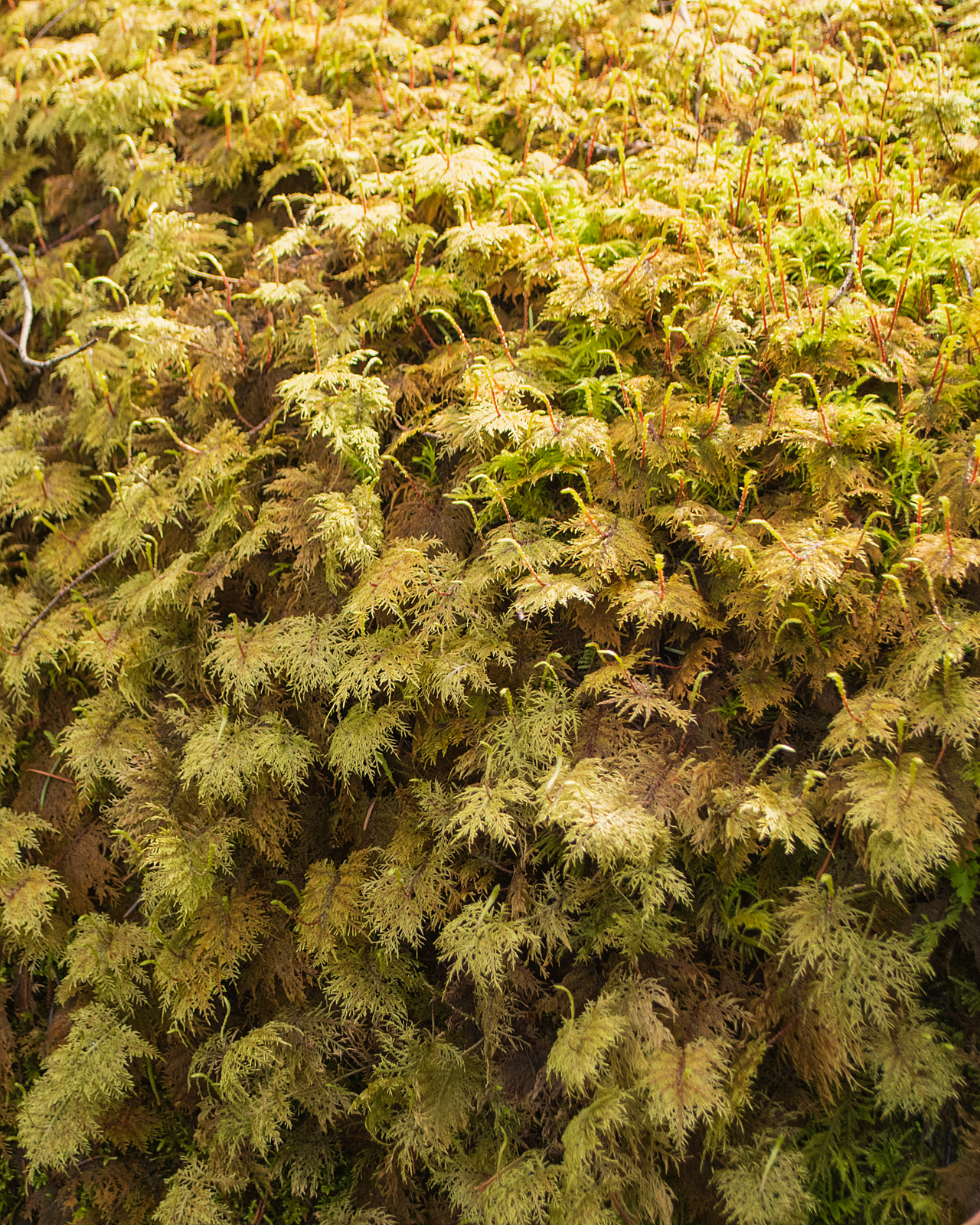
Yellow-green moss, purplish dead leaves.

Dead bracken ferns; freezing brings out the bright red colour.

Creamy lichen (witches' hair?) dangling from cedar branches.

Salal stays bright green all winter.

Red osier dogwood.

A closer look. Pink, almost magenta in spots.

Broken stick having a bad hair day.

An dark chocolatey, almost black seed pod of Scotch broom.

There's more; more colours, more shapes, a bunch of lichens. For tomorrow.

~~~~~~~~~~~~~~~~~~~

No hay gran cosa para ver, dije. Neblina y lluvia y árboles medio escondidos. Arriba, cielo gris, alrededor, sombras. Nada que te llama la atención.

Me equivocaba. Mientras seguía manejando, con los ojos fijos en el camino, viendo los árboles a ambos lados deslizándose entre nubes, estaba en realidad medio ciega. Para ver las cosas como se debe, hay que ir despacito. O mejor, pararte.

Mientras comía mi almuerzo en la entrada al camino de madereros — huevos hervidos frios, choricitos de pepperoni, pepino con chile en polvo y jugo de limón, café tibio —  miraba la vista en frente de mi parabrisas. Un bosque típico de los que se ven al lado del camino; los árboles maduros ya cosechados, la tierra revuelta por los constructores de caminos, hierbas invasivas ... Pero, ¡mira! En este dia oscuro y gris, ¡mira todos los colores! ¡Colores cálidos, alegres!

Apenas llovía ya. Envolví la cámara en plástico y fui a buscar colores.

  1. La vista desde mi parabrisas.
  2. Musgos verde/amarillo, con hojas muertas con un tinte de color morado.
  3. Helechos águila, Pteridium aquilinum, muertos. Al congelarse, se vuelven de este color rojo tabique.
  4. Un liquen color crema, probablemente "cabello de bruja", Alectoria sarmentosa, colgado de las ramas de un cedro rojo.
  5. El salal, Gualtheria shallon, se mantiene verde brillante todo el invierno.
  6. Cornus stolonifera.
  7. Unas de las ramas con sus botones. Los tallos siempre son rojos, pero el color es más intenso después de una helada.
  8. Un palo roto que parece que sufre de un dia de pelo alborotado.
  9. Una vaina de las semillas de retama negra. De color de chocolate oscuro, casi negro.
Hay más; otros colores, otras formas, un montoncito de líquenes. Lo dejo para mañana.

Sunday, September 28, 2025

View from the forest understory

So, in an on-again, off-again gentle rain, I was sitting on a mossy hummock on the forest floor, poking through the duff, looking for beasties and mushrooms, following spiders and peering into lichen "gardens". Looked up, stretching, resting my eyes and my back, saw the forest around me.

Salal, moss, and evergreen trunks. And a huckleberry growing on a stump.

Up-ended roots of a fallen evergreen.

Dead hemlock, growing lichens, still carrying seed cones.

Moss on a small fallen tree.

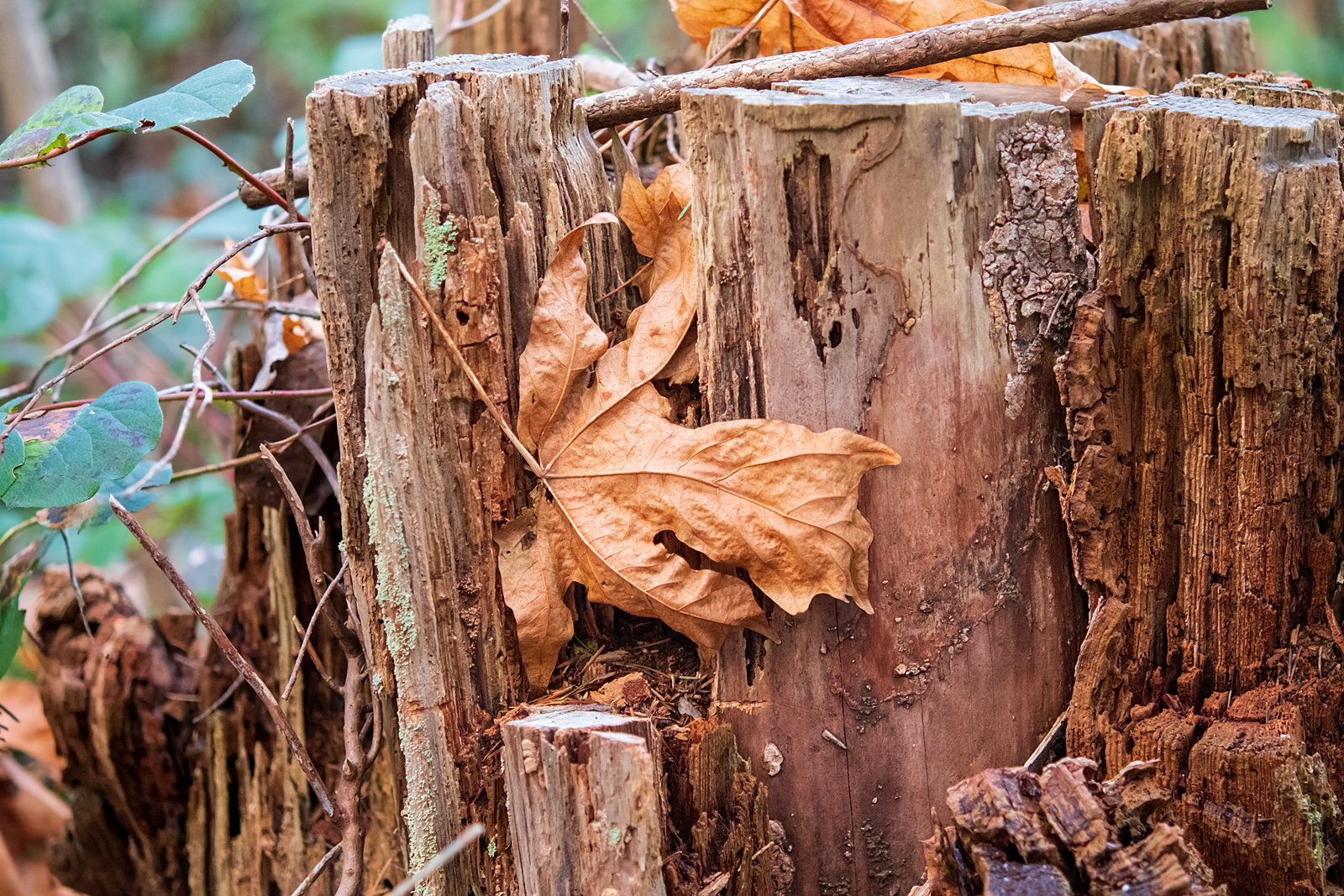
Dead leaf on top of a stump.

And the wood of an old, dried-out stump.

Log end, bracket fungi, and wet salal leaves.

Yes, there were beasties. And mushrooms and lichen ... Next.

~~~~~~~~~~~~~~~

Llovía. Una lluvia tenue, intermitente. Estaba sentada en el musgo en el suelo del bosque, examinando la hojarasca, buscando animalitos y hongos, sacando fotos de arañas y "jardines" de líquenes. Descansando, estirando para aliviar los ojos y la espalda, alcé la vista y vi el bosque alrededor.

  1. El sotobosque. Salal (Gualtheria shallon), los troncos de árboles,  y un tocón  viejo con su arbusto de "huckleberry" (Vaccinium parvifolium).
  2. Las raices de un árbol recién caído.
  3. Un árbol muerto,  Tsuga heterophylla, ahora sirviendo de sostén de líquenes, pero todavía deteniendo sus  conos de semilla.
  4. Musgos en un tronco caído.
  5. Una hoja muerta encima de un tocón podrido.
  6. Detalle de madera seca.
  7. El extremo de un tronco cortado, con sus hongos políporos, y hojas mojadas de salal.
Sí, encontré los animalitos, los hongos y muchos líquenes. Los dejo para mañana.

Thursday, July 04, 2024

Pick your own dessert

 BCParks' "Recreation Sites" on Vancouver Island don't offer many amenities. Parking, picnic tables, fire pits, boat launch, an outhouse; that's about it. Not counting the view, of course, or the birdsong, or the scented breeze ... Little Bear Bay offers, as well, dessert. Free.

I picked a double handful of huckleberries; sweet and juicy. Topped them off with orange salmonberries, a little on the tart side, so far;  a few more days of sunshine and they'll be as sweet as honey.

Salmonberries, Rubus spectabilis

Most salmonberries are red, but the orange ones, I've found, have a flavour all their own, but the sweetness varies with the weather.

And there will be salal. Not at the moment, but later: bring your buckets!

Salal flowers and unripe berries.

These bushes are loaded! A representative patch; the whole area is surrounded by these.

The berries, later, will be as large as the flowers, a deep, almost black purple. And sticky; the whole cluster of berries, stem and all, is sticky. It's hard to separate the soft berries from the stem. No matter; my mom used to harvest the whole lot, stem and leftover bracts and all.  She boiled the mass down, and strained it through a jelly bag (in her kitchen, an old, well-washed pillowcase, hung on a broom handle between two chairs.) The resulting purple juice made a delicious jelly, perfect in PBJ sandwiches.

The bears will probably get the bulk of these ones. If you see a bear stained purple around the snout, you'll know where he's been.


Little Bear River estuary, low tide. The yellow-green area is underwater at high tide.

Tomorrow: Trapped!

~~~~~~~~~~~~~~

Los "Sitios de Recreación" del Departamento de Parques BC ofrecen un mínimo de amenidades: estacionamiento, mesas de picnic, hogueras, rampa para embarcaciones, letrina rústica: nada más. Eso, si no tomas en cuento las vistas, o el canto de las aves, o el aire perfumado de bosque y mar ... La Bahía del Osito (Little Bear Bay) ofrece, además, postre. Gratis.

Coseché arándanos rojos (Vaccinium parvifolium) hasta llenarme las dos manos. Jugosos y dulces. Encima, salmonberries (Rubus spectabilis); en este sitio, las frutas son anaranjadas. Estas estaban todavía un poco ácidas; dales unos dias más de sol y estarán dulces como la miel.

  1. R. spectabilis. La mayoría de las frutas de esta especie son rojas, pero las anaranjadas, creo, tienen un sabor especial. Son más o menos dulces, según el clima.
  2. Y habrán bayas de salal, Gaultheria shallon. Todavía no, pero más tarde, ¡toneladas! Aquí, las flores y bayas inmaduras (les llamamos verdes, pero sin embargo son rojas). 
  3. Los arbustos llenos de bayas verdes. Un grupo representativo; todo el sitio está rodeado de esta planta.

    Las bayas, ya maduras, serán del tamaño de las flores, y un color morado casi negro. Y pegajosas; todo el ramito de bayas, con todo y tallo, es pegajoso. Es difícil separar las bayas blandas del tallo. No tiene importancia; mi mamá recogía todo, las bayas con el tallo y las brácteas y todo. Hervía la masa entera, y la pasaba por una coladera de jaleas. (En su cocina, esta consistía en una vieja funda de almohada, bien lavada, llena de la masa de salal, y colgada de un palo de escoba atorada en dos sillas. El jugo morado que resultaba rendía una jalea deliciosa, perfecta en los sandwiches de crema de cacahuate y jalea.

    Estos, aquí, los comerán los osos. Si alguna vez ves un oso con el hocico morado, ya sabrás donde andaba.
  4. El estuario del rio "Little Bear" con la marea baja. La zona amarilla queda bajo el agua cuando sube la marea.
Mañana: ¡Atrapada!

Sunday, June 25, 2023

Promise

 There will be gooey, deep purple berries. Soon.

Salal flowers, Gaultheria shallon

And the unripe berries.

~~~~~~~~~~~~~~~
Pronto habrán las frutas de salal, dulces y de color morado intenso.
Fotos: las flores y las frutas todavía no maduras de salal, Gautheria shallon.


Wednesday, January 25, 2023

Ain't dead yet

 And this one, long-since felled, still keeps on supporting its community.

Busy little stumpie
The outer bark and the layers of live wood have mostly rotted away, exposing the solid heartwood. Salal has rooted in the old wood, lichens grow on the outer edges, spiders and their prey hide in the many cracks. And big-leaf maple leaves rest on their trip to join the rotting mulch on the ground beneath.

Down underneath, invisible in the soil, the roots still form part of the living earth, the fungi, the inter-connected roots of the forest, still serving as conduits for liquid and nutrients.

Life goes on. And on.

~~~~~~~~~~~~~~~~~~~~~~~~~~~~~~~~
Otro tronco, éste cortado y desbaratándose, pero que sigue como soporte de su comunidad.

Foto: un tronco cortado bajito.

La corteza y las capas de madera activa se han pudrido en gran parte, dejando a la luz la madera del corazón, el duramen, todavía en firme. El arbusto nativo, salal, Gaultheria shallon, ha penetrado la madera con sus raices, en la superficies exteriores crecen líquenes, arañas y su presa se esconden en las múltiples grietas. Y encima, hojas del arce de hoja grande descansan camino a unirse a sus hermanos descomponiéndose hasta tornarse abono, en el suelo.

Y más abajo, debajo del suelo, invisibles, las raices siguen formando parte de la tierra viva, los hongos, las raices entrelazadas del bosque; todavía sirven para conducir el agua y los nutrientes que lleva.

La vida sigue. Y sigue ...


Monday, December 26, 2022

Understory greens

Now that the snow is gone, our world is mainly grey; the ocean is grey, the skies are grey, the mists on the mountaintops are grey. But inside a mixed deciduous and evergreen wood, brown takes over. In the little wood at the end of my block, the ground wears a brown carpet made up of dead alder leaves, rust-brown big-leaf maple leaves, fallen twigs, Douglas-fir cones and needles, crumbling wood. Far overhead, mostly, the Douglas-firs provide a greenish canopy, dark against the grey sky. Their trunks create a pillared wall all around. Also brown.

But the understory, the space between the soil beneath and the canopy overhead, even now in winter, after the deciduous leaves have melted into the brown carpet, the understory is suprisingly green.

Here's what I saw on a quick tour last week.

There's always moss. Here, a stone about the size of a canteloupr wears its cap of green.

Salal. They will retain their green leaves all winter.

Evergreen sword ferns, bent down by the snow, but still green. Most other ferns have gone into hiding for the winter.

Holly. This is an invasive species, well adapted to our shady, damp forests.

The huckleberry is a deciduous shrub, but its stems stay green all winter.

A few huckleberry leaves manage to hold on.

The native rhododendron, I think.

UPDATE: I've been warned that this is an invasive and poisonous species, Daphne laureola. I'll be carrying shears and a bag next time I'm in that bit of woods.

But there's more! Looking closely at those brown tree trunks, it turns out that many of them are green, too, covered with a ghostly-green dust lichen.

Coming in close, some are just dust, some are ruffled, like these. Possibly a Lepraria species.

And, of course, we begin and end with moss.

The Oregon grapes were still green, but badly spotted or broken. I kept looking for a tidy one, and ended up at the end of the trail without a sample.

~~~~~~~~~~~~~~~~~~~~~~~~~~~~~~~~~~~
Ahora que la nieve se ha derretido, volvemos a nuestro mundo gris. El cielo es gris, el mar es gris, las neblinas en las montañas son todas grises. Pero en el centro de un bosque mixto de árboles de hoja caduca y los de hoja perenne, el color café predomina. En el bosquecito al pie de mi calle, el suelo lleva su alfombra color café hecha de hojas muertas de aliso, las hojas color tabique de arce de hoja grande, ramitas caídas, las piñas y agujas de abeto de Douglas, y madera desbaratada. Allá muy arriba, en gran parte, las copas de los abetos sigue verde, un verde oscuro en la tenue luz. Alrededor, pilares de troncos de abetos forman una pared, también de color café.

Pero el sotobosque, ese espacio entre el suelo y la bóveda allá arriba, aun ahora en invierno, cuando las hojas de arce y aliso se han unido al suelo, ese sotobosque se mantiene verde todavía.

Estas plantas las vi en una vuelta por el bosque la semana pasada.

Fotos:
  1. Musgo. Siempre hay musgo. Esta piedra, como del tamaño de un melón, lleva su sombrerito de musgo.
  2. El salal, Gualtheria shallon. Estos se mantienen bien verdes sea cual sea el clima.
  3. Los helechos de espada son de hoja perenne. Otros helechos se han reducido a raices por el invierno.
  4. El acebo. Esta es una especie invasora, bien adaptada a nuestro clima.
  5. El arándano "huckleberry" pierde casi todas sus hojas, pero los tallos siguen verdes.
  6. Aquí unas hojas quedan sin caerse.
  7. El rododendro nativo, creo.
  8. Y hay más. Mirando de cerca esos troncos oscuros, se ve que están cubiertos de unos líquenes crustosos, de un color verde fantasma. Creo que son una especie de los Lepraria.
  9. Empezamos y terminamos con musgos. Porque siempre hay musgos.
También había muchas uvas de Oregón, Mahonia spp. pero todos tan manchados y rotos por la nieve. Iba buscando una entera, y llegué a la salida del bosque sin ver ni una.


Friday, May 13, 2022

On a wet side hill

 After a short break, I'm back looking at things found on the shore and mossy rock outcroppings beside McIvor Lake last week.

The weather was changeable, going from rain to watery sunshine back to rain. The moss was soaking wet; walking on it almost felt like wading. My shoes were soon full of water.
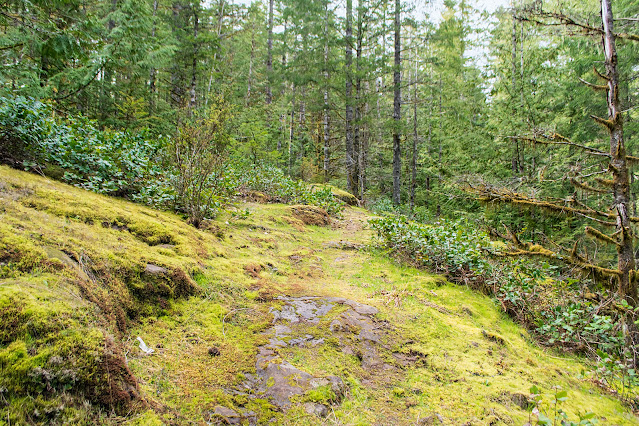
Sort of a trail crossing the rocks in the rain. Maybe a deer trail.

Salal grows well on rocky slopes. And on slippery hills, where the wet moss slides away under your feet, it's a life-saver. The stems are extremely strong, the roots grip the rock; I hold onto one as a support; they never give way, they never break. Fresh evergreen ferns are helpful, too. Tree branches are iffy; they do break suddenly; more than once I've ended up sliding down a slope on my back. Not when there's salal within reach.

Down on the flat, sunshine percolates through the trees.

Step moss, Hylocomium splendens, with this year's new "steps" sprouting from the older leaves. Growing on rock.

I just noticed, in my guide book, that, "the age of step moss may be estimated by counting its annual "steps." I'll have to dig one out to try that. 

One of the bone lichens, I think.

Slugs love mushrooms. It looks like they've been feasting on these.

Fungi on the end of a cut log. Red-belted polypore and some unidentified dark brown ones.

Lichen agaric mushrooms, Lichenomphalia umbellifera.

These mushrooms, with their always-associated green algae, grow on rotted wood. Here, on the rocky outcrop, they are growing on shreds of well-aged wood near the edge of the treed area.

~~~~~~~~~~~~~~~~~~~~~~
Después de un descanso corto, de vuelta estoy mirando lo que encontré en una caminata sobre las rocas cubiertas de musgo al lado del lago McIvor.

El clima de ese dia iba de lluvia a sol y de vuelta a lluvia. El musgo estaba empapado; caminar sobre las rocas se sentía como si vadeara en la playa. Pronto tenía los zapatos llenos de agua.

Foto: Un sendero poco marcado (tal vez un sendero de venados) sobre el afloramiento de rocas.

El "salal", Gaultheria shallon, crece bien en terreno rocoso. Y en los cerros donde el musgo se desliza bajo mis pies es un salvavidas. Los tallos son muy fuertes, las raices se adhieren bien a su sustrato. Yo agarro un tallo mientras bajo o subo; nunca me fallan, nunca se rompen. Los helechos de hoja perenne también sirven, si son frescos. La ramas de los árboles no tanto; a veces se rompen de repente; más de una vez he terminando bajando un declive sobre las espaldas. Pero nunca, si hay salal a la mano.

Foto: en el terreno plano al pie del cerro. El sol se cuela entre los troncos.

Foto #3: el musgo "de escaleras", Hylocomium splendens, con las nuevas hojas anuales saltando sobre las del año pasado.

Acabo de ver esto en mi libro guía: "La edad del musgo "step" se puede estimar contando los "escalones" anuales." Tendré que arrancar uno para ver esto.

Foto #4: Un liquen, tal vez uno de los líquenes "huesudos".

Foto #5: A las babosas les encanta la pulpa de los hongos. Se nota que aquí han estado cenando.

#6: Hongos en un troncón cortado. El poliporo de cinta roja, y unos que no pude identificar.

#7: Los honguitos de liquen, Lichenomphalia umbellifera. Estos, con su alga asociada, crecen sobre madera podrida. Aquí, entre las rocas, están establecidos en madera tan podrida que ha formado una capa ligera entre el musgo y la roca.

Friday, March 18, 2022

Burnt stump, early spring

 A burnt stump on a hillside, logged off a few years back, hosts salal, huckleberry, and lichens. Doing its bit to restore the lost forest.

The red branches are huckleberry, just ready to bud out. And on the ground, last year's bracken ferns shelter the new buds due to spring up this month from their rhizomes.

~~~~~~~~~~~~~~~~~~~~~~~~
Un tronco quemado en un sitio cosechado por los madereros hace pocos años, sirve como base y nutrientes para nuevas plantas de "salal", Gaultheria shallon; el nativo arándano rojo, Vaccinium parvifolium; y líquenes Cladonia, haciendo su parte en la restauración del bosque.

Las ramas rojas son del "huckleberry", el arándano rojo; están a punto de brotar las primeras hojas. Y el suelo está cubierto de helechos deciduos del año pasado; se mueren con las primeras heladas pero siguen en sitio protegiéndo a los nuevos brotes, que aparecerán este mes, brotando desde los rizomas.


Thursday, December 09, 2021

Protected zone

Microclimates: the inside of a burnt-out stump is protected from wind, warmer, maybe drier than the outside. This little stump is on the hillside above Lake Hoomak.

Hollow stump, with moss, lichens, salal,and evergreen ferns.

On the outside of the stump, the lichen is a Cladonia species. On the inside a dust lichen, probably a Lepraria species, covers the burnt sections. Moss grows on the broken rim, where moisture collects.

~~~~~~~~~~~~~~~~~~~~~~~~~~~~~~
Un tocón de un arbolito, habiendo perdido el centro, crea varios microclimas: dentro, está protegido de los vientos, menos frio, más seco; afuera recibe el impacto de los vientos y la lluvia que estos vientos cargan. Este toconcito está en la ladera arriba del lago Hoomak.

En el exterior, lleva líquenes Cladonia. Adentro, un liquen de polvo, probablemente de una de las especies de Lepraria, cubre la parte quemada. Y el borde superior, donde se detiene el agua, sostiene musgos. Alrededor, hay helechos perennes y salal (Gaultheria shallon).

Sunday, August 30, 2020

Up Cedar Creek Road

 I found a road going up in the hills behind the cliff faces I've been looking at.

Cedar Creek road.

The road is cut through deep forest, gravel, in places only one car width wide. In spots, the sun reaches the road, but mostly it's in shadow. In a wider spot, sun bleached a broken stump in the rubble on the shoulder.

Bleached turkey tail fungus.

Where the sunlight is only reflected from the bare road, the undergrowth is deep green.

Another stump. Salal and huckleberries, ripe and sweet. The salal dyed my fingers purple.

Next: a variety of lichens.

~~~~~~~~~~~~~~~~~~~~~~~~
Encontré un camino que sube atrás de los peñascos que he estado explorando. Está cortado por medio de bosque cerrado; el camino es de grava, angosto, a veces apenas permitiendo el paso de un coche a la vez, en sombra por la mayor parte.

En un espacio más abierto, dejaron los restos de este arbolito en pleno sol entre los escombros al lado del camino. El tronco, y el hongo "cola de guajolote" quedaron blanqueados.

Donde el sol apenas llega reflejado del camino, la vegetación es de un verde fuerte. Aquí salal (Gaultheria shallon) y huckleberry (Vaccinium parvifolium) producen sus frutillas, algunas ya maduras y dulces. El salal me pintó los dedos de un color morado.

Mañana: líquenes.


Saturday, September 28, 2019

Time-outs

The trails and stairs going to the Elk Falls river bed are long and steep; going down, my old knees protest. Going back up, I have to stop to catch my breath. And then I lean on the railings and look at whatever's just in front of me.

This time, it was a section of Douglas fir trunk.

Moss, lichen, salal, shed needles, growing on crevassed bark.

And then there was a patch of Western Maidenhair fern.

Adiatum aleuticum, with the ever-present, ever-green sword fern in the background.

Double-checking the name, since it once was included with the Eastern species, I came across an interesting pair of quotes:

The name, maidenhair, originated from another plant — a European bog species that young girls once used to turn their hair blonde. (Central Coast Biodiversity)

And: 

The Quinault burnt the leaves and rubbed ashes in their hair to make it long, shiny and black. (Native Plants, PNW)

But other sources say the name refers to the black root hairs, or, conversely, to the glossy black stems.


Powered By Blogger