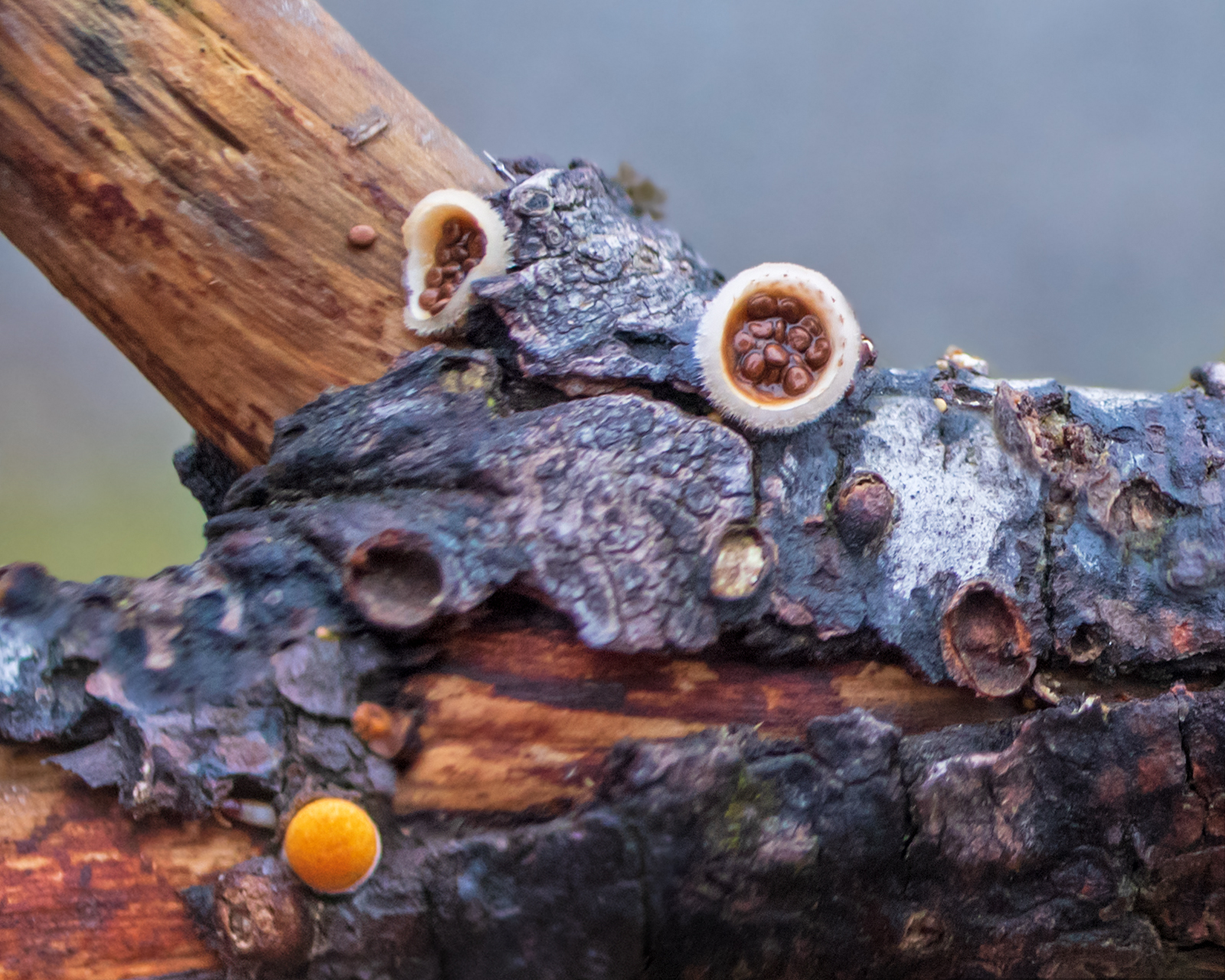
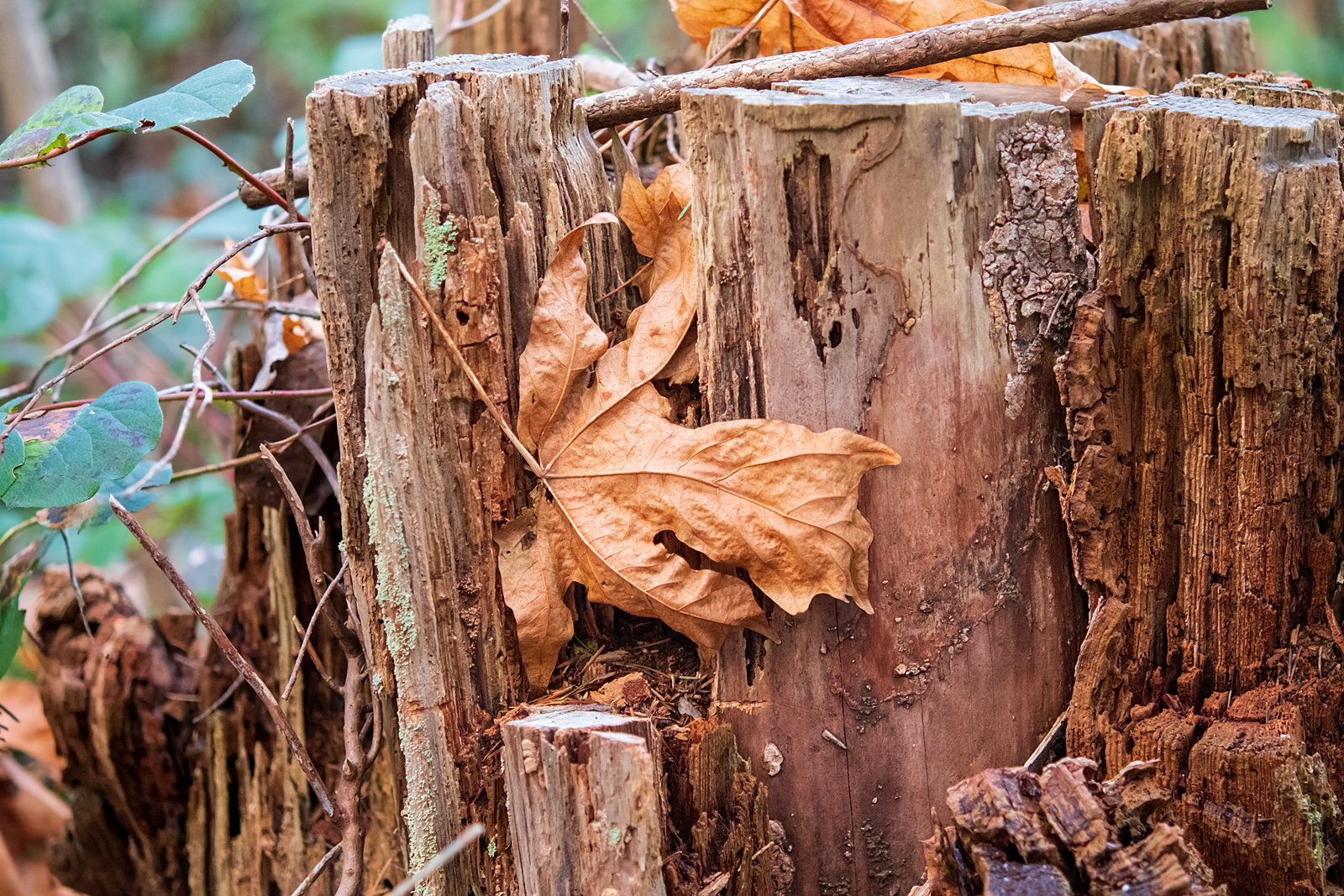
Showing posts with label fungi. Show all posts

Monday, December 15, 2025

Sapwood colonizers

I find mushrooms in the forest in several types of habitat. On the ground, in the duff, mainly. Or on the bark of trees dead or alive, standing or downed. On rotting wood, old stumps, logs that are halfway turned into duff. And a fourth general location: on human-cut wood: sawed logs, fallen trees cut to clear a trail, ground-level stumps in a lawn (like those in the museum's grounds).

These last show interesting patterns.

Log end. The growth starts in the recently live wood, the sapwood, and spreads towards the heartwood. It later sprouts through cracks in the bark.

On a nearby log. Probably Purple-toothed polypore, Trichaptum abietinum. 

About T. abietinum, which grows on conifer wood:
The fungus exclusively colonizes the sapwood of recently dead trees. ... When they develop on the cut end of logs, they cluster in a ring and cover the surface of the exposed sapwood. (Canadian Forest Service)

Cropped photo. The green shelves are overgrown with algae. Young Trichaptum sp.,will have a purplish tinge on the underside.

Another common pattern, probably not fungi:

I see many recently cut logs like this; a circle of hard, white patches oozing or sprouting from the sapwood.

Shapless white blotches, crusty and dry.

A Google image search and a search on iNaturalist came up with many contradictory ids for these: lichen or sap or white rot fungus or even insects. I tend to think it's dried sap, since it doesn't spread beyond the sapwood.

~~~~~~~~~~~~~~

En el bosque encuentro hongos en varios tipos de habitat. En el suelo, entre el detritus forestal, principalmente. O en la corteza de los árboles, sea vivos o muertos, de pie o caídos. En madera podrida: tocones viejos, troncos que están ya casi convertidos en detritus. Y en cuarto lugar, creciendo sobre madera cortada por humanos: troncos aserrados, cortados para abrir camino, tocones cortados casi al nivel del suelo en un césped urbano (como por ejemplo, alrededor del museo al final de mi calle). 

Estos últimos tienen características interesantes.

    1. Un tronco aserrado. El hongo brota de la madera activa, la albura, y luego se extiende un poco hacia el duramen (la madera del centro del tronco). Más tarde, aparece entre grietas en la corteza.

    2. En otro tronco cercano. Los hongos son probablemente el políporo de dientes púrpuras, Trichaptum abietinum.
El hongo coloniza exclusivamente la albura de árboles que han muerto recientemente. ... Cuando se desarrollan en los extremos cortados de troncos, se agrupan en un anillo y cubren la supeficie de la alburas expuesta. (Canadian Forest Service)
     3. Foto recortada. Los hongos verdes están cubiertos de algas. Ejemplares jóvenes de Trichaptum sp. tienen poros de color violeta en la superficie inferior.

Y veo círculos como este frecuentemente:

    4 . Un círculo de manchas blancas en la superficie cortada de la albura. No se extiende a la corteza ni al duramen en el centro.

    5. Manchas sin forma fija, secas y duras. Una búsqueda en imágenes Google y otra en iNaturalist produjo una variedad de identificaciones posibles, aparentemente al azar: mencionaron líquenes,  savia o resina, hongo de podredumbre blanca o hasta ¡insectos!. Creo que será  savia reseca, ya que no extiende más alla de la albura, donde fluye la savia.

Sunday, November 23, 2025

LBMs and two others.

There are always more mushrooms. Here's another half dozen, from the low-lying land beside the river.

Mica caps, Coprinellus micaceus. The caps go grey with age, toward the margins.

Unidentified. Interesting white borders.

LBMs. On bark of a living tree.

Stropharia ambigua. The gills (not shown) are a dark, purplish grey. A group of these covered a large grassy area, several metres across.

Another unidentified LBM, with moss and fir needles.

I was happy to see that my new mushroom guide book includes the LBM category, the Little Brown Mushrooms; it's even in the index. "... damnably difficult to put a name to," they say about some of these.
~~~~~~~~~~~~~~~~
Siempre hay más hongos. Estos se encuentran en la tierra baja al lado del rio.
  1. Coprinellus micaceus. Los sombreros se vuelven grises cerca de los bordes al envejecer.
  2. LBMs (Little Brown Mushrooms, honguitos color café) con márgenes blancos.
  3. Otros LBMs, estos creciendo en la corteza de un árbol vivo.
  4. Stropharia ambigua. Las laminillas (que no se ven aquí) eran de color gris oscuro, con un tinte morado. Un gran grupo de estos cubrían un area de varios metros de diámetro.
  5. Y otros LBMs, muy chicos, con musgos y agujas de abeto de Douglas.
Me dió gusto descubrir que mi nuevo libro guía sobre hongos incluye la categoría de LBM, los hongos pequeños color café; hasta pusieron este nombre en el índice. "... abominablemente difícil de ponerles nombres," dicen de algunos de estos hongos.

Saturday, November 22, 2025

More than 20 questions

It used to be so simple. Back when I was a kid, some **** years ago, we played "20 questions". And everything in the material world was either Animal, Vegetable, or Mineral. 3 kingdoms, animals, plants and dead things. That was it.

Fast forward a bit. What about Fungi? Well, they weren't exactly either plants or animals. That's another kingdom. Oh, and the tinies? The bacteria? The single-cell critters? Were they animals or plants, or neither?

And so it goes. Biologists kept looking at living things and trying to sort them out. By 1970 (I was pushing 30), there were 5 kingdoms of living things, although there was some doubt as to where specific creatures belonged.

The world is never so simple. Nothing is ever simple, ever. (Hey, I've even begun to count rocks as living beings. See Disguised as Mountains.) What are viruses? Are they even alive? The more we looked at nature, the more complicated it got. Where do the algae fit? Should we sort by DNA, or by life strategies, or by history? Or another criteria?

Then there were 6 kingdoms, 7, 8; forget kingdoms, there were 3 domains, superkingdoms. Or realms. It gets confusing just trying to think about it. For a detailed history, see Wikipedia; kingdom (Biology).

How I got into this: I started to wonder where the slime moulds* fit. They're not plants, nor animals. My old Audubon Mushroom book calls them fungi. Recent guides call them Protists.

Species in the class Myxogastria are colloquially known as plasmodial or acellular slime moulds. Some consider the Myxogastria a separate kingdom. (Wikipedia, Myxogastria)

That Wikipedia kingdom page gets to them, finally, including them in the supergroup of the Eukaryotes (which includes us, the fungi and algae, my cat, and the forest at the end of my street).

There they are. "A phylogenetic tree based on rRNA data showing Woese's three-domain system. All smaller branches can be considered kingdoms." (Wikipedia)

So that's where we are. Or were the last I looked; tomorrow, there will be new data, new questions. There always are. Ma Nature won't be so easily pinned down.

There is ongoing debate ... (Wikipedia, again)

And there is a whole realm of things left out. Where are the lichens? Why aren't they listed?

Because they straddle 2 or even 3 kingdoms. They're a partnership of fungi, green algae (listed under plants) and sometimes bacteria, combined to form one living being. Or not; there's always an exception. Like these:

Lichenomphalia umbellifera, moss, slime mold, maple and alder leaves, baby huckleberry, old wood.

Zooming in. Two fungal fruiting bodies, green algae, and two slime mold fruiting bodies.

The "mushroom" is the fungal partner of the lichen; all that smear of deep green is the single-celled green alga, Coccomyxa sp., that forms the other half of the symbiont. These are never found separately.**

**(Never, until someone finds one. Like crows are never white and swans are never black, until they turn up. "Never" is only an approximation of reality.)

And in that crack at the left, I'm pretty sure that ball on a stick is the fruiting body of a slime mold. Several others showed up in other photos of the same log. Which is where all this started.

*moulds or molds. Alternate spellings, British vs. American. We Canadians drop the "u" about half the time.

~~~~~~~~~~~~~~~~

Antes, todo era tan sencillo. Cuando era niña, hace unos **** años, jugábamos a las "20 preguntas". Y todo lo que existía en el mundo físico era o Animal, o Vegetal, o Mineral. 3 Reinos; animales, plantas, cosas muertas. Nada más.

Pasó el tiempo; aparecieron dudas. ¿Y qué eran los hongos? No eran ni plantas ni animales. Se necesitaba otro reino.  ¿Y las criaturas microscópicas? ¿Las bacterias? ¿Las criaturas monocelulares/ ¿Eran animales, o plantas, u otra cosa distinta?

Y así sigue. Los biólogos seguían examinando los seres vivientes y tratando de organizarlos. Ya en el año 1970 (yo andaba acercándome a los 30), se contaban 5 reinos de seres vivientes, aunque había dudas acerca de en cual de ellos algunas criaturas específicas deberían clasificarse.

El mundo no puede ser tan sencillo. Nada, nunca es tan sencillo. (Hasta he empezado a considerar las rocas como seres vivientes. Ve Disguised as Mountains.) ¿Y qué son los virus? ¿O se consideran seres vivos? Entre más estudiábamos el mundo natural, más complejo resultaba. ¿Dónde se deben colocar las algas? ¿Debemos separar las criaturas según su ADN, o según sus estrategias para vivir, o según su trayectoria histórica? ¿O según qué otro criterio?

Luego se nombraban 6 reinos, o 7, luego 8; olvídate de los reinos; eran 3 dominios, super-reinos. Imperios. Hasta tratar de formar una idea precisa, te deja enredada. Para una historia más detallada, mira Wikipedia: Reino (biología).

Como es que me metí en este lío: empecé a preguntar como se clasificaban los mohos mucilaginosos. No son ni plantas ni animales. My viejo libro de Audubon sobre Hongos los llama hongos. Guías más recientes los llaman Protistas.

Especies en la clase Myxogastria se conocen comunmente como mohos mucilaginosos plasmodiales o acelulares. Algunos consideran que los Myxogastria constituyen un reino separado. (Wikipedia, Myxogastria)

Esa página de Wikipedia sobre los reinos por fin llega a considerarlos, al incluirlos en el super-grupo de los Eukariontes (dentro del cual nos incluye, además de los hongos, las algas, mi gata, y el bosque al final de mi calle).

    1. Y allí están. "Un árbol filogenético basado en datos de rARN, mostrando el sistema de tres dominios de Woese. Todas las ramas menores se pueden considerar como reinos." (Wikipedia)

Bueno, hasta allí hemos llegado. O por lo menos, hasta allí estábamos la última vez que me fijé; mañana habrá más información, preguntas nuevas. Siempre hay. La Madre Naturalez no se deja definir tan facilmente.

Sigue el debate ... (Wikipedia, otra vez)

Y han dejado a un lado todo un reino de cosas. ¿Dónde están los líquenes? ¿Porqué no se incluyen  en estas clasificaciones?

Es porque se extienden sobre 2 o hasta 3 reinos. Son una asociación compuesta de hongos, algas verdes (que se clasifican ahora entre las plantas), y a veces bacterias, que se han unido para formar un ser viviente. O no: porque a toda regla hay siempre una excepción. Como por ejemplo, estos:

    2. Lichenomphalia umbellifera, musgos, moho mucilaginoso, hojas de arce y aliso, huckleberry nuevo, madera podrida.

    3. Visto más de cerca. Dos de los hongos, alga verde cubriendo la madera, y cuerpo fructífero de un moho mucilaginoso.

El hongo es parte del liquen, y toda esa capa verde oscuro está formada por el alga verde, monocelular, Coccomyxa sp.; que constituye la segunda mitad del simbionte. Estos dos organismos nunca se encuentran solas, por separado.**

**(Nunca, hasta que alguien encuentra uno de estos a solas. Como por ejemplo, los cuervos nunca son blancos, ni los cisnes negros, hasta que algún dia alguien los encuentra. "Nunca" es siempre solamente una aproximación general de la realidad.)

Y en esa grieta en el lado izquierdo de la segunda foto, estoy casi segura que esa pelotita sobre un tallo es el cuerpo fructífero de un moho mucilaginoso. Varios otros aparecieron en otras fotos del mismo sitio.Y aquí es donde todo esto empezó.

Friday, November 07, 2025

Big-leaf Braille

Big-leaf maple leaves are big. Not all of them, but enough to give the trees their name, even the scientific one; Acer macrophyllum; big leaves, in Greek. I picked one up from the trail by the river and brought it home to measure it. 43 cm, across.
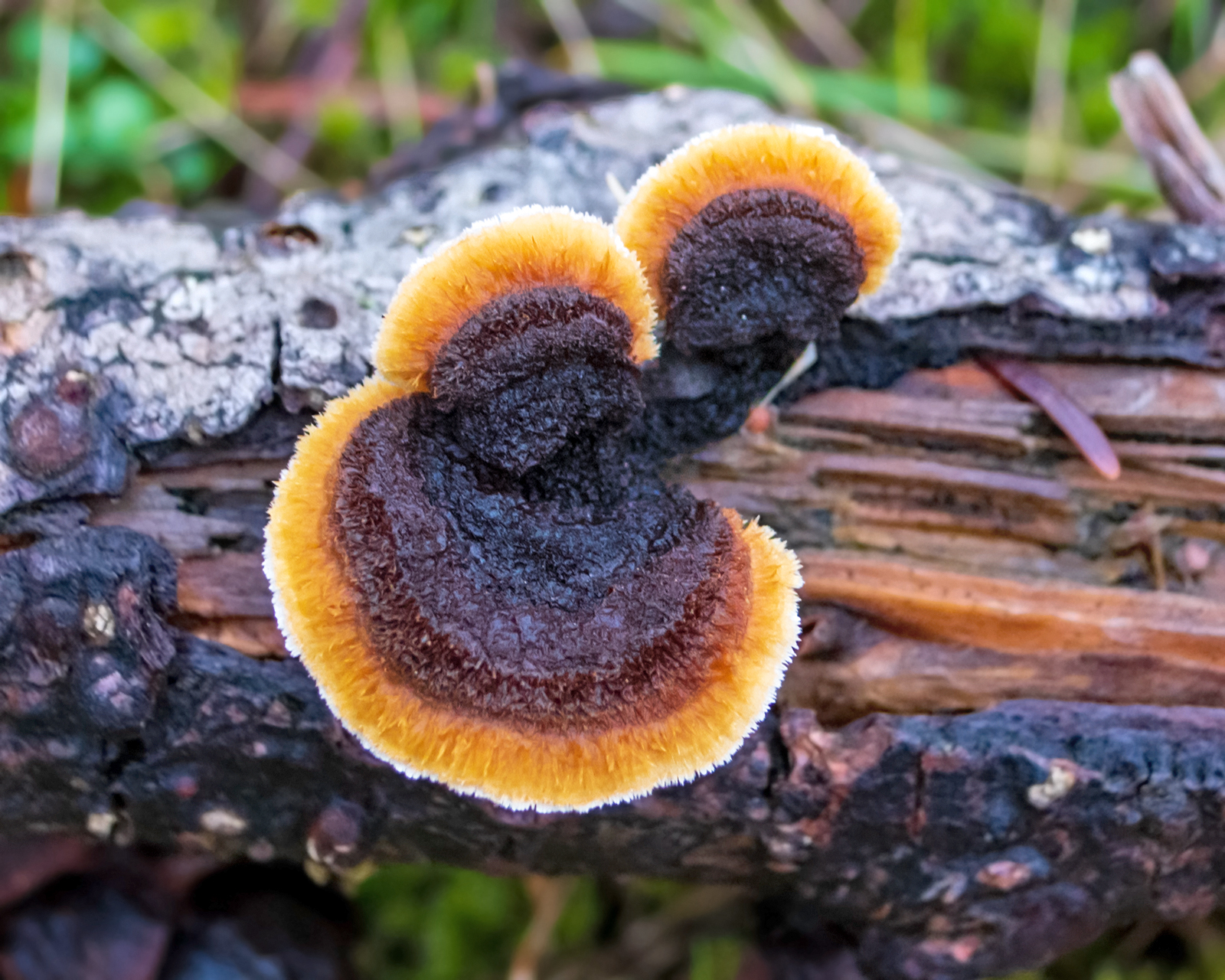
As found on the trail.

Walking back, carrying the leaf, I looked at those circular patches, wondered what made them. Now, watching where I stepped on the trail, I saw that many of the other maple leaves had those same markings.

The largest circle, as found on the trail.

By the time I got home the leaf had curled up; too much heat in my car. I pressed it under weights for two days to get it dry enough to stay flat, then took more photos.

The large circle, now dry. 4 cm, along the longest axis.

And a smaller patch, of tiny, raised black dots.

So what was this? Insects, leaf miners, I thought, at first; that didn't work out. Then I found the fungi. Rhytisma punctatum. Another appropriate name; punctatum is Latin for "dotted". The genus is also called "Tar Spot fungus", and this species is, in English, the Speckled Tar Spot.

This fungus (another of the Ascomycetes) infects the leaves of maple trees in the spring. During the growing season, they aren't noticeable; the leaves are healthy and green. This fungus is one of the endophytes; organisms that live inside plants. Without causing apparent disease, according to the definition of the word. It's only when fall comes and the leaves detach themselves from their branches, that the fungus shows its face.

When the weather turns cool and the days are short, the chlorophyll in the leaves breaks down, and the leaves turn yellow. But around the fungus, some of this chlorophyll remains, leaving a green circle; this part of the leaf is still alive. (Seen more clearly in the dry leaf: third photo above.)

The fungus matures, produces its reproductive bodies; small, raised, hard, black lumps; the tar spots. Under my finger tip they feel like Braille letters.  Here, over the winter, the spores will form. (Even in leaves lying in soggy layers in the mud!)

Tar Spot stromata seen through my microscope.

Come spring, the tar spots will release their spores and the wind will carry them up into the trees to find new leaves and start the cycle again.

I wondered; if the chlorphyll is still there, is photosynthesis still going on? Not feeding the tree any more, obviously, but does it feed the fungus? Apparently, it does.
The tar spot fungus, however, produces a hormone which stimulates the chlorophyll, keeping the chloroplasts alive for a while, even after the rest of the leaf has died. These green zones continue to produce glucose, which feeds the developing fungus spores. The fungus is farming small areas on leaves that are no longer attached to the trees which originally produced them. (Terry Taylor's Ecology Notes)

Another patch of fungus, showing green chlorophyll, and black "tar spots".

~~~~~~~~~~~~~~

Las hojas del arce de hojas grandes son grandes. No todas, pero suficientes para determinar el nombre del árbol, incluyendo el nombre científico;  Acer macrophyllum; hojas grandes, en el griego. Recogí una que reposaba en el camino al lado del rio y me la traje a casa para medirla. 43 cm.

    1: La hoja, donde la encontré.

Camino de regreso, llevando la hoja, miraba esas manchas circulares, considerando que fue lo que las hizo. Ahora, al fijarme donde anadaba, vi que muchas otras hojas tenían manchas parecidas.

    2: La mancha más grande, tal como la encontré.

Cuando llegué a casa, la hoja ya se había enrollado; en el coche hacía demasiado calor. La prensé bajo una charola pesada por dos dias para rendirla suficientemente seca para que se mantuviera aplanada, y entonces saqué otras fotos.

    3: La misma mancha, seca. Mide 4 cm en el eje más largo.

    4: Y un grupo de puntitos negros, elevados.

¿Pero qué era esto? Al principio pensé que serían insectos; los llamados mineros de hojas, pero una búsqueda no dió resultados. Y entonces descubrí los hongos. Es Rhytisma punctatum. Otro nombre bien escogido; punctatum, "moteado". El género recibe el nombre Mancha de Alquitrán del arce.

Este hongo, otro de los ascomicetos, invade las hojas de los arces en la primavera. Durante el verano pasan sin hacerse visibles; las hojas siguen verdes y sanas. Este hongo es uno de los endófitos, organismos que viven dentro de las plantas, aunque, según la definición de la palabra, sin causar daño. Llegando el otoño, cuando las hojas se separan de las ramas, entonces el hongo se hace aparente.

Cuando las temperaturas bajan y los dias se acortan, la clorofila dentro de las hojas se descompone y las hojas se vuelven amarillas. Pero el hongo retiene algo de esta clorofila, manteniéndola viva, formando un círculo verde. (Se ve esto más claro en la hoja seca de la tercera foto arriba.)

El hongo madura, y produce sus cuerpos reproductivos; masas pequeñas, negras, duras, elevadas: las manchas de alquitrán. Al tocarlas con el dedo parecen letras en braille. Aquí, durante el invierno, se formarán las esporas. (¡Aunque pasan este tiempo dentro de hojas aplastadas en capas empapadas en el lodo!)

    5: Estromas de Rhytisma punctatum vistas bajo mi microscopio.

En la primavera, estas estromas soltarán sus esporas y el viento las llevará a la copa de los árboles para encontrar hojas nuevas y empezar de nuevo el ciclo de vida.

Me preguntaba; si la clorofila sigue en sitio, ¿seguirá el proceso de fotosíntesis? No estará produciendo nutrientes para el árbol, claro está, pero ¿para el hongo? Parece que sí.
El hongo "mancha de alquitrán", sin embargo, produce una hormona que estimula a la clorofila, mantiendo con vida los cloroplastos por algún tiempo, aun cuando la mayor parte de la hoja ha muerto. Estas zonas verdes siguen produciendo glucosa, la cual sustenta las esporas en desarrollo. El hongo está cultivando pequeñas areas en hojas que ya no están conectadas a los árboles que las produjeron originalmente. (Terry Taylor's Ecology Notes)


Thursday, November 06, 2025

Welcome parasite

When is a mushroom not a mushroom? Well, maybe when it's two or more different species combined. Like the lichens, a fungus and an algae and maybe a bacteria forming one composite organism. Or when it's a fungus that has cannibalized a "normal" mushroom, like the so-called lobster mushroom, neither lobster nor mushroom.

Hypomyces lactifluorum.

All mushrooms are fungi, but most fungi are not mushrooms. Most of the typical mushrooms, fruiting bodies with a stem and a cap, are Basidiomycetes. Lobster "mushrooms" belong to a separate phylum of the fungi, the Ascomycetes, or sac fungi. 
This is the largest phylum of Fungi, with over 64,000 species. ... Familiar examples of sac fungi include morels, truffles, brewers' and bakers' yeast, dead man's fingers, and cup fungi. The fungal symbionts in the majority of lichens ... belong to the Ascomycota. (Wikipedia)
One of these Ascomycetes, Hypomyces lactifluorum, is a parasite that overwhelms mushrooms such as the white Russula brevipes, so common in our local forests. It engulfs the entire mushroom, cap, gills, and stalk, with bright orange flesh, changing the form of the mushroom, contorting it into fantastic shapes.

Same lobster "mushroom", from a different angle.

I saw several of these last week; none were entire; whether they've been eaten by slugs or raccoons or even bears, or whether the underlying mushroom has disintegrated as the orange coating grew, I can't tell.

Russula brevipes, the prey species. They crumble easily, are often slug-eaten.

The invading fungus changes the taste and edibility of the host mushroom; R. brevipes is basically tasteless; once parasitized, it's edible and choice.

Even the DNA changes!
A 2018 study (Laperriere et al.) determined that Hypomyces lactifluorum gradually conquers the host mushroom; during development of the Hypomyces, the host's DNA decreases; ... when the "lobster mushroom" is contorted and orange, very little of the host mushroom's DNA is still present, even though the interior flesh appears identical and unchanged. (MushroomExpert)
~~~~~~~~~~~~~~~
El reino de los hongos es enorme y variado. Entre ellos, existen los de las divisiones Basidiomycota, que incluye la mayoría de las setas familiares y Ascomycota, que incluye una gran diversidad de tipos de hongo como por ejemplo las levaduras, los componentes de la mayoría de los líquenes, los mohos de pan, las trufas, etc.

Los hongos "langosta" son uno de estos Ascomicetos, Hypomyces lactifluorum. Este hongo es un parásito que invade hongos como el Russula brevipes, tan común en nuestros bosques. Envuelve el hongo entero, desde el sombrero, las laminillas, y el tallo, con una carne anaranjado vívido, aumentando y retorciendo el hongo original.
  1. Hypomyces lactifluorum.
  2. El mismo, visto desde otro ángulo.
  3. Russula brevipes, el hongo que forma la base del hongo langosta.
Vi varios de estos la semana pasada; ninguno entero; si es que los han estado comiendo las babosas o los mapaches o hasta los oso, o es que el hongo original se ha desmoronado, no lo sé.

El hongo invasor cambia el sabor y la comestiblidad del hongo original. R. brevipes no sabe a nada (dice el libro guía, "no vale la pena comerlo"); y con el parásito, es delicioso y sano.

¡Y hasta cambia su ADN!
Un estudio en 2018 (Laperriere et al.) comprobó que Hypomyces lactifluorum cambia el hongo receptor poco a poco; durante el desarrollo del Hypomyces, el ADN del huésped  disminuye; ... cuando el "hongo langosta" está retorcido y anaranjado, muy poco del ADN del hongo huésped sigue presente, aunque la carne interior parece ser idéntico, sin haber cambiado. (MushroomExpert)

Friday, November 29, 2024

In case you're counting

Estimates vary. There are said to be up to 3.8 million species of fungi worldwide, of which about 148,000 have been described. Cutting it down to just the macrofungi, the mushrooms we see in the forest and our lawns, there are 14,000 known species, 3,000 of which grow on Vancouver Island. No wonder I keep seeing more!

These are growing on the museum lawn this week.

A deep pink cap, with widely-spaced gills. Rosy Russula, Russula sanguinea, I think.

Two more of the same.

This has been identified, on iNaturalist, as the Blackening Slime Spike, Gomphidius oregonensis. The Spike mushrooms have white stalks with a yellow base.

There will be more. Always.

~~~~~~~~~~~~~

Los números estimados varían. Se dice que hay hasta 3.8 million especies de hongos en todo el mundo, de los cuales unos 148.000 se han identificado. Limitándonos a los macrohongos, los hongos típico que vemos en los bosques y nuestros jardines, hay alrededor de 14.000 especies conocidas, de los cuales 3.000 crecen en nuestra pequeña isla de Vancouver. ¡Con razón veo otros cada vez que salgo!

Estos están creciendo en el césped del museo esta semana.

  1. Con un sombrero de color de rosa intenso, laminillas abiertas, y tallo blanco. Creo que puede ser uno de los hongos Russula sp., posiblemente R. sanguinea.
  2. Otros dos de los mismos.
  3. Este lo han identificado en iNaturalist, as Gomphidius oregonensis. Los hongos de este género tienen tallos blancos con la base en amarillo.
Habrá más. Siempre.


Saturday, October 26, 2024

Friendly fungi

"Gregarious: fond of the company of others, sociable." (Dictionary.com) The word struck me in a description of these mushrooms. The ones I saw along the Quinsam river were certainly gregarious, clustered together up and down the trunks of long-dead snags.

Trembling crust, Plebia tremellosa

Trembling crust, detail.

In many ways these look like soft polypores, the bracket fungi. But they're better called a crust, and they don't have pores. Each individual starts out as a flat circle on the wood, and as they mature, the top bends over, forming a protective lip. Now the face of the flat part and the underside of the lip wrinkle and fold; this is the spore-bearing part of the mushroom.* As it ages, it darkens, may become orange or pinkish. The top of the lip is paler and hairy.

The names, "trembling crust" and in Latin, Phlebia tremullosa, meaning "trembling veins" are descriptive. The flesh of the mushroom is soft and flexible, jelly-like. Another name is "jelly rot"; that's what they do, rot the old wood, which helps to provide nesting and shelter spaces for birds and other wildlife.

A new colony on another snag.

These mushrooms live on dead wood, of both conifers and deciduous trees.

*There is an excellent photo of the wrinkled underside of these mushrooms on First-Nature; the second photo on the page.

~~~~~~~~~~~~~
"Gregario": definido como "sociable, que tiende a vivir agrupado con otros congéneres".
La palabra, definiendo un hongo que había visto en a orilla del rio Quinsam, me llamó la atención. Bien que describía estos hongos, creciendo en grandes aglomeraciones a lo largo de varios árboles muertos.
  1. Phlebia tremullosa, "Costra temblorosa" en un tronco muerto.
  2. Detalle.
  3. Otra colonia en otro árbol.
Estos hongos, a primera vista, se parecen a los políporos, los hongos repisa. Pero mejor dicho, son costras, y no tienen poros. Cada hongo empieza la vida como un círculo plano en la madera, y al madurar, el borde superior se dobla para adelante, formando un sombrerito protector. Y ahora la superfice de la parte adherida a la madera, y la superficie inferior del sombrerito se pliegan, formando arrugas bien definidas.* Mientras pasa el tiempo, esta superficie se oscurece, y puede tomar un tono anaranjado o color de rosa. La parte superior del sombrero es pálido y lanudo.

El nombre científico, Phlebia tremullosa, "venas temblorosas" describe bien este hongo. La carne del hongo es gelatinosa o elástica, según la temporada, húmeda o seca. 

El hongo crece en maderas muertas, ya sea de coníferas o de árboles de hoja caduca, descomponiendo la madera y así contribuyendo sitios para anidar y para protegerse de los elementos para pájaros y otros animales salvajes.

*Hay una foto excelente de esta superficie arrugada en el sitio web, First-Nature. 


Tuesday, December 12, 2023

Tiny black spoons

 I wasn't looking for mushrooms; I had even left the camera in the car. But there they were, beside the entrance to the museum, tiny black spoons growing through the wet moss. I had to go back for the camera.

Moss, earth tongues, and a few "normal" mushrooms.

Fungi in the family Geoglossasseae

There are several similar (very) species of the black earth tongues. On iNaturalist, I found several specimens of the hairy earth tongue, Trichoglossum hirsutum, just south of here. These are probably hairies. Although, you never can be sure:
The use of a compound microscope is needed for accurate identification. (Wikipedia, on the entire family.)
A photo taken with the cell phone, which insisted on using the flash, fading the black of the nearest one to a chocolate brown (not as my eyes or the regular camera saw it), shows the shape of a typical club; a straight stipe and a broader spore-bearing top, flattened out and rolled at the edges. Spoon-shaped. Spoons for elves.

Cell phone photo.

~~~~~~~~~~~~~~~~
No iba en busca de hongos, hasta había dejado la cámara en el coche. Pero ahi estaban, entre los musgos al lado de la entrada al museo, cucharitas negras muy pequeñas. Tuve que regresar por la cámara.

Foto # 1; Musgos, lenguas de tierra de la familia Geoglossaceae, y unos honguitos "normales". Vista amplia.
#2: Más de cerca. 

Hay varias especies, muy parecidas, de las lenguas de tierra. En el sitio iNaturalist, encontré varios ejemplares de la lengua de tierra peluda, Trichoglossum hirsutum, muy cerca de aquí y creo que estos también serán de las peludas. Pero una identificación segura no es posible. Según Wikipedia:
El uso de un microscopio compuesto es esencial para una identificación precisa. (W. Geoglossaceae)
#3: Una foto que saqué con el teléfono, el cual insistía en usar el flash. Esto siempre cambia el color de los hongos; aquí la lengua más cercana se ve color chocolate, aunque mis ojos y la cámara grande las veía todos igualmente negras. Pero la foto muestra la forma usual de estos honguitos; un estípite recto y la clávula en forma de cuchara, con las orillas dobladas para el centro. Una cucharita para las hadas.


Tuesday, February 07, 2023

Flock of fans

Polypore fungi, the "shelf" mushrooms, orient themselves horizontally, like umbrellas, shielding the reproductive undersides from the rain. If they grow from a standing tree, the underside points to the ground underneath. Once the tree falls, new polypores are lined up along the now-horizontal trunk.

I came across this tree, fallen some years ago across the path beside the river, now cut into two sections. Its crop of fungi appeared after the fall.

On the cut end of the log.

And all along the length, growing through the bark.

On the cut end of the second piece. Are those brown lumps the beginnings of new ones, or something else entirely?

And on the first log section, below the crop of brown and whites.

I can't identify these fungi. I see three different species here, the white-bordered, white-bottomed fans, the larger, smoother, creamy ones beneath, and in between, a smear of old porridge which could be fungi or a slime mold.

Next log down, tomorrow.
~~~~~~~~~~~~~~~~~~~

Los poliporos, los hongos llamados "estante", se presentan orientados horizontalmente, algo así como pequeños paraguas que protegen los cuerpos reproductores de la lluvia. Si crecen en un árbol vivo, en pie, la parte inferior mira hacia las raices. Una vez caído el árbol hongos nuevos se orientan a lo largo del tronco que ahora reposa en el suelo.

En un árbol que cayó hace unos años cruzando el sendero al lado del rio, y que fue entonces cortado en varias secciones, encontré estos hongos, que crecieron después de la caída.

Fotos:
  1. En el extremo cortado del tronco.
  2. Y a lo largo, saliendo através de la corteza.
  3. En el extremo cortado de la segunda pieza. Esas bolas negras, ¿serán nuevos brotes del mismo hongo, u otra cosa completamente distinta?
  4. En la parte más baja del tronco.
No pude identificar estos hongos. Veo tres especies; los abanicos con los bordes y la parte inferior en blanco, los hongos más grandes, más lisos, color crema, y la masa que parece algo así como frijoles blancos refritos; éste puede ser otro hongo, o tal vez un moho mucilanigoso.

El próximo tronco, mañana.


Monday, January 30, 2023

Fans, eggs, and a yellow ball

 At the edge of a little woodland, a recently-fallen dead branch came down with its crop of fungi.

One end of the branch.

Seen on this end: Rusty-Gilled polypore, keeping a lookout, two birds' nests full of "eggs", the beginnings of a liverwort, another birds' nest, empty, and that yellow thing, unidentified.

3 Rusty-Gilled polypore fans. Gloeophyllum saepiarium.

These are all tiny; the branch is little more than 3 cm. across at its widest point. The birds' nests are a fraction of that.

Birds' nests, yellow ball, and what is that poking out from under the bark beside it?

I can't identify that tiny, pinhead yellow ball with a white foot. The colour of orange jelly or witches butter, but so perfectly rounded, and a bit fuzzy looking.

UPDATE: I've been told that the yellow ball is an immature birds' nest, a younger version of the two above it.

Zooming in on a bird's nest. Looks like a bowl of beans in broth on a frilly placemat.

The "eggs" are spore cases, peridioles. When it rains, drops will splash them out to start new nests. One is already freed, to the left of the twisted nest.

~~~~~~~~~~~~~~~~~~~~~~~~~
Al borde de un bosquecito, una rama caída, ya muerta, trae su carga de una variedad de hongos.

Foto #1: Un extremo de la rama. Con un hongo poliporo "de agallas rojizas" que mantiene vigilancia sobre el camino, dos hongos nido llenos de "huevos", una hepática apenas empezada, otro nido de ave, pero sin huevos, y esa pelotita amarilla que no pude identificar. Todo esto muy pequeñito; la rama, a lo más, mide 3 cm. de diámetro.

Foto #2: Otros tres abanicos del poliporo, Gloeophyllum saepiarium.

Foto #3: Los hongos nido, la pelotita amarilla, y ¿qué será esa cosa que se asoma desde debajo de la corteza a la izquierda?

No puedo identificar esa pelota amarilla. Tiene el color de jalea anaranjada, Dacrymyces chrysospermus, o de mantequilla de brujas, Tremella mesenterica, pero tan perfectamente redonda, y con ese base blanco.

*Puesta al dia: Ahora me han dicho que la pelotita amarilla es uno de los mismos hongos nido, en su forma inmadura.

Foto #4: Un hongo nido en macro. Parece un plato de caldo con frijoles grandes, sobre un mantelito individual. Los "huevos" son sacos de esporas, llamados periodolos. Cuando llueve, gotas de lluvia botarán estos periodolos fuera del recipiente, listos para empezar nuevos nidos. Se ve uno, ya libre, al lado izquierdo del nido torcido.


Wednesday, January 25, 2023

Ain't dead yet

 And this one, long-since felled, still keeps on supporting its community.

Busy little stumpie
The outer bark and the layers of live wood have mostly rotted away, exposing the solid heartwood. Salal has rooted in the old wood, lichens grow on the outer edges, spiders and their prey hide in the many cracks. And big-leaf maple leaves rest on their trip to join the rotting mulch on the ground beneath.

Down underneath, invisible in the soil, the roots still form part of the living earth, the fungi, the inter-connected roots of the forest, still serving as conduits for liquid and nutrients.

Life goes on. And on.

~~~~~~~~~~~~~~~~~~~~~~~~~~~~~~~~
Otro tronco, éste cortado y desbaratándose, pero que sigue como soporte de su comunidad.

Foto: un tronco cortado bajito.

La corteza y las capas de madera activa se han pudrido en gran parte, dejando a la luz la madera del corazón, el duramen, todavía en firme. El arbusto nativo, salal, Gaultheria shallon, ha penetrado la madera con sus raices, en la superficies exteriores crecen líquenes, arañas y su presa se esconden en las múltiples grietas. Y encima, hojas del arce de hoja grande descansan camino a unirse a sus hermanos descomponiéndose hasta tornarse abono, en el suelo.

Y más abajo, debajo del suelo, invisibles, las raices siguen formando parte de la tierra viva, los hongos, las raices entrelazadas del bosque; todavía sirven para conducir el agua y los nutrientes que lleva.

La vida sigue. Y sigue ...


Wednesday, January 11, 2023

Not quite forgotten

I'm tidying up the '22 files before they go into storage. And there are photos I meant to post and never got around to it.

Well, here it is!

The tree collection:

A baby grand fir, Abies grandis, a hand's breadth high. With trailing blackberry leaves. June.

Triple tips on a Douglas-fir branch. Same day.

Juniper sprawling over the roots of a cedar. February, Tyee Spit.

Small fungi populating a tree trunk, roots to as far up as I could see. October, museum woods.

And November. Cottonwoods still holding onto a few brown leaves. Tyee Spit.

Birds tomorrow, I think.
~~~~~~~~~~~~~~~~~~~~~~~~~~~
Estoy revisando las fotos del año pasado antes de archivarlas. Y hay algunos que pensaba subir antes, y nunca me llegó el momento. Ahora sí.

Fotos:
  1. Un "round tuit"; un juego de palabras que suena como "cuando tengo tiempo" en inglés. Nada que ver con "Twitter", que tiene otra etymología, refiriéndose a la conversación de pájaros.
  2. Un pino Abies grandis nuevecito, apenas de la altura de mi mano. Con hojas de mora nativa. En junio.
  3. La punta triple de una rama de abeto de Douglas. Junio, también.
  4. Un enebro común se enreda sobre las raices de un cedro. Febrero.
  5. Honguitos cubren el tronco de un árbol desde la raiz hasta donde yo pude ver. Octubre.
  6. Y en noviembre, los álamos todavía retienen unas cuantas hojas, ya en color café.
Mañana, pájaros.


Sunday, October 16, 2022

Spreading crust fungi

In a rainless, toasted forest, when even the moss is crunchy, these fungi are still soft to the touch, and slightly damp.

On the underside of a dry log. A thin crust, porous, with the "feel" of raw pie crust.

Large patches on an adjacent log.

And I'm not sure if these are the same species: they are on the trail down to Elk Falls, in fairly open forest, all very dry now. The same structure, large patches, dampish to touch, but mainly white.
On an upright dead snag.

With my hand as a measuring stick. About 15 cm for this smaller patch, the only one I could reach.

I think the first may be Ceriporia spissa, or at least one of the Ceriporia spp.; these come in a variety of colours. (I could be wrong. Easily.)  INaturalist has records of this species as close as Nanaimo. Polypores of British Columbia has a list and photos of the related species. (Here, pg. 65 ff.)

~~~~~~~~~~~~~~~~~~~~~~~~~~~~~~~~~~~

En un bosque pluvial, sin lluvia, seco, hasta tostado, cuando hasta el musgo está  crujiente, estos hongos se mantienen suaves y un poco húmedos.

Fotos:

  1. En la zona inferior de un tronco seco. Una masa delgada, porosa, con un tacto como de masa para pan.
  2. Otro en un tronco cercano.
  3. No estoy segura que estos sean de la misma especie. Crecen en un tronco todavía en pie, pero bien podrida, en el sendero camino a las Cataratas Elk, todo muy seco ahora. Pero el hongo sigue húmedo. Es de un color crema claro, haciendo encrustaciones grandes.
  4. Midiendo uno con la mano; aproximadamente 15 cm. Los otros, más grandes, estaban fuera de mi alcance.
Creo que los primeros pueden ser Ceriporia spissa, o si no, uno de los Ceriporia spp. Vienen en una variedad de colores. INaturalist reporta hongos de esta especie cerca de aquí, en Nanaimo. La publicación "Polypores of British Columbia" tiene una lista con fotos de las especies de Ceriporia que se encuentran aquí. (Véase p. 65 ff.)


Powered By Blogger