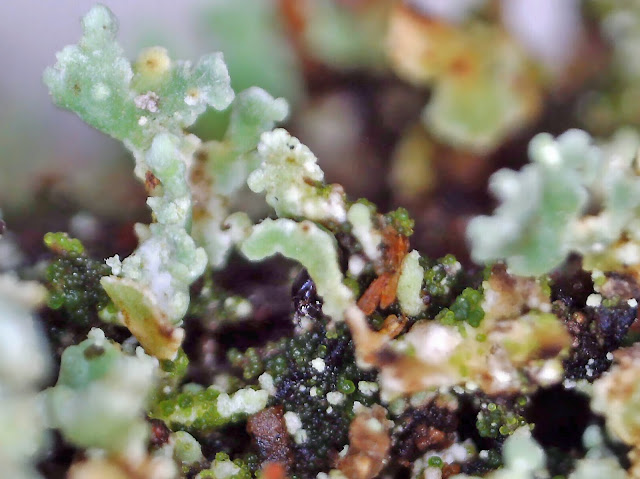
Showing posts with label lichenomphalia umbellifera. Show all posts

Monday, March 09, 2026

Marching lichens

Coming up from the beach at Oyster Bay through the dunes towards the little woods, I found that the lichens and mosses have expanded their footprint; they've moved out of deep shade and into the open area at the edge of the dunes. These mosses, lichens, and mushrooms were all growing in semi-shade; I found some out in the open, far from the trees.

Lichen agaric, Lichenomphalia umbellifera. The dark green coating on the wood is the algal component of the lichen.

Moss sporophytes and two species of Cladonia lichens.

An old log covered with pixie-cup Cladonia lichens.

Rusty-gilled polypore, Gloeophyllum sepiarium. AKA Conifer Mazegill

An old, twisty log end, wrapped in moss and Cladonia lichens.

~~~~~~~~~~~~~~

Subiendo desde la playa en Oyster Bay, cruzando las dunas hacia el bosquecito, descubrí que los musgos y líquenes han extendido su territorio; donde antes se veían en la sombra profunda bajo los árboles, ahora han colonizado la orilla de las dunas, con poca sombra.

  1. Lichenomphalia umbellifera. La masa verde oscuro que cubre la madera es el componente algal del lichen; los honguitos son el cuerpo fructífero de este liquen.
  2. Esporofitos de musgo y dos especies de líquenes Cladonia
  3. Tronco viejo cubierto de líquenes copa de hada, Cladonia sp.
  4. Políporo, Gloeophyllum sepiarium.
  5. Tronco torcido envuelto en musgos y líquenes Cladonia.

Saturday, November 22, 2025

More than 20 questions

It used to be so simple. Back when I was a kid, some **** years ago, we played "20 questions". And everything in the material world was either Animal, Vegetable, or Mineral. 3 kingdoms, animals, plants and dead things. That was it.

Fast forward a bit. What about Fungi? Well, they weren't exactly either plants or animals. That's another kingdom. Oh, and the tinies? The bacteria? The single-cell critters? Were they animals or plants, or neither?

And so it goes. Biologists kept looking at living things and trying to sort them out. By 1970 (I was pushing 30), there were 5 kingdoms of living things, although there was some doubt as to where specific creatures belonged.

The world is never so simple. Nothing is ever simple, ever. (Hey, I've even begun to count rocks as living beings. See Disguised as Mountains.) What are viruses? Are they even alive? The more we looked at nature, the more complicated it got. Where do the algae fit? Should we sort by DNA, or by life strategies, or by history? Or another criteria?

Then there were 6 kingdoms, 7, 8; forget kingdoms, there were 3 domains, superkingdoms. Or realms. It gets confusing just trying to think about it. For a detailed history, see Wikipedia; kingdom (Biology).

How I got into this: I started to wonder where the slime moulds* fit. They're not plants, nor animals. My old Audubon Mushroom book calls them fungi. Recent guides call them Protists.

Species in the class Myxogastria are colloquially known as plasmodial or acellular slime moulds. Some consider the Myxogastria a separate kingdom. (Wikipedia, Myxogastria)

That Wikipedia kingdom page gets to them, finally, including them in the supergroup of the Eukaryotes (which includes us, the fungi and algae, my cat, and the forest at the end of my street).

There they are. "A phylogenetic tree based on rRNA data showing Woese's three-domain system. All smaller branches can be considered kingdoms." (Wikipedia)

So that's where we are. Or were the last I looked; tomorrow, there will be new data, new questions. There always are. Ma Nature won't be so easily pinned down.

There is ongoing debate ... (Wikipedia, again)

And there is a whole realm of things left out. Where are the lichens? Why aren't they listed?

Because they straddle 2 or even 3 kingdoms. They're a partnership of fungi, green algae (listed under plants) and sometimes bacteria, combined to form one living being. Or not; there's always an exception. Like these:

Lichenomphalia umbellifera, moss, slime mold, maple and alder leaves, baby huckleberry, old wood.

Zooming in. Two fungal fruiting bodies, green algae, and two slime mold fruiting bodies.

The "mushroom" is the fungal partner of the lichen; all that smear of deep green is the single-celled green alga, Coccomyxa sp., that forms the other half of the symbiont. These are never found separately.**

**(Never, until someone finds one. Like crows are never white and swans are never black, until they turn up. "Never" is only an approximation of reality.)

And in that crack at the left, I'm pretty sure that ball on a stick is the fruiting body of a slime mold. Several others showed up in other photos of the same log. Which is where all this started.

*moulds or molds. Alternate spellings, British vs. American. We Canadians drop the "u" about half the time.

~~~~~~~~~~~~~~~~

Antes, todo era tan sencillo. Cuando era niña, hace unos **** años, jugábamos a las "20 preguntas". Y todo lo que existía en el mundo físico era o Animal, o Vegetal, o Mineral. 3 Reinos; animales, plantas, cosas muertas. Nada más.

Pasó el tiempo; aparecieron dudas. ¿Y qué eran los hongos? No eran ni plantas ni animales. Se necesitaba otro reino.  ¿Y las criaturas microscópicas? ¿Las bacterias? ¿Las criaturas monocelulares/ ¿Eran animales, o plantas, u otra cosa distinta?

Y así sigue. Los biólogos seguían examinando los seres vivientes y tratando de organizarlos. Ya en el año 1970 (yo andaba acercándome a los 30), se contaban 5 reinos de seres vivientes, aunque había dudas acerca de en cual de ellos algunas criaturas específicas deberían clasificarse.

El mundo no puede ser tan sencillo. Nada, nunca es tan sencillo. (Hasta he empezado a considerar las rocas como seres vivientes. Ve Disguised as Mountains.) ¿Y qué son los virus? ¿O se consideran seres vivos? Entre más estudiábamos el mundo natural, más complejo resultaba. ¿Dónde se deben colocar las algas? ¿Debemos separar las criaturas según su ADN, o según sus estrategias para vivir, o según su trayectoria histórica? ¿O según qué otro criterio?

Luego se nombraban 6 reinos, o 7, luego 8; olvídate de los reinos; eran 3 dominios, super-reinos. Imperios. Hasta tratar de formar una idea precisa, te deja enredada. Para una historia más detallada, mira Wikipedia: Reino (biología).

Como es que me metí en este lío: empecé a preguntar como se clasificaban los mohos mucilaginosos. No son ni plantas ni animales. My viejo libro de Audubon sobre Hongos los llama hongos. Guías más recientes los llaman Protistas.

Especies en la clase Myxogastria se conocen comunmente como mohos mucilaginosos plasmodiales o acelulares. Algunos consideran que los Myxogastria constituyen un reino separado. (Wikipedia, Myxogastria)

Esa página de Wikipedia sobre los reinos por fin llega a considerarlos, al incluirlos en el super-grupo de los Eukariontes (dentro del cual nos incluye, además de los hongos, las algas, mi gata, y el bosque al final de mi calle).

    1. Y allí están. "Un árbol filogenético basado en datos de rARN, mostrando el sistema de tres dominios de Woese. Todas las ramas menores se pueden considerar como reinos." (Wikipedia)

Bueno, hasta allí hemos llegado. O por lo menos, hasta allí estábamos la última vez que me fijé; mañana habrá más información, preguntas nuevas. Siempre hay. La Madre Naturalez no se deja definir tan facilmente.

Sigue el debate ... (Wikipedia, otra vez)

Y han dejado a un lado todo un reino de cosas. ¿Dónde están los líquenes? ¿Porqué no se incluyen  en estas clasificaciones?

Es porque se extienden sobre 2 o hasta 3 reinos. Son una asociación compuesta de hongos, algas verdes (que se clasifican ahora entre las plantas), y a veces bacterias, que se han unido para formar un ser viviente. O no: porque a toda regla hay siempre una excepción. Como por ejemplo, estos:

    2. Lichenomphalia umbellifera, musgos, moho mucilaginoso, hojas de arce y aliso, huckleberry nuevo, madera podrida.

    3. Visto más de cerca. Dos de los hongos, alga verde cubriendo la madera, y cuerpo fructífero de un moho mucilaginoso.

El hongo es parte del liquen, y toda esa capa verde oscuro está formada por el alga verde, monocelular, Coccomyxa sp.; que constituye la segunda mitad del simbionte. Estos dos organismos nunca se encuentran solas, por separado.**

**(Nunca, hasta que alguien encuentra uno de estos a solas. Como por ejemplo, los cuervos nunca son blancos, ni los cisnes negros, hasta que algún dia alguien los encuentra. "Nunca" es siempre solamente una aproximación general de la realidad.)

Y en esa grieta en el lado izquierdo de la segunda foto, estoy casi segura que esa pelotita sobre un tallo es el cuerpo fructífero de un moho mucilaginoso. Varios otros aparecieron en otras fotos del mismo sitio.Y aquí es donde todo esto empezó.

Sunday, October 26, 2025

Miniature gardens on old logs.

Short days, dark at midday under heavy clouds, cold nights, rain and more rain: my garden is shutting down, but out in the bush the wild gardens are just getting started. This is the weather they've been waiting for.

These two old logs with their grand blend of kingdoms; Fungi, Plantae, and Algae/Fungi/Bacteria (lichens) are in the Oyster Bay little wood.

Moss, Lichens, Mushrooms, old wood.

It seems that the moss is a broom forkmoss, possibly Dicranum sp.; these are very common mosses that grow on logs and woody duff. The brick-red gilled mushrooms may be the Vermilion Waxcap, Hygrocybe miniata. It grows on the ground or on rotting wood. The tiny, bluish lichens are Cladonia sp., and the other; yes, it's a lichen; the single, small pinkish mushroom is the fungal component of the Lichen Agaric, Lichenomphalia umbellifera. The algal component is made up of tiny globes or bubbles, here seen as a vague, dark green haze near the base of the mushroom.

Cladonia lichens, in two forms; the tiny squamules and the standing podetia, and more moss. Cottonwood leaves. No mushrooms here.

Tomorrow I'll start posting the mushrooms I found at Oyster Bay. I've loaded a bunch to iNaturalist, hoping for help with identifying them. We'll see.

~~~~~~~~~~~~~~~

Dias cortas, oscuras aun a mediodía bajo las nubes grises, noches frías, lluvia, lluvia; mi jardín se está volviendo a la tierra, pero en los bosques los jardines naturales se están despertando. Este es el clima que más les gusta.

Estos dos troncos viejos con su buena mezcla de reinos: el reino Fungi, el reino Plantae, y la combinación Fungi/Algae/Bacteria (o sea, los líquenes): se están desmoronando lentamente en el bosquecito de Oyster Bay.

Foto 1: Musgos, hongos, líquenes. Y madera vieja.

Parece que el musgo es un musgo de los dicranales, posiblemente Dicranum sp.; estos son musgos bastante comunes dondequiera, y crecen en troncos y suelos con materia orgánica. Los hongos rojos pueden ser el "Cera bermellón", Hygrocybe miniata. Crece en el suelo o en madera podrida. Los líquenes pequeñitos, azulados, son Cladonia sp., y el otro (sí es un liquen aunque parezca ser hongo) el hongo solitario es una parte del liquen, Lichenomphalia umbellifera. El alga que forma el otro componente del liquen consiste en glóbulos muy pequeños, aquí se ven como un borrón verde oscuro cerca de la base del hongo.

Foto 2: Líquenes Cladonia sp., en dos formas: las escamas miniaturas y los podecios, de pie. Musgos y hojas secas de álamo. Aquí no hay hongos. Por ahora.

Mañana empiezo a subir los hongos que vi en Oyster Bay. Ya subí muchos a iNaturalist, con la esperanza que alguien me pueda ayudar con su identificación. Ya veremos.


Saturday, May 03, 2025

Mostly green

The colours of April, here in the north woods. In town, the streets are lined with pink and purple, yellow and white. Deep blue bluebells, red-flowering currants, daffodils and crocuses, white-blossomed wild cherry trees, even a few red rhododendrons. A few minutes beyond city limits, however, the theme colour is green. With brown as an accent colour.

These are a few random shots taken here and there.

Just another nameless logging road.

Big-leaf maple, adding a hint of yellow to its greenery. Brown's Bay.

In a bleached log, two species of moss, Cladonia lichens, and Lichen Agaric mushrooms (Lichenomphalia umbellifera). Oyster Bay.

A bit of the north woods, tamed, but still green. Brown's Bay.

Nose to the bark; Cladonia lichen squamules.

And brown:

Bird's nest fungus, with "braided" red cedar leaves, dried.

And a small, brown mushroom.

There's always another trillium. Cumberland area.

~~~~~~~~~~~~~~

Los colores de abril, aquí en los bosques norteños. En la ciudad, las calles corren entre jardines pintados en color de rosa, morado, amarillo, blanco. Hay jacintos, en tonos de azul fuerte, grosellas, las que llevan flores rojas, hay narcisos y crocus, cerezos resplandecientes con sus flores blancas, hasta unos cuantos rododendros con flores rojas.  Pero saliendo del pueblo, apenas a una poca distancia, el tema es verde. Todo es verde, con el color café como color de contraste.

  1. Un camino de madereros, sin nombre.
  2. Arce de hoja grande, vestido en verde/amarillo.
  3. Un tronco podrido, blanqueado por el sol, con su "jardincito" de musgos (dos especies), líquenes Cladonia, y los hongos/liquen Lichenomphalia umbellifera.
  4. Un tramo del bosque norteño domesticado, pero sigue pintado de verde. Brown's Bay.
  5. Escamas de los líquenes Cladonia sp., vistas de cerca, en el tronco de un árbol.
  6. Y el color acento, café: aquí un hongo "nido de pájaro" con hojas secas del cedro rojo.
  7. Un honguito color café.
  8. Y siempre hay otro trilio.


Sunday, April 13, 2025

Mushrooms old and new

It's not a mushroomy time of the year, even though it's warm (at least not usually freezing) and generally rainy. But everywhere I go, I see only one or maybe two mushrooms, sometimes the remains of last year's 'shrooms. So in over a month, I've collected photos of only 4 species.

These:

Early March, Baikie Island. On an old, old fallen branch. Unidentified.

Baikie Island. Out of the rain under the overhang of the roots of a downed tree.

Today. Roberts Lake. Lichenomphalia umbellifera.

According to my mushroom guide book, this Lichen Agaric is "the first species to be seen in the spring." This afternoon I found about a dozen, all on well-rotted stumps, in the dark forest at Roberts Lake. Although I was searching closely, I saw only the remains of one other mushroom, mostly eaten by slugs. None of them had fed on any of the Lichen Agarics; not to their taste, I wonder?

The mushroom is actually a lichen; the mushroom is the fruiting body, and the algal component of the lichen is that dark green algae that covers the stump around this one. I had never seen it before arrange itself in these long lines, following something in the structure of the old wood, apparently.

These and others like them were on a few stumps in the deepest shade of this already gloomy forest, stumps covered with these green algae and a dark green dust lichen. Several times I have attempted to get photos of them; this was the first that halfway captured them. I've got a new pocket camera; it doesn't do RAW, and the photos are noisy, but it incorporates a ring light on the ultra-macro setting, which allows me to get really close, even in dark places.

Another stump, another Lichenomphalia, same camera. The green alga is that smear of green on the burnt wood.

Turkey tails, down by the river, mid-March.

~~~~~~~~~~~~~~~

En esta temporada del año casi no encuentro hongos, aunque ya no hace frío (por lo menos no baja la temperatura a menos de 0 grados por lo general) y hay lluvia suficiente. Pero dondequiera que busco, veo tal vez uno, tal vez dos hongos, estos pueden ser restos de los hongos del año pasado. En más de un mes, solo he podido sacar fotos de 4 especies.

Estos son:

  1. El once de marzo, en la isla Baikie, creciendo en una rama muy vieja. No los pude identificar.
  2. En la isla Baikie, protegidos de la lluvia bajo las raices de un árbol caído.
  3. Hoy, en el lago Roberts. Lichenomphalia umbellifera. 

    Según mi libro guía, este hongo es "la primera especie que se ve en la primavera." Hoy en la tarde encontré más o menos una docena, todos creciendo sobre tocones viejos, muy podridos, en el bosque oscuro cerca del lago Roberts. Aunque buscaba con atención, solamente vi los restos de un hongo distinto, este casi completamente devorado por las babosas. Pero no habían ni siquiera probado estos hongos Lichenomphalia umbellifera. ¿Será que no les guste el sabor?

    El hongo es, de hecho, un liquen; el "hongo" es el cuerpo fructífero, y el componente algal es esa materia verde oscuro que cubre el tocón alrededor del hongo. Nunca antes he visto que se distribuye en esas lineas largas, que aparentemente siguen algo en la estructura de la madera vieja.

    Estos y otros de la misma especie crecían en unos tocones que se hallan en la parte más oscura de este bosque, de por sí bastante sombreado. Estos tocones están todos cubiertos por estas algas verdes y un líquen de polvo, también verde oscuro. Varias veces he atentado sacar su foto, pero esta es la primera vez que más o menos salieron las fotos.  Tengo una camara de bolsillo nueva; no saca fotos en RAW, y todas las fotos muestran bastante ruido digital, pero la cámara tiene un iluminador circular alrededor de la lente, lo que me permite acercarme a unos pocos centímetros del sujeto, aun en sitios muy oscuros.
  4. Otro tocón, otro Lichenomphalia umbellifera, la misma cámara. El alga es ese tinte verde sobre la madera quemada.
  5. Hongo "cola de pavo", Trametes versicolor, en la orilla del rio, a mediados de marzo.


Tuesday, October 15, 2024

A profusion of fungi

So many mushrooms! I went out yesterday down a trail I hadn't followed before, alongside the Quinsam River, and stuffed the camera with another several dozen, mostly different species than the ones from the Oyster Bay little woods; every area has its own mix.

Processing, processing ... And I've still got to check the museum grounds at the end of my street.

Anyhow, these are some of the ones from Oyster Bay last week.

Cystodermella sp., possibly C. granulosa.

The same mushroom in a field of lichens (2 species) and mosses (2, too).

Log topper: Cladonia lichens, 2 mosses, a scattering of LBMs, and Lichen agarics; 2 of the parasol mushrooms, and quite a bit of the non-fruiting stage; that dark green smear on wood.

More of the LBMs. Possibly Xeromphalina sp.

Mushroom in the grass.

The same mushroom, flipped. Unidentified, but I know it's not a Russula, because the stem didn't snap, it tore.

Just another LBM. (Semi-official classification; Little Brown Mushroom)

Next: on to the Quinsam River trail: shrooms, critters, fall colour, and a peaceful birdie.

~~~~~~~~~~~~~~~~
¡Tantos hongos! Visité ayer un sitio donde no había caminado antes, siguiendo el rio Quinsam, y llené la cámara con docenas de fotos de hongos, muchos de tipos no vistos en el bosquecito de Oyater Bay. Cada sitio tiene su propia mezcla de especies.

Procesando fotos, procesando ... Y todavía me falta ver que ha brotado este mes alrededor del museo al final de mi calle.

Estos son algunos de los que vi en Oyster Bay la semana pasada.
  1. Este probablemente será un Cystodermella sp., posiblemente C. granulosa
  2. El mismo hongo rodeado de líquenes (2 especies) y musgos (2).
  3. Cubriendo un troncón viejo: líquenes Cladonia sp., 2 especies de musgo, hongos LBM (hongos pequeños de color café), y Lichenomphalia umbellifera, presente como dos de los honguitos en forma de paraguas, y en la forma sin cuerpos fructíferos, algas verdes de color oscuro que cubren la madera podrida.
  4. Otro grupo de los LBM, posiblemente Xeromphalina sp.
  5. Un hongo, con una hoja caída.
  6. El mismo hongo, ahora de cabeza. No lo pude identificar, solo que sé que no es un Russula. porque el tallo no se rompió como si fuera una gis, sino que se separó a lo largo del tallo.
  7. Otra variedad de LBM.
En seguida: vamos al sendero al lado del rio Quinsam; hay hongos, bichitos, colores de otoño, y un pajarito muy tranquilo.

Saturday, October 12, 2024

Yes, it's a lichen

With the onset of wet weather, the little wood at Oyster Bay is bursting out with mushrooms. I was happy to find these; I missed them last fall.

Lichen agaric mushrooms, Lichenomphalia umbellifera.

One website calls it a lichen. The next calls it a mushroom. It depends how you look at it.
lichen: any of numerous complex plantlike organisms made up of an alga or a cyanobacterium and a fungus growing in symbiotic association on a solid surface (such as on a rock or the bark of trees) (Merriam-Webster dictionary)
Most lichens form what looks like a single organism, whether a plant-like growth or a crust or dust. The lichen agarics, instead, grow with the cyanobacterium surrounding the fungal symbiont. So what we see are the mushrooms with the blue-green alga, Coccomyxa sp., coating the rotting log around them. They never grow separately.
This kind of partnership is what constitutes a lichen, and Lichenomphalia umbellifera is, indeed, a lichen—one that produces a gilled mushroom. When mushrooms are not being produced, the lichen is inconspicuous, dark green, and crust-like. (MushroomExpert)

One lichen agaric. The algal component is hidden under the moss.

~~~~~~~~~~~~~~~
Al llegar la temporada de lluvias, el bosquecito de Oyster Bay se ha llenado de hongos. Estuve feliz al hallar estos; no los vi el otoño pasado.

Foto #1: Lichenomphalia umbellifera.

En un sitio web, los llaman líquenes. En el que sigue, son hongos. Todo depende de como los miras.
Los líquenes son organismos complejos formados por la unión íntima –simbiosis– de un hongo y, al menos, un organismo fotosintético: un alga verde (clorofícea) o una cianobacteria. (LiquenCity)

La mayoría de los líquenes forman al parecer un solo organismo, ya sea en forma de planta, o como costra o polvo. Los Lichenomphalia umbellifera, en cambio, crecen con el alga verde (la cianobacteria) alrededor del simbionte (el hongo). Lo que vemos son los honguitos en un tronco (crecen en madera podrida) cubierto del alga verde. Nunca se encuentran por separado.

Este tipo de asociación es lo que constituye un liquen, y Lichenomphalia umbellifera es, en verdad, un liquen—uno que produce un hongo con laminillas. Cuando no se están produciendo los hongos, el liquen es poco llamativo, de un verde oscuro, y en forma de costra. (MushroomExpert)
Foto #2: Un solo hongo de Lichenomphalia umbellifera. El alga está escondida bajo el musgo.

Sunday, May 05, 2024

Pie crusts and green peas

I think these are my favourite mushrooms: delicate, creamy, gilled mushrooms with pie-crust edges and a "navel". 

Except that they're not really mushrooms; they're the fungal component, the fruiting body, of a lichen. They never grow alone, but always in a symbiotic relationship with a green alga, Coccomyxa sp.

I usually find them in deep, dark woods, growing in old wet logs. Here, in the little wood at Oyster Bay, they have extended their patch this year to the more open area on the edge of the dunes, finding shelter inside mossy logs.

Lichen agaric, Lichenomphalia umbellifera.

Look closely at the photo; see that dark green coating on the old wood? That is the single-celled blue-green alga, Coccomyxa sp. Seen close-up, it forms nearly microscopic green balls or bubbles. I found another name for these today; the green-pea mushroom lichen. That's exactly what the alga looks like. Here it is, under my home microscope:

Coccomyxa sp., with moss and Cladonia lichen, April 2021

View of the gills.

Here's another view, another log.

Lichen agarics, against a dark background of the green alga. With Cladonia lichens and some moss.

~~~~~~~~~~~~~~

Creo que estos hongos son mis favoritos; honguitos delicados, cremosos, con un borde ondulado como el de un pastel de frutas, y además un "ombligo".

Pero es que no son hongos, sino el cuerpo fructífero de un líquen. Nunca aparece el "hongo" solo, sino que existe siempre en una relación simbiótica con un alga verde, Coccomyxa sp..

Normalmente los encuentro en bosques oscuros y húmedos, creciendo dentro o encima de troncones bien podridos, y mojados. Estos, creciendo en el bosquecito de Oyster Bay, han extendido su zona este año, apareciendo al borde de las dunas, pero siempre refugiándose dentro de troncos cubiertos de musgos.
  1. El hongo liquenizado, Lichenomphalia umbellifera. Examina con cuidado la foto; ¿ves esa capa verde oscura sobre la madera? Es el alga verde unicelular, Coccomyxa sp. Vista de cerca, se nota que forma pelotitas o globos verdes casi microscópicos. Hoy descubrí otro nombre; el hongo liquenizado "chícharos" (guisantes). Y eso es precisamente lo que parecen.
  2. Aquí están esas algas vistas bajo mi microscopio, con musgo y líquenes Cladonia sp. en abril de 2021.
  3. Vistos desde abajo, mostrando las laminillas.
  4. Otro grupo, en otro troncón. Lo verde oscuro en el fondo es el alga.


Saturday, April 23, 2022

Innies and Outies

 A few more mushrooms:

Unidentified 'shrooms"

These were scattered along a path in open, dry forest, about 2 inches tall.

The colour ranges from a rich brown to off-white.

A broken one, as found, showing the gills.

Reading descriptions of mushrooms, trying without success to identify these, I found similar caps described as "umbonate". An umbo is a raised area in the centre of a mushroom cap.

In the wetlands at Nunns Creek, on a mossy log, the tiny mushrooms have the opposite shape: umbilicate, with an indentation, a "navel" in the centre of the cap. It's scientific name L. umbellifera, refers to this shape.

Lichen agaric mushrooms, Lichenomphalia umbellifera.

The mushroom only grows in association with the green alga, Coccomyxa sp.


Mycologyst.art has a useful page showing the different cap shapes and their names.

~~~~~~~~~~~~~~~~~~~~~~~~~
 Y algunos hongos:

Primeras tres fotos: estos honguitos crecen en bosque seco, abierto. Miden aproximadamente 5 o 6 cm. de alto. El color varía desde un café con leche hasta casi blanco. En la tercera foto se ve uno roto, tal como lo encontré, mostrando las agallas.

Leyendos descripciones de hongos, al tratar de identificar estos pero sin suerte, vi que describen la forma de sombrerillos o pileos como umbonado. El umbo es un area más elevada en el centro del pileo.

Las otras dos fotos muestran los honguitos Lichenomphalia umbellifera, creciendo en un tronco cubierto de musgo en el humedal de Nunns Creek. Estos hongos solo aparecen en conjunto con el alga verde, Coccomyxa sp. Y estos, en vez de un area elevada, tienen una depresión, o sea que son umbilicados, tienen un "ombligo", lo que se refiere en su nombre científico, L. umbellifera.


Friday, April 02, 2021

Vintage bird

 Woodpecker. A woody woodpecker. Really woody.

With mushrooms and a grass stem.

~~~~~~~~~~~~~~~~~

Un pájaro carpintero. O así parece. Nacido de la raiz de una rama.

Thursday, April 01, 2021

When is a lichen not a lichen?

 Okay. I had forgotten about these mushrooms and their companions. Matt, of Sitka Nature, commented on my post about those little green balls, reminding me. He sent me a helpful link to MycoWeb. Thanks, Matt!

The green balls are algae, always associated with the mushroom Lichenomphalia umbellifera, those little mushrooms growing over the logs on the forest floor. I had mentioned them last November, looking at the mushrooms, but I described the algae as a "dark green, crumbly-looking growth".

Lichen agaric mushrooms with lichen, moss, and "dark green stuff".

Well, they're not crumbly; they're shiny, damp balls. And though they look dark green in the shady woods, under a light they may be yellow-green to bluish.

More mushrooms, lichen, dead leaves, red sorrel, and the green algae.

Under the microscope, green algae swarm over a baby moss.

From the page on MycoWeb:

This small omphaloid mushroom is actually a lichen. The mycelium of Lichenomphalia umbellifera is symbiotically associated with the green alga Coccomyxa and forms tiny, granulose to globular bodies near the base of the agaric that were originally described as Botrydina vulgaris. Botrydina was considered a primitive lichen and has a complex arrangement of algal cells in a compact hyphal system.

A lichen is not one organism. It combines two or three different species. Usually, they combine so that they appear to be one thing, like the Cladonia in the photos above.

A lichen is not a single organism. Rather, it is a symbiosis between different organisms - a fungus and an alga or cyanobacterium. Cyanobacteria are sometimes still referred to as 'blue-green algae', though they are quite distinct from the algae. The non-fungal partner contains chlorophyll and is called the photobiont. The fungal partner may be referred to as the mycobiont. (Australian National Herbarium)

This combination, the mushroom and the algae break the rules; they grow together, but each keeps their own form. The alga, Coccomyxa, (which describes them in the scientific notation as "Cocco" - seed, and "myxa" - mucus, referring to their shape and texture) grows near, or at the base of the mushrooms, on rotting wood or damp soil. Because they contain chlorophyll, they capture sunlight, even down there in their dark hideouts, producing nutrients for the other half of the partnership.

While I was looking at the algae and lichens under the microscope, I discovered a lively collection of critters.


Spider, running. She kept dashing across my field, always in a great hurry. The pale green lobes are squamules of Cladonia lichens.

Little black mite. There were many of these.

And a pretty little springtail, Entomobria sp.. Many of these, too, all very busy.

I took their moss and lichen outside to a shady corner of my garden. I hope they like it there.

~~~~~~~~~~~~~~~~~~~~

Bueno. Se me había olvidado este hongo y sus compañeros. Matt, el dueño de Sitka Nature, puso un comentario en mi último post sobre esas pelotitas verdes; una gran ayuda, por cierto. Me envió un enlace para el sitio MycoWeb. ¡Gracias, Matt!

Las pelotitas sí son algas y siempre crecen en relación con el hongo Lichenomphalia umbellifera, esos honguitos que crecen en los troncos podridos en el suelo del bosque. Las había mencionado el noviembre pasado, viendo los hongos, pero describí el alga como "de un verde oscuro, friable".

Pues no son friables; son pelotitas brillosas, húmedas. Y aunque parecen de un color oscuro allí en las sombras del bosque, bajo la luz resulta que pueden ser amarillentas, verde claro, o hasta azul.

Primera y segunda fotos, los hongos, con líquenes Cladonia y el alga.

Tercera foto: bajo el microscopio, las algas cubren un musgo nuevecito.

De la página de MycoWeb:

Este pequeño hongo "omphaloid" (con ombligo) es realmente un liquen. El micelio de Lichenomphalia umbellifera se asocia en simbiosis con el alga verde Coccomyxa y forma cuerpos miniaturos globulosos o en grano, cerca de la base del hongo, los cuales antes se nombraban Botrydina vulgaris. Botrydina se consideraba un liquen primitivo y tiene una organización compleja de células de alga en un sistema compacto de hifas.

Un liquen no es un solo organismo. Lleva en combinación dos o tres diferentes especies. Casi siempre, se unen de forma que aparecen ser una cosa, como por ejemplo, los líquenes Cladonia de las fotos.

Del Herbario Nacional de Australia: 

Un liquen no es un organismo. En cambio, forma un simbiosis entre organismos diferentes — un hongo y un alga o una cianobacteria. A las cianobacterias todavía se les nombra a veces como algas verde azuladas, aunque son bastante diferentes de las algas. La pareja que no es hongo contiene clorofila y se llama el fotobionte. El hongo se puede llamar el micobionte.

Esta combinación particular, deshecha las reglas. Crecen juntos, pero cada organismo mantiene su propia forma. El alga, (que se describe en su nombre científico como "Cocco" es decir, semilla o frutilla, y "myxa", que quiere decir moco, refiriéndose a su forma y textura) crece cerca de la base del hongo en madera podrida o tierra húmeda. Porque contienen clorofila, se aprovechan de la luz del sol, aun aquí en sus escondites oscuros en en fondo del bosque y proveen los nutrientes que usa el hongo.

Mientras miraba los líquenes y las algas bajo el microscopio, aparecieron varios animalitos bastante activos.

Cuarta foto: una ar­aña, corriendo. Los lóbulos de verde claro son las escamas del liquen Cladonia.

Quinta foto: un ácaro negro, brilloso. Había muchos de estos.

Sexta foto: una brincacola Entomobria sp. También había varias, todas muy ocupadas.

Al final, llevé los líquenes con su carga de bichitos a una esquina sombreada de mi jardín. Ojalá la encuentran cómoda.


Wednesday, November 11, 2020

Pie-crust mushrooms

In the woods beside Oyster Bay, the forest floor is mostly made up of decayed wood, with old logs on top, gradually crumbling into the soil beneath. It's all covered with mosses and lichens. And after the fall rains, mushrooms.

Lichenomphalia umbellifera: lichens, mosses, mushrooms, on old log.

These mushrooms with the "navel" in the centre (whence they got the name "omphalia") and the pie-crust edge are scattered throughout the shady parts of the forest this week. They grow only in association with a lichen, Botrydina vulgaris; the dark green, crumbly-looking growth at their feet in this photo. The mushroom depends on the lichen for its nutrients, and both together grow on decaying wood.

~~~~~~~~~~~~~~~~~~~~~~~~~~

En el bosque al lado de Oyster Bay, el suelo está compuesto, por la mayor parte, de madera podrida, y cubierto de troncos caídos, lentamente volviéndose parte del suelo. Y todo cubierto de musgos y de líquenes. Ahora, después de las lluvias de otoño, hay hongos.

Estos honguitos blanquiscos con el "ombligo" en el centro (de donde sacan su nombre científico de "-omphalia") y el borde ondeado se ven esta semana en todos los sitios sombreados del bosque. Crecen únicamente en conjunto con el liquen Botydina vulgaris, que en la foto aparece al pie de los hongos: bolitas muy pequeñas de un verde oscuro. El hongo vive en simbiosis con este liquen, y depende de él por sus sustancias nutritivas. Los dos juntos crecen sobre madera descompuesta.


Powered By Blogger