Showing posts with label logging road. Show all posts

Sunday, June 14, 2026

Way points

Photos along the way ... Shots taken almost at tandom as I went north looking at flowers. In chronological order, starting just after 3 PM, an hour out of town.

Somewhere along the highway. I had stopped to look at lupins.

A disused logging road near Eve River. There were roses and thimbleberries here.

A trail down to Hoomak Lake. The sign reads, "Caution. Watch for overhead hazards. Do not use in windy conditions."

Hoomak Lake; the lakeside trail. Twinflowers and salal here.

A glimpse of Hoomak Lake. Hardhack, not in flower yet; the visible flower head is leftover from last year.

Sit and rest awhile.

Bottom of the staircase back to the Rest Area. Thimbleberry flowers here.

On the way home again. That's Jagged Mountain ahead. The Wikipedia photo was taken from this same spot, before all the alders filled the vacant space.

I guess this could count as a Skywatch post.

~~~~~~~~~~~~~~~~~

Algunas fotos del camino hacia el norte, mientras iba buscando flores. Están en orden cronológico; unas pocas horas, empezando cerca de las 3 de la tarde. (Salí de casa a las 2.)

  1. Al lado de la carretera, donde me había detenido para mirar unos lupinos.
  2. Un camino de forasteros en desuso. Aquí había rosas silvestres y flores de thimbleberry, Rubus parviflorus.
  3. Bajando por un sendero hacia el lago Hoomak. El aviso lee: "Cuidado. Estén conscientes de peligros en la copa del bosque. No usar (el sendero) en condiciones de viento."
  4. El sendero abajo, a la orilla del lago. Aquí hay flores gemelas y flores de salal, Gualtheria shallon.
  5. Una vista del lago. Las flores de hardhack, Spiraea douglasii, no salen todavía; las que se ven son las del año pasado.
  6. Siéntate y descansa un rato.
  7. Parte de la escalera que nos regresa al area de descanso. Aquí se ven las flores blancas de thimbleberry.
  8. Ya en camino de regreso, me detuve para mirar esas montañas. La del centro es Jagged Mountain (Montaña Accidentada o Irregular). La foto que se ve en Wikipedia  la sacaron de este mismo sitio, pero antes de que crecieran los alisos para llenar el espacio abierto.
Un post para Skywatch, donde se ven los cielos alrededor del mundo en esta semana.

Saturday, May 03, 2025

Mostly green

The colours of April, here in the north woods. In town, the streets are lined with pink and purple, yellow and white. Deep blue bluebells, red-flowering currants, daffodils and crocuses, white-blossomed wild cherry trees, even a few red rhododendrons. A few minutes beyond city limits, however, the theme colour is green. With brown as an accent colour.

These are a few random shots taken here and there.

Just another nameless logging road.

Big-leaf maple, adding a hint of yellow to its greenery. Brown's Bay.

In a bleached log, two species of moss, Cladonia lichens, and Lichen Agaric mushrooms (Lichenomphalia umbellifera). Oyster Bay.

A bit of the north woods, tamed, but still green. Brown's Bay.

Nose to the bark; Cladonia lichen squamules.

And brown:

Bird's nest fungus, with "braided" red cedar leaves, dried.

And a small, brown mushroom.

There's always another trillium. Cumberland area.

~~~~~~~~~~~~~~

Los colores de abril, aquí en los bosques norteños. En la ciudad, las calles corren entre jardines pintados en color de rosa, morado, amarillo, blanco. Hay jacintos, en tonos de azul fuerte, grosellas, las que llevan flores rojas, hay narcisos y crocus, cerezos resplandecientes con sus flores blancas, hasta unos cuantos rododendros con flores rojas.  Pero saliendo del pueblo, apenas a una poca distancia, el tema es verde. Todo es verde, con el color café como color de contraste.

  1. Un camino de madereros, sin nombre.
  2. Arce de hoja grande, vestido en verde/amarillo.
  3. Un tronco podrido, blanqueado por el sol, con su "jardincito" de musgos (dos especies), líquenes Cladonia, y los hongos/liquen Lichenomphalia umbellifera.
  4. Un tramo del bosque norteño domesticado, pero sigue pintado de verde. Brown's Bay.
  5. Escamas de los líquenes Cladonia sp., vistas de cerca, en el tronco de un árbol.
  6. Y el color acento, café: aquí un hongo "nido de pájaro" con hojas secas del cedro rojo.
  7. Un honguito color café.
  8. Y siempre hay otro trilio.


Saturday, March 19, 2022

The road just travelled

 Looking back:

The view in my rear-view mirror.

Pye Lake West road. It goes on through the woods and over the hills to a few campsites on Pye Lake. I've never made it that far; the road gets rocky and very steep; too risky for my little car and its tires, so soon I am looking for a spot wide enough to turn the car around. But every time I check out the lower stretch, I see something interesting. Stumps, elk scat, and lichen this trip.

And up the hill, it's so quiet! Wind whispering among the dried ferns, distant murmur of a car or two down on the highway, crunch of my footsteps on the rocks. And a smell of moss and mist.

~~~~~~~~~~~~~~~~~~~~
El camino ya visitado, visto en el espejo del coche.

Es el camino que llega, por fin, a unos campamentos en el lago Pye. Nunca he seguido el camino hasta ese fin; el camino sube por los cerros entre bosques, pero pronto se hace muy rocoso, muy inclinado, hasta que mi pobre cochecito brinca y se queja y le busco un sitio suficientemente amplio como para dar vuelta. Mucho riesgo para un coche de ciudad y sus llantitas. Pero en cada visita al extremo cerca de la carretera, veo algo interesante. Troncos viejos, excremento de alce, y líquenes en esta visita.

Y allá arriba, ¡qué silencio! El susurro del viento entre los helechos secos, el rumor de un coche en la carretera distante, el crujir de mis pasos sobre las rocas. Y una aroma de musgo y neblina.

Wednesday, July 01, 2020

Where the trail goes

And now the foxgloves are in bloom. In open spaces in the bush, along the highways, on lake shores; wherever the sunshine can reach.

I drove west, looking for a spot where I could get close to a patch. Once I was beyond the bustle of the city and the outlying businesses, gravel pits and the like, I looked for a stretch of highway with enough of a shoulder to get out of the way of trucks, far enough away from sharp curves for visibility (not so easy on the way west), away from deep forests, and with a shallow enough ditch for me to cross. And no blackberries in the ditch. Not an easy search.

Near Echo Lake, I found a suitable spot. And across the highway, a narrow path led off behind the trees.

The trail leads down the hill.

I often wonder about the little trails I find. Who makes them? Who goes from here, where there is nothing, to there, where there is just more bush?

The trail here was narrow, at times barely the width of a shoe. Not a bear trail; too narrow. Not a deer trail; it was too consistent, and there was no scat. Rabbits, maybe; where there was grass, it bent over the trail, making a tunnel. It had been used recently; some of the grass lay flat, and I saw a broken yarrow stalk, the flowers still fresh.

Humans, maybe a fisherman? But the trail meandered too much; uphill, then down, to the left, to the right. It finally led over the side of the hill, a steep climb, as I realized on the way back.

Tiny wild raspberries beside the trail. One has only one seed.

At the bottom of the hill, a gravel road skirted the lake.

Elk River Road.

I looked for it on Google maps later. The road leaves the highway on the far side of Echo Lake, passes a couple of campsites, then wanders east and south, almost randomly, for 17 km, until it ends up back on the outskirts of town. A logging road; there is nothing there but old logged-off forest, growing back. Side roads lead to clear patches, more recently logged.

On the far side of the road, the trail drops down through thick forest, and ends at the side of the lake. Mirror Lake, I learned from Google maps.

(The satellite view on Google maps is so good that I could even see the bush that the trail bends around before it drops to Elk River Road.)

And there were foxgloves.

Foxglove patch on the hillside above me.

And foxgloves beside Mirror Lake.

Foxgloves come in white, pink, and deep magenta.

On the way back to the highway, I picked a couple of handfuls of huckleberries. And then I came home.

~~~~~~~~~~~~~~~~~~~~~~~

Ahora las dedaleras (Digitalis purpurea) están en plena flor. Crecen donde hay sol, al lado de la carretera, en espacios abiertos en el bosque, al lado de laguitos.

Salí a buscarlas. Quería un sitio donde podría llegar cerca sin luchar contra moras o trepar en tierras movedizas. Tomé la carretera hacia el oeste, dejando atrás la ciudad y los sitios alrededor donde excavan grava, donde los camiones van y vienen. En la carretera, buscaba un sitio para estacionarme que tuviera suficiente espacio al lado del camino para no bloquear el paso, que no estuviera demasiado cerca de curvas donde no se puede ver lo que hay a la vuelta (algo difícil en esta carretera), donde el bosque no estuviera muy denso, donde la zanja no fuera muy honda, y donde no estuviera cubierta de moras. No era fácil de encontrar.

Cerca del lago Echo, encontré un sitio adecuado. Y al otro lado de la carretera, un caminito se dirigía atrás de los árboles.

Me intrigan estos caminitos. ¿Quién los hace? ¿Quién va desde un sitio sin nada hacia otro sitio que no es nada más que más bosque?

El caminito era angosto, a veces no más que el tamaño de mi pie. No era camino de osos: demasiado pequeño. Ni venados: ni había bolitas de venado, ni huellas, y el camino era demasiado consistente. Los venados brincan.

Tal vez lo hicieron unos conejitos. Donde había pasto, se doblaba para hacer un túnel del tamaño apropriado.

Y se había usado recientemente; pasé una planta de milenrama rota, con las flores todavía frescas.

¿Alguna persona? ¿Un pescador? Pero el caminito vagaba demasiado; iba para arriba, luego para abajo, hacia la izquierda, hacia la derecha ... Por fin bajó el cerro y llegó a otro camino, un camino de grava.

Lo busqué luego en las mapas Google; es un camino de madereros que da vueltas por el rumbo por unos 17 kilómetros hasta regresar al pueblo. Y aquí cruza por el lago Mirror (Lago Espejo).

El caminito baja hasta el borde del lago, y allí termina.

Y había dedaleras, en el cerro, y al borde del lago.

Las frutillas en la segunda foto son frambuesas silvestres. Muy pequeñas, no muy comunes.


Saturday, April 11, 2020

Company on the hill

From the first forest walk, I returned to the logging road and went on up the hill. Now I stopped at a side road, going into a logged-off area.

Recovering.
Seedling trees, saplings, dried ferns from last year, bits of salal. And dried stumps.

Here there is no moss. The sun has baked the old stumps; the ground underfoot is hard and dry.

Closer to the edge of the cleared area, a stump harbours salal and a huckleberry shrub (the red twigs).

From the road, a faint trail led off across the hill. Looked like an elk trail to me.

See it? I followed it to the edge of the hill.

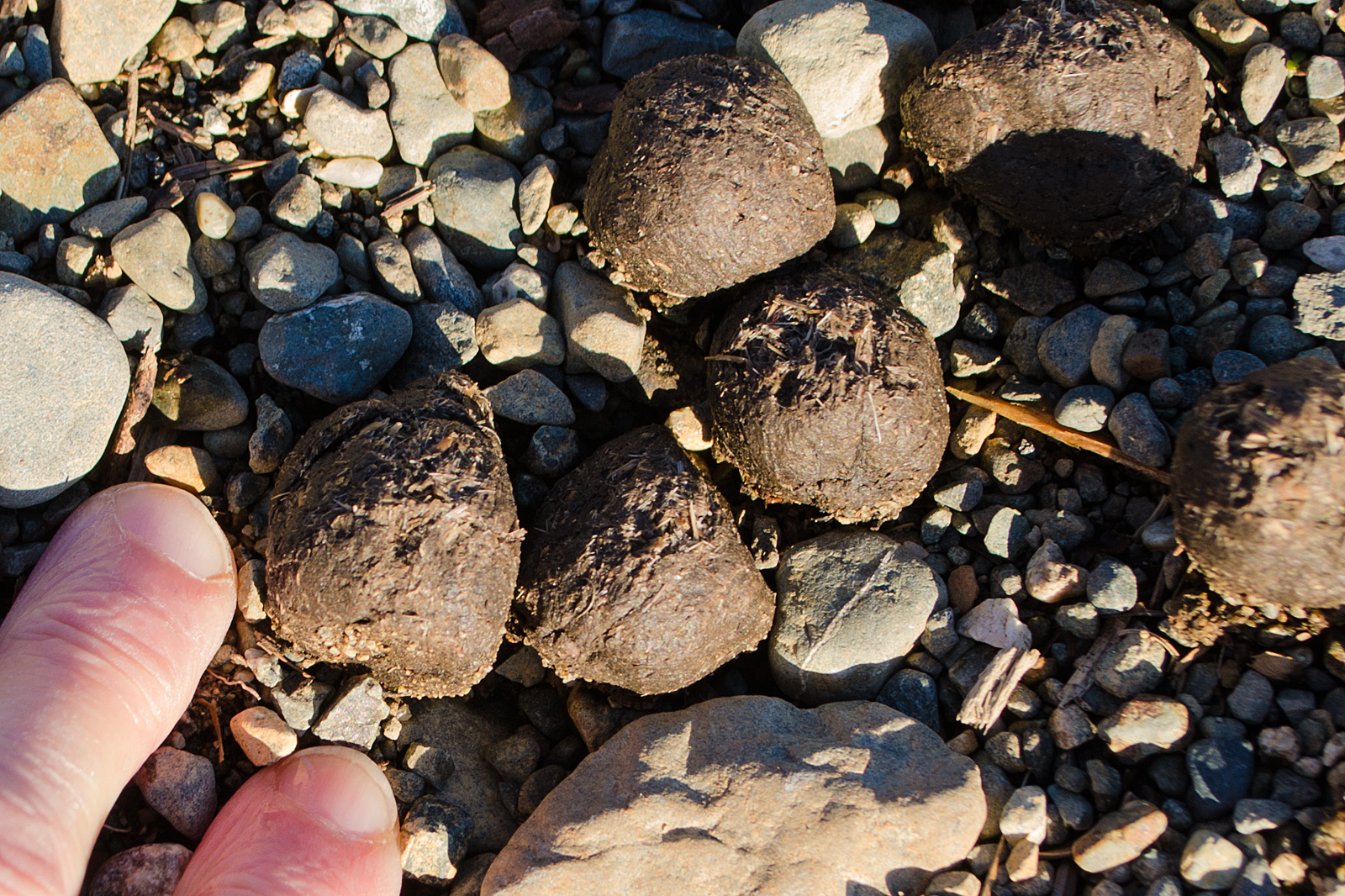
There were a few faint elk tracks, not clear because the ground is so hard, so covered with dry branches left over from the logging. But there was a patch of elk scat.

Elk scat, not fresh, with bits of dead fern on top.

But no elk. Maybe down in the valley ...

Google Earth view. Next trip, I'll go all the way to Pye Lake.

Time to go home. I walked back to the car, crawled down the hillside, dodging potholes. So I was going slowly enough to see the grouse watching me from behind a huckleberry bush. I stopped; so did she. We sat and watched each other for a few minutes. When I rolled down the window to get a photo, she turned and went into the trees.

Photo or no photo, I was happy to have seen her.

~~~~~~~~~~~~~~~~

Desde el bosquecito, regresé al coche y seguí cuesta arriba. Encontré otro caminito que cruzaba un area donde habían cortado los árboles hace unos años.

Aquí no había musgo; todo es seco, duro, tostado por el sol. Pero el bosque se está recuperando. Hay arbolitos, retoños, y jóvenes. El suelo está cubierto de helechos, los del año pasado, ya secos.
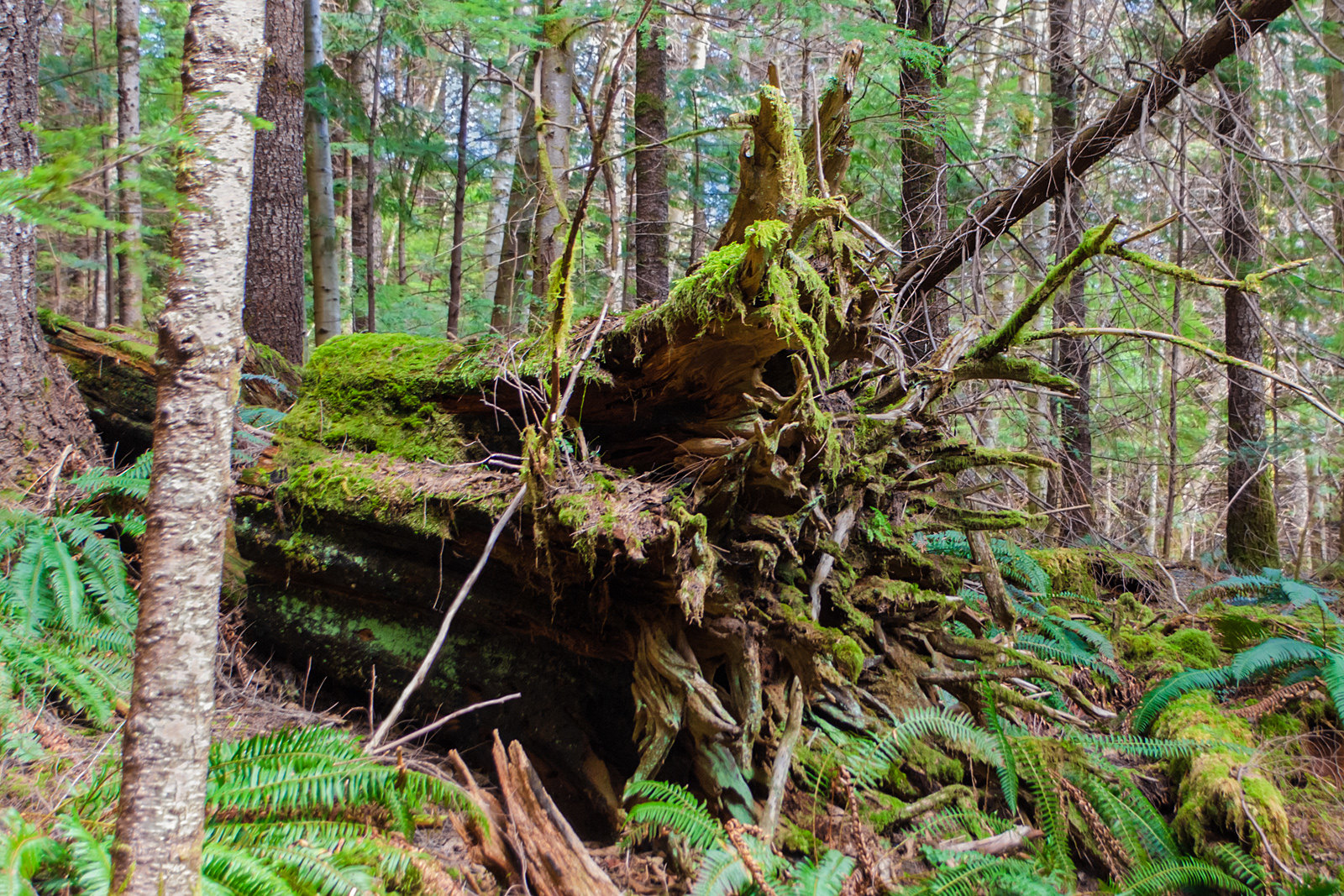
Un tronco al lado del bosque protegía plantas de "salal" (Gualtheria shallon) y de "huckleberry" (Vaccinium parvifolium), dos arbustos que se llenarán de frutillas en el verano, alimentos para pájaros y osos.

Un sendero apenas visible cruzaba el camino; parecía hecho por alces. Lo seguí por un rato. Las huellas que vi eran ligeras; el suelo está muy duro. Pero si había caca de alce.

En camino a casa, bajando el cerro despacito por los hoyos en el camino, tuve la suerte de ver una gallina fuliginosa que me observaba desde la sombra de un arbusto. Me detuve; tambien ella. Nos sentamos mirándonos por unos minutos. Cuando por fin bajé la ventana para sacar una foto, ella se dió vuelta y desapareció entre los árboles.

Con o sin foto, me sentí privilegiada de haberla visto.

Wednesday, April 08, 2020

Up Pye Road West

The day was sunny and warm. I took the highway north. Beyond Roberts Lake, I saw a logging road I hadn't investigated and headed up it.

Near the bottom, a trail went off into the forest. I parked and followed it.

First stop.

The human trail soon petered out, but a narrower trail wandered off uphill. So did I. It was a bear trail; I saw a few wide, round tracks, and a log torn apart, where a bear was looking for grubs. But in the daylight, it looked like I was alone. There was no sound except for the crackling twigs underfoot.

Open forest: ferns, moss, Oregon grape. Many downed, dry, crackling twigs.

Burned nurse stump. The new tree has split it in half.
Half a tree

Near the top of the woods, I turned back. At the bottom of the hill, the moss was thicker; there was a trickling stream winding through.

Fallen tree, with mossy roots.

Tomorrow: what else I found there. No, not a bear.

~~~~~~~~~~~~~~

Hacía sol, y un poco de calor; por fin pude dejar la chamarra. Tomé la carretera que va hacia el norte. Pasando el Lago Roberts, vi un camino de madereros que aún no había explorado. 

A no muy gran distancia, un caminito se dirigía dentro del bosque. Me estacioné y seguí el camino, que resultó ser muy corto. Pero otro sendero, no hecho por humanos, subía entre los árboles; lo seguí.

Era un camino de osos. Vi varias huellas, grandes y redondas, y un tronco viejo que el oso había hecho trizas, buscando hormigas o gusanos. Pero en ese momento, en el dia, parecía que yo estaba sola.

El bosque era abierto, con el suelo seco cubierto de ramas viejas, crujientes. Había un poco de musgo, algunos helechos, mucho silencio.

Cerca del final del bosque, di vuelta y regresé. Allá abajo, un riachuelo corría tranquilamente; el musgo era más espeso. Un árbol caído tenía las raices cubiertas de musgo.

Las otras dos fotos son de un tronco "criadero". El árbol a que dió albergue lo ha partido en dos.

Mañana: lo que encontré allí. No, no fue un oso.


Wednesday, January 08, 2020

Somewhere there is sunshine

I had the afternoon free and the camera packed. But the day was a dark grey, with patches of rain. Too dark for photos, too unpredictable for walking. And the tide would be high again until after dark. (Sunset was at 4:38.) Time to get out of town; maybe I could find the sun.

I decided to go north. That way, I might find snow, too. The camera and I would like the light; sunshine on snow!

Fog, fog, rain, fog. And more fog. The only colours visible in the watery light were grey, dingy browns, and the greyed dark greens of the evergreens. After the Sayward turnoff, about 50 km from home, where the highway climbs into the hills (and there are warnings to carry chains) snow started to show up on the side of the highway. And up ahead there were tiny patches of slightly blue sky. I drove on, hoping.

I found sunshine!

See? Sunshine on the trees and the valley beyond! No road goes there, though.

The sun came and went, playing peekaboo behind the mountains, then merging back into the fog. Tall trees bordering the highway hid the mountain peaks. I found an abandoned logging road and went up to get a better view.

My logging road. A few metres farther up, and the view was gone. The light patch on the hillside is a clearcut logged area.

Around the next bend. No sunshine visible from here. A bit of snow, behind the trees on the left.

The highway dipped down into the Woss Valley and the roadside snow disappeared. Fog settled in again. Farther north, it started to rain. I turned around and came home. There was snow on Mount Huksan, behind Sayward, visible sometimes when the clouds lifted for a moment. Dim fog merged gradually into dimmer twilight, even before sunset.

I was glad to see the lights of home twinkling over the water under a foggy full moon.

Wednesday, February 27, 2019

Elk signs, yellow, brown, muddy

Signs along the highways, going north or west from here, say "Elk", with a distance, such as 55 km. Or they show an outline of an elk, with the distance.

Elk sign, Highway 19.

I keep my eyes open, watching the road and the bushes along both sides. I never see an elk. Not in the daytime, not at night. Many deer, at any hour, but no elk. Not a hair.

On a hillside above the Salmon River, I found a different kind of elk sign.

Elk scat. About the size of brown marbles. Fairly fresh, still moist.

A closer look. They're slightly squarish, a hair longer than they are wide. That bit of glitter at the left is ice.

Farther along, I found more:

This scat is older, drying and splitting. My fingernail is 1.5 cm. at the wide point, so the largest of these is about 3 cm. long. The scat contains quite a bit of fiber; their diet at this time of year includes dried twigs, branches, whatever has survived the winter weather.

Elk droppings are bigger and longer than deer droppings. Moose are even larger yet. If the droppings are dry and cracked, it is because they are old and not left there recently. If they still glitter & shine from moisture and each one spreads like grainy peanut butter or room temperature chocolate chips when you slide your boot across them, it could have been minutes, or an hour or two, depending on the weather. If they are still steaming in the cold morning air, they’re close by!  (All About Moose)

No steam seen. The elk had left the immediate area. I wandered about, looking behind piles of logging slash, to be sure. No elk. But I did find this:

There's a baby!

Near a stream, where the water crossed a logging truck access, the gravel was soft, so that elk feet sunk deeply. Here, and nowhere else, I found the little tracks of a calf, still too small to make an impression on more solid ground. The deep end is the rear of the track.

With my muddy shoe for comparison. The bottom of the track is about 4 inches long. The scruffy area at top is caused by her dewclaws, which will leave no impression on a more solid surface. She and her calf were walking peacefully; when she runs, her toes spread apart in a V.

Another print near the muddy area. The dewclaw marks are clear.

So: still not an elk, but closer. Maybe next time.

Sunday, February 17, 2019

No name lake

Seen in passing.

Lake with a sort of swimming platform, accessed by swimming, I guess.

Vancouver Island is dotted with hundreds of lakes like this. Some smaller ones have names; some larger ones don't. This one is between Echo Lake and Mirror Lake, along a private logging road with access for summer recreational use. On Echo Lake, there is a pier and campsites; here, it's just a gravel road passing by.

Not seen in the photo: the call of a lovesick eagle in the distance, the rustle of dried grasses and waterside plants, the smell of dust and dying wood, spiced with fresh evergreen needles. Nor the potholes in the road, ever increasing in size and depth, until I had to turn back, not wanting to lose an axle on the back side of nowhere.

Some of the little lakes I passed this day, two weeks ago, wore a thin skin of ice; this one lies in full sun and there's not a hint of ice, even near the shore.

Now, of course, the banks are deep in slushy snow. It snowed again today. Then rained on the snow, of course: this is coastal BC.

Monday, September 17, 2018

Rain, mist, misty greens.

The fall rains have arrived. And very welcome, too!

Sunday afternoon. Rain, off and on. And the logging trucks are off the roads. I found a Forest Service road at Berry Creek, dropping down from the hills over Upper Campbell Lake, and drove up about 4 km, until the road got too rough for my little car. When it stopped raining for a few minutes, I would get out and walk.


From my first stop, looking back downhill. The orange pipes are an old gate, now rusted too much to be used, I think.

It is peaceful up there, away from the highway. The only sounds are the wind tiptoeing through the branches, the gravel or scree crunching under my slow tires, and the occasional cry of a woodpecker. I drove with the windows down as often as possible, just listening. And breathing; cool, moist, rain-scented air. I found myself grinning like an idiot as I drove.

Second stopping point, looking back over the highway I'd come from.

Higher up, the road followed Berry Creek, far below. I could hear the water rumbling along far down in the valley, but even leaning as far as I dared over the cliffside, I could see no sign of it.

Creek valley to the left, Upper Campbell Lake at the bottom.

Another car passed me as I was stopped at a wide spot in the road. And re-passed me, going downhill now, at the next stop. The driver and passenger were grinning like idiots, too.

Up near the top, where the road is extremely steep, the rain had chosen the middle of the road to make itself a new creek, washing away the small stones and gravel, leaving the bones of the mountain to hammer at mufflers. I crawled along at 5 kmh until I found a flattish spot, turned around and crept back down, foot on the brake all the way.

And still grinning.

Saturday, April 21, 2018

Down a logging road

I can't resist an unmapped road winding off into the bush.

Logging road. A sign near the highway warns of active logging Monday to Friday. Nobody there on Sunday afternoon; perfect for an explore.

A couple of kilometres in, I found logging slash, and a view of distant mountain tops.

I grew up around logging slash, hardly noticing it. In recent years, with the vast increase in machine logging, stripping much of our rain forest of its ancient cover, I've come to detest the thought of it. But here, the old familiarity returned, and I was able to see the beauty even in this ravaged forest, so busy now re-establishing itself.

Among the trees, I can always hear their quiet conversations. Here, on a Sunday afternoon, with the whispering evergreens far across the graveyard of their old friends, it was so silent that the buzzing of a fly echoed down the road. The air was spicy, smelling of cut wood and browning ferns. A few tiny white butterflies danced around the crumbling stumps. Huckleberry shrubs, still young, sprout from the crevices at the tops of nurse stumps, and around their feet, the first green shoots of next season's covering crops, fireweed and ferns, elderberry and blackberry, dot the ground.

I turned over fragrant slabs of wood and strips of bark, each one decorated with the tunnels and shredded fibers left by burrowing grubs.

A beetle's drawing of Don Quixote's nag, Rocinante?

Salal is evergreen and hardy, resisting even the tread of men and machines. With last year's dead ferns. The roots are still there, healthy and ready to sprout, now that the ice is gone.

Logging is still going on, farther into the mountains. Here, recovery begins.


Powered By Blogger