Showing posts with label big-leaf maple. Show all posts

Monday, February 16, 2026

Reaching to the sky

Yesterday I noticed the new pink catkins on the alders. Spring is on its way.

Celebrating the bare branches of deciduous trees; they'll be clothed soon enough.

Snakehead Lake, Feb. 14.

A tall alder. January, somewhere north, on Hwy. 19


Maple, Big Tree Creek.

McIvor Lake.

Alders. Looking over Seymour Narrows

A Skywatch post.
~~~~~~~~~~~~
Ayer vi las candelillas color de rosa nuevas de los alisos rojos. Un aviso: pronto llegará la primavera.

Estas fotos celebran las ramas desnudas invernales de los árboles de hoja caduca.
  1. El lago Snakehead, el 14 de febrero.
  2. Un aliso rojo grande. Carretera #19.
  3. Un arce de hoja grande. Big Tree Creek.
  4. En el lago McIvor.
  5. Alisos rojos en el Estrecho Seymour.

Sunday, November 16, 2025

Leaf sampler, with 'shrooms.

Most of Baikie Island's leaves are on the ground now, and rapidly turning black. They're hiding many mushrooms, which don't need sunlight; they get their food from plant-produced (originally) organic matter, just as we do. (One of the reasons why the fungi are considered closer to the animal kingdom than to the plants.) And when temperatures drop below zero, the rotting leaves will serve both as a heated blanket and as food for busy soil communities. 

The leaves here are cottonwood and big-leaf maple. Mushroom unidentified.

Unidentified mushroom, with big slug bites taken out. Cottonwood leaves and Douglas-fir needles (up to 3 cm. long).

A smaller yellow mushroom. Look for the 6 globular springtails.

Rough-stemmed, gilled, slug-bitten mushrooms. With red alder leaves, moss.

A clump of gilled mushrooms, with red alder, cottonwood, and big-leaf maple leaves.

I just received a new mushroom guide this afternoon; the Royal BC Museum Handbook; Mushrooms of British Columbia. With over twice as many mushrooms (350) as my go-to desk guide, and more detailed explanations, it is going to keep me reading for a while. On-line guides are good, but there are only so many pages you can keep open and the list of bookmarked sites gets unwieldy, and you can't really drop in a bit of notepaper with a bit of relevant detail added, or press a sample leaf there, so my little shelf of guidebooks above my desk gets a lot of activity. Paper books rule!

Tomorrow; Baikie Island puffballs.
~~~~~~~~~~~~~~
Casi todas las hojas caducas de la Isla Baikie ya están en el suelo, perdiendo sus colores, volviéndose negras. Esconden bajo su sombra muchos hongos, los cuales no necesitan la luz solar, porque obtienen sus nutrientes de sustancias orgánicas, producidas originalmente por las plantas, al igual que nosotros. (Esta es una de las razones por las cuales el reino de los hongos se considera más cercano al reino de los animales que al de las plantas.) Y  cuando llega el invierno con sus temperaturas bajo 0°, las hojas, pudriéndose, servirán tanto como cobija térmica como de alimento para las comunidades del suelo.
  1. Estas hojas son de arce de hoja grande, y de álamos. No pude identificar el hongo.
  2. Otro hongo sin identificación, con grandes mordidas de las babosas. Las hojas son de álamo, y las agujas de abeto de Douglas, que miden hasta 3 cm. de largo.
  3. Un honguito amarillo. Busca los 6 colémbolos.
  4. Hongos con tallos rugosos, con agallas, y mordidas de babosas. Las hojas son de aliso rojo.
  5. Un grupo de hongos con agallas, rodeados de hojas de álamo, aliso rojo, y arce de hoja grande.
Recibí esta tarde un nuevo libro guía; el Royal BC Museum Handbook; Mushrooms of British Columbia. Tiene más de doble el número de hongos (350) que los que tiene el guía que he estado usando, y descripciones muy detallados (aunque con letra muy chica; ni modo). Los sitios web son buenos y útiles, pero tener abiertas muchas pestañas resulta difícil, y la lista de sitios favoritos ya está demasiado grande, y no puedes insertar un papelito con tus propias observaciones para marcar tu lugar, ni guardar allí una hoja de muestra; razón por la cual mi pequeño estante de libros guía en mi escritorio está en uso constante.

Friday, November 07, 2025

Big-leaf Braille

Big-leaf maple leaves are big. Not all of them, but enough to give the trees their name, even the scientific one; Acer macrophyllum; big leaves, in Greek. I picked one up from the trail by the river and brought it home to measure it. 43 cm, across.

As found on the trail.

Walking back, carrying the leaf, I looked at those circular patches, wondered what made them. Now, watching where I stepped on the trail, I saw that many of the other maple leaves had those same markings.

The largest circle, as found on the trail.

By the time I got home the leaf had curled up; too much heat in my car. I pressed it under weights for two days to get it dry enough to stay flat, then took more photos.

The large circle, now dry. 4 cm, along the longest axis.

And a smaller patch, of tiny, raised black dots.

So what was this? Insects, leaf miners, I thought, at first; that didn't work out. Then I found the fungi. Rhytisma punctatum. Another appropriate name; punctatum is Latin for "dotted". The genus is also called "Tar Spot fungus", and this species is, in English, the Speckled Tar Spot.

This fungus (another of the Ascomycetes) infects the leaves of maple trees in the spring. During the growing season, they aren't noticeable; the leaves are healthy and green. This fungus is one of the endophytes; organisms that live inside plants. Without causing apparent disease, according to the definition of the word. It's only when fall comes and the leaves detach themselves from their branches, that the fungus shows its face.

When the weather turns cool and the days are short, the chlorophyll in the leaves breaks down, and the leaves turn yellow. But around the fungus, some of this chlorophyll remains, leaving a green circle; this part of the leaf is still alive. (Seen more clearly in the dry leaf: third photo above.)

The fungus matures, produces its reproductive bodies; small, raised, hard, black lumps; the tar spots. Under my finger tip they feel like Braille letters.  Here, over the winter, the spores will form. (Even in leaves lying in soggy layers in the mud!)

Tar Spot stromata seen through my microscope.

Come spring, the tar spots will release their spores and the wind will carry them up into the trees to find new leaves and start the cycle again.

I wondered; if the chlorphyll is still there, is photosynthesis still going on? Not feeding the tree any more, obviously, but does it feed the fungus? Apparently, it does.
The tar spot fungus, however, produces a hormone which stimulates the chlorophyll, keeping the chloroplasts alive for a while, even after the rest of the leaf has died. These green zones continue to produce glucose, which feeds the developing fungus spores. The fungus is farming small areas on leaves that are no longer attached to the trees which originally produced them. (Terry Taylor's Ecology Notes)

Another patch of fungus, showing green chlorophyll, and black "tar spots".

~~~~~~~~~~~~~~

Las hojas del arce de hojas grandes son grandes. No todas, pero suficientes para determinar el nombre del árbol, incluyendo el nombre científico;  Acer macrophyllum; hojas grandes, en el griego. Recogí una que reposaba en el camino al lado del rio y me la traje a casa para medirla. 43 cm.

    1: La hoja, donde la encontré.

Camino de regreso, llevando la hoja, miraba esas manchas circulares, considerando que fue lo que las hizo. Ahora, al fijarme donde anadaba, vi que muchas otras hojas tenían manchas parecidas.

    2: La mancha más grande, tal como la encontré.

Cuando llegué a casa, la hoja ya se había enrollado; en el coche hacía demasiado calor. La prensé bajo una charola pesada por dos dias para rendirla suficientemente seca para que se mantuviera aplanada, y entonces saqué otras fotos.

    3: La misma mancha, seca. Mide 4 cm en el eje más largo.

    4: Y un grupo de puntitos negros, elevados.

¿Pero qué era esto? Al principio pensé que serían insectos; los llamados mineros de hojas, pero una búsqueda no dió resultados. Y entonces descubrí los hongos. Es Rhytisma punctatum. Otro nombre bien escogido; punctatum, "moteado". El género recibe el nombre Mancha de Alquitrán del arce.

Este hongo, otro de los ascomicetos, invade las hojas de los arces en la primavera. Durante el verano pasan sin hacerse visibles; las hojas siguen verdes y sanas. Este hongo es uno de los endófitos, organismos que viven dentro de las plantas, aunque, según la definición de la palabra, sin causar daño. Llegando el otoño, cuando las hojas se separan de las ramas, entonces el hongo se hace aparente.

Cuando las temperaturas bajan y los dias se acortan, la clorofila dentro de las hojas se descompone y las hojas se vuelven amarillas. Pero el hongo retiene algo de esta clorofila, manteniéndola viva, formando un círculo verde. (Se ve esto más claro en la hoja seca de la tercera foto arriba.)

El hongo madura, y produce sus cuerpos reproductivos; masas pequeñas, negras, duras, elevadas: las manchas de alquitrán. Al tocarlas con el dedo parecen letras en braille. Aquí, durante el invierno, se formarán las esporas. (¡Aunque pasan este tiempo dentro de hojas aplastadas en capas empapadas en el lodo!)

    5: Estromas de Rhytisma punctatum vistas bajo mi microscopio.

En la primavera, estas estromas soltarán sus esporas y el viento las llevará a la copa de los árboles para encontrar hojas nuevas y empezar de nuevo el ciclo de vida.

Me preguntaba; si la clorofila sigue en sitio, ¿seguirá el proceso de fotosíntesis? No estará produciendo nutrientes para el árbol, claro está, pero ¿para el hongo? Parece que sí.
El hongo "mancha de alquitrán", sin embargo, produce una hormona que estimula a la clorofila, mantiendo con vida los cloroplastos por algún tiempo, aun cuando la mayor parte de la hoja ha muerto. Estas zonas verdes siguen produciendo glucosa, la cual sustenta las esporas en desarrollo. El hongo está cultivando pequeñas areas en hojas que ya no están conectadas a los árboles que las produjeron originalmente. (Terry Taylor's Ecology Notes)


Monday, November 03, 2025

Rioting colours

First week in November. The Big-leaf maples have shed most of their leaves, letting the sunlight reach the forest floor, where they've spread a carpet drenched in the warm colours of summer.

The fallen leaves

Pathway

Nurse stump

Catching the light

Reflections in Kitty Coleman Creek

Sit and rest a while.

Photos from Elk Falls and Kitty Coleman Provincial Parks.

~~~~~~~~~~~~
La primera semana de noviembre. Los arces de Hoja-Grande han dejado caer la mayoría de sus hojas, permitiendo colarse la luz del sol hasta el sotobosque, en donde han extendido una alfombra bañada con los colores cálidos del verano.
  1. Las hojas.
  2. Uno de los senderos.
  3. Tocón nodriza.
  4. En los rayos del sol.
  5. Reflejos en el riachuelo Kitty Coleman.
  6. Siéntate, descansa un rato.
Fotos de los parques provinciales, Elk Falls, y Kitty Coleman.

Friday, October 31, 2025

Nothing but footprints

 Reading the descriptions of local bolete mushrooms in my guide book, I notice how similar they all are; "brown to black, convex to flat, sticky or slimy when moist (6/10), growing on the ground ..." All the photos, of perfect specimens, of course, are similar; a stalk, a wide, flattish cap, a solid mass of yellowish pores beneath. Identifying a particular mushroom depends on changeable details: how does it change as it ages? Does it stain when you touch or cut it? Or on cutting it and bringing it home to take a spore print. Mushroom websites ask for microscopic details: the shape of the pores, the spores, or chemical reactions.

I'm reluctant to cut or remove a mushroom from its site, remembering always the old advisory: "Take nothing but photos, leave nothing but footprints." I'm even careful about footprints. I do, occasionally, snap a brittle-gill, or bring home a leaf or two, but I don't feel comfortable about it. We humans do enough damage, as it is.

The other characteristic mentioned in the book, one that is easily determined, is the species of trees associated with the mushroom; oak, hemlock, 2-needle pines, etc. The museum mini-forest where these two boletes grow is a mix of Douglas-firs, big-leaf maples, and a few red alders, with evergreen ferns, Oregon grape, huckleberry and salal in the understory.  And moss, of course; moss is everywhere here.

Brown boletes,wet, but not especially slimy. Growing close to ground; pores hidden away. Could be a Zeller's bolete, Xerocomellus zelleri

But here's one already turned over. With slug nibbles.

Detail of pores.

This one seems to be growing out of the root.

Wet; it was still dripping leftover raindrops under the trees. With small big-leaf maple leaf.

It's still raining.

~~~~~~~~~~~

 Al estudiar las descripciones de los hongos boletales de esta región en mi libro guía, veo que todos son extremadamente parecidos el uno al otro; casi gemelos. Los sombreros son — de marrón a negro, convexos a planos, pegajosos o resbalosos cuando están húmedos (6/10), creciendo en el suelo ... — Todas las fotos del libro, todas de hongos en condición perfecta, claro, se ven iguales: un tallo, un sombrero ancho y algo plano, una masa de poros amarillentos en la superficie inferior. Para identificar algún hongo al nivel de su especie, hay que examinar detalles cambiadizos: como cambia el hongo al madurar, como se mancha al tocar o cortarlo. O hay que traer el hongo a casa y tomar una impresión de las esporas. Los sitios web dedicados a los hongos piden detalles microscópicos, la forma de los poros o de las esporas. O las reacciones químicas.

No me siento bien al quitar un hongo de su lugar; siempre tengo en mente el viejo consejo: "No te lleves nada aparte de fotos, no dejes nada más que las huellas de tus pies." Hasta tengo cuidado de no dejar huellas a menos que no puedo evitarlo. De vez en cuando sí rompo un hongo de agallas quebradizas, o me traigo a casa una que otra hoja, pero hasta con eso, me siento algo culpable. Nostros los humanos hacemos bastante daño ya; ¿porqué hacer más?

Otra característica de los hongos que menciona el libro, y esta sí se puede averigüar con facilidad, es la especie de los árboles que se hallan asociados con los hongos; por ejemplo, los robles, la tsuga, los pinos de 2-agujas. El bosquecito del museo donde crecen estos dos boletales consiste en una mezcla de abetos de Douglas, arces de hoja grande, y unos cuantos alisos rojos, con helechos perennes, las uvas de Oregon, huckleberry y salal (Vaccinium parvifolium y Gualtheria shallon) en el sotobosque. Y musgos, claro; siempre y dondequiera hay musgos.

  1. Boletales. Mojados, pero no muy resbalosos. Crecen tan cerca del suelo que no pude ver los poros. Puede ser un Xerocomellus zelleri.
  2. Este ya se había caído. Tiene mordidas de babosas.
  3. La forma de los poros.
  4. Este parece crecer en la raiz del árbol.
  5. Está mojado, como todo el bosque; todavía caían gotas de la lluvia matutina desde la copa de los árboles. Con una hojita de un arce de hojas grandes.
Y sigue lloviendo.


Friday, August 15, 2025

Morning at Oyster Bay

I went down to Oyster Bay early in the morning, just after sunrise. Sea and sky lay washed in pink and blue light, the land still sleeping, gumweed flowers all half closed, waiting for full sun. A flock of swallows passed overhead, chattering as they went. Then the only sounds were the crunching of my shoes on stones, a faint rustle of dried grasses.

Walking the dogs. I was the second visitor this morning.

Misty hills, a loon and a fish boat.

Light on the water beside the breakwater.

The tide is low. Morning light on seaweed-coated breakwater rocks.

This surprised me. As the pink faded, light streamed down onto one small spot on the water, as if aimed by a spotlight.

The old maple, warmed by pink light.

Tea in the car, then home for breakfast.

A Skywatch post.

~~~~~~~~~~~~

Fui a caminar en Oyster Bay muy temprano, un poquito después del amanecer. El mar y el cielo estaban bañados de una luz tenue, azul y color de rosa; la tierra dormitaba, las flores amarillas de Grindelia seguían todas casi cerradas, esperando a que les tocara el sol, escondido todavía tras las montañas. Una bandada de golondrinas voló sobre la bahía, parloteando mientras iban. Después, los únicos sonidos eran el crujido de mis pies en las piedras, y el susurro de hierbas secas.

  1. Una mujer con sus perros. Yo era la segunda persona allí esta mañana.
  2. La neblina cubre los cerros y las montañas lejanas. Hay un barco pesquero y un solo colimbo. (Su pareja acaba de sumergirse.)
  3. Luz sobre el agua al lado del rompeolas.
  4. La marea estaba baja, y las rocas están cubiertas de algas marinas.
  5. Esto me sorprendió. El color rosa se iba desapareciendo, pero se enfocaba sobre un solo punto en el agua, que brillaba como si se estuviera quemando.
  6. El viejo arce de hoja grande, bajo la luz cálida.
Un post para Skywatch.


Saturday, May 03, 2025

Mostly green

The colours of April, here in the north woods. In town, the streets are lined with pink and purple, yellow and white. Deep blue bluebells, red-flowering currants, daffodils and crocuses, white-blossomed wild cherry trees, even a few red rhododendrons. A few minutes beyond city limits, however, the theme colour is green. With brown as an accent colour.

These are a few random shots taken here and there.

Just another nameless logging road.

Big-leaf maple, adding a hint of yellow to its greenery. Brown's Bay.

In a bleached log, two species of moss, Cladonia lichens, and Lichen Agaric mushrooms (Lichenomphalia umbellifera). Oyster Bay.

A bit of the north woods, tamed, but still green. Brown's Bay.

Nose to the bark; Cladonia lichen squamules.

And brown:

Bird's nest fungus, with "braided" red cedar leaves, dried.

And a small, brown mushroom.

There's always another trillium. Cumberland area.

~~~~~~~~~~~~~~

Los colores de abril, aquí en los bosques norteños. En la ciudad, las calles corren entre jardines pintados en color de rosa, morado, amarillo, blanco. Hay jacintos, en tonos de azul fuerte, grosellas, las que llevan flores rojas, hay narcisos y crocus, cerezos resplandecientes con sus flores blancas, hasta unos cuantos rododendros con flores rojas.  Pero saliendo del pueblo, apenas a una poca distancia, el tema es verde. Todo es verde, con el color café como color de contraste.

  1. Un camino de madereros, sin nombre.
  2. Arce de hoja grande, vestido en verde/amarillo.
  3. Un tronco podrido, blanqueado por el sol, con su "jardincito" de musgos (dos especies), líquenes Cladonia, y los hongos/liquen Lichenomphalia umbellifera.
  4. Un tramo del bosque norteño domesticado, pero sigue pintado de verde. Brown's Bay.
  5. Escamas de los líquenes Cladonia sp., vistas de cerca, en el tronco de un árbol.
  6. Y el color acento, café: aquí un hongo "nido de pájaro" con hojas secas del cedro rojo.
  7. Un honguito color café.
  8. Y siempre hay otro trilio.


Sunday, February 02, 2025

Should be big-lichen maple.

"Bigleaf maple carries a greater load of mosses and other plants than any other tree in our region. Sometimes the bark is not visible anywhere on the tree trunk and main branches." (From the guide, Plants of Coastal British Columbia.)

The "other plants" include licorice ferns, liverworts, a grand variety of lichens, and occasionally, seedlings of other trees. Winter is the best time to look at them, when the leaves are all rotting on the ground. Flowers won't appear until March, the first leaves a bit later.

At least two species of larger lichens here. And, of course, moss.

At the foot of the trees, a downed branch bearing lungwort, Lobaria pulmonaria. And moss.

Middle branches. These trees are young, and still have large areas of bare bark.

Compare with the clean lines of the red alders.

View from my road again. Notice the lichen crawling up the trunk. Sunlight shining through moss outlines the branches.

~~~~~~~~~~~~~

"El arce de hoja grande, Acer macrophyllum, sostiene una carga de musgos y otras plantas mayor que la de cualquier otro árbol de nuesta región. A veces la corteza no se puede  ver en ninguna parte del tronco ni en las ramas mayores." (Del libro guía, Plants of Coastal British Columbia.)

Las mencionadas otras plantas incluyen los helechos regaliz, Polypodium glycyrrhiza, las hepáticas, una gran variedad de líquenes, e incluso las plántulas de otros árboles. Se ven mejor en invierno, mientras las hojas del año pasado reposan muertas en el suelo. Las flores no aparecerán hasta marzo, y las primeras hojas un poco más tarde.

  1. Aquí se ven por lo menos dos especies de líquenes grandes, además de los musgos.
  2. Pulmonaria, un liquen grande, Lobaria pulmonaria, en una rama caída, acompañada por musgos, sobre hojas muertas de arce de hoja grande en el suelo.
  3. Ramas en el centro del árbol. Estos árboles son todavía jóvenes, y parte de su corteza sigue sin líquenes.
  4. En contraste, los troncos y ramas del aliso rojo siguen limpios, sin líquenes.
  5. La vista desde mi camino, mirando hacia el pantano allá abajo atrás de los árboles. Se ven los líquenes que cubren el tronco más grande; la luz del sol pasando por el musgo, delinea los troncos.


Monday, April 17, 2023

Just a typical rainforest spring.

It's raining. And raining. And raining, day after day. Dashing from my car parked right in front of the Post Office to the door and back again to the car was enough to soak my jacket enough to need drying before it went back in the hall closet. The mock orange outside my kitchen window is happily putting out new leaves; so are the bleeding hearts. The hyacinths smell as delicious as ever, half-drowned or not. But I, who love the rain, I'm not as young as I once was, and I can't find my good rain gear. I stayed home (except for the run to the P.O.) and looked at last year's spring photos.

I missed posting these last spring. This year's batch should be bursting out this week.

Big-leaf maple flowers, April 27, 2022.

Silhouettes.  The leaves are just starting to unfold.

And now we've got thunder and lightning. Ah, a glorious BC spring!

~~~~~~~~~~~
Llueve. Y llueve. Y llueve, dia tras dia. Corrí desde el estacionamiento hasta la puerta de la oficina de correos (y estaba justo enfrente), y de vuelta hasta el coche, y con eso bastó para empapar mi chaqueta. La celinda (Philadelphus spp. que aquí le llamamos "pseudo-naranja") afuera de mi ventana está feliz; se está cubriendo de hojitas nuevas, también lo están los corazones sangrantes. Los jacintos esparcen su olor dulce como si no estuvieran medio inundados. Pero yo, amante como soy de la lluvia, yo no soy tan joven como antes, y no pude hallar mi buena ropa impermeable. Me quedé en casa, aparte de esa vuelta rápida al correo, y me consolé mirando fotos de la primavera del año pasado.

Se me pasó subir estas fotos de flores de arce de hoja grande en abril de 2022. Ya deben estar al punto de florecer ahora. En estas fotos, las hojas apenas empiezan a desenvolverse.

(Y ahora, empezaron los truenos y relámpagos. ¡Las delicias de una primavera en la isla!)

Wednesday, January 25, 2023

Ain't dead yet

 And this one, long-since felled, still keeps on supporting its community.

Busy little stumpie
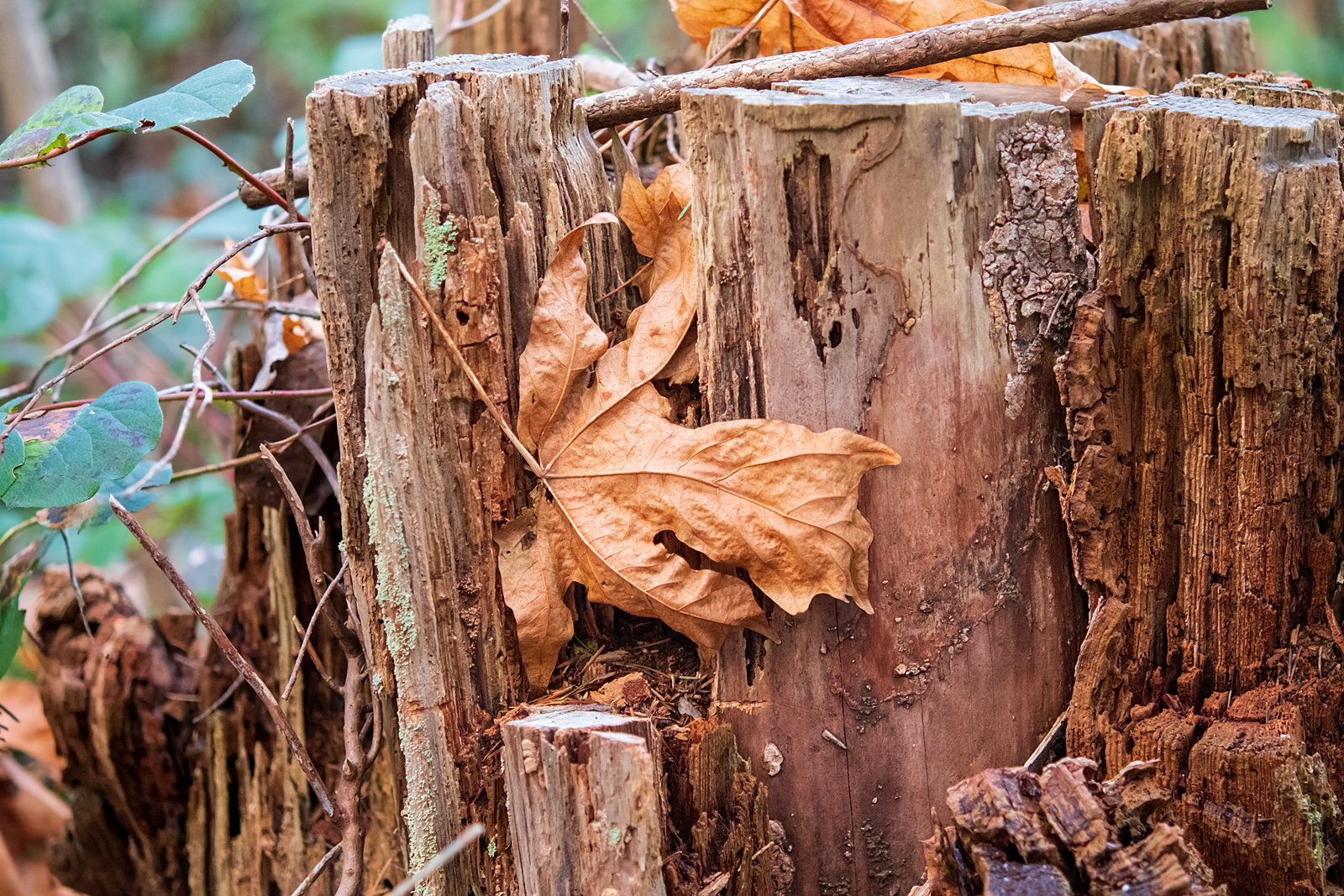
The outer bark and the layers of live wood have mostly rotted away, exposing the solid heartwood. Salal has rooted in the old wood, lichens grow on the outer edges, spiders and their prey hide in the many cracks. And big-leaf maple leaves rest on their trip to join the rotting mulch on the ground beneath.

Down underneath, invisible in the soil, the roots still form part of the living earth, the fungi, the inter-connected roots of the forest, still serving as conduits for liquid and nutrients.

Life goes on. And on.

~~~~~~~~~~~~~~~~~~~~~~~~~~~~~~~~
Otro tronco, éste cortado y desbaratándose, pero que sigue como soporte de su comunidad.

Foto: un tronco cortado bajito.

La corteza y las capas de madera activa se han pudrido en gran parte, dejando a la luz la madera del corazón, el duramen, todavía en firme. El arbusto nativo, salal, Gaultheria shallon, ha penetrado la madera con sus raices, en la superficies exteriores crecen líquenes, arañas y su presa se esconden en las múltiples grietas. Y encima, hojas del arce de hoja grande descansan camino a unirse a sus hermanos descomponiéndose hasta tornarse abono, en el suelo.

Y más abajo, debajo del suelo, invisibles, las raices siguen formando parte de la tierra viva, los hongos, las raices entrelazadas del bosque; todavía sirven para conducir el agua y los nutrientes que lleva.

La vida sigue. Y sigue ...


Sunday, January 22, 2023

Nose to the bark again

I was a kid growing up on the far west coast of this island, back in the days when little of it was logged off. All around us were the dense, green forests. Evergreens: hemlock, Douglas-fir, cedar. On the hill across the channel there was a stand of maple. Mom used to love those when they turned red in the fall; they reminded her of home in Ontario, she said. But we never went over to look at them more closely.

What I knew were the evergreens. I knew the way the cedars drape their branches to leave a dry hideaway underneath. I knew the taste of hemlock branch tips in the spring. I knew the smell of fresh-cut firewood and the spicy aroma of the huge Christmas tree in the hospital lounge. And the mossy silence under the giants. And the way the darkness of the shadows between the trunks beckoned me. Beyond that, not much. My curiosity led me down other paths, had me turning over stones on the beach and diving under the wharf. 

So when, years later, on drier shores, I learned that deciduous trees (like maples, not fruit trees; they were special, right?) produced flowers, I was astounded. I thought flowers were things that grew on the ground or on shrubs, like daisies and thimbleberries. And even now, in the spring when the maples and red alders dangle their catkins and blossoms, I am filled with that same sense of wonder.

And the wonder goes on; the more I look at the trees, the more amazing they become. Hence, looking at bark. How it works, how it changes, how it lasts. And what it looks like on individual trees.

Here are more nose-level tree trunks, these decorated with dust and crust lichens. All of these are in the lawns around the Campbell River museum.

Douglas-fir with green dust. It always looks like old paint.

This is a maple, and there are two lichens; the dry, crusty whitish patches, and a tiny leafy lichen colonizing the cracks in the bark.

I can't identify this tree; not even when it was in leaf. Spruce, maybe? It's painted top to toe with this green lichen.

Maple, with whitish patches. And I liked the extra pattern from the sun peeking through the leaves overhead.

Another Douglas-fir, I think, with just a light dusting of green lichens.

And I've been told to look at other details, the trunk flair, the buds, the cones. So many fractal levels! So I'll go back again soon, and again in the spring, when the leaves start to show.

~~~~~~~~~~~~~~~~~~~~~~~~~~~~~~~~
Yo era una niña que vivía entre los bosques en la costa del oeste de esta isla, en los años cuando todavía no se habían cortado tanto. Nos rodeaban esos bosques, verdes, tupidos. Siempre verde; eran tsugas (hemlock), cedros, abetos de Douglas. En la cara del cerro al otro lado del estrecho frente a nuestra casa crecía una arboleda de arces; a Mamá le gustaba cuando se volvían rojos en el otoño; le recordaban su casa en Ontario, decía. Pero nunca fuimos a mirarlos más de cerca.

Lo que yo conocía eran los árboles perennes. Sabía como cuelgan las ramas los cedros, dejando un escondite en seco junto al tronco. Conocía el sabor de las ramitas nuevas de tsuga en la primavera. Conocía el olor de leña recién cortada, y el aroma picante del gran árbol de Navidad en la sala de estar del hospital. Y es silencio bajo los gigantes, todos los sonidos del munído exterior apagados por el musgo. Y como la oscuridad entre los troncos me llamaba. Más de eso, no sabía gran cosa. La curiosidad me llevaba por otros caminos, volteando piedras en la playa o buceando debajo del muelle.

Así fue que cuando, años más tarde, en tierras secas, descubrí que los árboles de hoja caduca (no los frutales; ellos eran algo especial ¿no?) producían flores, me quedé atónita.  Hasta entonces, pensaba que las flores eran cosas que crecían en tierra, o en arbustos frutales, como por ejemplo las margaritas y las moras. Y hasta ahora, cuando en la primavera veo las flores y candelillas de los arces y los alisos rojos, me llena un asombro vivo.

Y sigue ese asombro; entre más observo los árboles, tanto más fascinantes son. Y por lo tanto, aquí estoy mirando cortezas, preguntando como es que funciona, como cambia, como perdura. Y como se ve en cada árbol individual.

Aquí subo más troncos vistos a nivel de mis ojos, todos creciendo en los jardines del museo de Campbell River y llevando líquenes de polvo o crustosos.

Fotos:
  1. Abeto de Douglas con liquen de polvo verde. Siempre se ve como si se hubiera tirado pintura.
  2. Un arce, con dos líquenes, uno duro, seco, blanquisco, el otro muy pequeño, folioso, creciendo entre las grietas de la corteza.
  3. No puedo identificar con certeza este árbol. Picea, tal vez. El liquen lo cubre desde arriba hasta abajo.
  4. Arce, con liquen blanquisco. Y me gustó el diseño de sombras formado por el sol entre las hojas.
  5. Otro abeto de Douglas con solo una salpicadura de liquen verde.
Y me han dicho que hay que ver otros detalles, o sea el ángulo de la base del tronco, los botones, las piñas. ¡Tantas capas de detalles que hay! Iré de vuelta pronto a visitarlos, y otra vez en la primavera, cuando empiezan a aparecer las hojas nuevas.

Powered By Blogger