As the crow flies, it's about 1 kilometer there and back, from our parking spot on the side of the road to the ravine where the trail gets steep, more challenging than I'm looking for most days. The trail was not mapped out by crows; it follows, more or less, a lazy, meandering creek at the bottom of a ravine, branching out here and there as someone — a deer, maybe, or a bear — went looking for huckleberries or fresh blackberry leaves or took a shortcut to the creek to get a drink. We humans follow their tracks, ending up at a dead end, or looping back into the main trail. Where we wander, our footprints widen the path.
The area is surrounded by "civilization"; highways, an airport, a housing development. But under the trees, all this disappears; we find bear tracks, torn moss where a bear dug for ants or grubs. Birds chatter in the branches, an eagle soars by overhead.
These are mixed woods, mostly deciduous, once heavily logged off. And in this small area, we find a variety of habitats. These are photos taken along the trail.
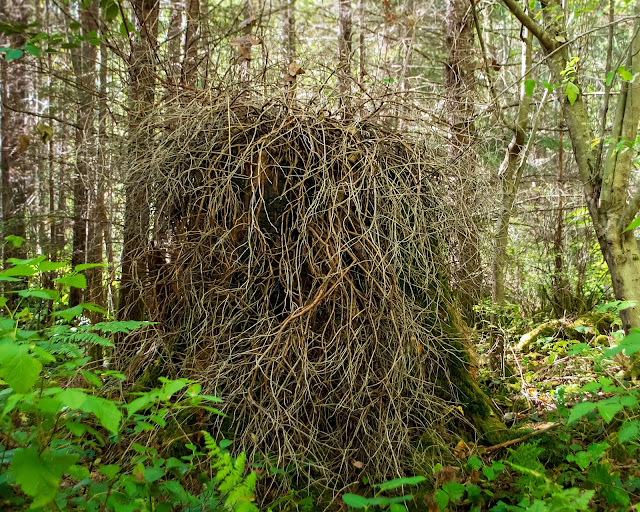 |
| Stump having a bad hair day. |
This was one of the ancient giants, a wide evergreen base, badly burnt, somewhat mossy. It had served as a nurse to this branchy shrub, which now has died, leaving a tangle of dried twigs.
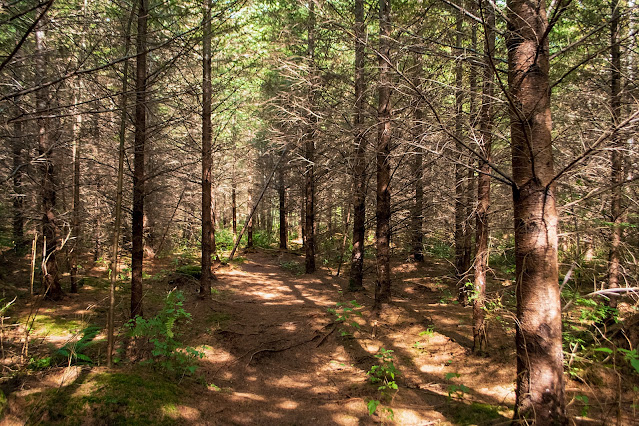 |
| The brown land |
Down one side trail, we walk through an area with almost no underbrush, just the bare soil, covered thinly by dead evergreen needles (not green any more). The lower branches are mostly dead, but the green roof above provides shade. This was where we found bear scrapings and tracks. 100 metres or so along, we're back in the usual shrubby green wood.
 |
| The creek at the bottom of its cut. |
The ravine isn't deep, but its sides are steep, and the soil loose. Dusty at this time of year, probably oozy after it rains. The rope in the photo provides a handhold on the way down. At the bottom, the creek slides by without a ripple; when someone came near, waterstriders scattered away across the surface of the water.
The trees here are mostly alder, big-leaf maple, and Douglas-fir. In the understory, in this photo I see salmonberry, huckleberry, and elderberry shrubs, mostly berry-free at this time of year. The ferns are the evergreen sword ferns. Looking closely, I would expect to find Oregon grape and our native trailing blackberry vines. And moss, of course.
At the top of the hill, the trail goes steeply down into the next ravine to cross another branch of this same creek; just beyond this, the main highway marks the outer edge of this tranquil patch.
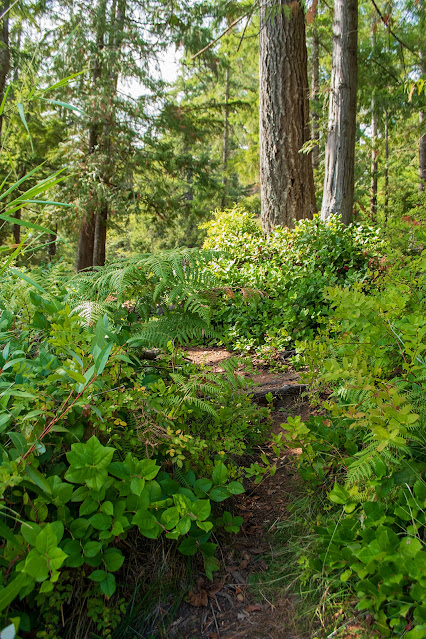 |
| Salal, huckleberries, willow, alder, Douglas-fir, bracken ferns, serviceberry branches. And grass. Another "accidental" trail. |
This photo is from a similar area, about 5 kilometers distant. The same mix of vegetation shows up.
And we came across several stoned alders:
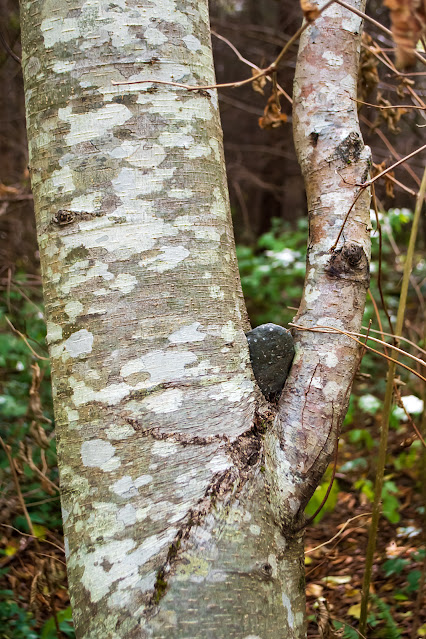 |
| Stoned alder |
They had stones caught and held in the angle of their branches. This one was about a metre above the ground, well wedged in; the tree has grown around it. Looking around the area, I found no stones similar. How did the trees collect them?
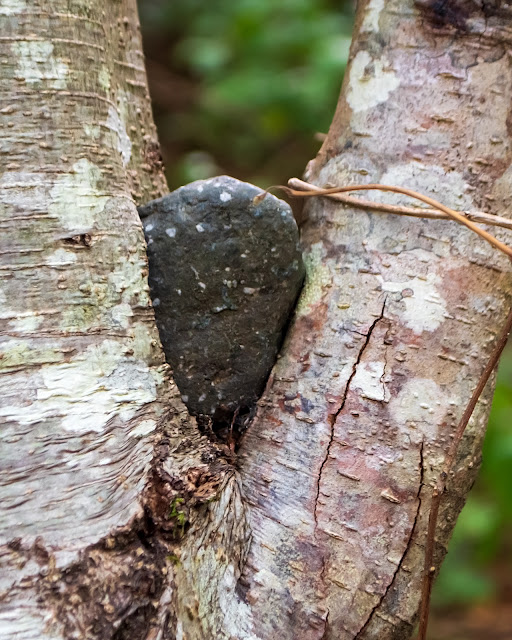 |
| Detail of the stone. The trunk has grown to cement it in place. I couldn't move it. |
~~~~~~~~~~
A vuelo de pájaro es como un kilómetro, de ida y vuelta, desde donde estacionamos el coche al lado de la calle hasta el barranquito donde el sendero se vuelve un poco más difícil de lo que tengo ganas de atreverme más que uno u otra vez. El sendero no lo planearon los pájaros; sigue, más o menos, el riachuelo que vaga sin prisas al fondo de su arroyo; el sendero se divide donde alguien — un venado, probablemente, o un oso — fue a buscar frutas de huckleberry, o hojas frescas de mora, o donde se alejó del camino para ir a beber del riachuelo. Nosotros los humanos seguimos sus huellas, ampliando con nuestras pisadas el nuevo caminito.
El sitio está rodeada de lugares "civilizados", carreteras, un aeropuerto, un complejo habitacional. Pero aquí bajo los árboles no lo sentimos. Hallamos huellas de osos y sitios donde desplazaron el musgo en búsqueda de hormigas o gusanos. Entre la ramas cantan los pájaros; muy por encima pasa un águila.
Este es un bosque mixto, talado desde hace años. Y en este sitio pequeño, hallamos varios tipos de habitat. Estas son algunas fotos que saqué al caminar.
- Tronco "enfermera" con el "pelo" desordenado. Este es uno de los árboles grandes originales al sitio, ya bien quemado, cubierto de musgo. Sirvió de base a un arbusto que ahora ha muerto, dejando solamente las ramas secas entrelazadas.
- "Las tierras muertas". Entrando en un camino al lado, entramos a este bosquecito de árboles bien separados, casi sin arbustos del sotobosque. El suelo lleva nada más una capa ligera de hojas de los abetos, ya secas. Casi todas las ramas inferiores de los abetos están muertas, pero allá arriba la copa de los árboles se mantiene verde. Es aquí donde encontramos las huellas de oso. Unos 100 metros más adelante, volvemos al bosque "normal" con un sotobosque espeso y verde.
- El barranquito, con el riachuelo allá al fondo. El barranco no es hondo, pero el pendiente es abrupto y la tierra floja. El lazo que se ve en la foto sirve de sostén al bajar. En el fondo, el agua pasa tranquila, casi sin ondas. Cuando pasa alguien, los insectos llamados patinadores de agua se dispersan rapidamente. Los árboles que se ven aquí son alisos, arce de hoja grande, y abeto de Douglas. En el sotobosque se encuentran los arbustos de salmonberry (Rubus spectabilis), saúco rojo (Sambucus racemosa), y arándano rojo (Vaccinium parvifolium), ya en esta temporada del año sin frutas. Los helechos son los helechos de espada, Polystichum munitum. Si buscara con cuidado, esperaría ver las enredaderas de nuestra mora nativa y las hojas brillosas de uva de Oregon. Al subir el pendiente al otro lado, se encuentra otro barranquito, y pasando este, llegamos a la carretera principal que marca fin a este bosque.
- Esta foto es de un sitio parecido, a unos 5 kilómetros de distancia. Se ven aquí más arándanos, alisos, abetos de Douglas, además de salal (Gaultheria shallon), saskatún, sauce. Aquí los helechos son el helecho águila, Pteridium aquilinum.
- y 6. Esto también vimos: algunos de los alisos han capturado piedras y han crecido de manera que las detienen firmemente. Esta está a más de un metro arriba del suelo. Como es que el árbol la logró atrapar no me lo imagino. La traté de separar del tronco; no pude.


