Showing posts with label Elk Falls Provincial Park. Show all posts

Monday, February 09, 2026

Granddaddy stump

Under the tall, skinny Douglas-firs at the top of the hill above Elk Falls, youngsters all, an ancient stump stands as a reminder of the forest's history.

Still hard at work, supporting and feeding lichens, moss, salal, huckleberries, and hemlock saplings. And of course, a bunch of spiders and beetles.

Elk Falls is, according to BC Parks, "home to the only significant stand of old-growth Douglas Fir north of ... Cathedral Grove." These trees, though, are down by the river. Here, "up top", the area has been logged off, and logged off again. Almost all the remaining trees are youngsters.

Just kids, really.

Commercial logging started here in the Campbell River area in 1928, cutting huge old trees with two-man crosscut saws and axes. A fire 10 years later ravaged the area; most of the old-growth trees down by the river are survivors of that fire. 50 years later, the loggers were working on second-growth trees. The trees we see now are the next generation.

A Douglas-fir 100 years old will be from 20 to 30 metres tall. And still skinny; toothpicks I used to call them, comparing them to the old ones, when a section of one trunk would be all a logging truck could carry.

Photo from Vancouver Archives.

Crowded "toothpicks" on the sunny side of the hill.

A few more crowded youngsters.

I love the forests, even the tightly-packed stands of thin trunks. But I do miss the grand old monsters that I used to see just outside our back door, back when I was growing up in the fifties on the far side of the island. How happy we were, back then, how proud, crowing over another big tree brought down; how blind! We seemed to think (or we just never thought  about it) that the forest would just go on and on, world without end.

~~~~~~~~~~~~~~~

Bajo los abetos de Douglas, altos y delgados, creciendo en la ladera arriba de las cataratas Elk; árboles jovencitos todos, un tocón anciano nos recuerda la historia del bosque.

    1. Sigue trabajando, sosteniendo y alimentando líquenes y musgos, arbustos de salal (Gualtheria shallon) y huckleberry (Vaccinium parvifolium) y arbolitos nuevos hemlock (Tsuga heterophylla).

Elk Falls es, dice BC Parks, "sitio de la única población de abetos de Douglas del bosque primario al norte de ... Cathedral Grove."  Pero aquellos árboles antiguos se encuentran allá abajo, en las orillas del rio. Aquí "arriba", se ha talado el sitio, y se ha vuelto a talar. Casi todos los árboles que quedan son jovencitos.

    2. Apenas adolescentes.

Se inició la tala industrial de árboles aquí alrededor de Campbell River en 1928; los madereros de ese tiempo cortaban árboles gigantes con sierras de corte transversal y hachas. 10 años más tarde, un incendio destruyó mucho del bosque; la mayoría de los árboles viejos cerca del rio sobrevivieron ese incendio. Y otros 50 años más tarde, los madereros empezaron con la tala de árboles jóvenes. Los abetos que ahora vemos son de la tercera generación.

Un abeto de Douglas de 100 años de edad medirá de 20 a 30 metros. Y el tronco estará todavía delgada; palillos de dientes, yo les llamaba al verlos por primera vez, comparándolos con los ancianos, de los años cuando una sección de un solo tronco sería lo más que podría cargar un camión maderero.

    3. Camión maderero. Foto de Vancouver Archives.

    4. Bosque de "palillos de dientes", en el lado asoleado del cerro.

    5. Y más abetos de D. jovencitos.

Soy amante de los bosques, aun de los bosques densos llenos de árboles chicos. Pero sí extraño los monstruos viejos, gigantes que antes veía por mi ventana, en los años de los cincuenta, en la costa opuesta de la isla. ¡Qué felices estábamos entonces, qué orgullosos, celebrando cada gran árbol que  tumbábamos: qué ciegos! Parece que pensábamos (si alguna vez se nos ocurría pensar) que los bosques durarían para siempre. 

Wednesday, November 19, 2025

All wet

The Campbell River is a short one, as rivers go; barely 6 km. as the crow flies from where it drains out of John Hart lake to where it reaches salt water beside Baikie Island. From above the three falls (Moose, Deer, and Elk) starting at 150 m. above sea level,  it tumbles down a narrow gorge between rocky cliffs for half its length. Then the walls fall back and expose a small flat space, about 1/3 of a kilometre across, at around 11 m. above sea level. Here the main body of the river keeps rushing on down to the sea, but some of the water finds openings to the flats, and wanders in, gets lost among the hummocks and the fallen trees and up-turned roots. Some of the water keeps moving and rejoins the river downstream, some gives up and soaks into the mud.

It's always wet down there under the trees, even in mid-summer. At this time of year, after a few weeks of rain, there's not a dry twig to be found, not a dry stone to sit on. A couple of trails loop the area; I took the longer route the other day, since a good bit of the short loop was underwater.

So: watery pics.

A drenched log in the stream, with red-belted conks and fallen leaves. (See video below.)

Another soaked log, this one with a gull.

The deciduous leaves overhead are gone, but in the understory, salmonberry and thimbleberry shrubs are just starting to drop theirs. 

Old upturned roots make mini-islands in the streams. View of a bridge from a bridge on a second trail.

Near the inner edge of the flats, the land rises, leaves an open space for wetland grasses.

Even now, there's a hint of pink at the tops of the alders; catkins getting ready for spring. Here's where my trail went underwater.

The ferns will stay green all winter.

Even the mushrooms hold their tiny pools.

On the bank of a slow-moving stream.


~~~~~~~~~~~~

El Rio Campbell es corto, apenas logrando ser un rio; corre apenas 6 km., midiendo en linea recta, desde donde sale del lago John Hart hasta donde llega al agua salada pasando la isla Baikie. Desde arriba de las tres cataratas, (Moose, Deer, Elk) empezando a 150 m. sobre el nivel del mar, cae entre paredes rocosas por un desfiladero angosto por unos 3 km. Y luego, las paredes se abren, dejando un pequeño sitio aplanado, aproximadamente de 35 metros de largo, a los above sea level,  it tumbles down  metros sobre el nivel del mar. Aquí, mientras el rio mayor sigue su carrera hacia el mar, una parte del agua encuentra aperturas que le permiten entrar a la tierra baja; entra, se pierde entre las islitas y los árboles caídos, con sus raices al aire. Parte del agua sigue corriendo hasta unirse de nuevo al rio; pero buena parte se rinde y se integra al lodo.

Está siempre mojado allí bajo los árboles, aun a mediados del verano. En esta temporada, después de semanas con lluvia, no hay ni un palito seco, ni una hoja que no gotea, no se puede hallar ni una piedra donde sentarse a descansar por un rato. Hay senderos; dos rutas circulares. Yo tomé la ruta más larga el otro dia, pues parte de la via corta estaba inundada.

Fotos de agua y cosas empapadas, entonces.

  1. Un árbol caído en la corriente, con unos poliporos Fomitopsis mounceae, y hojas muertas.
  2. Otro tronco mojado, este con una gaviota.
  3. Las hojas de los árboles de hoja caduca ya yacen en el suelo, pero los arbustos nativos, salmonberry y thimbleberry (Rubus spectabilis y R. parviflorus) apenas empiezan a caer.
  4. Raices de los árboles caídos forman islitas en agua de poca profundidad. En el fondo, un puente, visto desde otro puente en otro sendero.
  5. En el extremo opuesto al rio, el terreno empieza a subir, dejando un espacio abierto, donde pueden crecer pastos de los humedales.
  6. Ahora, en noviembre, ya se ve un tinte color de rosa en la copa de los alisos rojos; las candelillas preparándose ya para la primavera.
  7. Los helechos son perennes; se mantendrán verdes todo el invierno.
  8. Hasta los hongos llevan sus charquitos de agua.
  9. En el borde del agua, con corriente lenta.
Y un video del tronco de la primera foto. Aguas agitadas.


Monday, November 03, 2025

Rioting colours

First week in November. The Big-leaf maples have shed most of their leaves, letting the sunlight reach the forest floor, where they've spread a carpet drenched in the warm colours of summer.

The fallen leaves

Pathway

Nurse stump

Catching the light

Reflections in Kitty Coleman Creek

Sit and rest a while.

Photos from Elk Falls and Kitty Coleman Provincial Parks.

~~~~~~~~~~~~
La primera semana de noviembre. Los arces de Hoja-Grande han dejado caer la mayoría de sus hojas, permitiendo colarse la luz del sol hasta el sotobosque, en donde han extendido una alfombra bañada con los colores cálidos del verano.
  1. Las hojas.
  2. Uno de los senderos.
  3. Tocón nodriza.
  4. En los rayos del sol.
  5. Reflejos en el riachuelo Kitty Coleman.
  6. Siéntate, descansa un rato.
Fotos de los parques provinciales, Elk Falls, y Kitty Coleman.

Sunday, October 16, 2022

Spreading crust fungi

In a rainless, toasted forest, when even the moss is crunchy, these fungi are still soft to the touch, and slightly damp.

On the underside of a dry log. A thin crust, porous, with the "feel" of raw pie crust.

Large patches on an adjacent log.

And I'm not sure if these are the same species: they are on the trail down to Elk Falls, in fairly open forest, all very dry now. The same structure, large patches, dampish to touch, but mainly white.
On an upright dead snag.

With my hand as a measuring stick. About 15 cm for this smaller patch, the only one I could reach.

I think the first may be Ceriporia spissa, or at least one of the Ceriporia spp.; these come in a variety of colours. (I could be wrong. Easily.)  INaturalist has records of this species as close as Nanaimo. Polypores of British Columbia has a list and photos of the related species. (Here, pg. 65 ff.)

~~~~~~~~~~~~~~~~~~~~~~~~~~~~~~~~~~~

En un bosque pluvial, sin lluvia, seco, hasta tostado, cuando hasta el musgo está  crujiente, estos hongos se mantienen suaves y un poco húmedos.

Fotos:

  1. En la zona inferior de un tronco seco. Una masa delgada, porosa, con un tacto como de masa para pan.
  2. Otro en un tronco cercano.
  3. No estoy segura que estos sean de la misma especie. Crecen en un tronco todavía en pie, pero bien podrida, en el sendero camino a las Cataratas Elk, todo muy seco ahora. Pero el hongo sigue húmedo. Es de un color crema claro, haciendo encrustaciones grandes.
  4. Midiendo uno con la mano; aproximadamente 15 cm. Los otros, más grandes, estaban fuera de mi alcance.
Creo que los primeros pueden ser Ceriporia spissa, o si no, uno de los Ceriporia spp. Vienen en una variedad de colores. INaturalist reporta hongos de esta especie cerca de aquí, en Nanaimo. La publicación "Polypores of British Columbia" tiene una lista con fotos de las especies de Ceriporia que se encuentran aquí. (Véase p. 65 ff.)


Sunday, October 09, 2022

Dry weather fungi

It's supposed to be mushroom season. But it's far too dry this year. In three separate excursions where I kept an eye out for mushrooms, I saw mostly the polypores that remain whatever the weather, none of the usual soft mushrooms poking through wet duff.

Red-belted polypore. Without the red belt.

These look like the Shaggy Parasol, but they were growing on a fallen log. I couldn't get down far enough to see if they were gilled.

Layered shelf fungi at the base of a tree.

It was quite dark where these were growing, and they looked dark brown to black. The flash showed the pale undersides and the yellow bands. I climbed up to get a better look; difficult on loose duff and a steep slope, but I managed to get above the tree.

Top view.

They still looked dark, fading to black, to my eyes in the shade. Photoshop lightened the photos up to show the shape and patterns. Here, I didn't use the flash.

And a couple of people passing by gave me a hand coming down, so I didn't break my neck. Which for a moment seemed a possibility.

~~~~~~~~~~~~~~~~~~~~~~~
Es la temporada de hongos. O debe ser la temporada de hongos, pero este año estamos en sequía, y no han salido los honguitos que siempre he encontrado en octubre. En tres paseos por el bosque, siempre con los ojos pelados para ver hongos, casi los únicos eran los poliporos que duran todo el tiempo en los troncos viejos.

Foto #1: un poliporo de cinturón rojo, Fomitopsis pinicola.

Foto # 2: Estos se parecen a los Chlorophyllum spp., pero aquí están creciendo en madera en vez de suelo. No me pude agachar suficientemente como para ver si tienen o no lamelas.

Fotos #3 y 4: Estos hongos crecían sobre la base de un árbol situado en un declive empinado. A la luz baja de este sitio, los hongos parecían casi negros, pero con el flash de la cámara, se ven los colores pálidos de la parte inferior, y los bordes amarillos. Con trabajos (pues la tierra estaba seca, suelta, movediza, y muy empinada) logré subir hasta verlos desde arriba. Aquí, sin el flash, todavía se veían de un color café muy oscuro; con Photoshop, subí la luz para revelar su forma.

Una pareja que pasaba en el senderito me dieron una mano para ayudarme a regresar a tierra firma sin romperme el cuello. Lo que parecía probable, por unos momentos.

Saturday, October 08, 2022

Odds and ends. And middles.

 A few random shots taken along the trail by the river:

A fallen log, trimmed where it fell across the trail, bursting out in small, white fungi.

A bald-faced hornet, Vespula maculata, digs through the duff on a log.

The river reflects a sun-drenched, mossy hillside.

View from a bench where I rested; big-leaf maple dressed for fall.

In the understory, the Devil's club spreads its large leaves high enough to catch the sunlight.

Another big-leaf maple, this one, in deeper shade, with a trunk covered in lumps of moss.

~~~~~~~~~~~~~~~~~~~~~~~~~
Algunas fotos de cosas vistas en el paseo por el bosque y a la orilla del rio. Sin ninguna organización.

  1. En un tronco de un árbol caído, cortado donde cruza el sendero, brotan muchos hongos blancos.
  2. Una avispa Vespula maculata busca entre el detritus encima de un troncón viejo.
  3. Reflejos de una ladera asoleada en el agua del rio.
  4. Visto desde un banco donde me senté un rato; las hojas del arce de hoja grande, Acer macrophyllum, ya empiezan a adquirir sus colores brillantes de otoño.
  5. En la sombra debajo de los árboles, un garrote del diablo, Oplopanax horridus, levanta sus grandes hojas hasta alcanzar la luz.
  6. Otro arce de hoja grande, este en la sombra llevando en el tronco masas de musgos, cafés y amarillentos.


Friday, October 07, 2022

Cut rock

I'm back. I took a break for a week while I sorted and processed spiders for Arachtober, and went looking for more. We're off to a good start with hundreds of spider pics already this week; go check us out!

So I'm back. Now where was I? Oh, yes; walking through the woods and along the river above Elk Falls.

We started walking at the lower end, just above Elk Falls itself.

View of the falls from the usual viewing platform, this spring.

We turned away from the trail to the bridge and viewing platforms, to look at the waterfall from a different angle.

Side view of Elk Falls and the pool below. The falls drop 27 metres from the river bed to the pool.

From here, the rock masses, the bones of the earth, dominate the view. The forest sits on top, in a thin skin of soil and duff. Douglas-fir taproots may extend 3 metres downward, at most; the root systems of red-cedar and hemlock are shallower, spreading horizontally instead of vertically. And from there on down, it's rock, carved out for our viewing pleasure by millennia of rushing water.

A fallen log rests on a ledge halfway down the rock face.

This almost looks like some ancient fireplace. In a giant's house.

~~~~~~~~~~~~~~~~~~~~~~~~~~~~~
Estoy de vuelta. Me tomé un descanso esta semana mientras preparaba y surtía fotos de arañas para Arachtober, y luego fui a buscar más.  Vamos bien ahora; ya tenemos cientos de fotos en estos 7 dias. Vale la pena ir a verlas.

Bueno, pues, ¿dónde estaba? Ah, sí, paseando por el bosque y al lado del rio arriba de la catarata Elk. Empezamos la ruta al lado del rio justo arriba de la catarata.

Foto #1: La catarata, vista desde la plataforma de observación en la ruta usual. Esta foto la saqué esta primavera. Pero esta vez, seguimos el sendero en dirección opuesta, dejando atrás la puente y las plataformas.

Foto #2: La catarata y el rio más abajo, vistos desde el lado. La catarata cae 27 metros desde su cauce.

Desde este punto de vista, lo que salta a la vista son las grandes masas de roca. El bosque apenas las cubre con una capa delgada de tierra y detritus. Las raices primarias de abeto de Douglas apenas se extienden unos 3 metros para abajo; el hemlock (Tsuga heterophylla) y el cedro rojo tienen raices que se extienden horizontalmente y no llegan a la profundidad que alcanzan las del abeto de Douglas. Y de allí para abajo, es roca. Roca excavada para nuestro deleite durante milenios por el agua corriente. 

Foto #3: Un troncón caído hace años se sostiene sobre una terraza de roca.

#4: Esto parece una chimenea antigüísima. En una casa de gigantes, por cierto.


Thursday, September 29, 2022

Ancient companions

I promised you trees. From the trail through the forest above the Campbell River. Here are a few.

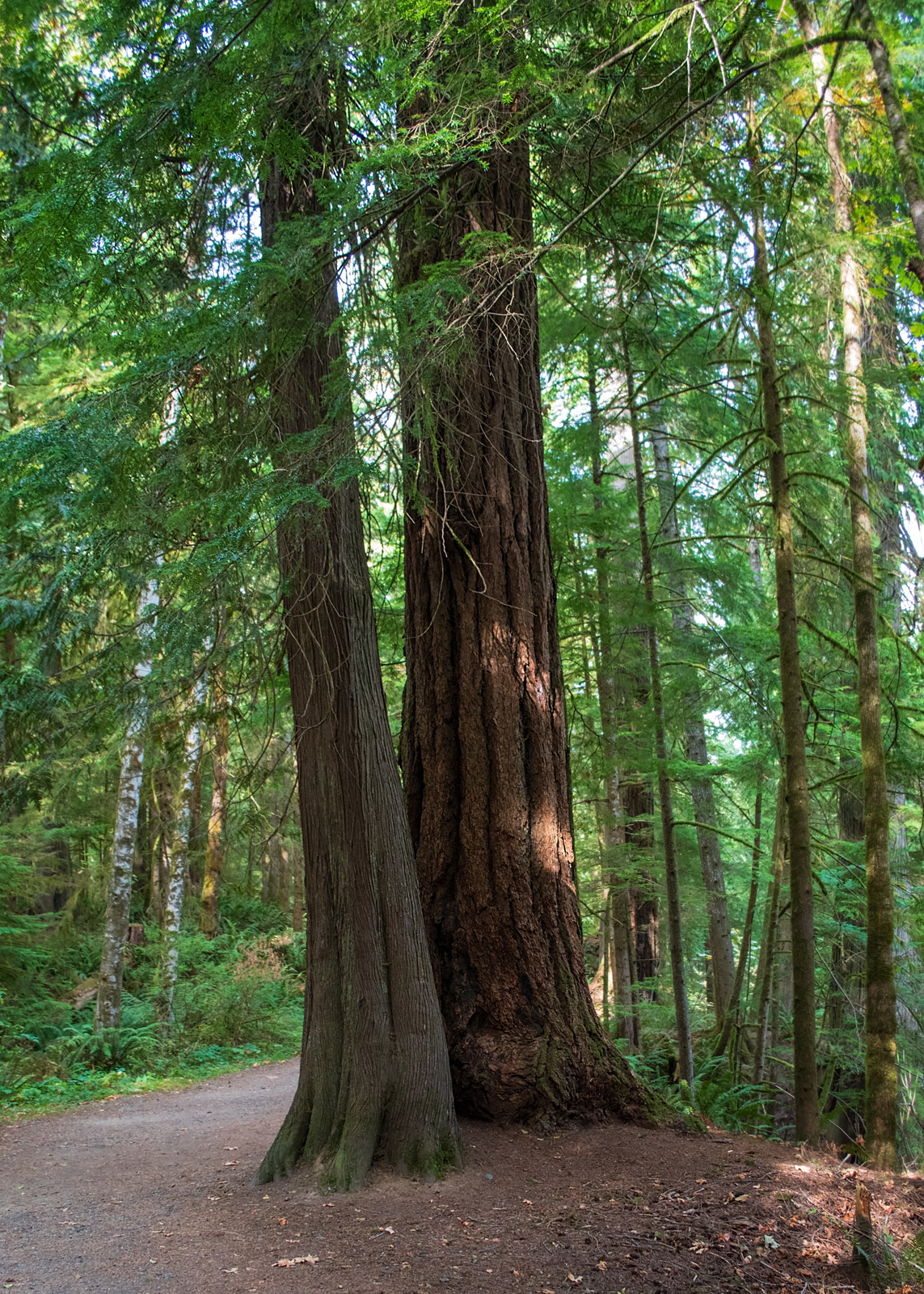
Companions. A Douglas fir and a cedar.

This is a mixed forest, home to "the only significant stand of old-growth Douglas Fir north of Macmillan Provincial Park [Cathedral Grove].” ... the “towering old growth Douglas Fir and Cedar trees” in the  3.5 kilometre Riverside and Old Growth Loop trails. (CortesCurrents) Some of these trees are hundreds of years old.

I've been examining the bark. Mature Douglas fir bark is thick, tough, and deeply grooved, resistant to fire, sometimes singed black. On some trees the grooves are deep enough for me to insert my whole hand.

Cedar bark is thin and fibrous, and forms long strips. First Nations peoples used the inner bark, which is soft and pliable, for clothing and woven baskets, for masks and ropes, even for fishing lines. (See The Story of Cedar, Powell River Museum.)

Cedar and Douglas fir bark.

Another cedar.

Gauti made a cut near the base of the tree that was about the width of his hand, peeled the bark up the tree as far as it could reach, and then tore it off. ... “It’s important that we do this sustainably. We only take one strip from it for the life of that tree, so that it will forever only have a minor wound to heal, instead of a huge wound that could kill the tree,” (Saanich News)

Kwaguʼł girl, wearing a cedar blanket and abalone earings. Public Domain photo, 1914.

Next, another old cedar.

~~~~~~~~~~~~~~~~~~~~
Les prometí unos árboles. Aquí vienen los primeros, vistos en el sendero por el bosque al lado del rio Campbell.

Fotos:
1: Compañeros. Un abeto de Douglas y un cedro rojo.

Este es un bosque mixto, donde se encuentra "el único grupo importante de abetos de Douglas antiguos al norte del Parque Provincial Maxmilian (Bosque Catedral)" ... los "antiguos y altísimos cedros y abetos de Douglas" a lo largo de los 3.5 km de los senderos al lado del rio" (Campbell) (Cortes Currents). Algunos de estos árboles datan de hace cientos de años.

He estado mirando las cortezas. La corteza de un abeto de Douglas maduro es grueso, fuerte, agrietado, resistente al fuego (a veces quemado pero todavía entero). En algunos de estos árboles, los surcos son tan grandes que puedo hundir la mano entera.

La corteza de cedro, en cambio, es fina, fibrosa, formando tiras largas. Las poblaciones indígenas usaban la corteza interior, suave y flexible, para hacer ropa, canastas, máscaras y lazos; inclusive para hacer sedal de pesca. (Véase The Story of Cedar, Powell River Museum.)

Foto #2: Esos dos árboles vistos de cerca.

#3: La corteza de otro cedro.

Gauti hizo un corte cerca de la base del árbol aproximadamente al tamaño de su palma, peló la corteza del árbol hasta donde pudo alcanzar, y la desprendió. ... Es importante que lo hacemos de manera sostenible. Le sacamos solamente una hilera durante la vida del árbol, para que siempre tenga solamente una herida leve para sanar, en vez de una herida que puede matarlo. (Saanich News)
Foto #4: Una muchacha Kwagu'ł, vistiendo una capa de cedro y aretes de abulón. Foto en dominio público, 1914.

Mañana, otro cedro antiguo.


Monday, December 20, 2021

Not so hot.

On a hot day in July ...

So says the sign beside the parking lot at Elk Falls. It seemed a bit out of context this week.

Campbell River Fire information sign.

Sign text: "On a hot day in July 1938, an ominous smoke pillar near Gosling Lake signalled a forest fire which was to ravage 115 square miles of logged and timbered land. Over 1500 firefighters battled grimly for weeks to save timber and communities. Costs and damages were enormous. Reforestation, intensified by the Forest Service, helped to heal the black scar. Province of British Columbia 1966"
Some fire damage is still visible on older trees farther down the slope towards the falls.

I walked down as far as the first bridge over the ditch where the old wood pipeline carried water from the dam upriver.

First bridge, with dog walker. And dogs.

Crossed the bridge and followed deep footprints up to the edge of the forest.

Looking back to the parking lot. The building just visible is the park information centre.

The footprints went on into the forest. I didn't.

~~~~~~~~~~~~~~~~~~~~~~~~~~

Fue un dia caluroso de julio ...

Así proclama un letrero al lado del estacionamiento de las cataratas Elk Falls. Esta semana parecía un poquito fuera de contexto.

Foto: el letrero, con la nieve apilada alrededor.

Texto del letrero: "Incendio de Campbell River. En un dia caluroso de julio de 1938, una columna de humo amenazadora cerca del lago Gosling señaló un incendio que iba a destrozar 115 millas cuadradas de bosque y areas ya cosechadas. Más de 1500 bomberos lucharon fuertemente por semanas para proteger los bosques y las comunidades. Los costos y los daños fueron enormes. La reforestación, con la asistencia del Servicio Forestal, ayudó a sanar la negra cicatriz. La Provincia de Colombia Británica, 1966"
Todavía se ve quemaduras en algunos de los árboles viejos en la bajada hacia las cataratas.

Yo seguí el sendero hasta el primer puente, que cruza la zanja donde antaño el conducto de madera llevaba el agua saliendo de la presa.

Segunda foto: el puente, con paseadora de perros. Y dos perritos.

Crucé el puente y subí el cerrito, siguiendo unos pasos bien hundidos en la nieve hasta el borde del bosque.

Tercera foto: mirando atrás, hacia el estacionamiento, y la casita de informes del parque.

Los pasos seguían para adentro del bosque. Yo no.


Monday, October 28, 2019

On the rocks

Water and rocks. A recent trip to Elk Falls:

The Campbell River leaves Lower Campbell Lake and winds down to the drop-off. At one time, all this rock was river bed, but the dam and hydroelectric project has diminished it considerably, leaving open rock suitable for exploring. Carefully.

Last pool before the cliff.

A sheer, single-drop fall. 27 metres.

View from the platform along the return trail.

Sunday, June 23, 2019

Between bee season and bear season

Bees come for the flowers. Bears come for the ripe berries. They'll be ready soon.

Thimbleberries, green, and just getting started.

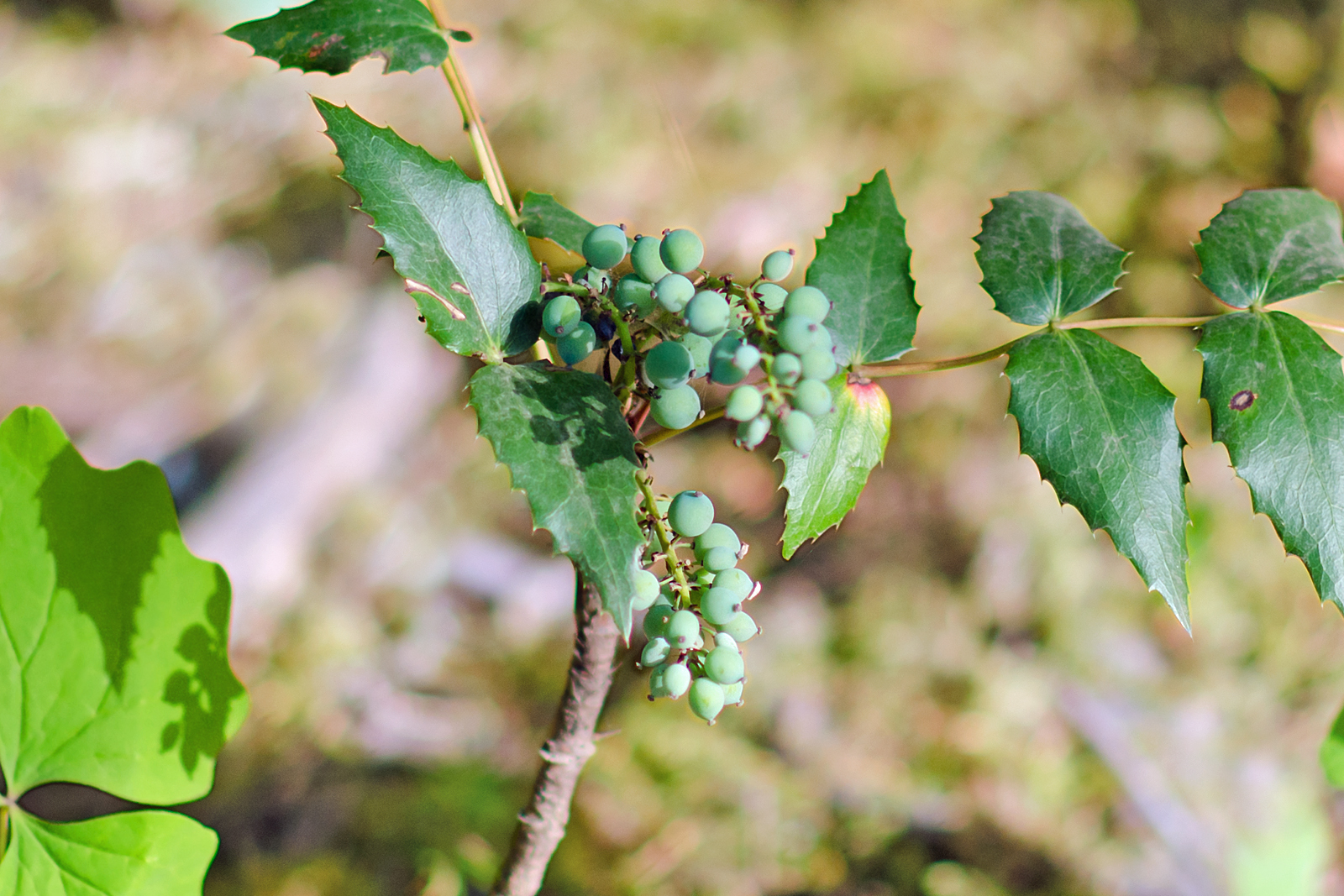
Oregon grape. The berries will be deep purple, and semi-sweet.

I haven't seen many salmonberry flowers this spring, and only one or two green berries. Many of the salal bushes are turning brown, and they have only a few flowers. It may be too hot and dry this year for these rainforest plants.

These two plants were on the side hill at Elk Falls. The whole area is brown and dry this year, the hillsides crumbling and dusty, the moss crunchy. We need rain!

Powered By Blogger