Showing posts with label logs. Show all posts

Wednesday, November 19, 2025

All wet

The Campbell River is a short one, as rivers go; barely 6 km. as the crow flies from where it drains out of John Hart lake to where it reaches salt water beside Baikie Island. From above the three falls (Moose, Deer, and Elk) starting at 150 m. above sea level,  it tumbles down a narrow gorge between rocky cliffs for half its length. Then the walls fall back and expose a small flat space, about 1/3 of a kilometre across, at around 11 m. above sea level. Here the main body of the river keeps rushing on down to the sea, but some of the water finds openings to the flats, and wanders in, gets lost among the hummocks and the fallen trees and up-turned roots. Some of the water keeps moving and rejoins the river downstream, some gives up and soaks into the mud.

It's always wet down there under the trees, even in mid-summer. At this time of year, after a few weeks of rain, there's not a dry twig to be found, not a dry stone to sit on. A couple of trails loop the area; I took the longer route the other day, since a good bit of the short loop was underwater.

So: watery pics.

A drenched log in the stream, with red-belted conks and fallen leaves. (See video below.)

Another soaked log, this one with a gull.

The deciduous leaves overhead are gone, but in the understory, salmonberry and thimbleberry shrubs are just starting to drop theirs. 

Old upturned roots make mini-islands in the streams. View of a bridge from a bridge on a second trail.

Near the inner edge of the flats, the land rises, leaves an open space for wetland grasses.

Even now, there's a hint of pink at the tops of the alders; catkins getting ready for spring. Here's where my trail went underwater.

The ferns will stay green all winter.

Even the mushrooms hold their tiny pools.

On the bank of a slow-moving stream.


~~~~~~~~~~~~

El Rio Campbell es corto, apenas logrando ser un rio; corre apenas 6 km., midiendo en linea recta, desde donde sale del lago John Hart hasta donde llega al agua salada pasando la isla Baikie. Desde arriba de las tres cataratas, (Moose, Deer, Elk) empezando a 150 m. sobre el nivel del mar, cae entre paredes rocosas por un desfiladero angosto por unos 3 km. Y luego, las paredes se abren, dejando un pequeño sitio aplanado, aproximadamente de 35 metros de largo, a los above sea level,  it tumbles down  metros sobre el nivel del mar. Aquí, mientras el rio mayor sigue su carrera hacia el mar, una parte del agua encuentra aperturas que le permiten entrar a la tierra baja; entra, se pierde entre las islitas y los árboles caídos, con sus raices al aire. Parte del agua sigue corriendo hasta unirse de nuevo al rio; pero buena parte se rinde y se integra al lodo.

Está siempre mojado allí bajo los árboles, aun a mediados del verano. En esta temporada, después de semanas con lluvia, no hay ni un palito seco, ni una hoja que no gotea, no se puede hallar ni una piedra donde sentarse a descansar por un rato. Hay senderos; dos rutas circulares. Yo tomé la ruta más larga el otro dia, pues parte de la via corta estaba inundada.

Fotos de agua y cosas empapadas, entonces.

  1. Un árbol caído en la corriente, con unos poliporos Fomitopsis mounceae, y hojas muertas.
  2. Otro tronco mojado, este con una gaviota.
  3. Las hojas de los árboles de hoja caduca ya yacen en el suelo, pero los arbustos nativos, salmonberry y thimbleberry (Rubus spectabilis y R. parviflorus) apenas empiezan a caer.
  4. Raices de los árboles caídos forman islitas en agua de poca profundidad. En el fondo, un puente, visto desde otro puente en otro sendero.
  5. En el extremo opuesto al rio, el terreno empieza a subir, dejando un espacio abierto, donde pueden crecer pastos de los humedales.
  6. Ahora, en noviembre, ya se ve un tinte color de rosa en la copa de los alisos rojos; las candelillas preparándose ya para la primavera.
  7. Los helechos son perennes; se mantendrán verdes todo el invierno.
  8. Hasta los hongos llevan sus charquitos de agua.
  9. En el borde del agua, con corriente lenta.
Y un video del tronco de la primera foto. Aguas agitadas.


Saturday, March 05, 2022

Shelter

Ma Nature gets an early start on the spring growing season; a crack in a log makes a good cold frame.

Moss and the earliest tiny flowers (Draba sp.?) Tyee Spit

A knothole works, too. Moss and Cladonia lichen, Oyster Bay

Mosses, already bearing sporophytes,

Moss, lichen, and sprouting plants with red leaves. Oyster Bay little wood.

~~~~~~~~~~~~~~~~~~~~~~~~~

Cuando, al finales del invierno, la madre Naturaleza quiere adelantarse a la primavera, un buen sitio para establecer su invernadero es en las grietas de un troncón viejo.

Fotos:

  1. Musgos y las primeras florecitas (parece que son Draba sp.) en campo abierto en Tyee Spit.
  2. Un nudo en la madera sirve muy bien. Líquenes Cladonia y musgos.
  3. Musgos que ya llevan sus esporofitos.
  4. Musgos, líquenes y brotes de una pequeña planta con hojas rojas. En el bosquecito de Oyster Bay.

Sunday, February 20, 2022

A small strip of forest

 I call it the "little wood". Which makes it sound bigger than it is.

From the 1920s to somewhere in the '50s, the area around Oyster Bay was a logging camp, with eventually over 100 workers' cabins, heavy equipment, and mud, mud, mud. The original forest was wiped out. In the decades since, after the loggers moved out, Scotch broom moved in and completely covered the area.

Since the site was declared a protected park, back in 1996, the broom has been removed (mostly; I saw a few new shoots last week.) The area now consists of the bay with its breakwater, shore birds and ducks and purple martin houses, a long beach on the "outside", gravelly and sandy, then the line of thousands of logs, the sand beyond, and the trail to the rest area. Between the bay and the rest area, there's the dike and the meadow where protected plants thrive. A great mix of habitats in a short walk!

And there's the "little wood"; just a strip of trees and shrubs that somehow survived all that history. A narrow strip, but full of life; here on every visit I find new marvels: mushrooms and lichens, mosses and slime mold, spiders and sowbugs, bees and caterpillars, a mix of native shrubs and trees, deciduous and evergreen.

Google maps image.

A mix of Douglas fir, deciduous trees and shrubs, rotting, moss-covered logs.

Random shot of the ground. Cottonwood leaves, fir needles and cones (two species), moss and Cladonia lichen, fresh evergreen twigs, old wood, grasses and new spring plants.

"Knobby" tree. I have to wait for new leaves to identify it.

Old log with moss and reindeer lichen.

At the edge of the wood, a log laughs in the sunlight.

~~~~~~~~~~~~~~~~~~~~~~~~~~~~
Yo lo llamo el "bosquecito". Lo que lo hace parecer más grande de lo que es en realidad.

Desde la década de los 1920 hasta los '50, el area alrededor de Oyster Bay era un centro de industria maderera, donde en un tiempo existían mas de cien casitas para obreros, gran cantidad de maquinaria pesada, y lodo. Mucho lodo. El bosque original desapareció. Después de que la industria dejó el sitio, fue invadido por la planta invasora retama negra, que lo cubrió totalmente.

En el año de 1996, el sitio se declaró un parque protegido, y voluntarios eliminaron la retama. (No totalmente; vi unos brotes la semana pasada.) El area ahora consiste en la bahía con su rompeolas, sus aves costeras, patos, y las casitas para golondrinas purpúreas; una playa a lo largo del "exterior", con piedritas o arena; luego los miles de troncones, después un tramo con más arena, y el camino que lleva a la zona de descanso. Entre este y la bahía, está el dique y el prado donde crecen plantas protegidas. ¡Una buena mezcla de habitats en un paseo corto!

Y ahí está el bosquecito; apenas unos pocos árboles y arbustos que de alguna manera sobrevivieron toda esa historia. Un tramo angosto, pero lleno de vida; en cada visita descubro nuevas maravillas. Hongos y líquenes, musgos y moho mucilaginoso, arañas y cochinillas, abejas y orugas, una mezcla de arbustos y árboles indígenos, tanto de hoja caduca como perenne.

Fotos:

  1. Mapa de Google.
  2. En el bosque. Abeto de Douglas, árboles y arbustos caducifolios, y troncones bien podridos, cubiertos de musgo.
  3. Una vista al azahar del suelo: hojas de álamo, hojas y conos de abeto (dos especies), musgo y liquen Cladonia, ramitas frescas de abeto, y madera podrida, pasto y los nuevos brotes de la primavera.
  4. Este árbol no lo podré identificar hasta que salgan las hojas.
  5. Un troncón viejo con musgos y liquen de los renos.
  6. Al borde del bosquecito, un troncón sonrie en los rayos del sol.

Saturday, February 19, 2022

One new tree

 More logs along the shore:

And a new tree.

Crumbling tide-thrown logs hold down the sand, gradually disintegrating to form new soil, creating habitat for salt-tolerant plants, then grasses, and eventually for pioneer trees. Which will, in time, become tide-wandering logs ...

~~~~~~~~~~~~~~~~~~~~~~~~~~~~~~~
Troncones dejados por la marea detienen la arean, y poco a poco se desmoronan, formando un nuevo suelo donde pueden crecer plantas halófilas, y más tarde, los pastos, abriendo paso para los árboles pioneros. Los cuales, con el tiempo, llegarán a ser troncones llevados por la marea. 


Wednesday, February 16, 2022

Organic breakwater

Hundreds of logs. Thousands. They lie beached between usual high tide line and the most extreme highs, wherever the land slopes gradually down to the water. Some newly arrived, most old-timers, crumbling over the years into woody pulp. These hold down the sand along the Oyster Bay shore near sundown.

And my shadow, as I sat on another log.

~~~~~~~~~~~~~~~~~~~
Cientos, miles de troncos viejos. Descansan en la arena entre el nivel superior acostumbrado de la marea y donde llegan las más fuertes tempestades, en dondequiera el terreno baja en declive gradual hacia el mar. Algunos son nuevos; la mayoría tienen años aquí, desintegrándose lentamente hasta formar una masa rojiza. En la foto, cubren y detienen la arena a lo largo de la bahía Oyster cerca de la puesta del sol.


Thursday, November 11, 2021

On old wood

Mushrooms on logs. Mushrooms beside logs. Mushrooms deep inside logs. It pays to peer down cracks.

These are from old logs on Tyee Spit.

Shapeless orange fungus squeezed out through cracks in a rotting log. 

At the bottom of a deep, narrow crack in a log, a mushroom and lichens avoid the cold wind up top.

Another log, still solid on the outside, shredded inside, with mushrooms.

And on wood chips between the logs along the shore.

~~~~~~~~~~~~~~~~~~~~~~~~~~~~

Hay hongos que crecen encima de troncos viejos. O al lado de los troncos. O dentro de los troncos, bien escondidos adentro. Vale la pena examinar las grietas con cuidado.

Estos hongos crecen en troncos viejos en la lengua de tierra Tyee.

  1. Brotan desde adentro, saliendo en masas sin forma precisa.
  2. Casi en el mero centro del tronco, un hongo y líquenes aprovechan la protección de los vientos.
  3. La madera exterior del tronco sigue sólido y seco, pero en el interior está hecha pedazos; allí crecen honguitos cafés.
  4. Y entre los troncos que bordean la costa, brotan honguitos anaranjados.

Monday, February 15, 2021

Staying warm

When the wind is chilly and the nights are long, overwintering plants (and lichens) like a cosy container garden.

Practice chain-saw cuts hold in the heat.

Moss and cladonia lichen in the heartwood.

Cladonia lichen over a bed of moss.

The tinies, just getting started. Moss, lichen, kinnikinnick.

Oyster Bay woods, last week. Now they're all even cozier, under a blanket of snow.

~~~~~~~~~~~~~~~~~~~~~~~~~~~
Cuando el viento es frío y las noches largas, plantas y líquenes pasando el invierno al aire libre están felices en sus jardincitos en contenedores, estos al natural.

Musgos y líquenes cladonia, con unas hojas de kinnikinnick, protegidos dentro de troncos viejos en el bosquecito de Oyster Bay, la semana pasada. Hoy, están aun más contentos y calientitos, bajo una cobija de nieve.


Wednesday, November 18, 2020

Slow carvings

Water, weather, and worms shape old wood. I wonder what combination did this?

Log on the dunes. With a bit of lichen.

This one has been sitting out in the rain for years. But the worms got it first.

(Except that they're not worms: they're teredo clams.)
 

I'm still working on those 1950s photos. It's slow going.)


~~~~~~~~~~~~~


Entre el agua, el clima, y los bichos, se las arreglan para hacer esculturas de troncos viejos.

Tuesday, February 18, 2020

Log jam pond

Google maps are sometimes amazing.

At one end of the Campbell Lake, there's a side channel that gets lost in a clump of islands and dead ends. There's probably an old creek flowing in here; the river itself leaves the lake from another channel. The highway winds through the hills and valleys along the lake shores, and here cuts off a narrow neck of the lake, leaving only a small drainage culvert under the road. Years ago, a pile of logs were dumped into the upper end, floated down to the culvert, and were stuck. They're still there.

I stop sometimes, to look at the logs. Last week I stopped again. The lake end was frozen, with a light coating of snow on top, and on the logs at the surface.

Cross-hatching

I looked up the lake end on Google maps. The logs can be seen from the overhead view.

The lake ends at the right, at a gravel pit. The lower left channel leads out to the main body of water.

And from the street view, taken in September of 2011, nine years ago, some of the same logs are recognizable.

Even to the weeds growing on the one center front.

They were old, even then.

~~~~~~~~~~~~~

A veces se ven cosas sorprendentes en las mapas de Google.

En un extremo del Lago Campbell, el lago hace una diversión que se pierde entre varias islitas. Parece que aquí entra un riachuelo; el río sale por otro canal. La carretera sigue las costas de los lagos, y aquí hace puente sobre una brecha angosta, dejando solo una apertura pequeña para la salida del agua. Hace años, se tumbaron troncos al agua, flotaron hasta la carretera, y allí se atoraron. Todavía están allí.

De vez en cuando, al pasar, me paro para mirar los troncos. La semana pasada, el agua estaba cubierta de hielo, con unos cuantos centímetros de nieve encima del hielo y de los troncos flotantes.

Busqué el sitio en las mapas Google; se ven los troncos en la vista aérea. Y desde la calle, en su foto tomada en septiembre de 2011, hace nueve años, algunos de esos troncos se pueden reconocer. Son los mismos de hoy; aún algunos de los arbustos que crecen encima de uno que otro tronco se pueden ver.

Quien sabe cuantos años han esperado aquí estos troncos; en 2011 ya eran viejos.

Thursday, May 16, 2019

Dune walk

Along the dunes at Oyster Bay. Mostly sandy, with logs piled higgledy-piggledy from the high tide line to the forest; grassy, prickly with the seed heads of big-headed carex, dusted with lichens, anchored with tall grasses and assorted salt-tolerant shrubbery; home to garter snakes, grasshoppers, butterflies, and little twittering birds.

Photos in no particular order.

Typical mix. I'm not sure what the shrub is. There are orange fungi on the end of the farthest log out on the left and on the front log on the far right.

Silver burweed, Ambrosia chamissonis, just starting out. By mid-summer they will cover most of the bay end of the dunes.

Trails in the sand.

These trails were everywhere on the bay end of the dunes, well above the high tide line, in dry sand. There were no snail trails below the high tide line; these aren't made by sea snails, nor crabs, nor hermits. They're too irregular to be garter snake trails. If they're made by land snails, it's odd; the trails end abruptly, as if the snail picked up her skirts and tiptoed away. I've seen no live snails in this end of the dunes.

Any ideas?

One of the many grasses. A brome, I think.

Baked tree root.

Thursday, January 10, 2019

Black

Burnt logs on the shore

Leftovers from a forest fire? Or from someone's huge beach bonfire?

Saturday, November 24, 2018

Shoreline logs

Stopping to look at the logs I usually try to climb over or thread my way through, on my way up or down to the shore:

Wet and slippery and all jumbled together. I doubt that that little yellow rope does anything to hold the log down; more likely the reverse.

On a wider stretch of beach, an old stump shows off its roots. It took a very high tide to strand this one.

Detail of a soaking wet log.

Friday, November 23, 2018

Unbeatable

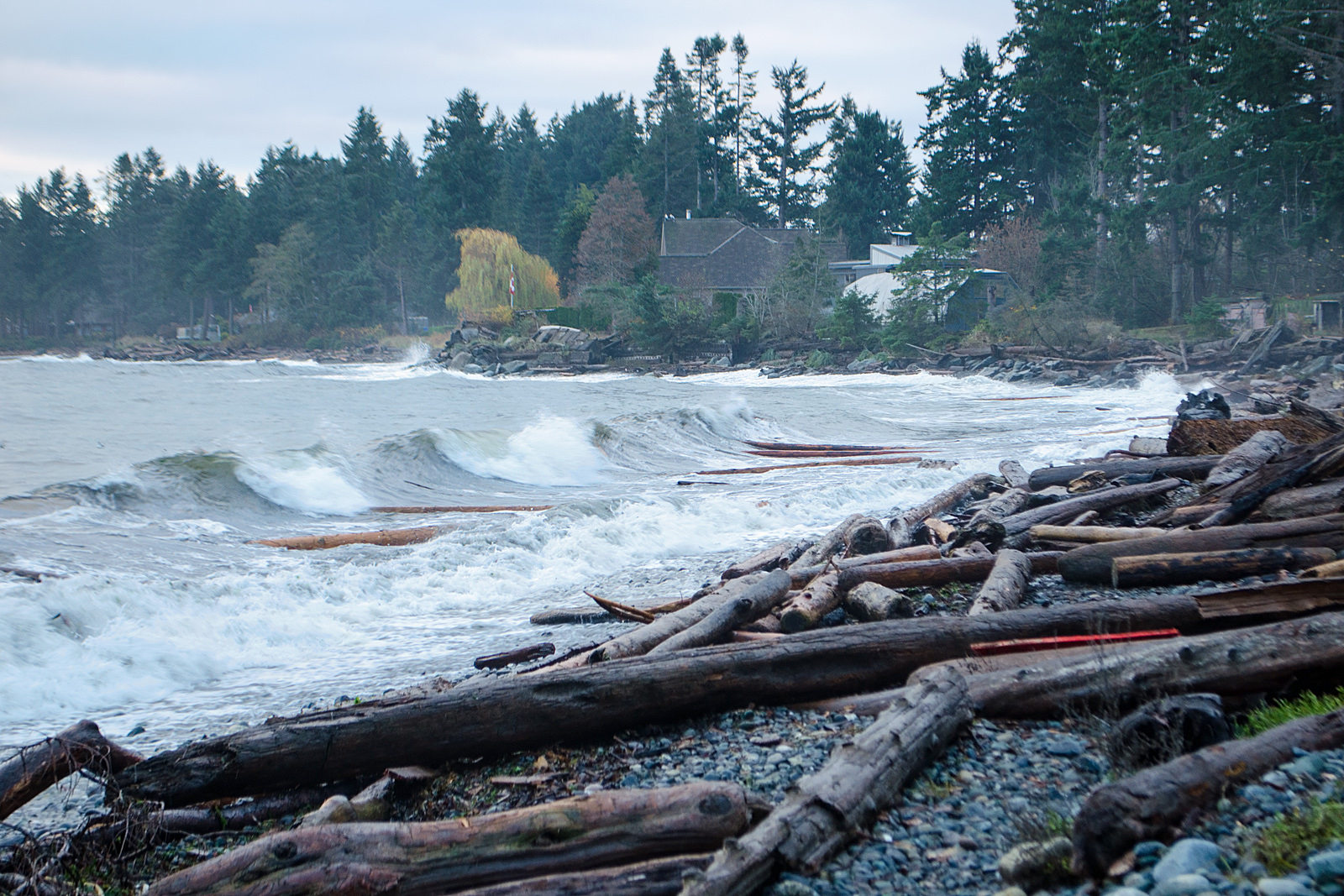
The waves were strong and relentless. Along the shoreline, they were picking up logs and hauling them out to sea, only to toss them back on the rocks with the next roller, like so many sticks from a game of pick-up-sticks.

Five logs on the way out.

With each wave, the stones on the beach rattled and rumbled, rolling down, being thrown back up. An unexpectedly high wave pulled the stones out from under my feet, tossing me back on my tail end in the wet. It was lucky for me that the stones felt soft, as they slid loosely in the surf. I was not hurt, much.

And coming back in.

And yet ... and yet ... Among the rolling stones, I find fragile pieces of shell, sea critters, even spider webs, holding their own against the pounding waves.

Molted carapace of a small kelp crab.

Soft sponge

So fragile! A piece of hydrocoral, tangled with seaweeds. Found half-buried in rolling stones.

Molted piece of crab belly plate.

And last, above the reach of the waves at the moment, but still within their spray zone, an old stump, torn and battered, and sheltering, among other things, a community of spiders.

These shells and stone were at my elbow height above the beach, and above the high tide line. Somehow they've been tossed up here, out of the reach of most waves. And if you look closely, there are at least two spider webs tying the stump together. I'm not sure, but I think there's a greyish spider in the centre of the main one. Do you see it?

I returned and saw under the sun, that the race is not to the swift, nor the battle to the strong, ... ; but time and chance happeneth to them all. Ecclesiastes 9:11, KJV (just because I like the KJV language.)


Powered By Blogger