Showing posts with label spring buds. Show all posts

Wednesday, March 29, 2023

Finally!

She's a quick change artist: here are two photos, 3 days apart:

Last Sunday, Ma Nature was still wearing her winter outfit.

Bare branches.

And today, she's all decked out in yellow-green sequins.

New leaves, like green fairy lights.

~~~~~~~~~~~~
Un cambio rápido. Hace tres dias, los árboles llevaban las ramas desnudas, aparentemente muertas, sin color. Hoy, estrenan hojitas nuevas, luminosas.

Ya era hora.


Monday, May 16, 2022

Curly

The most commonly-seen ferns in our local forests are the evergreen sword ferns, and the bracken ferns, which die down in the fall and sprout again in the spring from their rhizomes underground. Maybe a better word for it is "unroll". The first to appear is a tight coil at the tip of the growing stalk. I posted photos of the coils of the evergreen ferns a while ago.

These are the growing tips of the deciduous bracken fern, Pteridium aquilinum:
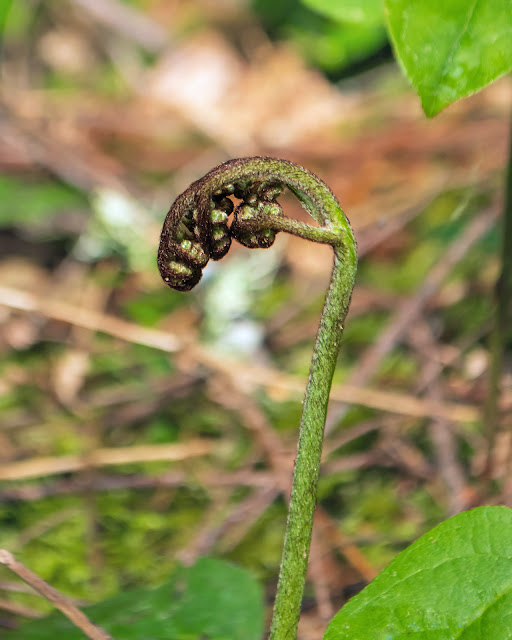
New tip. Covered with dark reddish hairs. These will remain on the underside of the mature leaves.

The varieties most common in BC belong to the subspecies Pteridium aquilinum ssp. lanuginosum. Translating that: Pteris, from the Greek, means fern or feathery; aquilinum, "like an eagle" (maybe because of its wing-like structure when full grown); lanuginosum, "hairy".
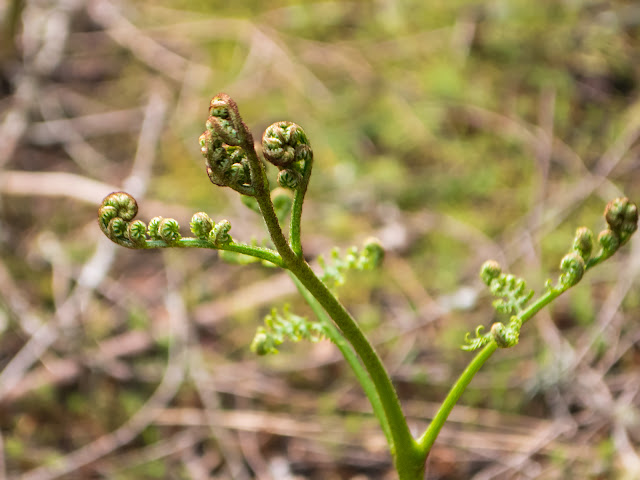
And each new branch and each new leaf unrolls from its own tight coil.

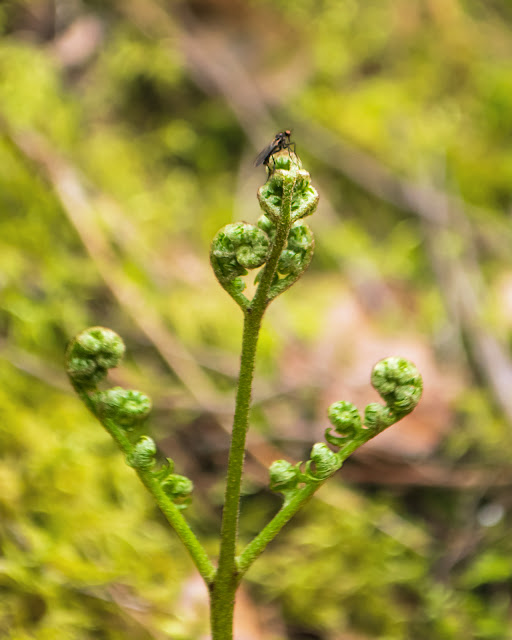
Another, with a red-eyed fly as a topper.

The First Nations peoples, up and down the coast, cooked and ate the rhizomes. And the fresh, still tightly-rolled tips are a spring delicacy. Mom harvested them and served them boiled, as a green vegetable, very welcome after a winter eating canned veggies. I learned to eat the tips raw; they have a delicious, nutty flavour.

Everything in moderation. Bracken fern is toxic to many animals, and contains a toxin, ptalquiloside, a carcinogen. (But what isn't?) However it is largely destroyed by cooking.

What this means is that a very normal cooking process for fiddleheads—blanching in salty water, then shocking in ice water, then sauteeing—renders the fiddlehead close to harmless. (The Atlantic)
And then, it is habitual eating that seems to cause the problem. My once or twice a year nibble on fern tips, even raw, is safe enough.

~~~~~~~~~~~~~~~~~~~~~~~~~~~~~~
Los helechos más comunes en nuestros bosques son los helechos perennes, Polystichum munitum, y el helecho deciduo, helecho águila, Pteridium aquilinum. Estos últimos desaparecen en el otoño y saltan desde sus rizomas en la primavera. O mejor dicho, se desenrollan. Lo primero que sale es un espiral bien enroscado, el cual, al crecer, da raiz al tallo. Subí fotos de las roscas del helecho perenne, hace poco.

Las que siguen son fotos de las rosquitas del helecho águila.

Al principio, están cubiertos de pelos rojizos; al abrirse, este pelaje se situará en la parte inferior de las hojas.

Las variedades más comunes en Colombia Británica son las Pteridium aquilinum ssp. lanuginosum. Traduciendo eso, tenemos: Pteris, del Griego,  "helecho" o "plumoso"; aquilinum, "águila", tal vez referiendo la forma, como una ala, de las hojas; y lanuginosum, "peludo".

Las naciones indígenas en nuestras costas, comían las rizomas, resecadas y tostadas. Y las puntas de los brotes nuevos, todavía bien enrolladas, son una delicia de la primavera. Mi mamá las cosechaba y las servía hervidas como una verdura, muy apreciada después del invierno, estación en la cual, en esos tiempos, estábamos limitados a comer verduras enlatadas. Yo aprendí a comer las puntas crudas, tal como las encontraba; tienen un sabor delicioso a nueces.

Todo con medida. El helecho águila resulta tóxico para muchos animales, y contiene una toxina, ptalquilosida, que es un carcinógeno. (Pero en estos dias, ¿qué cosa no lo es?) Sin embargo, la toxina se destruye, en gran parte, con el proceso de cocinar.

"Lo que esto significa es que un proceso normal de cocinar para los "fiddleheads" (puntas enroscadas de los helechos) — escaldado en aqua salada, imersión en agua helada, y luego sofriéndolas — deja el "fiddlehead" casi inocuo. (The Atlantic)

Y al fin de cuentas, parece que es el comerlos habitualmente lo que causa el problema. Mis bocadillos primaverales, saboreados una o dos veces por año, aun en crudo, no trae peligro.

Friday, March 18, 2022

Burnt stump, early spring

 A burnt stump on a hillside, logged off a few years back, hosts salal, huckleberry, and lichens. Doing its bit to restore the lost forest.

The red branches are huckleberry, just ready to bud out. And on the ground, last year's bracken ferns shelter the new buds due to spring up this month from their rhizomes.

~~~~~~~~~~~~~~~~~~~~~~~~
Un tronco quemado en un sitio cosechado por los madereros hace pocos años, sirve como base y nutrientes para nuevas plantas de "salal", Gaultheria shallon; el nativo arándano rojo, Vaccinium parvifolium; y líquenes Cladonia, haciendo su parte en la restauración del bosque.

Las ramas rojas son del "huckleberry", el arándano rojo; están a punto de brotar las primeras hojas. Y el suelo está cubierto de helechos deciduos del año pasado; se mueren con las primeras heladas pero siguen en sitio protegiéndo a los nuevos brotes, que aparecerán este mes, brotando desde los rizomas.


Saturday, March 05, 2022

Shelter

Ma Nature gets an early start on the spring growing season; a crack in a log makes a good cold frame.

Moss and the earliest tiny flowers (Draba sp.?) Tyee Spit

A knothole works, too. Moss and Cladonia lichen, Oyster Bay

Mosses, already bearing sporophytes,

Moss, lichen, and sprouting plants with red leaves. Oyster Bay little wood.

~~~~~~~~~~~~~~~~~~~~~~~~~

Cuando, al finales del invierno, la madre Naturaleza quiere adelantarse a la primavera, un buen sitio para establecer su invernadero es en las grietas de un troncón viejo.

Fotos:

  1. Musgos y las primeras florecitas (parece que son Draba sp.) en campo abierto en Tyee Spit.
  2. Un nudo en la madera sirve muy bien. Líquenes Cladonia y musgos.
  3. Musgos que ya llevan sus esporofitos.
  4. Musgos, líquenes y brotes de una pequeña planta con hojas rojas. En el bosquecito de Oyster Bay.

Tuesday, January 26, 2021

Mostly snow

 The small things, seen from the trail from Elk Falls, in and under new snow.

Sapling in snow

Stub under snow.

Oregon grape under snow.

Baby evergreen in its snowy shelter.

Hanging snow. Note the red leaf buds.

Mushroom with a snow cap.

Fence post with its snow cap.

Without commentary.

~~~~~~~~~~~~~~~~~
Las cosas pequeñas, bajo la nueva nieve, vistas desde el sendero subiendo de las cataratas.

Sin comentario.


Tuesday, May 07, 2019

Spring decor on the dunes

Most of the year, our Douglas firs are dressed in sober greens, dark and mysterious under the grey skies. But come spring, the youngsters deck themselves out in bright yellowy greens and orange paper decorations.

Young Douglas-fir, Oyster Bay dunes. The new buds grow at the tips of every branch, and before they open, they're gift wrapped.

New tips at the top of the tree, with the remains of the papery orange wrapping.

Another tree, another batch of buds, and a beetle just spreading his elytra, preparing to fly away. The wings underneath are transparent.

Sunday, March 24, 2019

Looking up, looking down, looking across

Views from the Ridge Trail.

From a point where the trail came to the edge of the ridge, looking down at the river below.

Looking up. Crown shyness in evergreens.

Crown shyness ... is a phenomenon observed in some tree species, in which the crowns of fully stocked trees do not touch each other, forming a canopy with channel-like gaps....The phenomenon is most prevalent among trees of the same species, but also occurs between trees of different species. (Wikipedia)

'Way up top; pinkish buds. Yay, spring!

Power line and mainland mountains.

At one point, this power line crosses the trail. It goes from the John Hart generating station down on the river, and leads to the Duncan Bay on the coast, 3 km. away. Since there are only low-lying islands between this spot and the mainland, there is a clear view to distant snow-capped peaks.

Area map. The small one on centre left shows the direction of the cut. The line ends in Ts'y-los Provincial Park.


Thursday, January 24, 2019

Huckleberry spider

Our red huckleberry, common in our deep rainforests, is evergreen, after a fashion. It sheds its leaves in the fall, like the rest of the deciduous plants, but the stems and branches stay bright green all winter. And now, with the warm winter that we're having, they are deciding it's spring already, and sending out bright pink buds.

Huckleberry shrub, Canyonview trail

Zooming in to see the pink buds.

Moving around the bush, looking to find a less busy background, I almost put my nose through a spider's web.

Long-legged trapper.

I haven't seen many spiders, or insects, either this winter, although I've been searching for them, so I was glad to see a spider, and I hope she's had better luck with insects than I have.

Blurry; she's noticed me, and is pretending to be a bit of twig or dry pine needle twisting in the wind.

And maybe it will be safer over here on the branch.

I had frightened her, so I backed off and went my way. At least I hadn't broken her web.


Powered By Blogger