Showing posts with label mushroom. Show all posts

Monday, January 19, 2026

Soggy lifer

Another mushroom lifer.

The sign at the bottom of the hill called it the watershed for the Race Point community. It was shedding water, certainly; the path going up the hill was first muddy, then wet, then under an inch of running water. And everything above ground was dripping, although it had been well over a day since it stopped raining.

I stepped over an alder that had fallen across the trail, splashed into deeper water, turned to go back, and realized that what I had thought were more soggy leaves were really mushrooms in the moss on the log. Leaf-shaped mushrooms.

The alder log, with some of its mushrooms.

All wet.

The underside of another one. Widely-spaced gills.

Before I found this mushroom broken off, I tried to turn one of the first ones over; it felt soft, slippery, flexible; sort of like the finger jelly you make for kids with twice the gelatin of regular jelly. And as tough as that jelly, or as soft rubber. It bent easily, but didn't break, and as soon as I let go of it, it sprung back into its original shape.

I found a couple fallen on the ground, broken off, maybe when the tree came down, or maybe there has been a visit by some mushroom-loving animal. Not a slug, though; of all the ones I looked at, not one had slug bites. (Unusual among local mushrooms.)

They have deep gills, splitting into double gills near the wavy edges. And barely a hint of a stalk, attached at one side. I tried to smell one; green scents, a smell of mud, of evergreens, no mushroom scent at all.

One of the broken ones, as found among rotting leaves.

This one has a hint of speckly stalk.

An image search gave me conflicting identifications. I've posted photos to iNaturalist and to a Mushroom Identification page on Facebook, but haven't heard back yet. I'm inclined to think they may be the Rosy Oysterling, Scytinotus longinquus. Or maybe not.

UPDATE: I've been told it's Sarcomyxa serotina, the Late Oyster.

~~~~~~~~~~~~~~~~

Otro hongo que nunca he visto antes.

El letrero al pie del cerrito lo llamaba el acuífero para la comunidad de Race Point. Y por cierto tenía bastate agua; el camino que subía al bosque al principio estaba lodoso, luego mojado, luego cubierto de centímetros de agua corriente. Y todo el bosque goteaba, aunque ya llevaba más de un dia desde que dejó de llover.

Salté un aliso que había caído cruzando el camino, y me encontré en agua más profunda; di vuelta para regresar y me di cuenta de que lo que parecía más hojas empapadas en realidad eran hongos que crecían entre el musgo en el tronco del aliso. Hongos con forma de hoja.

    1. El tronco del aliso rojo, con algunos de los hongos.

    2. Hongo bien mojado.

    3. Un hongo boca arriba, con laminillas separadas.

Antes de encontrar este hongo roto, traté de doblar uno de los primeros para ver las laminillas. Se sentía suave, resbaloso, flexible; algo así como la gelatina "para comer con los dedos" que haces para los  niños, usando el doble de gelatina que en la receta normal. Y tan resistente como esa gelatina, o como hule suave. Se doblaba facilmente, pero al soltarlo, regresaba instantáneamente a su forma original, sin romperse.

Encontré dos en el suelo; rotos tal vez al caer el árbol, o quizás algún animal ha estado de visita. No era una babosa. De todos los hongos que examiné, ni uno solo tenía mordidas de babosa. (Algo inusitado en los hongos locales.)

Tienen laminillas profundas, que se dividen en dos cerca del borde del hongo. Y casi no tienen tallo, que se adhiere a un lado, no en el centro. Traté de oler uno; distinguí aromas verdes, el olor de lodo, de árboles coníferos; nada de olor a hongo.

    4. Uno de los hongos separados de su base, como lo encontré entre hojas podridas.

    5. Este tiene un poco de tallo.

Una búsqueda por imagen me dió varias posibilidades de géneros, sin poder saber cual era más acertada. He subido las fotos a iNaturalist y a una página en Facebook dedicada a la identificación de hongos de la isla, pero sin respuesta hasta el momento. Se me ocurre que estos pueden ser Scytinotus longinquus. O tal vez no.

Me corrigieron: es Sarcomyxa serotina.


Monday, March 04, 2024

Mostly green

I've been unable to post for over a week. Now where was I? Oh, yes; looking at mushrooms and lichens. And some rocks.

These are the last of the small finds on that hillside of mossy rock, sorted by age; fresh and new, old, ancient. 

A very tiny mushroom, with moss, old Douglas-fir needles, and a bit of ice.

Leaf lichen and dry twig, both bleached almost white.

Lichen, by the time we notice it, is always old, having grown so slowly, a few millimetres a year.

Ancient, coming to us from the time of bouncing mountains: green veins in the rock, squeezed out like when I fix a broken pot and put on too much of the glue.

Pale pistachio green rock ooze. They tell me it's epidote.

Another vein, and some sprinkles.

And tomorrow, if all goes well, I can move on to the Deer Falls side hills.

~~~~~~~~~~~~~~~

Hace más de una semana que no he podido hacer un post. Y ahora, ¿dónde estaba? Ah, sí; mirando hongos y líquenes. Y unas rocas.

Estas son las últimas de las fotos que saqué en esas rocas envueltas en musgo. Las he organizado según la edad; algo fresco, algo viejo, y lo viejísimo.

  1. Un hongo muy pequeño, con musgos, hojas de abeto de Douglas, y cristales de hielo.
  2. Una rama rota, muy seca, con sus líquenes foliosos, todo blanqueado hasta volverse casi blanco. Los líquenes, crecidos hasta llamarnos la atención, siempre son viejos, ya que crecen tan despacio, al son de uno milímetros por año.
  3. Y viejísimo, ya que nos llega desde la juventud de las montañas; venas de roca verde, exprimida de entre la piedra mayor mientras se enfriaba.
  4. Otra vena, y gotitas.
Siguiente: otro cerro, éste cerca de las cataratas Deer.

Saturday, December 16, 2023

On a wet forest floor

 I almost missed this mushroom in the dark of the woods on a grey afternoon. I only saw it because I was bent over collecting fallen fir boughs to make a little Christmas "tree" for my cat; she does so enjoy redecorating them!

Bubbly, about 7 cm. across the cap.

The stalk is covered in a greenish slime, and some drips off the cap, too. It was wet to the touch, but so was everything else that afternoon.

As usual, I can't identify this one.

~~~~~~~~~~~~~~
Casi se me escapó este hongo, apenas lo vi en el bosque oscuro en una tarde gris porque andaba recogiendo ramas caídas de abeto para hacerle un "arbolito" de Navidad para mi gatita; le encantan.

Foto: el hongo. Mide unos 7 cm. El estípite está cubierto con una baba gelatinosa, y también gotea desde el sombrero.

Tampoco puedo identificar este hongo.


Sunday, November 19, 2023

One last 'shroom. Or not.

The last of the mushrooms. Well, not quite; I went out today to look at birds, and came home with more 'shroom photos. Call this the last of the "bigger than a fingernail" mushrooms.

The gills show through the skin on the top.

And a brown, mottled stem.

The stems around them give the size; a stem is about 1 cm. across. These mushrooms turned black as they aged. Unidentified, of course.

And now, to start processing the unexpected tinies.

~~~~~~~~~~~~~~
Este es el último de los hongos. O por lo menos, así creí. Y hoy salí a buscar pájaros y vi más hongos. Mejor, se puede decir que éste es el último de los hongos de tamaño más grande que la uña de mi dedo meñique.

Fotos: un hongo pequeño, alrededor de 4cm de diámetro. Se le ven las laminillas através de la capa superior del sombrero. Este hongo se puso negro al envejecer. No lo he podido identificar.

Y ahora; a procesar las fotos de los hongos miniaturos.


Saturday, November 12, 2022

Things that make me happy

 My photo files keep filling up with one-offs; photos I will use "later". I try to organize them, but end up with too many categories, each with one or two photos in the folder. Looking at the mess today, I came up with a general label for the whole shebang: Things that Make Me Happy. And then it all made sense.

So here is a first installment from that file, in no particular order.

Cornus kousa.

Behind the museum, I found this tree. The ground was covered with fallen fruit; a few remained here on the branches. One of the dogwoods, probably Kousa dogwood.

Frozen sponge, Oyster Bay.

Lichen-covered trees. Alongside the Campbell River.

Mango tree.

I read that you could get mango pits to sprout, and I tried it out. These are the first ones that grew. The new leaves are pink, but turn green later on.

Pinkish mushroom, in the museum lawn.

Mountain ash bark.

A blue-eyed amphipod in my tank.

Tomorrow, another batch.

~~~~~~~~~~~~~~~~~~~~~~~~~
Mi archivo de fotos está lleno de fotos solitarias, fotos que voy a usar "más tarde, algún dia". Y las trato de organizar, pero caen en tantas distintas categorías que al fin tengo docenas de carpetas, cada una con una o dos fotos. Viéndolas otra vez hoy, se me ocurrió un título que se puede aplicar a todas: Cosas que me hacen feliz. Y con eso, se dice todo.

Pues aquí viene la primera parte de las fotos de la carpeta "Cosas que me hacen feliz", escogidas al azar.
  1. Atrás del museo encontré este árbol. El suelo estaba cubierto de estas frutitasEs bien machucadas pero algunas quedaban entre las ramas. Es un árbol de cornejo, probablemente Cornus kousa.
  2. Esponja congelada, uno de nuestros invertebrados intramareales, depositado en la playa por las olas.
  3. Árboles cubiertos de líquenes, al lado del rio.
  4. Un mango. Había leído que se pueden cultivar en casa, e hice la prueba. Estos son los primeros brotes. Las hojas nuevas son color de rosa, pero pronto se vuelven verdes.
  5. Un honguito color de rosa, en el césped del museo.
  6. La corteza de un árbol "ceniza de montaña", Sorbus spp.
  7. Un anfípodo con ojos azules en mi acuario.
Más, mañana.


Wednesday, May 04, 2022

Green blankets

I love moss. Good thing, because in our wet climate, it coats everything in our forests and fields, and even our towns: rocks, trees, old logs, stumps and up-turned roots, shady hillsides, old lumber, cement barriers, abandoned vehicles, roofs, wet lawns, and little-travelled roadways. These three photos are from the trail beside the river.

On a log

With a mushroom, on a log

On a stump.

I often attempt to identify mosses as to species. Usually without luck. These three remain unnamed, for now.

~~~~~~~~~~~~~~~~~~~~
Me encanta el musgo. Lo que es una buena cosa, ya que en nuestro clima tan húmedo, los musgos cubren todo, en los bosques, las praderas, y aun en nuestros pueblos: las rocas, los árboles, troncos caídos y todavía en pie, raices invertidas, laderas de los cerros, las barreras de cemento, madera de construcción vieja, vehículos abandonados, techos, el césped donde hay agua cerca de la superficie, y caminos sin mucho tráfico. Estas tres fotos son de musgos que vi al lado del sendero a lo largo del rio.

Muchas veces trato de identificar cada musgo con referencia a su especie. Casi siempre me falla. Éstos tres siguen sin identificar por ahora.


Saturday, February 26, 2022

Empty-nesters

Lichens and mushrooms in the duff at Roberts Lake: the sun was shining, and in the open, the snow has melted although there are still heaps on the shady side of the road. I explored the ground under a stand of Douglas firs.

Bird's nest fungus, moss and Douglas fir needles.

It hasn't rained for a while, but melting snow dropping from the tree above has splashed the peridioles out of the cup; one of them is still in the open, on top of a dried fir needle.

Four bird's nest fungi.

Brown mushrooms, much beaten about by the weather. The cones are Douglas fir and hemlock.

A wide-leafed lichen. The underside is brown, shading to black.

~~~~~~~~~~~~~~~~~~~~~~~

Di una vuelta por el lago Roberts. Hacía sol, y en campo abierto, se ha derretido la nieve, aunque en la sombra todavía sigue amontonada. Alrededor de un grupo de abetos de Douglas, entre las agujas y los conos caídos, encontré hongos y líquenes.

Fotos:

  1. Un hongo "nido de pájaro". Aunque no ha llovido recientemente, gotas de la nieve al derretirse, cayendo desde el árbol han botado los sacos de esporas, los peridiolos, dejando el nido vacío. Se ve todavía uno de los periodolos encima de una agujita de abeto.
  2. Cuatro "nidos".
  3. Dos hongos algo maltratados por la nieve. Los conos son de abeto de Douglas y de pinos "hemlock".
  4. Un liquen folioso. La superficie inferior va de un color café hasta casi negro.

Saturday, September 25, 2021

Stump fungus

This was on the cut surface of an old stump.

Fungus on old wood.

It had rained the day before, and the stump felt dampish, but the fungus was wetter. The fungus was solid, but the ligher areas felt soft, like velvet. I couldn't detect any scent, other than wet wood.

Zooming in. The dark lumps were higher, about an inch deep, harder and drier.

I have no way to identify this.


~~~~~~~~~~~~~~~~~~~~~~~~~~~~~~~~

Este hongo crece en la superficie cortada de un tronco viejo. No lo puedo identificar. Mide como 1 cm de hondo en las partes más claras, y 2 cm en las bolas. Había llovido el dia anterior, y la madera se sentía húmeda, pero el hongo, en las partes claras, estaba más húmedo. Todo es sólido, pero las partes claras tienen la textura de terciopelo.
 

Wednesday, September 22, 2021

Donkey engine sprouts

Last year, in cracks in the dry logs that support the Campbell River museum's ancient donkey engine, I found several orange mushrooms. Passing by this Saturday, I looked for them again. There were none in the site of last year's find, but from a crack on the log on the opposite side, something is pushing its way out.

New stems or old?

These look as if they had been sheared off, just leaving the truncated stems. I didn't crop out the one on the right side, even though it's not in focus; at least it looks as if more of the mushroom is there.

This is the mushroom as I found it last November:

I identified it, tentatively, as the false chanterelle, Hygrophoropis aurantiaca.

I'll check on it again next week.

~~~~~~~~~~~~~~~~~~~~~~~~~~~~~~

En noviembre del año pasado, encontré varios hongos anaranjados creciendo en grietas en el tronco que sostiene el antiguo "burro de vapor" del museo de Campbell River. Este sábado, al pasar por el sitio, otra vez examiné los troncos. No había nada en el sitio donde crecían los hongos el año pasado, pero en una grieta en el tronco del otro lado, algo está saliendo.

Primera foto: la grieta, con lo que parece ser tallos truncados del hongo, como si alguien los hubiera cortado. ¿O será que así son de nuevecitos?

Segunda foto: el hongo que encontré el año pasado. Lo identifiqué, con algunas dudas, como uno de los falsos rebezuelos, Hygrophoropis aurantiaca.

Volveré la semana que entra para ver si han crecido.


Thursday, April 01, 2021

When is a lichen not a lichen?

 Okay. I had forgotten about these mushrooms and their companions. Matt, of Sitka Nature, commented on my post about those little green balls, reminding me. He sent me a helpful link to MycoWeb. Thanks, Matt!

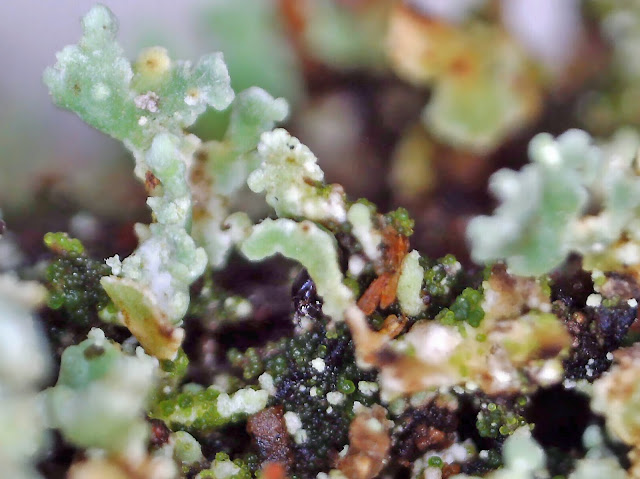
The green balls are algae, always associated with the mushroom Lichenomphalia umbellifera, those little mushrooms growing over the logs on the forest floor. I had mentioned them last November, looking at the mushrooms, but I described the algae as a "dark green, crumbly-looking growth".

Lichen agaric mushrooms with lichen, moss, and "dark green stuff".

Well, they're not crumbly; they're shiny, damp balls. And though they look dark green in the shady woods, under a light they may be yellow-green to bluish.

More mushrooms, lichen, dead leaves, red sorrel, and the green algae.

Under the microscope, green algae swarm over a baby moss.

From the page on MycoWeb:

This small omphaloid mushroom is actually a lichen. The mycelium of Lichenomphalia umbellifera is symbiotically associated with the green alga Coccomyxa and forms tiny, granulose to globular bodies near the base of the agaric that were originally described as Botrydina vulgaris. Botrydina was considered a primitive lichen and has a complex arrangement of algal cells in a compact hyphal system.

A lichen is not one organism. It combines two or three different species. Usually, they combine so that they appear to be one thing, like the Cladonia in the photos above.

A lichen is not a single organism. Rather, it is a symbiosis between different organisms - a fungus and an alga or cyanobacterium. Cyanobacteria are sometimes still referred to as 'blue-green algae', though they are quite distinct from the algae. The non-fungal partner contains chlorophyll and is called the photobiont. The fungal partner may be referred to as the mycobiont. (Australian National Herbarium)

This combination, the mushroom and the algae break the rules; they grow together, but each keeps their own form. The alga, Coccomyxa, (which describes them in the scientific notation as "Cocco" - seed, and "myxa" - mucus, referring to their shape and texture) grows near, or at the base of the mushrooms, on rotting wood or damp soil. Because they contain chlorophyll, they capture sunlight, even down there in their dark hideouts, producing nutrients for the other half of the partnership.

While I was looking at the algae and lichens under the microscope, I discovered a lively collection of critters.


Spider, running. She kept dashing across my field, always in a great hurry. The pale green lobes are squamules of Cladonia lichens.

Little black mite. There were many of these.

And a pretty little springtail, Entomobria sp.. Many of these, too, all very busy.

I took their moss and lichen outside to a shady corner of my garden. I hope they like it there.

~~~~~~~~~~~~~~~~~~~~

Bueno. Se me había olvidado este hongo y sus compañeros. Matt, el dueño de Sitka Nature, puso un comentario en mi último post sobre esas pelotitas verdes; una gran ayuda, por cierto. Me envió un enlace para el sitio MycoWeb. ¡Gracias, Matt!

Las pelotitas sí son algas y siempre crecen en relación con el hongo Lichenomphalia umbellifera, esos honguitos que crecen en los troncos podridos en el suelo del bosque. Las había mencionado el noviembre pasado, viendo los hongos, pero describí el alga como "de un verde oscuro, friable".

Pues no son friables; son pelotitas brillosas, húmedas. Y aunque parecen de un color oscuro allí en las sombras del bosque, bajo la luz resulta que pueden ser amarillentas, verde claro, o hasta azul.

Primera y segunda fotos, los hongos, con líquenes Cladonia y el alga.

Tercera foto: bajo el microscopio, las algas cubren un musgo nuevecito.

De la página de MycoWeb:

Este pequeño hongo "omphaloid" (con ombligo) es realmente un liquen. El micelio de Lichenomphalia umbellifera se asocia en simbiosis con el alga verde Coccomyxa y forma cuerpos miniaturos globulosos o en grano, cerca de la base del hongo, los cuales antes se nombraban Botrydina vulgaris. Botrydina se consideraba un liquen primitivo y tiene una organización compleja de células de alga en un sistema compacto de hifas.

Un liquen no es un solo organismo. Lleva en combinación dos o tres diferentes especies. Casi siempre, se unen de forma que aparecen ser una cosa, como por ejemplo, los líquenes Cladonia de las fotos.

Del Herbario Nacional de Australia: 

Un liquen no es un organismo. En cambio, forma un simbiosis entre organismos diferentes — un hongo y un alga o una cianobacteria. A las cianobacterias todavía se les nombra a veces como algas verde azuladas, aunque son bastante diferentes de las algas. La pareja que no es hongo contiene clorofila y se llama el fotobionte. El hongo se puede llamar el micobionte.

Esta combinación particular, deshecha las reglas. Crecen juntos, pero cada organismo mantiene su propia forma. El alga, (que se describe en su nombre científico como "Cocco" es decir, semilla o frutilla, y "myxa", que quiere decir moco, refiriéndose a su forma y textura) crece cerca de la base del hongo en madera podrida o tierra húmeda. Porque contienen clorofila, se aprovechan de la luz del sol, aun aquí en sus escondites oscuros en en fondo del bosque y proveen los nutrientes que usa el hongo.

Mientras miraba los líquenes y las algas bajo el microscopio, aparecieron varios animalitos bastante activos.

Cuarta foto: una ar­aña, corriendo. Los lóbulos de verde claro son las escamas del liquen Cladonia.

Quinta foto: un ácaro negro, brilloso. Había muchos de estos.

Sexta foto: una brincacola Entomobria sp. También había varias, todas muy ocupadas.

Al final, llevé los líquenes con su carga de bichitos a una esquina sombreada de mi jardín. Ojalá la encuentran cómoda.


Tuesday, January 26, 2021

Mostly snow

 The small things, seen from the trail from Elk Falls, in and under new snow.

Sapling in snow

Stub under snow.

Oregon grape under snow.

Baby evergreen in its snowy shelter.

Hanging snow. Note the red leaf buds.

Mushroom with a snow cap.

Fence post with its snow cap.

Without commentary.

~~~~~~~~~~~~~~~~~
Las cosas pequeñas, bajo la nueva nieve, vistas desde el sendero subiendo de las cataratas.

Sin comentario.


Sunday, November 29, 2020

Slow day

 Just another brown mushroom.

Gilled mushroom, on the Elk Falls trail.

~~~~~~~~~~~~~~~~~


Otro honguito café, en el sendero hacia las cataratas Elk Falls.


Thursday, November 05, 2020

Still holding my breath

 Fragile. Suits my mood tonight, watching events down south.

Tiny mushroom on a stump, more stem than cap.

~~~~~~~~~~~~~~~

Frágil. Así me siento esta noche, siguiendo las noticias de los EE UU. Este honguito me llama.


Saturday, September 19, 2020

Mushroom season again!

It's raining! It's even washed away some of the smoke; this afternoon, there was even a small patch of blue between the clouds! It's time to go mushrooming again.

A few, in a friend's lawn, even jumped the gun.

Big brown mushroom, with oak leaf.

The mushroom had attached itself to the oak leaf so that when my friend removed it, the mushroom tore. I liked it as is.

Gilled mushroom, unidentified

I've mostly given up on trying to identify mushrooms, unless they're old favourites. I'm happy just to celebrate their appearance.

A smaller, almost lacy mushroom. And is that a pile of worm poop behind it?

Top view.

There were also a few puffballs, new and white, but not enough for a meal.

~~~~~~~~~
Ya empezó la temporada de hongos. Hoy y ayer ha estado lloviendo. Y la lluvia nos quitó el humo de los incendios; hasta apareció una zona pequeña de cielo azul entre las nubes esta tarde. Y ahora ya es tiempo de ir a buscar hongos.

Estos dos tenían prisa y le ganaron a la lluvia. Están el el césped de una amiga.

No las pude identificar; ya no me enfado tanto en tratar de hallar su género; es suficiente celebrar su aparición y sus múltiples formas y colores.

Saturday, September 05, 2020

Brown hairy mushroom

 I found this mushroom in a weedy cleared space between parking space and picnic benches in the forest, in full sun.

Looks like an Armillaria

Although it looks like one of the honey mushrooms, these grow in clumps. This was almost alone; there was one smaller one a few feet away.

~~~~~~~~~~~~~~~~
Encontré este hongo en un espacio abierto hecho para estacionamiento en el bosque, en pleno sol.

Se parece a los hongos de miel, Armillaria sp., aunque ellos acostumbran crecer en grupos, todos saliendo de un solo punto. Este andaba solo, aparte de otro, mas pequeño, también solitario, a la distancia, aproximadamente de un metro.


Powered By Blogger