Okay. I had forgotten about these mushrooms and their companions. Matt, of Sitka Nature, commented on my post about those little green balls, reminding me. He sent me a helpful link to MycoWeb. Thanks, Matt!
The green balls are algae, always associated with the mushroom Lichenomphalia umbellifera, those little mushrooms growing over the logs on the forest floor. I had mentioned them last November, looking at the mushrooms, but I described the algae as a "dark green, crumbly-looking growth".
 |
| Lichen agaric mushrooms with lichen, moss, and "dark green stuff". |
Well, they're not crumbly; they're shiny, damp balls. And though they look dark green in the shady woods, under a light they may be yellow-green to bluish.
 |
| More mushrooms, lichen, dead leaves, red sorrel, and the green algae. |
 |
| Under the microscope, green algae swarm over a baby moss. |
From the page on
MycoWeb:
This small omphaloid mushroom is actually a lichen. The mycelium of Lichenomphalia umbellifera is symbiotically associated with the green alga Coccomyxa and forms tiny, granulose to globular bodies near the base of the agaric that were originally described as Botrydina vulgaris. Botrydina was considered a primitive lichen and has a complex arrangement of algal cells in a compact hyphal system.
A lichen is not one organism. It combines two or three different species. Usually, they combine so that they appear to be one thing, like the Cladonia in the photos above.
A lichen is not a single organism. Rather, it is a symbiosis between different organisms - a fungus and an alga or cyanobacterium. Cyanobacteria are sometimes still referred to as 'blue-green algae', though they are quite distinct from the algae. The non-fungal partner contains chlorophyll and is called the photobiont. The fungal partner may be referred to as the mycobiont. (Australian National Herbarium)
This combination, the mushroom and the algae break the rules; they grow together, but each keeps their own form. The alga, Coccomyxa, (which describes them in the scientific notation as "Cocco" - seed, and "myxa" - mucus, referring to their shape and texture) grows near, or at the base of the mushrooms, on rotting wood or damp soil. Because they contain chlorophyll, they capture sunlight, even down there in their dark hideouts, producing nutrients for the other half of the partnership.
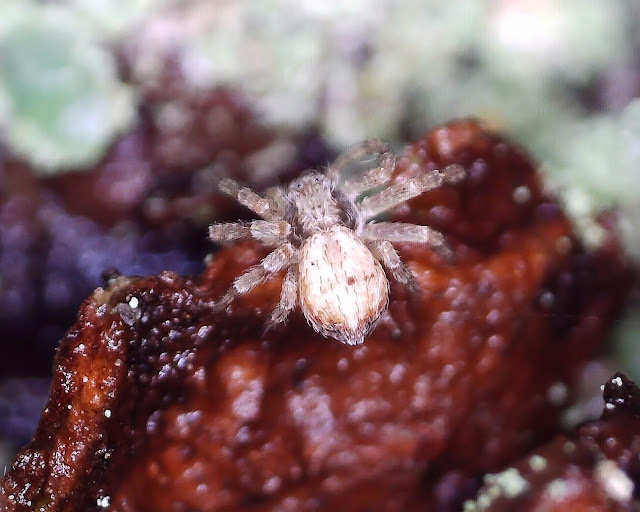
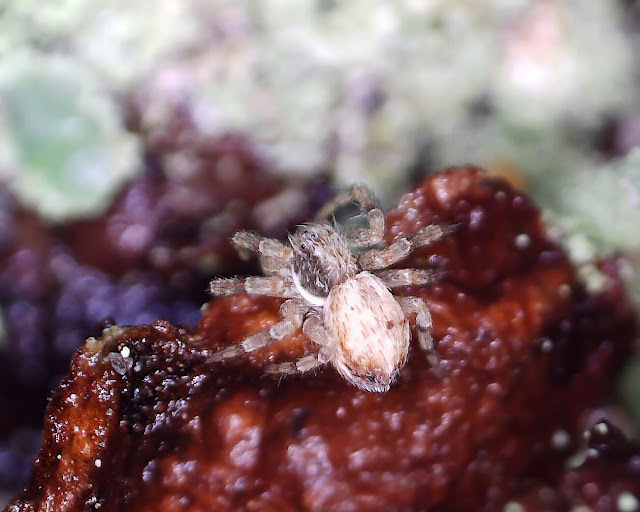
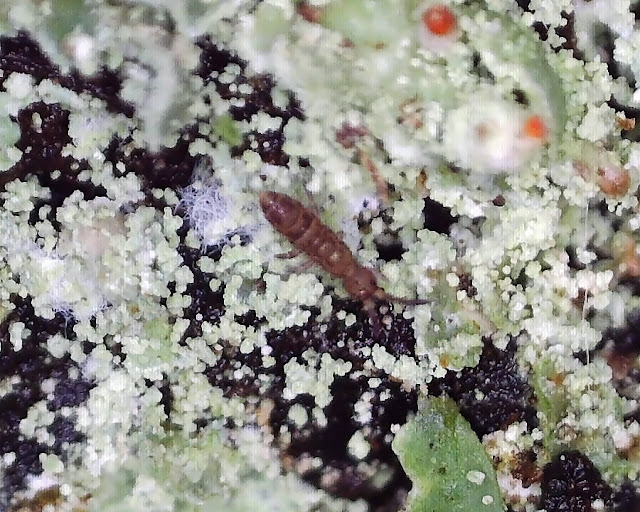
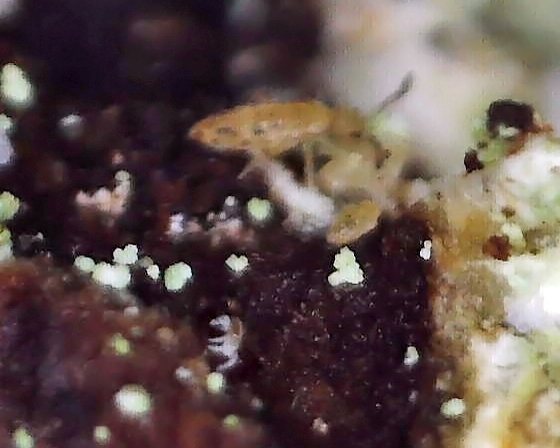
While I was looking at the algae and lichens under the microscope, I discovered a lively collection of critters.
 |
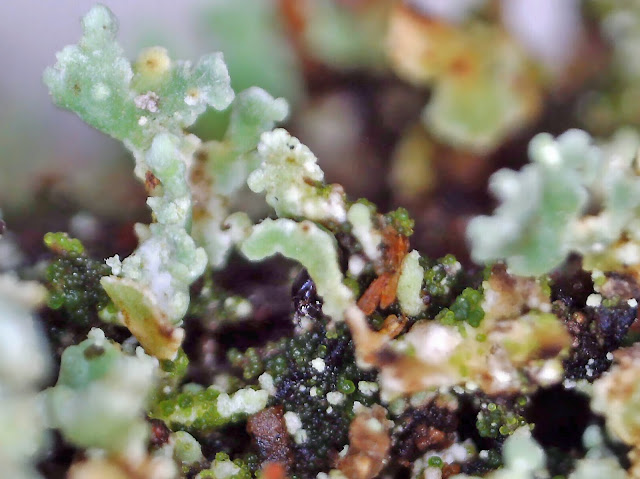
| Spider, running. She kept dashing across my field, always in a great hurry. The pale green lobes are squamules of Cladonia lichens. |
 |
| Little black mite. There were many of these. |
 |
| And a pretty little springtail, Entomobria sp.. Many of these, too, all very busy. |
I took their moss and lichen outside to a shady corner of my garden. I hope they like it there.
~~~~~~~~~~~~~~~~~~~~
Bueno. Se me había olvidado este hongo y sus compañeros. Matt, el dueño de Sitka Nature, puso un comentario en mi último post sobre esas pelotitas verdes; una gran ayuda, por cierto. Me envió un enlace para el sitio MycoWeb. ¡Gracias, Matt!Las pelotitas sí son algas y siempre crecen en relación con el hongo Lichenomphalia umbellifera, esos honguitos que crecen en los troncos podridos en el suelo del bosque. Las había mencionado el noviembre pasado, viendo los hongos, pero describí el alga como "de un verde oscuro, friable".
Pues no son friables; son pelotitas brillosas, húmedas. Y aunque parecen de un color oscuro allí en las sombras del bosque, bajo la luz resulta que pueden ser amarillentas, verde claro, o hasta azul.
Primera y segunda fotos, los hongos, con líquenes Cladonia y el alga.
Tercera foto: bajo el microscopio, las algas cubren un musgo nuevecito.
De la página de MycoWeb:
Este pequeño hongo "omphaloid" (con ombligo) es realmente un liquen. El micelio de Lichenomphalia umbellifera se asocia en simbiosis con el alga verde Coccomyxa y forma cuerpos miniaturos globulosos o en grano, cerca de la base del hongo, los cuales antes se nombraban Botrydina vulgaris. Botrydina se consideraba un liquen primitivo y tiene una organización compleja de células de alga en un sistema compacto de hifas.
Un liquen no es un solo organismo. Lleva en combinación dos o tres diferentes especies. Casi siempre, se unen de forma que aparecen ser una cosa, como por ejemplo, los líquenes Cladonia de las fotos.
Del Herbario Nacional de Australia:
Un liquen no es un organismo. En cambio, forma un simbiosis entre organismos diferentes — un hongo y un alga o una cianobacteria. A las cianobacterias todavía se les nombra a veces como algas verde azuladas, aunque son bastante diferentes de las algas. La pareja que no es hongo contiene clorofila y se llama el fotobionte. El hongo se puede llamar el micobionte.
Esta combinación particular, deshecha las reglas. Crecen juntos, pero cada organismo mantiene su propia forma. El alga, (que se describe en su nombre científico como "Cocco" es decir, semilla o frutilla, y "myxa", que quiere decir moco, refiriéndose a su forma y textura) crece cerca de la base del hongo en madera podrida o tierra húmeda. Porque contienen clorofila, se aprovechan de la luz del sol, aun aquí en sus escondites oscuros en en fondo del bosque y proveen los nutrientes que usa el hongo.
Mientras miraba los líquenes y las algas bajo el microscopio, aparecieron varios animalitos bastante activos.
Cuarta foto: una araña, corriendo. Los lóbulos de verde claro son las escamas del liquen Cladonia.
Quinta foto: un ácaro negro, brilloso. Había muchos de estos.
Sexta foto: una brincacola Entomobria sp. También había varias, todas muy ocupadas.
Al final, llevé los líquenes con su carga de bichitos a una esquina sombreada de mi jardín. Ojalá la encuentran cómoda.