Showing posts with label mite. Show all posts

Friday, January 14, 2022

Springtails, not springing

The weather was better today and I was able to collect a few leaf and Usnea lichens on Douglas fir twigs. I've been wanting to get a closer look at the lichens, to try to get a better understanding of their varied structures, looking at them under my little microscope.

I am easily side-tracked. The leaf lichens were crawling with tiny beasties; flies, worms, baby sowbugs, and several species of springtails. Most were too busy for my slow focusing with the microscope, but a few globular springtails were sleepy.

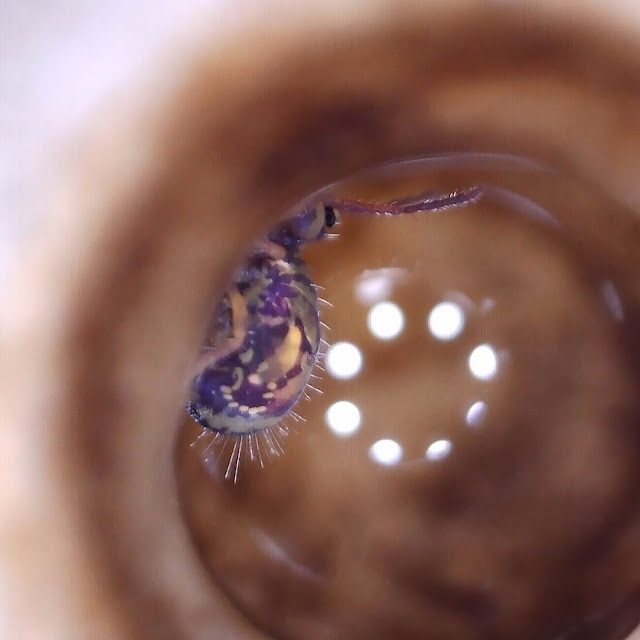
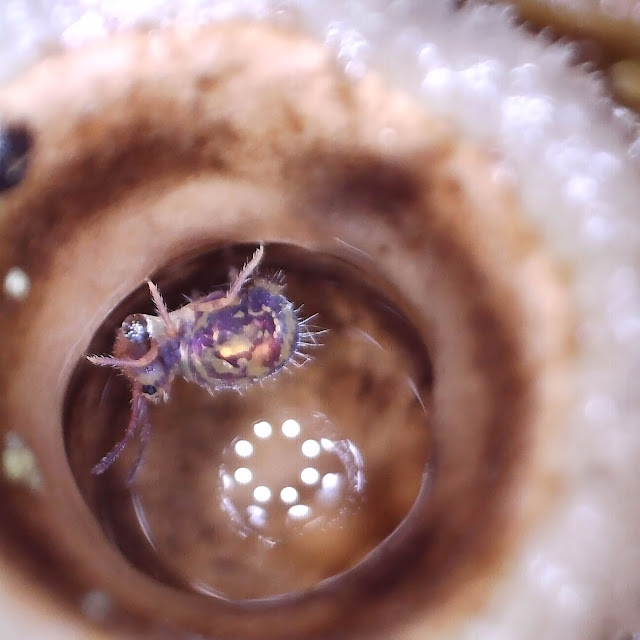
The globulars are the cutest of all the six-legged critters. This first one was hiding in the bottom of a birds' nest fungus.
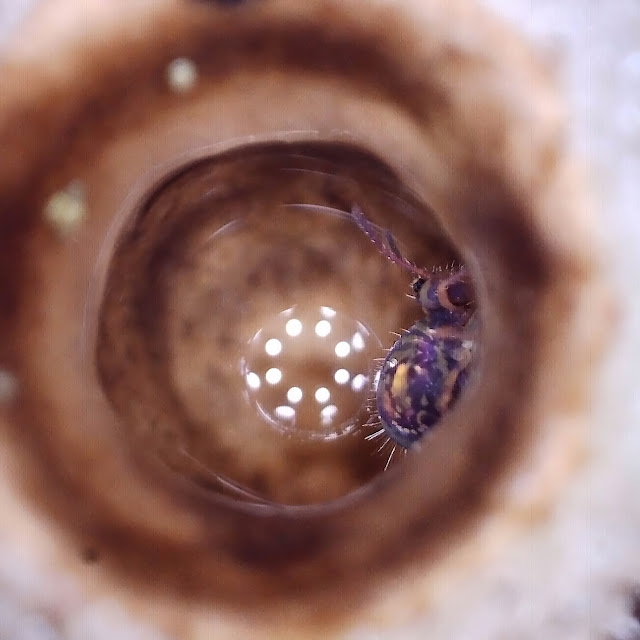
Collembola, Dicyrtoma sp. The circle of lights are from the microscope.

Getting a bit closer in.

Full side view. He's carrying a drop of water in his mouthparts. He dropped it soon after.

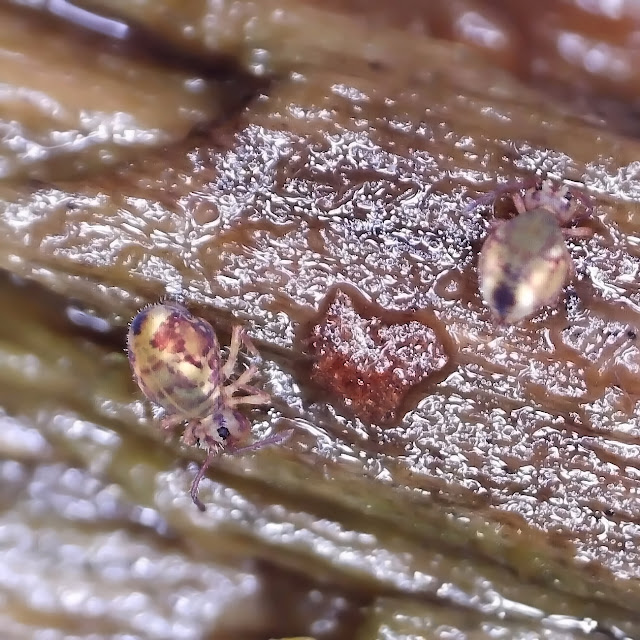
Two more, on a wet piece of bark.
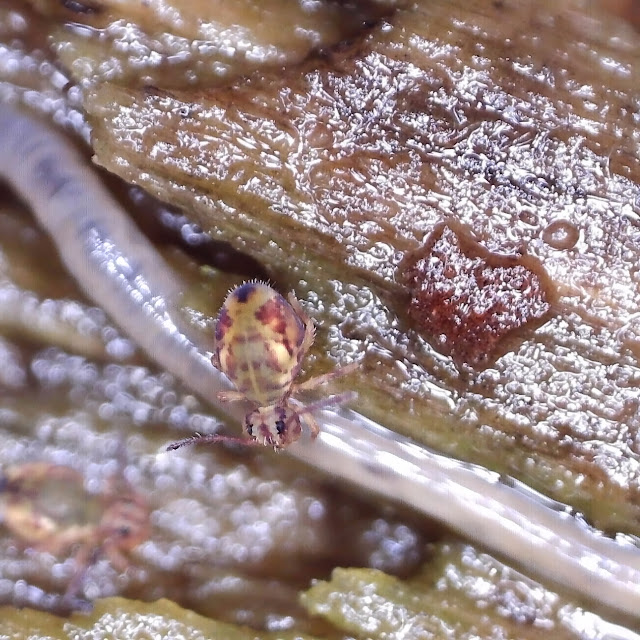
And one walking over one of the worms. The worm is about 1 cm. long.

Watching the springtails live, I could see that the pattern on their abdomens constantly shifted back and forth, as if a small light was moving inside. Heartbeat or breathing or digestion?

The springtails are about 2 mm long. But they are giants compared to this other critter I found:
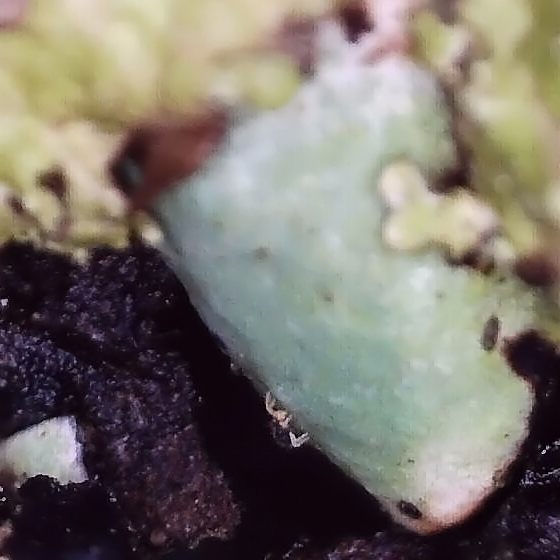
Very tiny. Maybe as long as a springtail's leg. By the mouthparts in front, it could be some variety of mite. Or not.

When I was done, I took them all out to the rainy garden.

~~~~~~~~~~~~~~~~~~~~~~~~

Hoy no llovió, y pude encontrar unas ramitas caídas de abeto de Douglas con sus líquenes; líquenes foliosas y del género Usnea. He estado buscando líquenes para mirarlos bajo el microscopio para lograr tal vez un mejor conocimiento de sus variadas estructuras.

Me distraigo facilmente. Estos líquenes estaban poblados de una gran variedad de criaturas, desde moscas miniaturas, gusanitos, cochinillas infantiles, y colémbolos de varias especies. La mayor parte estaban demasiado ocupadas en correr de aquí para allá para que yo, enfocando tan lentamente el microscopio, les capturara. Pero algunos de los colémbolos, los simfipleones, a los que llamamos "globosos", se estaban en paz.

Estos colémbolos globosos, a mi parecer, son los más adorables de todos los criaturas de seis patas. El primero que encontré se escondía en el fondo de un hongo "nido de pájaro".

3 fotos. Un colémbolo Dycirtoma. El círculo de luces es del microscopio. En la tercera foto, lleva en la boca una gota de agua, que luego abandonó.

Cuarta foto: otros dos colémbolos.

Quinta: y con un gusanito, que mide aproximadamente 1 cm. de largo.

Mirando los colémbolos en vivo, pude ver que los colores de su abdomen están en movimiento continuo, como si tuvieran adentro una pequeña luz. ¿Será su corazón que late, o su respiración, digestión?

Estos colémbolos miden más o menos 2 mm. de largo. Pero son gigantes al lado de esta otra criatura que vive en el liquen.

Sexta foto: ¡Tan pequeñito! Tal vez el tamaño de una pata de colémbolo. Viendo las estructuras alrededor de la boca, podría ser una variedad de ácaro. Quizás.

Cuando terminé, los llevé a todos afuera al jardín y la lluvia.


Thursday, April 01, 2021

When is a lichen not a lichen?

 Okay. I had forgotten about these mushrooms and their companions. Matt, of Sitka Nature, commented on my post about those little green balls, reminding me. He sent me a helpful link to MycoWeb. Thanks, Matt!

The green balls are algae, always associated with the mushroom Lichenomphalia umbellifera, those little mushrooms growing over the logs on the forest floor. I had mentioned them last November, looking at the mushrooms, but I described the algae as a "dark green, crumbly-looking growth".

Lichen agaric mushrooms with lichen, moss, and "dark green stuff".

Well, they're not crumbly; they're shiny, damp balls. And though they look dark green in the shady woods, under a light they may be yellow-green to bluish.

More mushrooms, lichen, dead leaves, red sorrel, and the green algae.

Under the microscope, green algae swarm over a baby moss.

From the page on MycoWeb:

This small omphaloid mushroom is actually a lichen. The mycelium of Lichenomphalia umbellifera is symbiotically associated with the green alga Coccomyxa and forms tiny, granulose to globular bodies near the base of the agaric that were originally described as Botrydina vulgaris. Botrydina was considered a primitive lichen and has a complex arrangement of algal cells in a compact hyphal system.

A lichen is not one organism. It combines two or three different species. Usually, they combine so that they appear to be one thing, like the Cladonia in the photos above.

A lichen is not a single organism. Rather, it is a symbiosis between different organisms - a fungus and an alga or cyanobacterium. Cyanobacteria are sometimes still referred to as 'blue-green algae', though they are quite distinct from the algae. The non-fungal partner contains chlorophyll and is called the photobiont. The fungal partner may be referred to as the mycobiont. (Australian National Herbarium)

This combination, the mushroom and the algae break the rules; they grow together, but each keeps their own form. The alga, Coccomyxa, (which describes them in the scientific notation as "Cocco" - seed, and "myxa" - mucus, referring to their shape and texture) grows near, or at the base of the mushrooms, on rotting wood or damp soil. Because they contain chlorophyll, they capture sunlight, even down there in their dark hideouts, producing nutrients for the other half of the partnership.

While I was looking at the algae and lichens under the microscope, I discovered a lively collection of critters.


Spider, running. She kept dashing across my field, always in a great hurry. The pale green lobes are squamules of Cladonia lichens.

Little black mite. There were many of these.

And a pretty little springtail, Entomobria sp.. Many of these, too, all very busy.

I took their moss and lichen outside to a shady corner of my garden. I hope they like it there.

~~~~~~~~~~~~~~~~~~~~

Bueno. Se me había olvidado este hongo y sus compañeros. Matt, el dueño de Sitka Nature, puso un comentario en mi último post sobre esas pelotitas verdes; una gran ayuda, por cierto. Me envió un enlace para el sitio MycoWeb. ¡Gracias, Matt!

Las pelotitas sí son algas y siempre crecen en relación con el hongo Lichenomphalia umbellifera, esos honguitos que crecen en los troncos podridos en el suelo del bosque. Las había mencionado el noviembre pasado, viendo los hongos, pero describí el alga como "de un verde oscuro, friable".

Pues no son friables; son pelotitas brillosas, húmedas. Y aunque parecen de un color oscuro allí en las sombras del bosque, bajo la luz resulta que pueden ser amarillentas, verde claro, o hasta azul.

Primera y segunda fotos, los hongos, con líquenes Cladonia y el alga.

Tercera foto: bajo el microscopio, las algas cubren un musgo nuevecito.

De la página de MycoWeb:

Este pequeño hongo "omphaloid" (con ombligo) es realmente un liquen. El micelio de Lichenomphalia umbellifera se asocia en simbiosis con el alga verde Coccomyxa y forma cuerpos miniaturos globulosos o en grano, cerca de la base del hongo, los cuales antes se nombraban Botrydina vulgaris. Botrydina se consideraba un liquen primitivo y tiene una organización compleja de células de alga en un sistema compacto de hifas.

Un liquen no es un solo organismo. Lleva en combinación dos o tres diferentes especies. Casi siempre, se unen de forma que aparecen ser una cosa, como por ejemplo, los líquenes Cladonia de las fotos.

Del Herbario Nacional de Australia: 

Un liquen no es un organismo. En cambio, forma un simbiosis entre organismos diferentes — un hongo y un alga o una cianobacteria. A las cianobacterias todavía se les nombra a veces como algas verde azuladas, aunque son bastante diferentes de las algas. La pareja que no es hongo contiene clorofila y se llama el fotobionte. El hongo se puede llamar el micobionte.

Esta combinación particular, deshecha las reglas. Crecen juntos, pero cada organismo mantiene su propia forma. El alga, (que se describe en su nombre científico como "Cocco" es decir, semilla o frutilla, y "myxa", que quiere decir moco, refiriéndose a su forma y textura) crece cerca de la base del hongo en madera podrida o tierra húmeda. Porque contienen clorofila, se aprovechan de la luz del sol, aun aquí en sus escondites oscuros en en fondo del bosque y proveen los nutrientes que usa el hongo.

Mientras miraba los líquenes y las algas bajo el microscopio, aparecieron varios animalitos bastante activos.

Cuarta foto: una ar­aña, corriendo. Los lóbulos de verde claro son las escamas del liquen Cladonia.

Quinta foto: un ácaro negro, brilloso. Había muchos de estos.

Sexta foto: una brincacola Entomobria sp. También había varias, todas muy ocupadas.

Al final, llevé los líquenes con su carga de bichitos a una esquina sombreada de mi jardín. Ojalá la encuentran cómoda.


Saturday, April 27, 2019

A promise of future blooms

It's still early in the season for the rest of our wildflowers. But they're coming!

At the base of a stump, a patch of false lily-of-the-valley leaves. At the top, a salmonberry sprout and a couplle of stalks of (I think) Hooker's fairy bells.

About the false (aka western) lily of the valley, E-Flora says:
Occurs ... on very moist to wet, nitrogen-rich soils ... on water-receiving and water-collecting sites, commonly found on stream-edge sites, floodplains ... Grows with ... Lysichitum americanum (skunk cabbage). Characteristic of alluvial floodplain forests.

Pretty much describes the Nunns Creek wetland.

Young horsetail spike. With lily of the valley leaves and ivy (invasive here).

The fertile stems of common horsetail show up early in the spring, mature and die before the leafy stalks (non-fertile) appear.

Hooker's fairy bells, Disporum hookeri. One flower is open; the rest are still in bud.

Another trillium. I think the red dot is a red velvet mite. It's too small to be sure, but the colour and size are right. Blown up to 400%, I can see the shadows of the legs.

And since they were everywhere, another pink fawn lily.

Powered By Blogger