Showing posts with label collembola. Show all posts

Thursday, August 15, 2024

In the blink of an eye

Beasties Project, continued 

Repost of "Christmas Stocking Animal" from January, 2012

"In the blink of an eye..." The phrase is used to suggest speed, and with reason; the human eye can complete a blink in 0.15 seconds, or 150 milliseconds.  Fast enough; anything that happens faster than that, we fail to notice.

A springtail's response time is about one tenth of that. In 18 milliseconds, less than 0.02 seconds, he has disappeared from here and landed over there, up to 100 times his body length away. And he arrives in the new location primed and ready to leap again, should the situation not be to his liking; he has no steering mechanism and has to take potluck. His continued survival depends on being able to move on instantly.

He has no wings. His legs are slender and used for walking. For those high jumps, he uses a spring and lock system on the underside of his abdomen. The furca, visible as he jumps, is a pronged, clawed fork, hinged near the tail. Usually, this is carried folded up, ending just under his chin, and secured by a locking mechanism, the retinaculum. When the lock is released, the fork snaps back like the drawn string of a bow and arrow, flinging the owner into the air with great force.

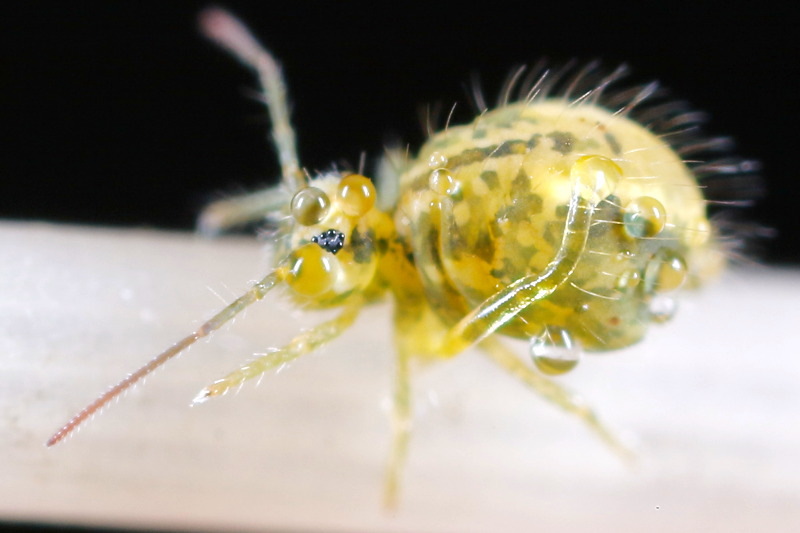
Globular springtail, caught mid-leap.

Quite simple, really. Easily understood. Except that it takes considerable energy either to leap, or to re-set the spring. So I looked closely at the underbelly of the springtail walking up the wall of a glass box.

View from the tail end.

Another view.

The spring is that long V up the center. Between the two prongs, about mid-way up, there is a small button; this is the lock. But what are all those other contraptions?

I found a couple of very helpful photos on Flickr, here and here, annotated by Frans Janssens, the go-to Collembola expert. The large round organs on either side of the base of the furca are torsion bars, the spring mechanism. (I had to look this up; it's been a while since I studied these.)
A spring can be defined to be an elastic member which exerts a resisting force when its shape is changed due to an applied force and returns to its original shape when the force is let off. ... when one side is fixed to an immovable object and the other is twisted, torque is applied. The torsion bar resists this torque and like any other spring it returns to its original position when the torque is let off. From a GM truck site.
The bars are powered by large muscles in this abdominal segment.

Slender springtail, showing the furca and torsion bars.

Now, look at the photo of the leaping springtail again. (Re-inserted below, to save scrolling.) See that thick, protruding bar just below the second set of legs? That's the collophore, or ventral tube, another unique springtail piece of equipment. This is what gives the springtails their scientific name, Collembola, from colla, glue, and embolon, a plug.

Globular springtail, caught mid-leap.

All Collembola have a ventral tube. From this tube they can everse two 'sacs'. In Symphypleona, (the globular springtails) these sacs are evolved into long tubes. These eversible tubes are multifunctional organs. They are used to regulate the internal osmotic pressure by taking up water with the tips of the eversed sacs/tubes. They are also used as an aid to adhere themselves on a smooth substrate surface .... In Symphypleona the long eversible tubes are also used for grooming. (Frans Janssens)
The BugGuide page where I found this shows another use for the tubes; a springtail turned belly-up is trying to use the tubes to right himself. Frans comments, "This is a trick only Collembola can perform."

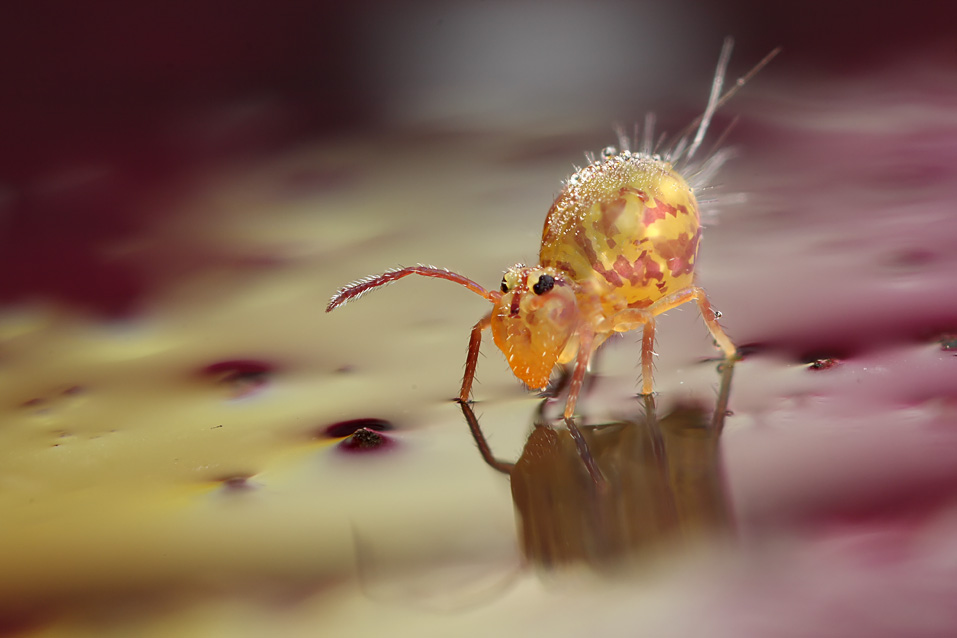
And how about this one? Here's a photo of a springtail using an eversible tube to drink the dew off his own back! (Collembolas, Jan van Duinen)

We're not done yet! Springtails are full of surprises; Christmas stockings, all lumpy and bumpy with mysterious packages.

Beautiful patterns, no two alike. I love this "Southwestern blanket" one.

Look at the shape of the eyes. Well, not exactly eyes; they're irregluarly shaped eye patches. Each one is dotted with up to 8 "ocelli", simple eye, not joined to each other, and of different sizes. These are not like the compound eyes of insects and instead, are called "composed eyes". The internal workings are not the same, and the individual eyes never touch each other.

One last photo; Smiley!

Cheerful little jumper, isn't he?

Even more: here is a pair of links to YouTube clips from a David Attenborough series, "Life in the Undergrowth", showing some great footage of springtails. In the first, as the animals leap, if you watch carefully, you'll see the furca folding back into place while the animal somersaults through the air. The second shows a head-butting mating dance. Thanks, DBM!

And here's a video of a BBC team catching and photographing a jumping springtail. Check it out!

~~~~~~~~~~~~~~~~
Sigo con el Proyecto Bichitos.

Este es un post que escribí en enero de 2012, editado y traducido, sobre la manera de saltar (y más) de los saltarines, los colémbolos.

"En un abrir y cerrar de ojos ..." La frase se usa para sugerir velocidad, y con razón; el ojo humano puede completar un pestañeo en 0,15 segundos, o 150 milisegundos. Suficientemente rápido para nuestros propósitos. Lo que ocurre en menos tiempo, no lo vemos.

El tiempo que necesita un colémbolo para actuar es alrededor de una décima parte de eso. En 18 milisegundos, menos que 0,02 segundos, ha desaparecido de este lugar y aparecido en otro, a una distancia de hasta 100 veces de la longitud de su cuerpo. Y llega al sitio nuevo ya preparado para volver a saltar, si no le parece bien el nuevo lugar; no tiene mecanismo para guiarse y se ha lanzado para atrás dando volteretas por el aire en una trayectoria impredecible, y aterriza casi al azar. Su vida depende de la habilidad de lanzarse fuera de peligro instántaneamente.

No tiene alas. Sus patas son delgadas y se usan solamente para caminar. Para lograr esos saltos enormes, cuenta con un sistema de resorte y cerradura que lleva en la parte inferior del abdomen. El órgano de salto, la fúrcula, es un apéndice bifurcado en forma de horquilla, visible cuando salta. En reposo, la lleva doblada contra el cuerpo, donde la detiene una estructura llamada retináculo. Cuando el retináculo se retrae, la fúrcula se desdobla de golpe hacia abajo contra el sustrato, y catapulta el brincacola con fuerza al aire.

Foto #1: colémbolo globoso saltando.

Un mecanismo sencillo, fácil de entender. Aparte de que se necesita una energía considerable para saltar, y más, para volver a fijar la fúrcula en su posición de reposo. Un colémbolo dentro de una caja de vidrio me dejó examinarlo desde abajo.

Foto #2: La fúrcula con su "bisagra".

#3: Otra vista de la fúrcula.

La fúrcula es esa "V" en en centro. Entre los dos extremos, cerca del centro del abdomen, hay un botoncito; este es el retináculo. Y esos otros aparatos, ¿qué son?

Encontré unas fotos en Flickr que clarifican todo, aquí (1, 2) con comentario por Frans Janssens, un experto en colémbolos. Los órganos grandes, redondos, de cada lado de la fúrcula son el mecanismo del resorte, las barras de torsión. (Y tuve que buscar una explicación.)
Un resorte se puede definir como un miembro elástico el cual ejerce una fuerza de resistencia cuando se opera un cambio a su forma de parte de una fuerza aplicada, y que regresa a su forma original cuando se deja de aplicar la fuerza. ... cuando un extremo está fijada en un objeto inmóvil y se gira el otro extremo, se aplica torsión. La barra de torsión resiste esta fuerza, y como cualquier otro resorte, regresa a su posición original cuando cesa la fuerza de torsión. (De un sitio GM sobre camiones)
Músculos grandes en esta parte del abdomen del bicho operan las barras.

#4: Colémbolo delgado (Entomobrya sp.), mostrando la fúrcula y barras de torsión.

Ahora, mira la primera foto de nuevo. ¿Ves esa barra gruesa que se alza desde el abdomen justo abajo del segundo par de patas? Es el colóforo, o tubo ventral, otra pieza del equipo especial de los colémbolos, y la que les da su nombre científico, Collembola, de colla (pegamento, cola) y embolon (un tapón.

#1 otra vez.
Todos los colémbolos tienen este tubo ventral. Desde este tubo pueden extender dos bolsas. En Symphleona, los colémbolos globosos, estas bolsas se han convertido en tubos evertibles largos, que son órganos con múltiples funciones. Se usan para controlar la presión osmótica interna, adquiriendo agua con las puntas de los tubos evertidos. También se usan para adherirse en una superficie lisa. ... los tubos largos evertibles también se usan para el aseo del animalito. (Frans Janssens)
La página en BugGuide donde hallé esto muestra otro uso para los tubos: un colémbolo que se encontró de espaldas está tratando de usar los tubos para ponerse de vuelta sobre sus patas. Frans Janssens comenta, "Este es un truco que solamente los colémbolos pueden hacer."

¿Y esto? Aquí hay una foto de un colémbolo usando su tubo eversible para beber el rocío de su propia espalda. (Collembolas, Jan van Duinen)

¡Y eso no es todo! Los colémbolos están repletos de sorpresas. 

#5: Diseños hermosos. No hay dos idénticos.

Mira la forma de los ojos. Bueno, no son precisamente ojos; son grupos de ojitos, arreglados como sea. Cada "ojo" lleva hasta 8 "ocelos", ojos sencillos, no unidos el uno al otro, y de tamaños distintos. No son como los ojos compuestos de los insectos; la estructura interna es distinta, y los ocelos individuales nunca tocan a los otros.

#6: Una foto más: sonriendo para la cámara.

Un poco más: hay unos videos YouTube de David Attenborough, muy interesantes. En el primero, si te fijas con cuidado, cuando saltan los animalitos puedes ver como la fúrcula se vuelve a su posición de reposo mientras el colémbolo da volteretas en el aire. El segundo es de un baile nupcial.

Y un video de unos científicos de BBC sacando fotos de un colémbolo mientras da sus saltos mortales. Aquí.

Tuesday, August 13, 2024

Suddenly not here

Beasties Project, ongoing ...

I hadn't realized just how far back my files of photos "on hold" goes. These photos of a springtail are from last February; cold, wet weather, springtails' happy times.

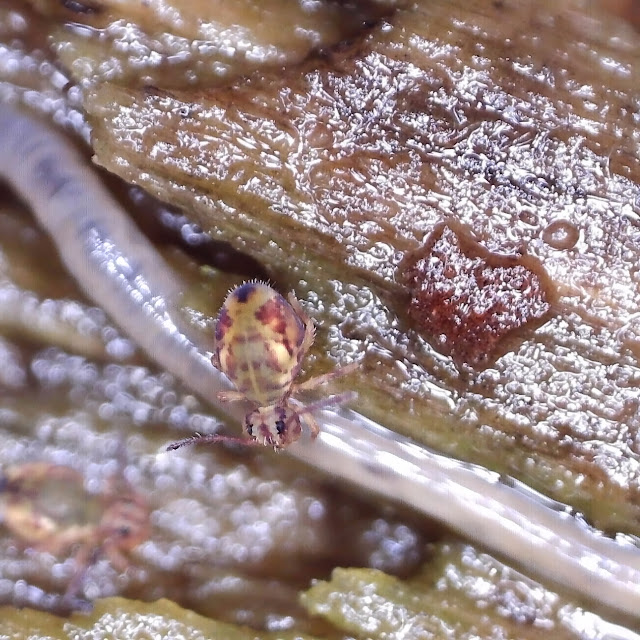
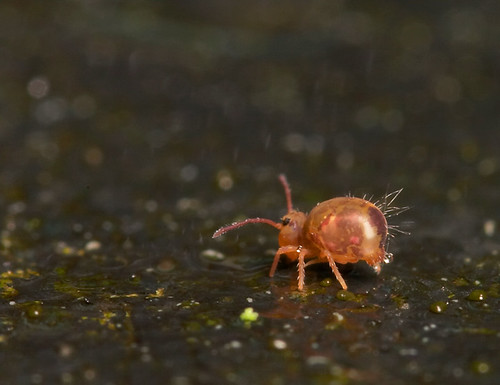
Entomobrya katzi, one of the Slender Springtails, under 5 mm. long.

The black patches on its head are eye clusters, each made of ≤8 single eyes. The tip of the antennae are taste organs.

These are not insects. They are in the Subphylum Hexapoda (the hexapods), arthopods (critters with jointed legs) with six legs. And this subphylum is divided into insects (with wings), and Entognatha: three smaller groups of wingless arthropods, the Collembola (Springtails), Protura, and Diplura.

Springtails can be found anywhere in the soil and leaf litter, year-round. These were on the lemon balm leaves growing by my door.

They are called springtails (should really be spring-bellies) because of their unique system of locomotion, using a spring mechanism under the abdomen.

I wrote a dozen years ago: "If you're looking at a moving reddish (or green) dot, not taking your eyes off it for even a moment; maybe you've got the camera focused on it; and then suddenly it's not there - you didn't see it go, it just ceased to exist in that spot - and then you find it a few inches away, calmly scratching its nose or taking a drink, you've found a springtail. They don't need the wings they never have; they've got a faster means of propulsion." (Popcorn Critters on Ice)

I explained that further in a blog post back then. I'll repost that tomorrow, adding a translation, as I do these days.

~~~~~~~~~~~~~

Seguimos con el Proyecto Bichitos.

No me había dado cuenta desde cuando estaba dejando fotos para "más tarde". Estas fotos de colémbolos datan del febrero pasado. Un mes frio, húmedo; condiciones favoritas de estos animalitos.

Fotos: Entomobrya katzi, uno de los colémbolos delgados, midiendo menos de 5 mm. Las manchas negras en la cabeza son grupos de ojos, con hasta 8 ojos en cada grupo. Los extremos de las antenas son órganos gustativos.

No son insectos. Pertenecen al subfilo​​ de hexápodos: artrópodos, o sea animales con apéndices articulados; los hexápodos son los que tienen 6 patas. El subfilo incluye a los insectos, que tienen alas, y 3 grupos de criaturas sin alas; los colémbolos, los proturos y los dipluros.

Los colémbolos se encuentran dondequiera en la tierra y la hojarasca, en todas las estaciones del año. Estas las encontré en las hojas del toronjil (Melissa officinalis) que crece al lado de mi puerta.

Las llamamos "brincacola" debido a su sistema único de propulsión, usando un tipo de resorte o muelle debajo de su abdomen.
Escribí hace una docena de años: "Si estás observando un puntito rojizo (o verde) que se mueve, y no le estás dejando de observar ni por un segundo; tal vez tienes la cámara lists, ya enfocada; y de repente ya no está allí — no viste cuando se fue, nada más dejó de existir en ese lugar — y luego lo encuentras a una distancia de varios centímetros, tranquilamente limpiándose la cara o bebiendo una gota de agua; pues hallaste un brincacola. No necesitan las alas que nunca tienen; tienen una manera de impulsarse más rapidamente." (Popcorn Critters on Ice)
Expliqué esto con más detalle en un post en aquel entonces. Mañana lo vuelvo a subir, ahora con una traducción, como acostumbro en estos dias.

Friday, January 14, 2022

Springtails, not springing

The weather was better today and I was able to collect a few leaf and Usnea lichens on Douglas fir twigs. I've been wanting to get a closer look at the lichens, to try to get a better understanding of their varied structures, looking at them under my little microscope.

I am easily side-tracked. The leaf lichens were crawling with tiny beasties; flies, worms, baby sowbugs, and several species of springtails. Most were too busy for my slow focusing with the microscope, but a few globular springtails were sleepy.

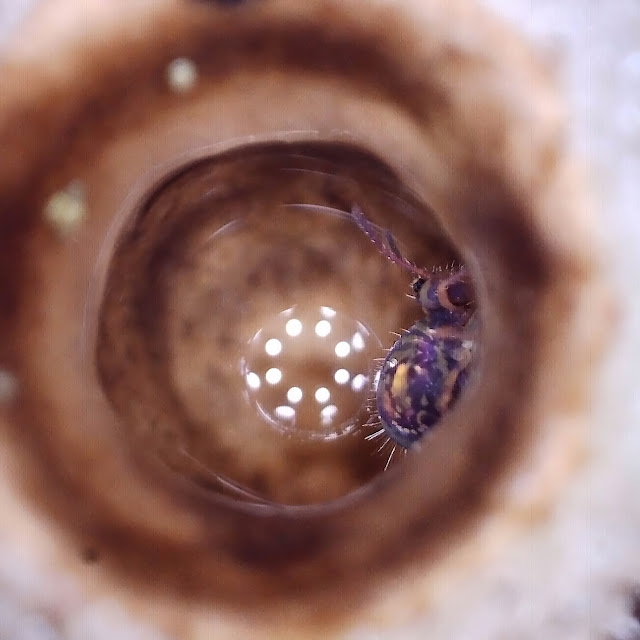
The globulars are the cutest of all the six-legged critters. This first one was hiding in the bottom of a birds' nest fungus.

Collembola, Dicyrtoma sp. The circle of lights are from the microscope.

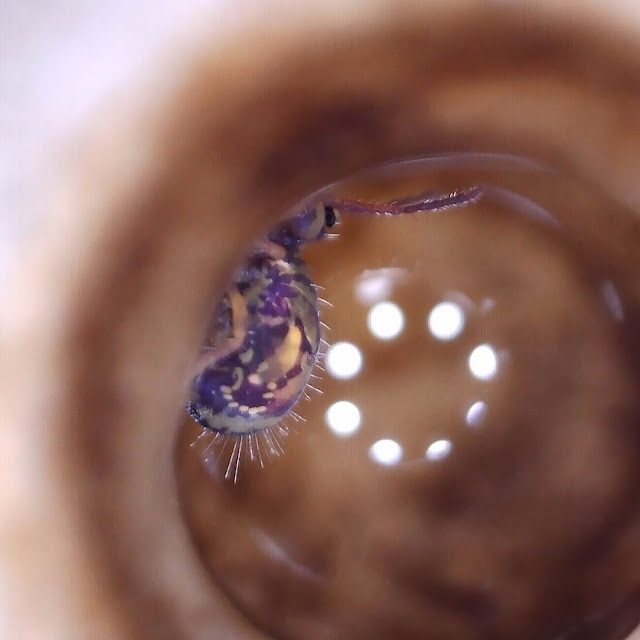
Getting a bit closer in.

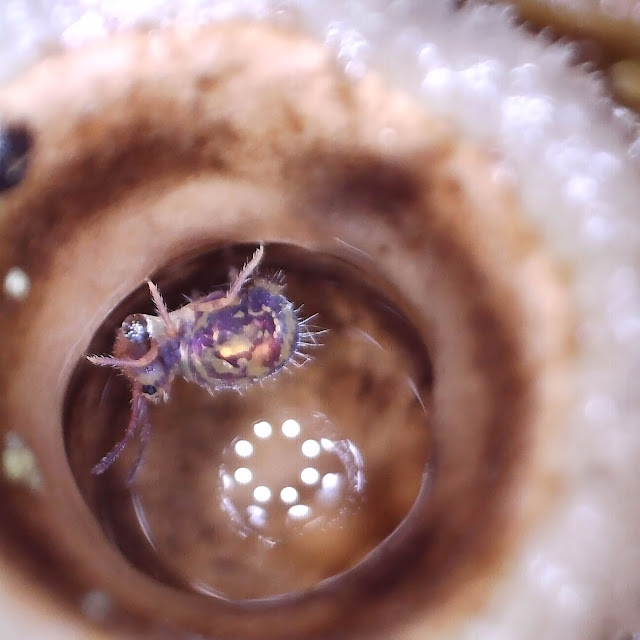
Full side view. He's carrying a drop of water in his mouthparts. He dropped it soon after.

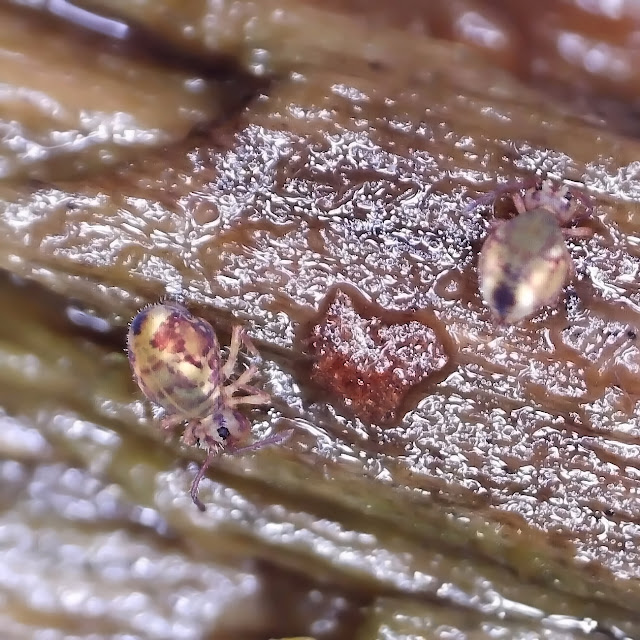
Two more, on a wet piece of bark.
And one walking over one of the worms. The worm is about 1 cm. long.

Watching the springtails live, I could see that the pattern on their abdomens constantly shifted back and forth, as if a small light was moving inside. Heartbeat or breathing or digestion?

The springtails are about 2 mm long. But they are giants compared to this other critter I found:

Very tiny. Maybe as long as a springtail's leg. By the mouthparts in front, it could be some variety of mite. Or not.

When I was done, I took them all out to the rainy garden.

~~~~~~~~~~~~~~~~~~~~~~~~

Hoy no llovió, y pude encontrar unas ramitas caídas de abeto de Douglas con sus líquenes; líquenes foliosas y del género Usnea. He estado buscando líquenes para mirarlos bajo el microscopio para lograr tal vez un mejor conocimiento de sus variadas estructuras.

Me distraigo facilmente. Estos líquenes estaban poblados de una gran variedad de criaturas, desde moscas miniaturas, gusanitos, cochinillas infantiles, y colémbolos de varias especies. La mayor parte estaban demasiado ocupadas en correr de aquí para allá para que yo, enfocando tan lentamente el microscopio, les capturara. Pero algunos de los colémbolos, los simfipleones, a los que llamamos "globosos", se estaban en paz.

Estos colémbolos globosos, a mi parecer, son los más adorables de todos los criaturas de seis patas. El primero que encontré se escondía en el fondo de un hongo "nido de pájaro".

3 fotos. Un colémbolo Dycirtoma. El círculo de luces es del microscopio. En la tercera foto, lleva en la boca una gota de agua, que luego abandonó.

Cuarta foto: otros dos colémbolos.

Quinta: y con un gusanito, que mide aproximadamente 1 cm. de largo.

Mirando los colémbolos en vivo, pude ver que los colores de su abdomen están en movimiento continuo, como si tuvieran adentro una pequeña luz. ¿Será su corazón que late, o su respiración, digestión?

Estos colémbolos miden más o menos 2 mm. de largo. Pero son gigantes al lado de esta otra criatura que vive en el liquen.

Sexta foto: ¡Tan pequeñito! Tal vez el tamaño de una pata de colémbolo. Viendo las estructuras alrededor de la boca, podría ser una variedad de ácaro. Quizás.

Cuando terminé, los llevé a todos afuera al jardín y la lluvia.


Sunday, February 02, 2014

Hungry spider, playful lichen

A month ago, I was looking at a handful of tiny spiders on a mossy, licheny twig. Afterwards, I left the works outside on a potting shelf and forgot about it. This afternoon, curious as to what would still be living in the dry moss, I brought it in again.

Still alive, and loaded with sporophytes.

Zooming in on that heart-shaped* moss clump:

Almost ripe sporophytes, most still closed over the developing spores.

Here it is, last month, for comparison:


No orange capsules; just green moss leaves.

I found only one spider this time, and one springtail. The larger (but still tiny) spiders have moved on.

Spider hoping for fat springtail lunch. She wasn't fast enough, though.

The springtail, checking out my foam mat. I moved him back to the moss later on.

Interesting pattern of wood cells in the broken twig.

And my imagination often runs away with me; here's a happy green dog, playing some sort of net-ball game.

A tiny web, built by a tiny spider, holding a tiny drop of water.

*Makes a nice heart wreath for Clytie's Valentine post.


Wednesday, January 18, 2012

Christmas stocking animal

"In the blink of an eye..." The phrase is used to suggest speed, and with reason; the human eye can complete a blink in 0.15 seconds, or 150 milliseconds.  Fast enough; anything that happens faster than that, we fail to notice.

A springtail's response time is about one tenth of that. In 18 milliseconds, less than 0.02 seconds, he has disappeared from here and landed over there, up to 100 times his body length away. And he arrives in the new location primed and ready to leap again, should the situation not be to his liking; he has no steering mechanism and has to take potluck. His continued survival depends on being able to move on instantly.

He has no wings. His legs are slender and used for walking. For those high jumps, he uses a spring and lock system on the underside of his abdomen. The furca, visible as he jumps, is a pronged, clawed fork, hinged near the tail. Usually, this is carried folded up, ending just under his chin, and secured by a locking mechanism, the retinaculum. When the lock is released, the fork snaps back like the drawn string of a bow and arrow, flinging the owner into the air with great force.

Globular springtail, caught mid-leap.

Quite simple, really. Easily understood. Except that it takes considerable energy either to leap, or to re-set the spring. So I looked closely at the underbelly of the springtail walking up the glass wall of the spider box.

View from the tail end.

Yesterday's photo, again.

The spring is that long V up the center. Between the two prongs, about mid-way up, there is a small button; this is the lock. But what are all those other contraptions?

I found a couple of very helpful photos on Flickr, here and here, annotated by Frans Janssens, the go-to Collembola expert. The large round organs on either side of the base of the furca are torsion bars, the spring mechanism. (I had to look this up; it's been a while since I studied these.
A spring can be defined to be an elastic member which exerts a resisting force when its shape is changed due to an applied force and returns to its original shape when the force is let off. ... when one side is fixed to an immovable object and the other is twisted, torque is applied. The torsion bar resists this torque and like any other spring it returns to its original position when the torque is let off. From a GM truck site.
The bars are powered by large muscles in this abdominal segment.

Slender springtail, showing the furca and torsion bars.

Now, look at the photo of the leaping springtail again. (Re-inserted below, to save scrolling.) See that thick, protruding bar just below the second set of legs? That's the collophore, or ventral tube, another unique springtail piece of equipment. This is what gives the springtails their scientific name, Collembola, from colla, glue, and embolon, a plug.


Globular springtail, caught mid-leap.

All Collembola have a ventral tube. From this tube they can everse two 'sacs'. In Symphypleona, (the globular springtails) these sacs are evolved into long tubes. These eversible tubes are multifunctional organs. They are used to regulate the internal osmotic pressure by taking up water with the tips of the eversed sacs/tubes. They are also used as an aid to adhere themselves on a smooth substrate surface .... In Symphypleona the long eversible tubes are also used for grooming. (Frans Janssens)

The BugGuide page where I found this shows another use for the tubes; a springtail turned belly-up is trying to use the tubes to right himself. Frans comments, "This is a trick only Collembola can perform."

And how about this one? Here's a photo of a springtail using an eversible tube to drink the dew off his own back! (Collembolas, Jan van Duinen)

We're not done yet! Springtails are full of surprises; Christmas stockings, all lumpy and bumpy with mysterious packages.

Beautiful patterns, no two alike. I love this "Southwestern blanket" one.

Look at the shape of the eyes. Well, not exactly eyes; they're irregluarly shaped eye patches. Each one is dotted with up to 8 "ocelli", simple eye, not joined to each other, and of different sizes. (Image) These are not like the compound eyes of insects and instead, are called "composed eyes". The internal workings are not the same, and the individual eyes never touch each other.

One last photo; Smiley!

Cheerful little jumper, isn't he?

Update: in the comments, "Don't Bug Me" added a pair of links to YouTube clips from a David Attenborough series, "Life in the Undergrowth", showing some great footage of springtails. In the first, as the animals leap, if you watch carefully, you'll see the furca folding back into place while the animal somersaults through the air. The second shows a head-butting mating dance. Thanks, DBM!

Update #2: I just found this video; a BBC team catching and photographing a jumping springtail. Check it out!

Thursday, October 13, 2011

In a handful of moss

We've not been able to get out of urban environments for a while; all our outings have been to family gatherings or running errands. And since the weather changed, most of our bugs and other critters have disappeared, except for the one carpet beetle larva and a crop of fruit flies.

I was hungering for something green, something wet, something alive and slithery. So, at the end of another day hopping from store to store, I went out in the rain and gathered a few tufts of moss; tiny will do; let my camera do the walking.

Green and wet.

The moss was beautiful, glowing translucently under my light, the spiky leaves green at the top, a rich brown beneath. Underneath, where the moss still held remnants of soil, a couple of miniature slugs were sleeping. Disturbed, they woke and stretched, heading for new cover. At their full length, neither was more than a half inch long.

When I pulled the largest clump of moss apart, I exposed a cozy nest.

Slug eggs, almost as big as the slug diameters.

A closer view, trying to distinguish features of the developing slugs inside. No luck.

Closer view.

Apart from the slugs, their eggs, and one tiny earthworm (so tiny he crawled into my eyedropper), the only other visible animals were black springtails, from pinhead size on down to mere visibility, racing and hopping around. I found one stopped for a breather.

Springtail, Collembola.

Under a good lens, I found more animals: a little black snail, barely a pinprick to the naked eye once I knew where to look for it; another earthworm, identifiable as such only under the microscope, and a few slow-moving, beautiful, shiny, deep red mites. I took photos, but they show only red-black spots with a hint of legs along the edge.

This different mite was about twice their size:

Unidentified mite. 

It has eight legs, but holds the first two high in front, like antennae. And it looks like it's carrying at least one, maybe two smaller mites on its back. Babies? Or parasites? Maybe they'll know at BugGuide. I'll ask.


Wednesday, January 19, 2011

Tiny, but fat. Globular, even.

These cuties were in a dish of moss flanked by two rusty birds.

Bird with globular springtail (Dicyrtomina ornata?) on his beak.

Heading down to the moss. They don't like my light.

Two springtails in the moss.

Another view. The moss is under an inch tall, the springtail around 1 mm. long.

Zooming in.

I notice little spikes coming out of the tail end, on this one and another couple. Hairs, or tubes?  Frans Janssens mentions wax excretions, with a similar photo. I must e-mail him to ask about them.

And, in reply to Anon. in recent comments, these last three photos were taken with the little Sony and that old homemade lens. It gives me about an extra 2x magnification. Now to upgrade it ...

Tuesday, December 02, 2008

Who lives in the birdhouse in winter?

I went outside the other night, to look for moths for my latest captive spider, and on a whim, brought in the birdhouse that has been housing cattail fluff, just to see what is happening on and in it. After the recent rains, it was probably growing fungi, maybe another crop of the slime mold I found a year ago last March.

No. Wrong time of year, probably. But there were a few patches of a white fibrous mass, and many tiny yellowish "thumbtacks".


The large yellow circles are about the size of a pinhead.

But what is that little thing at the bottom left? It looks like it has legs.

I examined the whole birdhouse with a magnifying glass. Eventually, I saw movement:


A globular springtail.

He was racing along, and I soon lost him down a crack. But I found another, peacefully grazing:


Dicyrtomina ornata, I think. Isn't he cute?


Rear view, and the reason for my tentative ID

Looking for info and ID, tonight, I found some amazing photos of these; a whole album of springtails, by Brian Valentine, and with comments and ID by Frans Janssens. And here's a slideshow by Krister Hall; just beautiful!

After looking over those, I was tempted to scrap my blurry photos. But I didn't; I inflicted them on you, instead. Now, go on over to Flickr and delight your eyes.
.

Tuesday, February 12, 2008

Fighting Collembola!

Rainy day bug blogging:

If I can't get outside because of the weather, I can always bring the outside in. I went to the edge of the garden and collected a cupful of topsoil, brought it in and inspected it.

It's still too cold for baby slugs and spiders, but the springtails were swarming. I popped them under a bright light and aimed the camera at them.

Aren't they cute?

This family of springtails, the Onychiuridae, doesn't spring. Most springtails have an appendage at the tail that they carry clipped underneath the body. When they release the bond, it snaps back, popping the owner high into the air. These little guys don't have one, so they just run about.

They are also blind and colorless. (In the photo above, the white balance is off, but I didn't correct it because they became so bright that the segments weren't visible.)

No eyes.

Lack of vision doesn't seem to slow them down any. When I disturb the soil and other tiny soil residents make themselves scarce or freeze in place, these Collembola keep on going, around and about, under and over, back and forth, ignoring me and my works.

And something weird; they float. They bounce up to the top of any amount of water like tiny white corks. Squirming corks, that is. They are unwettable, unsinkable.

I added a litre of water to my cup of soil, and poured it out into a shallow tray. The springtails clumped on the surface, all together, and could be scooped out with a spoon.

Here they are, on 1/2 inch of water.

On the water, the mass of springtails squirms, moving constantly, but with no grip on the surface, they just jitter from spot to spot. I video'd them at it; check this out:


These aren't the only Collembola in my patch of soil; the Entomobryidae show up sometimes. These do jump, and are not blind.

I was filming a handful of the Onychiuridae on a wet leaf, when a little brown springtail came around the corner. Cute little guy. But I was quite taken aback by what happened next. Watch this video; keep your eyes on the little dark one at the tip of the stick. The big white springtail that attacks him fights rather like a cat, and leaves the poor little one in tough shape.

(Blogger was driving me crazy tonight. It wouldn't accept the good copy of this video. So I loaded it onto my website; here. A blurry, dark, abbreviated copy, all that Blogger would allow, is below.)


Unfortunately, a couple of the beasties in this video are belly up, and others seem a bit disoriented. I had the hot light just a few inches away, and I'd been decanting them from cup to pot to tray to leaf; with that, even a springtail loses his oomph. Can't have that; I carefully put them back in the garden where I found them, with my apologies.
Powered By Blogger