Showing posts with label springtails. Show all posts

Thursday, August 15, 2024

In the blink of an eye

Beasties Project, continued 

Repost of "Christmas Stocking Animal" from January, 2012

"In the blink of an eye..." The phrase is used to suggest speed, and with reason; the human eye can complete a blink in 0.15 seconds, or 150 milliseconds.  Fast enough; anything that happens faster than that, we fail to notice.

A springtail's response time is about one tenth of that. In 18 milliseconds, less than 0.02 seconds, he has disappeared from here and landed over there, up to 100 times his body length away. And he arrives in the new location primed and ready to leap again, should the situation not be to his liking; he has no steering mechanism and has to take potluck. His continued survival depends on being able to move on instantly.

He has no wings. His legs are slender and used for walking. For those high jumps, he uses a spring and lock system on the underside of his abdomen. The furca, visible as he jumps, is a pronged, clawed fork, hinged near the tail. Usually, this is carried folded up, ending just under his chin, and secured by a locking mechanism, the retinaculum. When the lock is released, the fork snaps back like the drawn string of a bow and arrow, flinging the owner into the air with great force.

Globular springtail, caught mid-leap.

Quite simple, really. Easily understood. Except that it takes considerable energy either to leap, or to re-set the spring. So I looked closely at the underbelly of the springtail walking up the wall of a glass box.

View from the tail end.

Another view.

The spring is that long V up the center. Between the two prongs, about mid-way up, there is a small button; this is the lock. But what are all those other contraptions?

I found a couple of very helpful photos on Flickr, here and here, annotated by Frans Janssens, the go-to Collembola expert. The large round organs on either side of the base of the furca are torsion bars, the spring mechanism. (I had to look this up; it's been a while since I studied these.)
A spring can be defined to be an elastic member which exerts a resisting force when its shape is changed due to an applied force and returns to its original shape when the force is let off. ... when one side is fixed to an immovable object and the other is twisted, torque is applied. The torsion bar resists this torque and like any other spring it returns to its original position when the torque is let off. From a GM truck site.
The bars are powered by large muscles in this abdominal segment.

Slender springtail, showing the furca and torsion bars.

Now, look at the photo of the leaping springtail again. (Re-inserted below, to save scrolling.) See that thick, protruding bar just below the second set of legs? That's the collophore, or ventral tube, another unique springtail piece of equipment. This is what gives the springtails their scientific name, Collembola, from colla, glue, and embolon, a plug.

Globular springtail, caught mid-leap.

All Collembola have a ventral tube. From this tube they can everse two 'sacs'. In Symphypleona, (the globular springtails) these sacs are evolved into long tubes. These eversible tubes are multifunctional organs. They are used to regulate the internal osmotic pressure by taking up water with the tips of the eversed sacs/tubes. They are also used as an aid to adhere themselves on a smooth substrate surface .... In Symphypleona the long eversible tubes are also used for grooming. (Frans Janssens)
The BugGuide page where I found this shows another use for the tubes; a springtail turned belly-up is trying to use the tubes to right himself. Frans comments, "This is a trick only Collembola can perform."

And how about this one? Here's a photo of a springtail using an eversible tube to drink the dew off his own back! (Collembolas, Jan van Duinen)

We're not done yet! Springtails are full of surprises; Christmas stockings, all lumpy and bumpy with mysterious packages.

Beautiful patterns, no two alike. I love this "Southwestern blanket" one.

Look at the shape of the eyes. Well, not exactly eyes; they're irregluarly shaped eye patches. Each one is dotted with up to 8 "ocelli", simple eye, not joined to each other, and of different sizes. These are not like the compound eyes of insects and instead, are called "composed eyes". The internal workings are not the same, and the individual eyes never touch each other.

One last photo; Smiley!

Cheerful little jumper, isn't he?

Even more: here is a pair of links to YouTube clips from a David Attenborough series, "Life in the Undergrowth", showing some great footage of springtails. In the first, as the animals leap, if you watch carefully, you'll see the furca folding back into place while the animal somersaults through the air. The second shows a head-butting mating dance. Thanks, DBM!

And here's a video of a BBC team catching and photographing a jumping springtail. Check it out!

~~~~~~~~~~~~~~~~
Sigo con el Proyecto Bichitos.

Este es un post que escribí en enero de 2012, editado y traducido, sobre la manera de saltar (y más) de los saltarines, los colémbolos.

"En un abrir y cerrar de ojos ..." La frase se usa para sugerir velocidad, y con razón; el ojo humano puede completar un pestañeo en 0,15 segundos, o 150 milisegundos. Suficientemente rápido para nuestros propósitos. Lo que ocurre en menos tiempo, no lo vemos.

El tiempo que necesita un colémbolo para actuar es alrededor de una décima parte de eso. En 18 milisegundos, menos que 0,02 segundos, ha desaparecido de este lugar y aparecido en otro, a una distancia de hasta 100 veces de la longitud de su cuerpo. Y llega al sitio nuevo ya preparado para volver a saltar, si no le parece bien el nuevo lugar; no tiene mecanismo para guiarse y se ha lanzado para atrás dando volteretas por el aire en una trayectoria impredecible, y aterriza casi al azar. Su vida depende de la habilidad de lanzarse fuera de peligro instántaneamente.

No tiene alas. Sus patas son delgadas y se usan solamente para caminar. Para lograr esos saltos enormes, cuenta con un sistema de resorte y cerradura que lleva en la parte inferior del abdomen. El órgano de salto, la fúrcula, es un apéndice bifurcado en forma de horquilla, visible cuando salta. En reposo, la lleva doblada contra el cuerpo, donde la detiene una estructura llamada retináculo. Cuando el retináculo se retrae, la fúrcula se desdobla de golpe hacia abajo contra el sustrato, y catapulta el brincacola con fuerza al aire.

Foto #1: colémbolo globoso saltando.

Un mecanismo sencillo, fácil de entender. Aparte de que se necesita una energía considerable para saltar, y más, para volver a fijar la fúrcula en su posición de reposo. Un colémbolo dentro de una caja de vidrio me dejó examinarlo desde abajo.

Foto #2: La fúrcula con su "bisagra".

#3: Otra vista de la fúrcula.

La fúrcula es esa "V" en en centro. Entre los dos extremos, cerca del centro del abdomen, hay un botoncito; este es el retináculo. Y esos otros aparatos, ¿qué son?

Encontré unas fotos en Flickr que clarifican todo, aquí (1, 2) con comentario por Frans Janssens, un experto en colémbolos. Los órganos grandes, redondos, de cada lado de la fúrcula son el mecanismo del resorte, las barras de torsión. (Y tuve que buscar una explicación.)
Un resorte se puede definir como un miembro elástico el cual ejerce una fuerza de resistencia cuando se opera un cambio a su forma de parte de una fuerza aplicada, y que regresa a su forma original cuando se deja de aplicar la fuerza. ... cuando un extremo está fijada en un objeto inmóvil y se gira el otro extremo, se aplica torsión. La barra de torsión resiste esta fuerza, y como cualquier otro resorte, regresa a su posición original cuando cesa la fuerza de torsión. (De un sitio GM sobre camiones)
Músculos grandes en esta parte del abdomen del bicho operan las barras.

#4: Colémbolo delgado (Entomobrya sp.), mostrando la fúrcula y barras de torsión.

Ahora, mira la primera foto de nuevo. ¿Ves esa barra gruesa que se alza desde el abdomen justo abajo del segundo par de patas? Es el colóforo, o tubo ventral, otra pieza del equipo especial de los colémbolos, y la que les da su nombre científico, Collembola, de colla (pegamento, cola) y embolon (un tapón.

#1 otra vez.
Todos los colémbolos tienen este tubo ventral. Desde este tubo pueden extender dos bolsas. En Symphleona, los colémbolos globosos, estas bolsas se han convertido en tubos evertibles largos, que son órganos con múltiples funciones. Se usan para controlar la presión osmótica interna, adquiriendo agua con las puntas de los tubos evertidos. También se usan para adherirse en una superficie lisa. ... los tubos largos evertibles también se usan para el aseo del animalito. (Frans Janssens)
La página en BugGuide donde hallé esto muestra otro uso para los tubos: un colémbolo que se encontró de espaldas está tratando de usar los tubos para ponerse de vuelta sobre sus patas. Frans Janssens comenta, "Este es un truco que solamente los colémbolos pueden hacer."

¿Y esto? Aquí hay una foto de un colémbolo usando su tubo eversible para beber el rocío de su propia espalda. (Collembolas, Jan van Duinen)

¡Y eso no es todo! Los colémbolos están repletos de sorpresas. 

#5: Diseños hermosos. No hay dos idénticos.

Mira la forma de los ojos. Bueno, no son precisamente ojos; son grupos de ojitos, arreglados como sea. Cada "ojo" lleva hasta 8 "ocelos", ojos sencillos, no unidos el uno al otro, y de tamaños distintos. No son como los ojos compuestos de los insectos; la estructura interna es distinta, y los ocelos individuales nunca tocan a los otros.

#6: Una foto más: sonriendo para la cámara.

Un poco más: hay unos videos YouTube de David Attenborough, muy interesantes. En el primero, si te fijas con cuidado, cuando saltan los animalitos puedes ver como la fúrcula se vuelve a su posición de reposo mientras el colémbolo da volteretas en el aire. El segundo es de un baile nupcial.

Y un video de unos científicos de BBC sacando fotos de un colémbolo mientras da sus saltos mortales. Aquí.

Tuesday, August 13, 2024

Suddenly not here

Beasties Project, ongoing ...

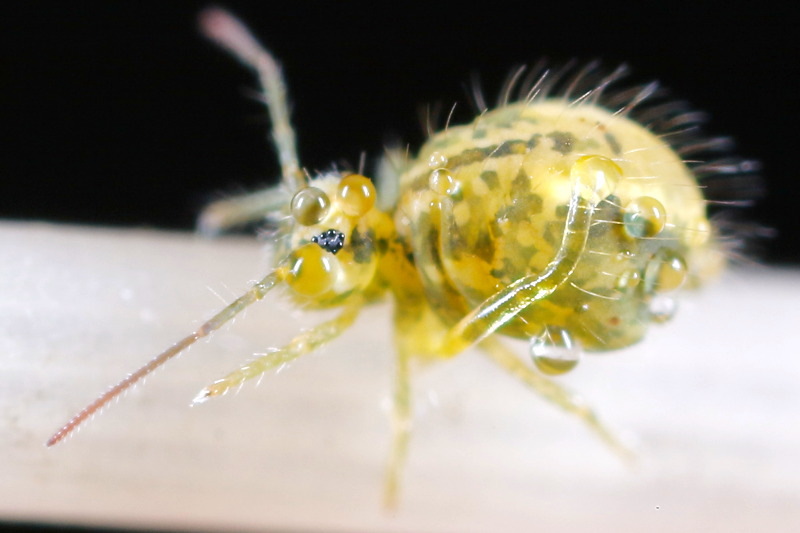
I hadn't realized just how far back my files of photos "on hold" goes. These photos of a springtail are from last February; cold, wet weather, springtails' happy times.

Entomobrya katzi, one of the Slender Springtails, under 5 mm. long.

The black patches on its head are eye clusters, each made of ≤8 single eyes. The tip of the antennae are taste organs.

These are not insects. They are in the Subphylum Hexapoda (the hexapods), arthopods (critters with jointed legs) with six legs. And this subphylum is divided into insects (with wings), and Entognatha: three smaller groups of wingless arthropods, the Collembola (Springtails), Protura, and Diplura.

Springtails can be found anywhere in the soil and leaf litter, year-round. These were on the lemon balm leaves growing by my door.

They are called springtails (should really be spring-bellies) because of their unique system of locomotion, using a spring mechanism under the abdomen.

I wrote a dozen years ago: "If you're looking at a moving reddish (or green) dot, not taking your eyes off it for even a moment; maybe you've got the camera focused on it; and then suddenly it's not there - you didn't see it go, it just ceased to exist in that spot - and then you find it a few inches away, calmly scratching its nose or taking a drink, you've found a springtail. They don't need the wings they never have; they've got a faster means of propulsion." (Popcorn Critters on Ice)

I explained that further in a blog post back then. I'll repost that tomorrow, adding a translation, as I do these days.

~~~~~~~~~~~~~

Seguimos con el Proyecto Bichitos.

No me había dado cuenta desde cuando estaba dejando fotos para "más tarde". Estas fotos de colémbolos datan del febrero pasado. Un mes frio, húmedo; condiciones favoritas de estos animalitos.

Fotos: Entomobrya katzi, uno de los colémbolos delgados, midiendo menos de 5 mm. Las manchas negras en la cabeza son grupos de ojos, con hasta 8 ojos en cada grupo. Los extremos de las antenas son órganos gustativos.

No son insectos. Pertenecen al subfilo​​ de hexápodos: artrópodos, o sea animales con apéndices articulados; los hexápodos son los que tienen 6 patas. El subfilo incluye a los insectos, que tienen alas, y 3 grupos de criaturas sin alas; los colémbolos, los proturos y los dipluros.

Los colémbolos se encuentran dondequiera en la tierra y la hojarasca, en todas las estaciones del año. Estas las encontré en las hojas del toronjil (Melissa officinalis) que crece al lado de mi puerta.

Las llamamos "brincacola" debido a su sistema único de propulsión, usando un tipo de resorte o muelle debajo de su abdomen.
Escribí hace una docena de años: "Si estás observando un puntito rojizo (o verde) que se mueve, y no le estás dejando de observar ni por un segundo; tal vez tienes la cámara lists, ya enfocada; y de repente ya no está allí — no viste cuando se fue, nada más dejó de existir en ese lugar — y luego lo encuentras a una distancia de varios centímetros, tranquilamente limpiándose la cara o bebiendo una gota de agua; pues hallaste un brincacola. No necesitan las alas que nunca tienen; tienen una manera de impulsarse más rapidamente." (Popcorn Critters on Ice)
Expliqué esto con más detalle en un post en aquel entonces. Mañana lo vuelvo a subir, ahora con una traducción, como acostumbro en estos dias.

Sunday, December 03, 2023

Nose to the ground

Everywhere I go now, there are mushrooms. They like this weather; cold and wet, with brief interludes of watery sunshine. This batch, small to tiny mushrooms, grows all over the museum lawn.

Gilled mushrooms with a knobbed cap. With three springtails.

With moss and a Douglas-fir cone.

The gills are closely spaced, and cut back from the stem.

Tiny pair and tinier orange newbie.

More of the same mushrooms. The cap changes shape as it ages.

With moss, Douglas-fir needles

Needles, lichen, and more white mushrooms.

~~~~~~~~~~~~~
Dondequiera, estos dias, hay hongos. Les gusta el clima de esta temporada; frio, con abundante lluvia, y breves momentos cuando sale el sol a medias. Este grupo de honguitos y honguitos más chicos crecen entre los musgos en el césped del museo.

  1. Honguitos blancos con laminillas y el sombrero mamelonado. Y con tres colémbolos.
  2. Aquí con musgos pequeños y una piña de abeto de Douglas.
  3. Las laminillas están algo apretadas y distanciadas del estipe.
  4. Estos son más chicos. La pelotita está como el tamaño de la cabeza de un alfiler de perla.
  5. Más del mismo tipo. El sombrero cambia de forma mientras pasa el tiempo.
  6. Con musgos y hojas de abeto de Douglas.
  7. Más hojas de abeto, un pedazo de líquen, y otros honguitos.


Sunday, July 24, 2022

Cave dwellers

The more you look, the more there is to see ...

I've returned several times to look into those caves in the bark of the snags beside the river, zooming in as close as I could get, trying out a couple of flashlights, wishing for a battery-powered microscope.

The holes were made by woodpeckers digging for ants or grubs. And now I was looking for those ants. I found a couple of large ones and chased them up and down the trunk; they never stopped running.

Racing ant. With lichen and moss.

Zooming in closer, and enlarging the photos once I got them home, I found a busy community:

Floor and walls of one "cave".

The black oval looks like a pupa of some insect. On the next visit, it was no longer there. I searched all the holes I could reach, and found no others. On the left, those off-white globes may be slug eggs. And on the left, near the top, the popsicle on a stick is probably a slime mold. Lower down there are a few wearing pink.

Zooming in on that slime. Is the blurry white blob more of the same, in a different stage?

Springtails and a spider.

In a dark corner, small, black balls, much smaller than the slug eggs. There were many, but all in the most protected areas. Larger balls, a dark red, not confined to the dark, may be mites.

There's more!

And a piece of moss.

And I'll be back. With a better flashlight, maybe one I can strap to my forehead. And a decent hand lens.

~~~~~~~~~~~~~~~~~~~~~~~~~~~~~~

Entre más miras, más hay que ver.

Regresé varias veces a ese grupo de troncos "muertos" al lado del rio, acercándome lo más posible, tratando de alumbrar las cuevitas en la corteza con unas linternas de mano (sin mucha suerte), sintiendo la falta de un microscopio de pilas.

Las cuevas las hicieron los pájaros carpinteros, buscando hormigas u otros bichos. Y ahora, yo buscaba esas hormigas. Encontré unas grandes y las perseguí mientras corrían de un lado para otro en la corteza. Nunca dejaron de correr, ni por un instante.

Foto # 1: una hormiga, corriendo.

Haciendo zoom, y aumentando las fotos en casa, encontré una comunidad diversa.

Foto # 2: El piso y las paredes interiores de una cuevita. El paquetito negro parece ser la pupa de algún insecto. En la siguiente visita, ya no estaba, y aunque busqué por todos lados, no vi ningún otro.

Al lado izquierdo hay unas bolitas blancas; pueden ser huevos de babosas. A la derecha, arriba, hay algo que parece una paleta sobre su palo; creo que es un moho mucilanigoso; abajo hay otros, pero con un tinte de color de rosa.

Foto # 3: Haciendo zoom. Y la masa blanca en el hoyo ¿será más moho, pero en diferente etapa?

Foto # 4: Colémbolos, y una araña.

Foto # 5: En la sombra, se ven muchas pelotitas negras, mucho más chicas que los huevos de babosa.  Otras pelotitas, algo rojizas, y que no se limitan a la oscuridad pueden ser ácaros.

Foto # 6: Una comunidad diversa: las flechas apuntan mohos mucilanigosos, la pupa, colémbolos, las pelotitas, huevos de babosa, una araña (puede ser la muda), y algo con espinas.

Regresaré. Con una linterna mejor, tal vez una que puedo fijar en mi cabeza. Y una buena lente de mano.

Friday, November 16, 2018

Springtail feast

I always look for slug bites on the mushrooms. It's one of a slug's favourite foods. I didn't think to look for springtail nibbles until I blew up these photos.

Amanita. No good for humans, but the springtails love it. There are 16 on this cap.

Boletus. Only one springtail here, but he seems to have eaten out a small cavity.

Flattish beige mushroom, with 3 springtails.

Thursday, October 26, 2017

It's mushroom (and bug) season

I was sure I'd seen a spider. I was searching through the new growth and the logging slash on a recently cleared site, looking for the last few spiders I need to complete the month of Arachtober. And I knew I had pointed the camera at one. But where was it?

It had been too fast for my shutter finger. I enlarged all my photos and peered at them, looking for even a trailing leg; nothing! But it wasn't wasted effort: I found spider food. Tiny bugs!

White and cream mushrooms. With bluish springtails, a couple of globular springtails (one brown, one orange), and a startling blue fly.

These mushrooms are coated with a jelly-like orange varnish.

Zooming in. A red-eyed fly above, and a tiny, patterned bug on the mushroom.

No critters on this beige mushroom.

Nor on these. They were all too busy on the creamy/orange ones.

A different species of orange mushrooms. The critter here is down on the piece of wood beneath them, too blurry to make out. But it's long, has two antennae visible, and a segmented body. I wish I'd focused on the wood, rather than the mushrooms.

And I eventually got my spider for today's Arachtober entry; he came to my door in the middle of the night.

Crane fly patrol.


Friday, December 04, 2015

Of fangs and feet

I went out in a pouring rainstorm to look for sowbugs for my spider momma. grabbed the first thing I saw, and brought it inside. The old smokestack; it would be damp and dark; I could be sure of finding some good spider groceries there.

I hadn't thought of springtails. I think they're too small for my Brownie, anyhow. But there they were; cute, fat, globular springtails, scurrying grey Orchesellas, hints of those blind, white ones, just disappearing beneath flakes of rust. And there was a tiny, golden spider, small enough to consider a springtail a good meal.

Spider on the right, globular springtail hiding in the crack to the left.

Her fangs are as big as the springtails themselves.

Iffy photo. Included because of the claws.

Spiders' feet are complex structures; they have to be for the spider to race along her web, or hang on in a windstorm. (Or to hold onto the windshield of my car while I drive; one came home with me like that from Boundary Bay, 25 km away.)

Spider toes.

First, the tips of the feet are hairy. But those hairs have "feet", themselves; each one ends in a flat suction cup-like structure, and each cup has its own feet.

The end of each leg is covered with thick brushes of hair, and the end of each hair is covered in tiny microscopic "feet." (From How stuff works.) (Diagram here.)

And then, big enough for my camera to get a glimpse of them, each of the eight feet ends in two toothy claws. (Visible on the foot on the left, above.) If the spider is a web builder, like Brownie, she also has a smaller, third claw, behind these two, which is used to hold a strand of silk and slide along it as she goes. The two toothed claws work for general walking.

Diagram of web-walker's foot, from microscopy.uk.org.

So; Brownie got her dinner, a fat sowbug from the smokestack, and she was very excited about it. So much so that she was scrabbling on the wet glass of her box, and not getting anywhere until she decided on a less direct route. Those feet are wonderful, but they don't cling to wet glass!

(More info on spider feet, at Infinite Spider, SpydaWeb, and How Stuff Works.)


Wednesday, July 01, 2015

Creatures of the night

One nice thing about being a night owl is that, when the days get too hot, the nights are perfect, and I'm not wasting them asleep in bed. A whole heap of critters agree with me, too.

I found these in my backyard, this week:

Once the birds are asleep, others get a chance at the birdbath, resting on the "shore", or even going swimming. This weevil is following the edge around and around, looking for the exit.
Slug and springtail on birdbath.

Algae on my bare cement, and snail eating algae.

I checked the new BirdCam's photos, and was amused by this snail. I was fussing around with flashlights and the tripod, and the BirdCam kept taking photos as I moved around. And in all the bustle, in each photo, there was the snail, moving right along, and somehow not getting stepped on.

Long slug, going places.

"Look before you slither."

The mosquitoes have been voracious these past few weeks. Even though I slather myself with repellent, I'm still scratching bites. I tried burning these mosquito coils outside the door to discourage them. I don't know that it helped.

On the plate with the next night's coil set up, I found this small slug. He doesn't seem to mind the chemicals in the coil. Later, I found him on the coil itself.

"Did I hear something behind me?"

The door stays open until late. A few critters followed me inside.

Pretty yellow spider on the wall by my desk Update: Enoplogatha ovata.

Very small moth, ditto. (White-shouldered moth)

And this: what is it? The BirdCam picked this up last night.

Something in a hurry.

Not a 'coon, not a skunk, not a cat, nor a fox, rat, or dog. It looks to me like a possum. I hadn't realized that we have possums here in the Lower Mainland.

And take a look at those toes!

Headless prowler.

I'm still sorting the ten-lined June beetle photos; I took 'way too many.


Sunday, March 08, 2015

A bagful of bugs

Over the winter, I wrap a few of my more sensitive potted plants in several layers of recycled brown paper bags. In the spring yard cleanup, the bags get their second (or third) recycling, this time shredded into the compost. After I remove the critters that have used it for their winter quarters, of course.

In the bags around my sausage vine, besides a humongous slug, I found a nice assortment of tiny creepy-crawlies.

A striped springtail, Orchesella cincta. Most of these were impossible to catch, and went into the compost with the bag. This guy was lucky.

A quick red mite.

There were quite a few of these long snails, about the size of a short grain of rice. (Update: Columella edentula)

Spiderling with a yellow belly.

As I demolished the bags, I brushed off all the little ones I could into a pill bottle. Before I took them outside and set them free, on a whim, I pointed the camera straight down into the bottle. I liked the result:

8 or 9 snails, several different springtails, a couple of spiders, and a handful of sowbugs. The mite is in there somewhere, too.

And then they all went out into the warm spring night to find a new home.


Powered By Blogger