Showing posts with label fall mushrooms. Show all posts

Thursday, November 02, 2023

Drapey, frilly, buttery, purple ...

 I give up! So many mushrooms, so very many! I'm half-way through processing the first batch from the start of the trail to Elk Falls; I've been looking each one up in the guides, and never quite finding them. And I give up.

So here's a selection of the ones I found at the top of the trail, mostly unidentified, unless my nicknames count: drapey tablecloth, frilly skirts, piecrust tiny ...

Drapey tablecloth mushrooms.

It had not been raining, but the ground, in the shade, was still covered with frost. Where the sun had warmed the soil, there were droplets of water, melted frost.

For scale, the needles in these photos are Douglas fir; they measure around 2.5 cm long (an inch).

Purple platter

Shrivelled purple platter, showing the white meat, where a slug has been breakfasting. Do you see the tiny fly?

Tinies growing out of the bottom of a log.

Larger white mushroom. There were many of these, mostly badly damaged, some mushy.

This one at least, I can name. It's one of the Amanitas.

Frilly folk-dancers' skirts on the cut end of an old log. Maple, I think.

Zooming in on those skirts.

Something's already been here for breakfast.

Piecrust-edged tinies. With moss, Douglas fir needles. I don't know how they do it: the ground was frozen overnight, for the last few nights. And here are new baby sprouts; let it freeze! Who cares?

Another one I know. Witches' butter. Maybe. If not, it's Orange Jelly.

And I'm just getting started. There are still dozens of Elk Falls mushrooms, and a batch from last week, here in town. And they're promising us rain, and I still haven't checked out the mushrooms at the museum at the end of my block yet.

We are inundated with fungi!

~~~~~~~~~~~~
¡Me rindo! ¡Tantos hongos, tantísimos! Estoy apenas a la mitad de las fotos del primer tramo del camino a Elk Falls, buscando cada hongo en los libros guía al procesarlos, y sin encontrar más que uno o dos. Me rindo. Aquí va una pequeña selección de las fotos de los hongos que crecen en el principio del camino, sin identificación, a menos de que valgan los apodos que les he puesto: manteles ondulados, faldas con volantes, chiquitines con bordes estilo pastel de manzana, ...

Las fotos:

  1. Mesitas cubiertas con manteles. (Hay que notar que no ha llovido: donde se ven gotas de agua, es la escarcha que se ha calentado con el sol. Para calcular el tamaño de los varios hongos, mira las agujas de abeto de Douglas que los rodean; cada una mide alrededor de  2.5 cm.)
  2. Un plato color morado.
  3. Plato morado arrugado, mostrando la carne interior blanca donde le ha mordido una babosa. ¿Y ves la mosquita?
  4. Honguitos que crecen de entre la madera debajo de un tronco.
  5. Este es más grande. Había muchos de estos, pero casi todos medio destrozados o derretidos.
  6. De este, sí le conozco el nombre. Es uno de los Amanita.
  7. Parecen faldas de bailarines folklóricas.
  8. Vistas más de cerca.
  9. Alguien ya desayunó con este hongo.
  10. Chiquititos con bordes ondulados. Con musgo y las hojas de abeto de Douglas. Y no me imagino como sucede esto: tenemos tres noches ya que todo se congela, y aquí, brotando como si estuviéramos en primavera, salen estos retoñitos. ¡Que llegue el invierno! ¡No nos espanta!
  11. Y otro que conozco. Es mantequilla de brujas, Tremella mesenterica. Creo. O si no, Jalea Anaranjada, Dacrymyces chrysospermus. Son casi idénticos.
Y apenas empiezo con todos los hongos. Hay muchos más del camino de las cataratas, y otros muchos de la semana pasada, aquí en el pueblo. Y nos promete lluvia, y todavía no he ido a buscar hongos en el terreno del museo a fines de mi calle.

Nos cubre un tsunami de hongos.

Friday, November 26, 2021

System of measurement

 And a few more mushrooms: these are smaller. Moss branches and Douglas fir needles serve as measuring sticks.

Nice pie-crust edges. The annual "steps" of the step moss are from 3 to 5 cm. long. (Up to 2 inches.) These mushroom caps are half that.

This one's quite a bit larger. Compare the step moss branches beside it.

So tiny, so fragile! Douglas fir needles are up to 3 cm. long.


Thursday, November 11, 2021

On old wood

Mushrooms on logs. Mushrooms beside logs. Mushrooms deep inside logs. It pays to peer down cracks.

These are from old logs on Tyee Spit.

Shapeless orange fungus squeezed out through cracks in a rotting log. 

At the bottom of a deep, narrow crack in a log, a mushroom and lichens avoid the cold wind up top.

Another log, still solid on the outside, shredded inside, with mushrooms.

And on wood chips between the logs along the shore.

~~~~~~~~~~~~~~~~~~~~~~~~~~~~

Hay hongos que crecen encima de troncos viejos. O al lado de los troncos. O dentro de los troncos, bien escondidos adentro. Vale la pena examinar las grietas con cuidado.

Estos hongos crecen en troncos viejos en la lengua de tierra Tyee.

  1. Brotan desde adentro, saliendo en masas sin forma precisa.
  2. Casi en el mero centro del tronco, un hongo y líquenes aprovechan la protección de los vientos.
  3. La madera exterior del tronco sigue sólido y seco, pero en el interior está hecha pedazos; allí crecen honguitos cafés.
  4. Y entre los troncos que bordean la costa, brotan honguitos anaranjados.

Friday, November 05, 2021

Nameless

Here are some of the other mushrooms from the forest floor at Roberts Lake. I can't identify them, but that's not the point, for me. I think they're marvellous, just as is, nameless.

Pale beige, starting to disintegrate. Ferns, step moss, alder leaves.

One of the orange ones, upside-down. Look closely for the springtails.

In the crack of an old log.

I saw only one clump like this, all jammed together, fraying at the edges.

Growing out of a fallen branch.

Small white button.

~~~~~~~~~~~~~~~~~~~~~~~~

Aquí hay más de los hongos que crecen en el suelo del bosque del lago Roberts. No los puedo identificar, pero eso no es el objeto; simplemente creo que son maravillosos, con o sin nombre.

El segundo trae unos colémbolos; ¿los puedes ver?

Wednesday, November 03, 2021

Rainforest carpet

The forest around the shores of Lake Roberts, away from the edges where the sun shines, are, at a human eye level, brown and dark: tall, closely packed trunks of Douglas fir and cedar, with a carpet of Oregon beaked moss and evergreen sword ferns, and here and there the little lights of huckleberry leaves. Earlier in the year, vanilla leaf and starflowers grew among the ferns; now in November, all that remains of them are brown, shrivelled leaves.

Stump with huckleberry crown, brown trunks.

Oregon beaked moss, Kindbergia oregana Step moss, Hyclomium splendens.

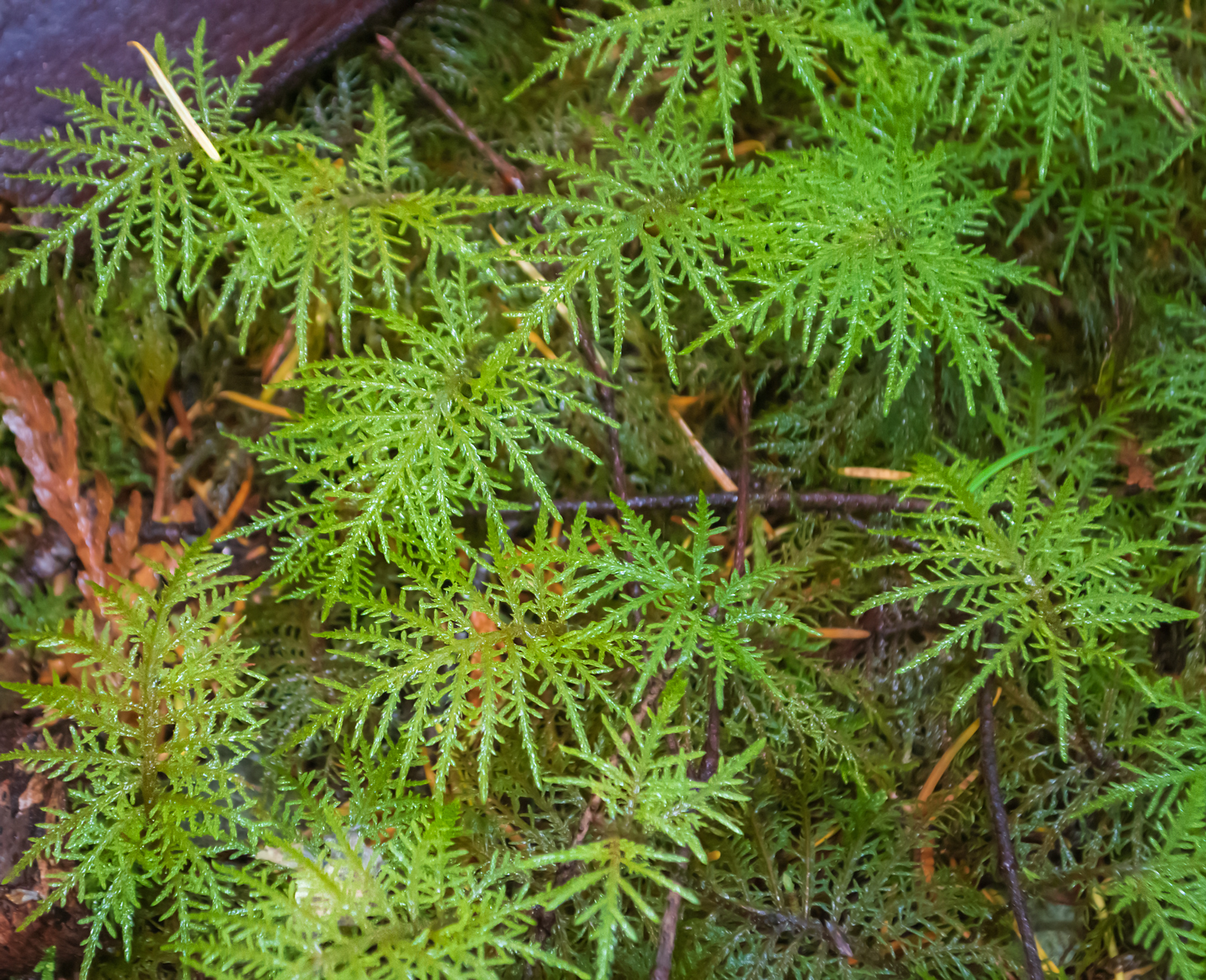
Delicate, fern-like leaves of step moss

And this month, now that the rains have returned, the forest floor is covered with flat-topped orange mushrooms, so many that, walking among the trees, I had to be careful where I put my feet to avoid crushing them.

Unidentified orange caps.

Slugs love them.

More mushrooms, other species, tomorrow.

~~~~~~~~~~~~~~~~~~~~~~~
El bosque alredededor del lago Roberts, aparte del borde donde le llega el sol, donde crecen árboles de hoja caduca, son, al nivel del ojo humano, de color café, y algo oscuro; una multitud de troncos de abetos de Douglas y cedro. Abajo, una alfombra verde, hecha del musgo Kindbergia oregana y los helechos perennes. Los arbustos de huckleberry proveen lucecitas verdes de adorno. En el verano, entre los helechos se encontraban Achlys, hoja de vainilla, y flores estrella; ahora en noviembre tan solo les quedan algunas hojas muertas.

Fotos: 1. El bosque, con un tronco cortado, desbaratándose, con su planta de huckleberry encima.

2 y 3. El musgo Kindbergia oregana.

Y ahora que ha vuelto a llover, el suelo está cubierto de hongos de sombrilla anaranjada, plana. Tantos hay que tuve que caminar con mucho cuidado para no aplastarlos.

Fotos 4 y 5. Los hongos. Uno está medio comido; obra de una babosa.

Mañana habrá más hongos, de otras especies.


Thursday, October 28, 2021

Brand new turkey tails

6 weeks ago, I came across a cut stump in the grass at the Campbell River museum. The cut surface was covered with a fungus I couldn't identify.

As seen, September 18, 2021

Searching for mushrooms again last week, I checked out the same stump. Look at it now!

Fresh new turkey tails.

So that's one mystery solved.

~~~~~~~~~~~~~~~~~~~~~~~

Hace mes y medio, encontré en un tronco viejo al lado del bosquecito del museo de Campbell River. Estaba cubierto de un hongo que no pude identificar.

Primera foto: el hongo como lo vi el 18 de septiembre.

La semana pasada, buscando hongos, volví a mirar el mismo tronco. Y ahora, ¡mira como se ha desarrollado!

Segunda foto: hongos "cola de pavo", Trametes versicolor.

Un misterio aclarado.


Monday, October 25, 2021

The timid mushrooms

 More of the museum grounds mushrooms. These are some of the tinies.

These are in a crack in the supports for the ancient donkey engine.

Pale pinkish mushrooms. A large Douglas fir cone measures up to 3.5 inches, so these mushrooms are about 2 inches across the cap.

White mushrooms, with Douglas fir cones, moss.

These last two photos were taken under mixed trees, conifers, big-leaf maple and alders, in the same spot where I found similar mushrooms last year.

Tiny mushroom on stumps of small shrubs. In the museum woods, under Douglas fir, big-leaf maples, and mixed understory shrubs.

More white muushrooms, and one of the slimy brownish ones. I found many of these, under leaves, already turned to mush.

Tomorrow; a batch of more showy mushrooms.

~~~~~~~~~~~~~~~~~~~~~~~~~~~~~

Estos son algunos otros de los hongos que encontré alrededor del museo anteayer; para el dia de hoy, los chiquitos.

  1. En una grieta en el soporte del antiguo "burro de vapor" afuera del museo.
  2. Unos hongos de un color de rosa muy pálido. Los conos de los abetos Douglas miden, a lo máximo, 9 cm. Por lo tanto, los sombreros de estos honguitos miden aproximadamente 4 cm.
  3. Honguitos blancos y más conos de abeto Douglas. Estos y los anteriores crecían bajo árboles coníferos y deciduos, arces de hoja grande, y alisos. El año pasado los encontré en el mismo sitio.
  4. En el bosquecito del museo, bajo abetos Douglas y arces de hoja grande, además de una variedad de arbustos nativos, este pequeño hongo crece en los troncos viejos de arbustos.
  5. Más de los hongos blancos, y uno café. Estos últimos son siempre mojados, viscosos. Encontré muchos debajo de las hojas, todos bien desmoronados ya.
Para mañana, tengo un grupo de hongos más llamativos.


Sunday, October 24, 2021

Stump edge mushrooms

 At the end of October last year, I searched the Campbell River museum grounds for mushrooms; there were many, of many different species. I looked again this year, after the first rains, finding few. It has been raining all month; yesterday there were mushrooms all over. A few were the same species as last year, in almost the same spots, but there were new ones, most surprisingly, these:

These were big! 6 inches across and more!

Out in the centre of the lawn. The stumps they are on are old, but the mushrooms weren't there last year.

Buttons on stump # 2. With a slug.

Buttons on stump # 1. With a slug bitten hole.

Stump # 3.

I think these were all Douglas fir stumps: at least the standing trees around this part of the lawn are Douglas firs.

Tomorrow, some of the other mushrooms I found.

~~~~~~~~~~~~~~~~~~~~

A finales de octubre del año pasado, estaba buscando hongos en los jardines y el bosquecito del museo de Campbell River. Había muchos, de muchas especies.Hace un mes, después de las primeras lluvias, volví al museo, pero encontré pocos. Ha estado lloviendo todo este mes; ayer di la vuelta otra vez, y había muchos hongos, algunos de los mismos del año pasado, y en los mismos sitios. Pero había algunos nuevos, incluyendo estos, una buena sorpresa a medio césped.

Fotos: los hongos miden hasta 15 cm. o un poco más. Todos crecen alrededor de tres troncos cortados y viejos, que creo son de abetos Douglas. En un hongo hay una babosa; a las babosas les encanta la carne de hongo.

Mañana subo algunos de los otros hongos que vi.

Sunday, November 01, 2020

Steam donkey decor

Beside the Campbell River Museum, an outdoor exhibit houses a steam donkey, built in 1916 and installed on the museum grounds 25 years ago. It rests on a log sled, probably a replacement of the original, but still well aged.

The donkeys, "donkey engines" we called them when I was a kid, were used to haul logs; I remember seeing (and hearing) them on the side hills chugging away, pulling logs out of the bush and down the slope to the waiting booms and tugs. They were powered by steam, using firewood as fuel. A small pile of lengths lies waiting beside the float, for the once yearly firing.

On the dry logs of the skids, out of the cracks, orange mushrooms are sprouting.

Orange all the way through. Maybe the false chanterelle, Hygrophoropis aurantiaca?

Another angle, showing the stem.


The principal fieldmarks are the orange to brown cap and stem, decurrent gills that are orange and dichotomously forked, and white spore deposit. It is common in the Pacific Northwest.(From E-Flora)

"Decurrent". The gills extend down the stalk. Towards the outer edge, some are forked. I didn't check the spores; there's no way I would kill those beauties!

~~~~~~~~~~~~~~~~~~~~


Al lado del museo de Campbell River, una presentación de equipo de explotación forestal luce una máquina a base de vapor, a la que llamamos "el burro". Este fué contruído en 1916, e instalado en el museo hace veinticinco años. Descansa sobre una base de troncos grandes, ya secos, probablemente más nuevos que la máquina que soportan.

Estas máquinas, que llamábamos "motores burro" cuando yo era niña, se usaban para transportar los árboles cortados (bastante grandes en aquel entonces), arrancándolos desde el bosque y depositándolos en el mar al pie de la montaña, donde les esperaban los barquitos remolcadores. La caldera se calentaba a base de leña; al lado del burro en el museo hay una pila de troncos esperando el evento anual cuando echan a andar la máquina.

Los grandes troncos de la base son ya viejos, secos, expuestos al sol y con buen drenaje como están. Y desde las grietas a lo largo del tronco, brotan hongos de un color café anaranjado.

Se me hace que pueden ser falsos rebezuelos. (Me puedo equivocar, facilmente.) Según el sitio E-Flora, se conocen por el color anaranjado o café tanto del tallo como del sombrerete, las agallas que se extienden hacia abajo en el tallo, y que se dividen en dos. Y por el depósito blanco de las esporas. Es muy común en esta región.

No traté de obtener una muestra de las esporas. No quise matar a ni uno de estos hongos.

Friday, October 30, 2020

Chicken and egg mushrooms

And more mushrooms. Mystery mushrooms; impossible to identify by sight alone. These are all growing on rotting (or very rotted) stumps, among Douglas-firs.

They look like fried eggs to me. Sunny side up. These are inside a disintegrating stump.

The stump itself is interesting. Here, just beside the mushroom's hole, are tracks of some largish bark borer, long gone.

Deep inside another small stump. The mushrooms look like soggy Turkey tail mushrooms. Very soggy, though, very soft. Blurry, even to the naked eye.

There are several species that cluster like this, in the same habitat: rotting wood, especially Douglas-fir.

Which came first, the mushroom that rotted the wood, or the rotted wood that fed the mushrooms?
~~~~~~~~~~~~~~~~~~~

Y más hongos. Hongos misterio, ya que no los pude identificar por la vista. Todos están creciendo en troncos podridos, algunos muy podridos, bajo árboles de abeto de Douglas.

Los primeros me parecen huevos fritos, sin voltear. Están dentro de un tronco ya listo para convertirse en polvo mojado. El tronco, de por si, también merece un vistazo; la segunda foto muestra las huellas de algún insecto que hace túneles bajo la corteza, que ya desapareció hace mucho.

Los hongos de la tercera foto estaban dentro de otro tronco bien podrido. Se parecen a los hongos comunes "cola de guajolote", pero remojados, aún en un dia de sol, suaves, borrosos a la vista.

Hay varios hongos que crecen en grupos apretados como los de la cuarta foto, todos en el mismo habitat: madera de coníferos podrida, especialmente en madera de abeto de Douglas.

El misterio del huevo y la gallina: ¿cuál vino primero; el hongo que pudrió la madera, o la madera podrida que alimentó al hongo?


Thursday, October 29, 2020

The museum "mushroom" mushrooms.

There are so many mushrooms around this month! Not only are they dotted all over the ground and logs, but there are many different species, more than I have seen in a long time.

These were a few of the ones I found in a walk around the museum grounds. Just the cliché "mushroom shape" mushrooms, for today. I haven't been able to identify any of them with any certainty. All but the first ones were under Douglas fir trees; all but the first and last, in the lawn.

Under mixed deciduous and evergreen trees. Dry, flat caps, with brown fibres.

A small one: see Douglas fir cone for size. And the yellow fly, of course.

These ones were wet and slimy looking. And there's another fly.

Beautiful violet colour.

A purplish grey mushroom, again with yellow fly. Slugs love mushrooms; these caps have several slug bites.

Could this be the Rosy Gomphidius? Obviously a slug favourite, anyhow.

A paler version? Or a different mushroom altogether?

This one was around the back, in waste land, deep shade. 

Tomorrow: fried egg 'shroom" (my name) and more.

~~~~~~~~~~~~~~~~~~


¡Hay tantos hongos este mes! Hay docenas y veintenas dondequiera que voy, y no solo de una o dos especies; también de estas hay docenas. No he visto tantos y de tantos tipos a la vez por muchos años.

Estos son los que vi en una vuelta alrededor del museo al fin de mi calle. Por hoy, nada más subí los hongos en forma estereotípica de hongo; tallo y sombrerete en forma de paraguas. No pude identificar a ninguno con alguna certeza. Todos, con excepción de los primeros, crecían bajo árboles abeto de Douglas; los primeros estaban en un grupo mixto de árboles.

A las babosas les gustan los hongos; varios de estos tienen grandes mordidas de babosa. El que tiene más, el hongo color de rosa oscura, puede ser (pero facilmente me puedo equivocar) el gomphidio rosado, tal vez el que sigue, también. El último crecía atrás del museo en suelo descuidado y casi a oscuras.

Mañana; más hongos, pero estos van a ser diferentes.


Powered By Blogger