Showing posts with label fallen leaves. Show all posts

Sunday, November 23, 2025

LBMs and two others.

There are always more mushrooms. Here's another half dozen, from the low-lying land beside the river.

Mica caps, Coprinellus micaceus. The caps go grey with age, toward the margins.

Unidentified. Interesting white borders.

LBMs. On bark of a living tree.

Stropharia ambigua. The gills (not shown) are a dark, purplish grey. A group of these covered a large grassy area, several metres across.

Another unidentified LBM, with moss and fir needles.

I was happy to see that my new mushroom guide book includes the LBM category, the Little Brown Mushrooms; it's even in the index. "... damnably difficult to put a name to," they say about some of these.
~~~~~~~~~~~~~~~~
Siempre hay más hongos. Estos se encuentran en la tierra baja al lado del rio.
  1. Coprinellus micaceus. Los sombreros se vuelven grises cerca de los bordes al envejecer.
  2. LBMs (Little Brown Mushrooms, honguitos color café) con márgenes blancos.
  3. Otros LBMs, estos creciendo en la corteza de un árbol vivo.
  4. Stropharia ambigua. Las laminillas (que no se ven aquí) eran de color gris oscuro, con un tinte morado. Un gran grupo de estos cubrían un area de varios metros de diámetro.
  5. Y otros LBMs, muy chicos, con musgos y agujas de abeto de Douglas.
Me dió gusto descubrir que mi nuevo libro guía sobre hongos incluye la categoría de LBM, los hongos pequeños color café; hasta pusieron este nombre en el índice. "... abominablemente difícil de ponerles nombres," dicen de algunos de estos hongos.

Sunday, November 16, 2025

Leaf sampler, with 'shrooms.

Most of Baikie Island's leaves are on the ground now, and rapidly turning black. They're hiding many mushrooms, which don't need sunlight; they get their food from plant-produced (originally) organic matter, just as we do. (One of the reasons why the fungi are considered closer to the animal kingdom than to the plants.) And when temperatures drop below zero, the rotting leaves will serve both as a heated blanket and as food for busy soil communities. 

The leaves here are cottonwood and big-leaf maple. Mushroom unidentified.

Unidentified mushroom, with big slug bites taken out. Cottonwood leaves and Douglas-fir needles (up to 3 cm. long).

A smaller yellow mushroom. Look for the 6 globular springtails.

Rough-stemmed, gilled, slug-bitten mushrooms. With red alder leaves, moss.

A clump of gilled mushrooms, with red alder, cottonwood, and big-leaf maple leaves.

I just received a new mushroom guide this afternoon; the Royal BC Museum Handbook; Mushrooms of British Columbia. With over twice as many mushrooms (350) as my go-to desk guide, and more detailed explanations, it is going to keep me reading for a while. On-line guides are good, but there are only so many pages you can keep open and the list of bookmarked sites gets unwieldy, and you can't really drop in a bit of notepaper with a bit of relevant detail added, or press a sample leaf there, so my little shelf of guidebooks above my desk gets a lot of activity. Paper books rule!

Tomorrow; Baikie Island puffballs.
~~~~~~~~~~~~~~
Casi todas las hojas caducas de la Isla Baikie ya están en el suelo, perdiendo sus colores, volviéndose negras. Esconden bajo su sombra muchos hongos, los cuales no necesitan la luz solar, porque obtienen sus nutrientes de sustancias orgánicas, producidas originalmente por las plantas, al igual que nosotros. (Esta es una de las razones por las cuales el reino de los hongos se considera más cercano al reino de los animales que al de las plantas.) Y  cuando llega el invierno con sus temperaturas bajo 0°, las hojas, pudriéndose, servirán tanto como cobija térmica como de alimento para las comunidades del suelo.
  1. Estas hojas son de arce de hoja grande, y de álamos. No pude identificar el hongo.
  2. Otro hongo sin identificación, con grandes mordidas de las babosas. Las hojas son de álamo, y las agujas de abeto de Douglas, que miden hasta 3 cm. de largo.
  3. Un honguito amarillo. Busca los 6 colémbolos.
  4. Hongos con tallos rugosos, con agallas, y mordidas de babosas. Las hojas son de aliso rojo.
  5. Un grupo de hongos con agallas, rodeados de hojas de álamo, aliso rojo, y arce de hoja grande.
Recibí esta tarde un nuevo libro guía; el Royal BC Museum Handbook; Mushrooms of British Columbia. Tiene más de doble el número de hongos (350) que los que tiene el guía que he estado usando, y descripciones muy detallados (aunque con letra muy chica; ni modo). Los sitios web son buenos y útiles, pero tener abiertas muchas pestañas resulta difícil, y la lista de sitios favoritos ya está demasiado grande, y no puedes insertar un papelito con tus propias observaciones para marcar tu lugar, ni guardar allí una hoja de muestra; razón por la cual mi pequeño estante de libros guía en mi escritorio está en uso constante.

Monday, November 03, 2025

Rioting colours

First week in November. The Big-leaf maples have shed most of their leaves, letting the sunlight reach the forest floor, where they've spread a carpet drenched in the warm colours of summer.

The fallen leaves

Pathway

Nurse stump

Catching the light

Reflections in Kitty Coleman Creek

Sit and rest a while.

Photos from Elk Falls and Kitty Coleman Provincial Parks.

~~~~~~~~~~~~
La primera semana de noviembre. Los arces de Hoja-Grande han dejado caer la mayoría de sus hojas, permitiendo colarse la luz del sol hasta el sotobosque, en donde han extendido una alfombra bañada con los colores cálidos del verano.
  1. Las hojas.
  2. Uno de los senderos.
  3. Tocón nodriza.
  4. En los rayos del sol.
  5. Reflejos en el riachuelo Kitty Coleman.
  6. Siéntate, descansa un rato.
Fotos de los parques provinciales, Elk Falls, y Kitty Coleman.

Monday, December 26, 2022

Understory greens

Now that the snow is gone, our world is mainly grey; the ocean is grey, the skies are grey, the mists on the mountaintops are grey. But inside a mixed deciduous and evergreen wood, brown takes over. In the little wood at the end of my block, the ground wears a brown carpet made up of dead alder leaves, rust-brown big-leaf maple leaves, fallen twigs, Douglas-fir cones and needles, crumbling wood. Far overhead, mostly, the Douglas-firs provide a greenish canopy, dark against the grey sky. Their trunks create a pillared wall all around. Also brown.

But the understory, the space between the soil beneath and the canopy overhead, even now in winter, after the deciduous leaves have melted into the brown carpet, the understory is suprisingly green.

Here's what I saw on a quick tour last week.
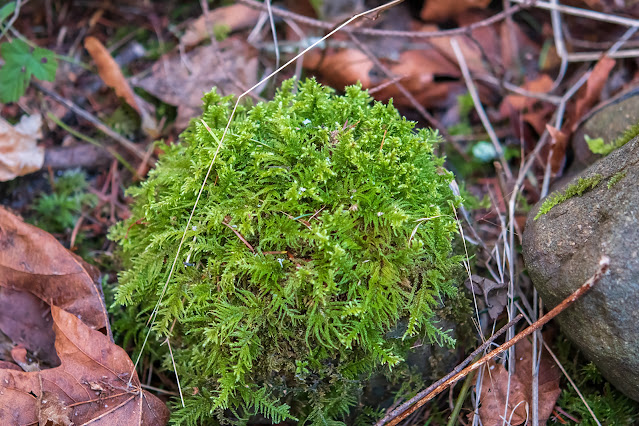
There's always moss. Here, a stone about the size of a canteloupr wears its cap of green.

Salal. They will retain their green leaves all winter.

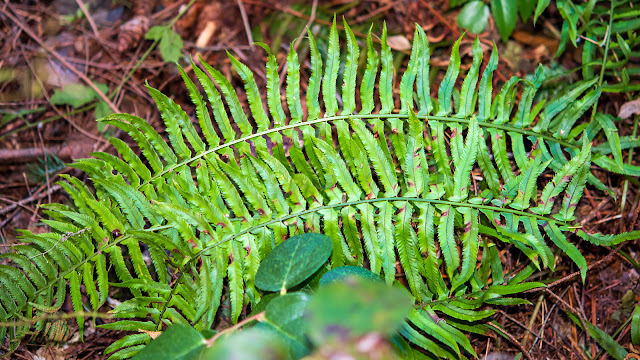
Evergreen sword ferns, bent down by the snow, but still green. Most other ferns have gone into hiding for the winter.

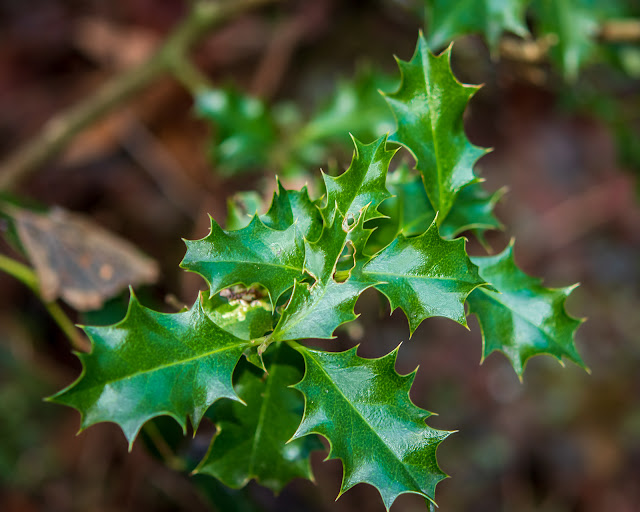
Holly. This is an invasive species, well adapted to our shady, damp forests.

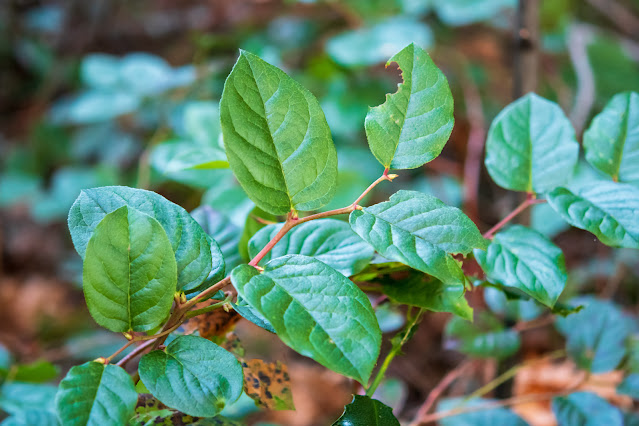
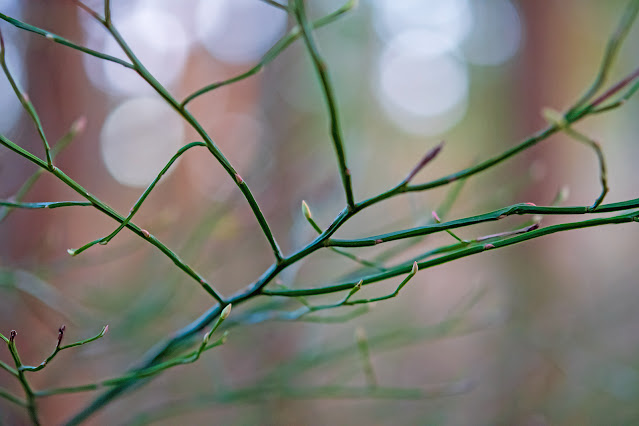
The huckleberry is a deciduous shrub, but its stems stay green all winter.

A few huckleberry leaves manage to hold on.

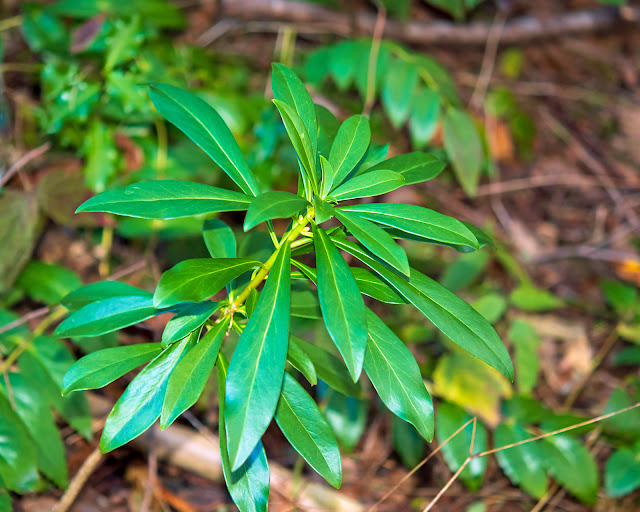
The native rhododendron, I think.

UPDATE: I've been warned that this is an invasive and poisonous species, Daphne laureola. I'll be carrying shears and a bag next time I'm in that bit of woods.

But there's more! Looking closely at those brown tree trunks, it turns out that many of them are green, too, covered with a ghostly-green dust lichen.
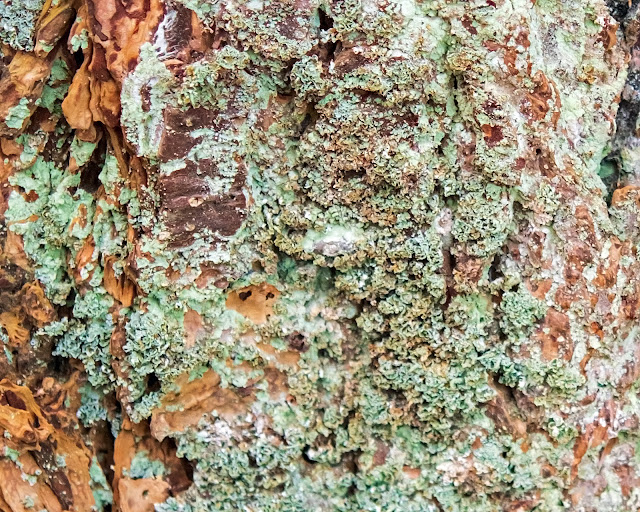
Coming in close, some are just dust, some are ruffled, like these. Possibly a Lepraria species.

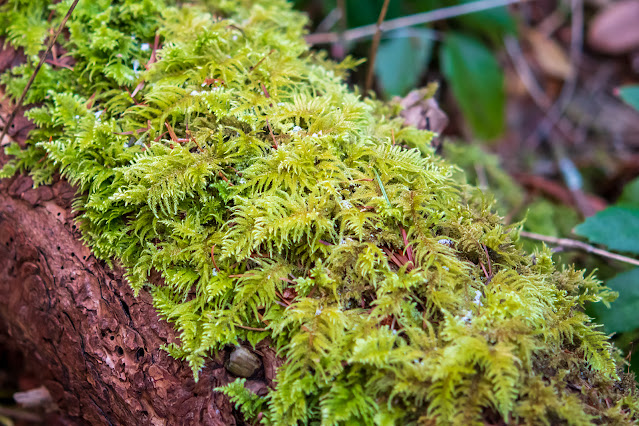
And, of course, we begin and end with moss.

The Oregon grapes were still green, but badly spotted or broken. I kept looking for a tidy one, and ended up at the end of the trail without a sample.

~~~~~~~~~~~~~~~~~~~~~~~~~~~~~~~~~~~
Ahora que la nieve se ha derretido, volvemos a nuestro mundo gris. El cielo es gris, el mar es gris, las neblinas en las montañas son todas grises. Pero en el centro de un bosque mixto de árboles de hoja caduca y los de hoja perenne, el color café predomina. En el bosquecito al pie de mi calle, el suelo lleva su alfombra color café hecha de hojas muertas de aliso, las hojas color tabique de arce de hoja grande, ramitas caídas, las piñas y agujas de abeto de Douglas, y madera desbaratada. Allá muy arriba, en gran parte, las copas de los abetos sigue verde, un verde oscuro en la tenue luz. Alrededor, pilares de troncos de abetos forman una pared, también de color café.

Pero el sotobosque, ese espacio entre el suelo y la bóveda allá arriba, aun ahora en invierno, cuando las hojas de arce y aliso se han unido al suelo, ese sotobosque se mantiene verde todavía.

Estas plantas las vi en una vuelta por el bosque la semana pasada.

Fotos:
  1. Musgo. Siempre hay musgo. Esta piedra, como del tamaño de un melón, lleva su sombrerito de musgo.
  2. El salal, Gualtheria shallon. Estos se mantienen bien verdes sea cual sea el clima.
  3. Los helechos de espada son de hoja perenne. Otros helechos se han reducido a raices por el invierno.
  4. El acebo. Esta es una especie invasora, bien adaptada a nuestro clima.
  5. El arándano "huckleberry" pierde casi todas sus hojas, pero los tallos siguen verdes.
  6. Aquí unas hojas quedan sin caerse.
  7. El rododendro nativo, creo.
  8. Y hay más. Mirando de cerca esos troncos oscuros, se ve que están cubiertos de unos líquenes crustosos, de un color verde fantasma. Creo que son una especie de los Lepraria.
  9. Empezamos y terminamos con musgos. Porque siempre hay musgos.
También había muchas uvas de Oregón, Mahonia spp. pero todos tan manchados y rotos por la nieve. Iba buscando una entera, y llegué a la salida del bosque sin ver ni una.


Tuesday, October 26, 2021

Fallen-leaf-coloured mushrooms

 And there are still more mushrooms! These blend in nicely with the colours of the fallen leaves.

Freckled mushroom with big-leaf maple and fresh dandelion leaves.

These are orange and slimy. And covered with springtails.

Tan leaves, tan mushrooms

One of the first freckled mushrooms, turning black. With herb-robert leaves.

I long ago gave up trying to identify most mushrooms; there are too many look-alikes, and they change so rapidly. Tomorrow, though, I think I can ID tomorrow's mushrooms. More or less, anyhow.

~~~~~~~~~~~~~~~~~~~~~~~~~~
¡Y todavía hay más hongos! Estos van bien con los colores de las hojas caídas.

  1. Hongo mediano con puntitos alzados. Con hojas secas de arces de hoja grande y hojas frescas de diente de león.
  2. Estos hongos anaranjados llevan la capa viscosa, y traen un grupo de colémbolos.
  3. Hojas color café claro, con hongos en los mismos tonos.
  4. Este es uno de la misma especie que los primeros, pero ya se está volviendo negro. Las hojas son de geranio silvestre, Geranium robertianum.
Hace mucho que dejé de tratar de identificar la mayoría de los hongos; hay tantos que se parecen entre sí, y cambian tan rapidamente. Pero mañana, creo, voy a poder ponerle nombre a unos honguitos. Creo.


Monday, October 25, 2021

The timid mushrooms

 More of the museum grounds mushrooms. These are some of the tinies.

These are in a crack in the supports for the ancient donkey engine.

Pale pinkish mushrooms. A large Douglas fir cone measures up to 3.5 inches, so these mushrooms are about 2 inches across the cap.

White mushrooms, with Douglas fir cones, moss.

These last two photos were taken under mixed trees, conifers, big-leaf maple and alders, in the same spot where I found similar mushrooms last year.

Tiny mushroom on stumps of small shrubs. In the museum woods, under Douglas fir, big-leaf maples, and mixed understory shrubs.

More white muushrooms, and one of the slimy brownish ones. I found many of these, under leaves, already turned to mush.

Tomorrow; a batch of more showy mushrooms.

~~~~~~~~~~~~~~~~~~~~~~~~~~~~~

Estos son algunos otros de los hongos que encontré alrededor del museo anteayer; para el dia de hoy, los chiquitos.

  1. En una grieta en el soporte del antiguo "burro de vapor" afuera del museo.
  2. Unos hongos de un color de rosa muy pálido. Los conos de los abetos Douglas miden, a lo máximo, 9 cm. Por lo tanto, los sombreros de estos honguitos miden aproximadamente 4 cm.
  3. Honguitos blancos y más conos de abeto Douglas. Estos y los anteriores crecían bajo árboles coníferos y deciduos, arces de hoja grande, y alisos. El año pasado los encontré en el mismo sitio.
  4. En el bosquecito del museo, bajo abetos Douglas y arces de hoja grande, además de una variedad de arbustos nativos, este pequeño hongo crece en los troncos viejos de arbustos.
  5. Más de los hongos blancos, y uno café. Estos últimos son siempre mojados, viscosos. Encontré muchos debajo de las hojas, todos bien desmoronados ya.
Para mañana, tengo un grupo de hongos más llamativos.


Powered By Blogger