Showing posts with label Kitty Coleman Park. Show all posts

Friday, January 16, 2026

A matter of size

"The largest surviving (Douglas-) Fir in the Comox Valley." So reads the sign I found at the base of a tree in Kitty Coleman Park.

The lower end of the trunk.

Well. I had to check the numbers. This one measures 58 metres tall (but the top has been lopped off, so it would have been taller) and has a diameter at the base of 2.7 metres. Big, but not exceptionally so.

The largest Douglas-fir in Cathedral Grove, 60 km. to the southwest, is slightly larger, measuring 76 metres tall, and with a diameter of 2.9 metres.

Sorting through my Dad's old photo albums yesterday for a family project, I found one of him in Cathedral Grove, with one of these big trees.

Big Douglas-Fir, Dad, 1991.

Dad was 1.76 metres tall. (They made people shorter back in his day.) Comparing him to the tree behind him, it looks like they measured the diameter right down at soil level.

The largest Douglas-fir in Canada, and some say in the world, by volume, is the Red Creek Fir here on Vancouver Island, in Port Renfrew, on the southwest coast. It measures 74 metres tall and has a diameter of 4.2 metres at a height of 1.37 metres above ground.

All these trees are between 600 to 1000 years old, and have survived our periodic forest fires; Douglas-fir is good at that, the older trees having an extra-thick bark that can tolerate a medium-intensity fire.

Back to this particular tree's history:

The sign.
Legend: 
Douglas Fir.
Kitty Coleman Beach Class "C"  Provincial Park has may (sic) large Douglas Fir growing in the Park. This Douglas Fir is the largest in the Park to have survived early logging on the British Columbia Coast. This tree was to be cut down, but was saved as the under cut was put in the base of the tree, the marks are still visible.
It was noticed around 1970 that the top part of the tree was dead. The die back continued, and in 1992 an arborist climbed the giant Fir, swinging over from a balsam tree near by. He then trimmed the top below the center rot, this procedure saved the tree from more die back, giving the tree more years of growth.
The age of the tree can be determined by it's (sic) growth rings.
The giant Fir has been, and is at this time, supporting a large eagle nest near the top.
This Douglas Fir is considered to be the largest surviving Fir in the Comox Valley. It is estimated to be 600 to 800 years old. It has a circumference of 28 feet and a height of 190 feet.
Kitty Coleman Beach Class "C" Provincial Park Board.
It was raining too hard and it was too foggy up top to see the eagle's nest. But I stopped to look at the depth of those creases and holes in the bark. The bark may be 30 or more centimetres thick on a mature tree, and the fissures may go right down to the inner layer. These were not quite that.

Deeply fissured bark.

While I was there, I stopped to look at another Douglas-fir, this one growing a good collection of conks.

The whole interior of the tree must be full of fungal mycelium.

Probably Red-belted Polypore, Fmetromitopsis mounceae. The broken one exposes the struture of the pores.

~~~~~~~~~~~~~~~

"El Abeto de Douglas sobreviviente más grande en el valle Comox." Así dice el letrero que vi junto a un árbol en el Parque Provincial Kitty Coleman.

    1. Foto de la parte inferior de este árbol.

Bueno, tuve que comparar esos números. Este árbol alcanza 58 metros de altura (pero le han cortado, o estaría más alto) y tiene un diámetro de 2.7 metros. Es grande, pero nada excepcional.

El abeto de Douglas más grande en Cathedral Grove, a 60 km. hacia el sudoeste, en un poco más grande, midiendo 76 metros de altura, y con un diámetro de 2.9 metros.

Ayer estaba examinando unos álbumes viejos de mi Papá, planeando un proyecto familiar, y encontré una foto suya, tomada en Cathedral Grove, con uno de estos árboles grandes.

    2. Cathedral Grove, 1991.

Papá medía 1.76 metros. (En esos dias, todos eran un poco más chaparros.) Comparándole con el árbol, parece que midieron el diámetro a nivel del suelo.

El abeto de Douglas más grande en Canadá, y dicen algunos, en el mundo, por su volumen, es el Abeto de Red Creek aquí en la isla, en Port Renfrew, en la costa sudoeste, Mide 74 metros de altura y tiene un diámetro de 4.2 metros a una altura de 1.37 metros sobre el nivel del suelo.

Todos estos árboles tienen de 600 a 1.000 años, y han sobrevivido nuestros repetidos incendios forestales : los abetos de Douglas maduros tienen la corteza muy gruesa, y pueden tolerar un incendio mediano.

Regresando a la historia de este árbol, el del parque KC:

    3. El letrero.

Texto del letrero:
Legend: 
Abeto de Dougla
Muchos abetos de Douglas grandes crecen en el Parque Provincial Clase "C" Kitty Coleman. Este abeto de Douglas es el más grande que ha sobrevivido la tala de madera en la costa de Columbia Británica. Este árbol fue designado para la tala, pero lo salvaron cuando ya se había hecho la primera corte en la base; todavía se ven las huellas.
Se observó cerca de 1970 que la copa del árbol estaba muerta. La parte muerta siguió aumentando, y en 1992, un arborista se trepó al abeto gigante, llegando por medio de un álamo cercano. Cortó la copa debajo de la zona podrida; este procedimiento previno mortalidad subsiguiente, dando al árbol más años de crecimiento.
La edad de un árbol se puede determinar por medio de sus anillos de crecimiento.
El abeto gigante ha sostenido, y todavía sostiene un gran nido de águilas cerca de la copa.
Este abeto de Dougas se considera que es el abeto más grande que todavía existe en el valle Comox. Se estima que tiene de 600 a 800 años de vida. Tiene una circunferencia de 28 pies y una altura de 190 pies.
Kitty Coleman Beach Class "C" Provincial Park Board.
La lluvia y la neblina me hicieron imposible ver el nido de los águilas. Pero examiné lo hondo de esas grietas y agujeros en la corteza. Esta corteza puede llegar a más de 30 cm. de espesor en un árbol maduro, y las fisuras pueden alcanzar hasta la capa interior de la corteza. Estos no llegaban a tanto.

    4. Corteza hondamente agrietada.

Camino de regreso, me detuve para mirar otro abeto de Douglas; este está completamente invadido por hongos políporos.

    5. La madera de este árbol estará totalmente infiltrado por el micelio del hongo.

    6. Probablemente son Fomitopsis mounceae. El hongo roto expone a la vista la estructura de los poros.


Saturday, November 08, 2025

Everyone behaves except for the gulls.

The file was labelled "assorted birds". But then I decided to add a moth, since it was all alone in its file. So now it's a collection of winged beasties seen in the last week or so.

The moth. Sleeping on blackberry leaves. One of the Noctuinae, cutworm and dart moths. It's late in the season for these.

Gull. Just a gull. Behaving.

Gulls misbehaving. Being gulls.

I had been watching a gull argument for a bit before I remembered the camera. They were on the far side of the river, disagreeing over possession of that guano-stained rock. One would sit on the rock, and the other would attack, chase his rival away and claim the rock for himself. The dispossessed one would then sit on the other stone for a brief moment, (Catching his breath? Considering the angles? Muttering gullish imprecations?) then leap to the attack. This was the fourth round that I saw. They were still going at it when I turned and headed down the trail again.

Harlequin male, Kitty Coleman PP.

Great blue heron with golden reflections. Kitty Coleman creek.

More activity on the far side of the river. A small flock of mergansers (8 or 10) were slowly heading upstream, with occasional stops to do a bit of fishing.

Red-breasted merganser, female. Off Kitty Coleman PP.

~~~~~~~~~~~~~~

El archivo tenía el título "pájaros, varios". Pero decidí añadir una mariposa nocturna, porque era la única foto en el  archivo apropriado. Estos, entonces son el conjunto de los animales con alas que vi en las últimas semanas.

  1. La mariposa nocturna. Una de las Noctuinae, las mariposas, etapas adultas del gusano cortador. Es un poco pasado el tiempo normal para encontrar estas polillas.
  2. Gaviota. Portándose bien.
  3. Gaviotas, portándose mal, como de costumbre. Había estado observando esta "discusión" por unos minutos antes de acordarme de la cámara. Las gaviotas estaban en la orilla opuesta del rio, disputando sobre la posesión de esa roca manchada con guano. Una se sentaba en la roca, y la otra atacaba, forzando su enemigo a abandonar el puesto, y entonces declarándose la dueña. La que perdió se posaba unos momentos sobre la segunda piedra — ¿Recobrando el aliento? ¿Considerando los ángulos de ataque? ¿Refunfuñando? — y luego saltaba al aire y volvía al ataque. Este era el cuarto "round" de los que vi. Cuando me di vuelta y seguí mi camino, todavía estaban peleando.
  4. Un pato Arlequín, macho. En el Parque Provincial Kitty Coleman.
  5. Una garza azul, con reflejos amarillos.
  6. Otra vista a la orilla opuesta del rio. Una bandada de serretas (unas 8 o  10) nadaban rio arriba, contra la corriente. Lentamente, pausando de vez en cuanto para buscar presa en el fondo.
  7. Una serreta mediana hembra. Estas no tienen la división marcada entre cabeza y pecho.

Wednesday, November 05, 2025

In mushroom heaven

Soil composed of rotting wood, leftover evergreen needles and cones, dead leaves (mostly Big-leaf maple), and water. Always water; does this soil ever dry out? I doubt it. Add a carpet of several layers of dying maple leaves over a base of moss. Sopping wet, of course; it's been raining most days lately.

Between these two layers, wet soil and dripping leaves, it's mushroom heaven. These are some of the ones I saw in Kitty Coleman Provincial Park this week.

Amanita muscaria, the fly amanita. So poisonous, but so pretty!

One of the Russulas. These mushrooms open up while they're still underground, then push their way up carrying a load of the dirt that covered them. This one even kept a few stones.

Coral mushroom, probably the Upright Coral, Ramaria stricta.

Dyer's polypore, Phaeolus schweinitzii.

And the very common Red-belted polypore, Fomitopsis mounceae. I don't know how these got so stained, high up out of the splash zone on the tree.

While this one, and its neighbours, near the ground, are all pure white underneath.

I'm leaving a couple for tomorrow.

~~~~~~~~~~~~

Un suelo compuesto de madera podrida, agujas viejas y piñas de los árboles coníferos, hojas muertas principalmente de arce de hoja grande, y agua. Siempre hay agua; ¿se secará alguna vez este terreno? Lo dudo. Encima de esto, una alfombra de varias capas de hojas recién caídas sobre una base de musgos. Empapada esta alfombra, claro; llueve casi todos los dias en esta temporada.

Entre estas dos capas. tierra mojada y hojas hechas sopa, hay un paraíso para los hongos. Estos  son unos de los que vi esta semana en el parque provincial Kitty Coleman.

  1. Amanita muscaria. Tan tóxicos, pero ¡tan bellos!
  2. Uno de los russulales. Estos hongos se forman completamente bajo la superficie del suelo, y luego se alzan, trayendo consigo la tierra que los cubría. Este se trajo hasta unas piedritas.
  3. Hongo coralino, probablemente Ramaria stricta.
  4. El poliporo de los tintoreros, Phaeolus schweinitzii.
  5. El muy común poliporo de cinta roja, Fomitopsis mounceae. No entiendo como es que estos terminaron tan manchados, creciendo allá arriba en el tronco, a una buena distancia del suelo.
  6. Cuando estos, apenas unos 30 a 50 cm. del suelo todos resultaron tan limpios.
Dejo unos hongos para mañana; hongos parásitos.


Monday, November 03, 2025

Rioting colours

First week in November. The Big-leaf maples have shed most of their leaves, letting the sunlight reach the forest floor, where they've spread a carpet drenched in the warm colours of summer.

The fallen leaves

Pathway

Nurse stump

Catching the light

Reflections in Kitty Coleman Creek

Sit and rest a while.

Photos from Elk Falls and Kitty Coleman Provincial Parks.

~~~~~~~~~~~~
La primera semana de noviembre. Los arces de Hoja-Grande han dejado caer la mayoría de sus hojas, permitiendo colarse la luz del sol hasta el sotobosque, en donde han extendido una alfombra bañada con los colores cálidos del verano.
  1. Las hojas.
  2. Uno de los senderos.
  3. Tocón nodriza.
  4. En los rayos del sol.
  5. Reflejos en el riachuelo Kitty Coleman.
  6. Siéntate, descansa un rato.
Fotos de los parques provinciales, Elk Falls, y Kitty Coleman.

Wednesday, April 03, 2019

Half-seen birds

... at Kitty Coleman Park.

Cawing crow, mostly in silhouette. On a hemlock branch.

Happy harlequins, on a calm sea.

And in the forest, a woodpecker pounded away on a tree, over and over, pausing between each sequence; to dig out a grub? Listen for fleeing grubs? Wait for his brain to stop ringing? Not long, anyhow. I heard him, walked down the trail until I located the tree, and stood squinting against the light, trying to see the bird. Impossible. Until he decided to switch trees, and I caught a glimpse of his shadow as he disappeared behind a fat old Douglas fir.


Tuesday, April 02, 2019

New white trilliums

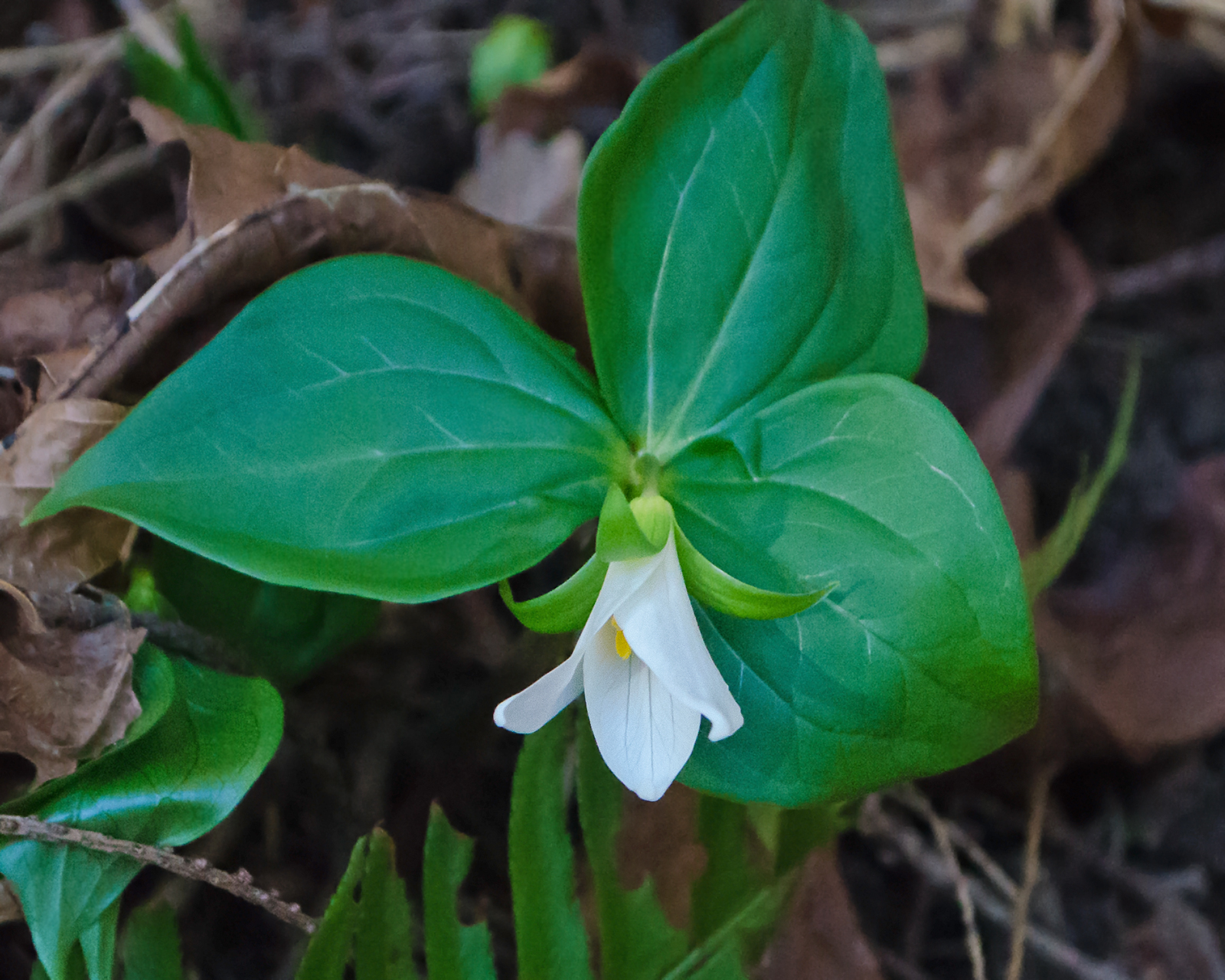
Spring. There are flowers everywhere, yellow, pink, purple. Under the trees in the shady woods at Kitty Coleman Park, a short drive south of here, white trilliums were joining in.

Trillium ovatum, the Western trillium. White when they're new, turning pink as they age.

Most were still barely open.

Fully open, these will spread the three petals almost flat.

This is an "ant plant". My guide book, Plants of Coastal British Columbia (Mackinnon and Pojar), explains:

"Each seed has a little, oil-rich appendage that is attractive to ants.The ants lug the seeds back to their nests, where they eat the appendages or feed them to the larvae and then discard the remaining seeds on their rubbish piles. This is a reasonably effective mechanism for seed dispersal, especially for plants of the dim, becalmed forest floor. Ants disperse up to 30% of the spring-flowering, herbaceous species in the deciduous forests of eastern North America. Our forest flora is less dependent, but we do have several spring-flowering "ant plants", including bleeding heart, inside-out flower and wild ginger, as well as trilliums."

The Kitty Coleman forest is mostly evergreen; cedar, hemlock, old-growth Douglas fir, and sword fern, with a few red alders to provide more shade in the summertime. I didn't see any ants.


Powered By Blogger