Showing posts with label dyer's polypore. Show all posts

Wednesday, November 05, 2025

In mushroom heaven

Soil composed of rotting wood, leftover evergreen needles and cones, dead leaves (mostly Big-leaf maple), and water. Always water; does this soil ever dry out? I doubt it. Add a carpet of several layers of dying maple leaves over a base of moss. Sopping wet, of course; it's been raining most days lately.

Between these two layers, wet soil and dripping leaves, it's mushroom heaven. These are some of the ones I saw in Kitty Coleman Provincial Park this week.

Amanita muscaria, the fly amanita. So poisonous, but so pretty!

One of the Russulas. These mushrooms open up while they're still underground, then push their way up carrying a load of the dirt that covered them. This one even kept a few stones.

Coral mushroom, probably the Upright Coral, Ramaria stricta.

Dyer's polypore, Phaeolus schweinitzii.

And the very common Red-belted polypore, Fomitopsis mounceae. I don't know how these got so stained, high up out of the splash zone on the tree.

While this one, and its neighbours, near the ground, are all pure white underneath.

I'm leaving a couple for tomorrow.

~~~~~~~~~~~~

Un suelo compuesto de madera podrida, agujas viejas y piñas de los árboles coníferos, hojas muertas principalmente de arce de hoja grande, y agua. Siempre hay agua; ¿se secará alguna vez este terreno? Lo dudo. Encima de esto, una alfombra de varias capas de hojas recién caídas sobre una base de musgos. Empapada esta alfombra, claro; llueve casi todos los dias en esta temporada.

Entre estas dos capas. tierra mojada y hojas hechas sopa, hay un paraíso para los hongos. Estos  son unos de los que vi esta semana en el parque provincial Kitty Coleman.

  1. Amanita muscaria. Tan tóxicos, pero ¡tan bellos!
  2. Uno de los russulales. Estos hongos se forman completamente bajo la superficie del suelo, y luego se alzan, trayendo consigo la tierra que los cubría. Este se trajo hasta unas piedritas.
  3. Hongo coralino, probablemente Ramaria stricta.
  4. El poliporo de los tintoreros, Phaeolus schweinitzii.
  5. El muy común poliporo de cinta roja, Fomitopsis mounceae. No entiendo como es que estos terminaron tan manchados, creciendo allá arriba en el tronco, a una buena distancia del suelo.
  6. Cuando estos, apenas unos 30 a 50 cm. del suelo todos resultaron tan limpios.
Dejo unos hongos para mañana; hongos parásitos.


Thursday, March 21, 2024

Oldie but goodie

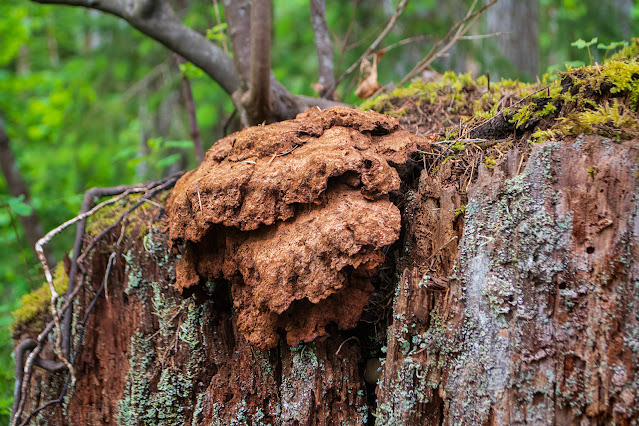
Every now and then I come across these huge, messy, broken mushrooms. They're dark brown, sometimes almost black, almost shapeless, looking like stacked cow pies. And they hide in the darkest corners of the forest, where they blend in with crumbly, rotten wood, or the duff at the roots of old trees.

We came across a couple on top of a stump where trees have been felled, allowing sunlight to penetrate. And these still have kept their shape.

Old Dyers' polypore

Second stack.

And they are intact enough to show the bands of darker colour near the edges.

I've posted photos of a typical messy one, a couple of years ago:

Stacked cow pies.

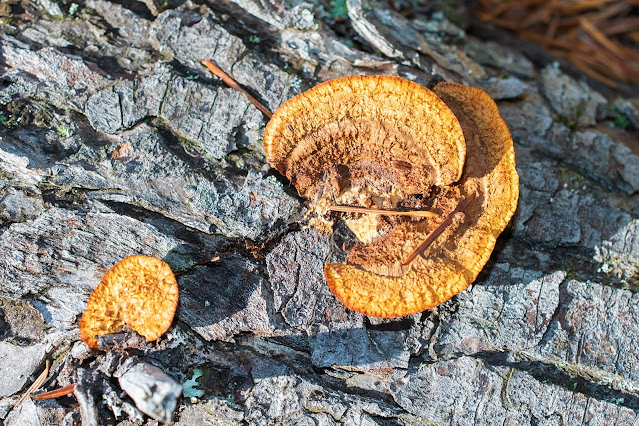
I gave up trying to identify this one. Another one I found later, with yellow bands and all, I just called "shelf fungi".

Taken with flash. Without, I couldn't see the yellow.

I keep looking for unbroken examples and never seem to find any. But actually, I have, and didn't realize it; when I finally identified the latest ones as Dyer's polypores, Google came up with hundreds of photos. Except that mostly, this is not what they look like. Young, they're pale brown, with yellow or white edges and bands. I've probably seen them many times, thinking they were possibly turkey tails. Large turkey tails; Dyers' polypores grow up to 30 cm. across.

Here's a young specimen, found on iNaturalist, and found just south of here. iNaturalist has dozens of reports from local sites.

Image by sooillus, Creative Commons.
Young fruiting bodies are little more than yellowish, velvety blobs. (FungusFactFriday)
Here's a photo of a youngster, by Michael Kuo, on MushroomExpert.Com:

A yellowish, velvety blob.

These mushrooms are durable; the big, dark ones I've been finding are last year's fruiting bodies. 
When the mushroom first emerges, the entire surface is covered in velvety yellow tissue that stains brown immediately when touched. This is the mushroom’s actively growing surface. As a testament to this fact, the stains on the tissue don’t last long; within an hour or two bruised areas become bright yellow again as new growth covers up the injury (amazingly, this can happen even after a mushroom has been picked). (FungusFactFriday)
I'll try that on the next "yellowish, velvety blob" I find.

~~~~~~~~~~~~~~~
De vez en cuando encuentro unos hongos muy grandes, medio desbaratados, de color café oscuro hasta casi negro. A veces es difícil identificarlos como hongos; más bien parecen madera podrida. Y se esconden en los sitios más oscuros del bosque.

Encontramos dos encima de un tocón cerca de donde habían caído unos de los árboles, dejando entrar unos rayos de luz. Y éstos todavía se mantienen casi enteros.

Fotos:
1, 2. Phaeolus schweinitzii, el poliporo de los teñidores. Hasta preservan las bandas de color.

3. Hace dos años, subí esta foto de uno más típico. No pude identificarlo.

4. Luego encontré éste, y con el flash se veían las bandas amarillas. Hongo repisa, dije, sin saber la especie.

Siempre estoy buscando ejemplares enteros, sin encontrarlos. O así pensaba. Resulta que los he visto muchas veces, creyendo que eran "colas de pavo". Una vez que identifiqué estos últimos como 
Phaeolus schweinitzii, Google me dió cientos de fotos. Lo que pasa es que normalmente no se parecen a estas masas oscuras. Nuevos, son hongos de un color café claro o hasta crema, con bordes y bandas blancas y amarillas. 

5. Un poliporo de los teñidores joven; esta foto la encontré en iNaturalist, y es uno de docenas registrados muy cerca de aquí. 

6. "Los cuerpos fructíferos nuevos son apenas unas masas amarillentas, aterciopeladas." (FFF) Esta foto fue tomada por Michael Kuo, (MushroomExpert.com)

Los hongos no desaparecen al final de la temporada; los que están completamente cafés son los del año pasado.
Al principio, cuando el hongo apenas brota, toda la superficie está cubierta de terciopelo amarillo, el cual se vuelve café de inmediato al tocarlo. Esta es la superficie que está en crecimiento activo, lo que se puede comprobar viendo que las manchas en el tejido no duran; dentro de una o dos horas las areas entintadas vuelven a recuperar su color amarillo brillante, con tejido nuevo que cubre la parte dañada. (Sorprendentemente, esto puede ocurrir aun cuando el hongo ha sido cortado.) (FungusFactFriday)
Voy a hacer la prueba en el próximo "masa amarillenta, aterciopelada" que encuentro.

Tuesday, November 07, 2023

Fungi in search of a good home

 Some mushrooms like soil, others look for wood. But not just any wood; it has to be the right kind, the right age, even the right location. But how do they find it, in a broken environment? For example, in a forest where there are scattered logs, some conifers, some deciduous, some green, some old and dry, some exposed, many hidden under a thick coating of moss. And the mushrooms which grow on these logs drop their spores vertically from gills or pores on the underside, sometimes barely millimetres away from the wood; how, then, do they manage to find a good home on the right sort of log many metres away?
Rusty gilled polypore,Gloeophyllum saepiarium, almost flat on the log.

Rusty gills on the end of a log; here the spores have a better chance, it seems.

Dyer's polypore, Phaeolus schweinitzii, on the ground under dead wood.

The spores are formed in the gills or pores; when they are ready, they are expelled into the space between the gills and gravity pulls them down. And then? 
Once the spore has fallen below the bottom edge of the mushroom cap, and is clear of the gills, it strikes air that is not still. Even on what looks like a windless day, there are always slight breezes. While a human may not feel them, they are usually strong enough to be felt by a spore that is only about a hundredth of a millimetre long. These micro-breezes may pick up the spore and carry it higher into the air and away from the parent mushroom. The spore may come to rest a metre or a kilometre or even further away from the mushroom. (AustralianFungi)
And this helps, too: 
Here we show that evaporative cooling of the air surrounding the pileus (the cap) creates convective airflows capable of carrying spores at speeds of centimeters per second. Convective cells can transport spores from gaps that may be only 1 cm high and lift spores 10 cm or more into the air. This work reveals how mushrooms tolerate and even benefit from crowding and explains their high water needs. (PNAS)

Crowded gilled mushrooms on a log.

Witches' butter forms its spores on the surface of the jelly. This allows the spores also to be carried by rain.

Witches' butter, Tremella mesenterica, on maple. It grows only on deciduous wood.

~~~~~~~~~~~~~~~
A algunos hongos les gusta vivir en el suelo; otros buscan sitios en madera. Pero no cualquier madera: son exigentes, y tiene que ser la madera de su tipo favorito, de la edad adecuada, y hasta en el ambiente preferido. Pero, ¿cómo la van a encontrar, en un sitio variable? Por ejemplo, en un bosque donde hay troncos caídos, algunos coníferos, otros de hoja caduca, algunos todavía verdes, otros bien secos, algunos expuestos al aire y al sol, otros bajo una gruesa cobija de musgos. Y los hongos que crecen en estos troncos dejan caer sus esporas desde laminillas o poros en la superficie inferior, donde a veces apenas milímetros les separa de la madera. ¿Cómo es, entonces, que logran instalarse en otro sitio en un tronco adecuado tal vez a muchos metros de distancia de su origen?

Fotos:
  1. Un políporo, Gloeophyllum saepiarium, creciendo casi pegado al tronco.
  2. Otros de la misma especie en el extremo del tronco; aquí parece que las esporas tienen mejor posibilidad de viajar.
  3. Un políporo, Phaeolus schweinitzii. Este está creciendo en el suelo debajo de madera muerta.
Las esporas se forman dentro de las laminillas o los poros; cuando están listos, se lanzan al espacio entre las laminillas y caen al aire libre. ¿Y entonces?

Una vez que la espora ha caído debajo del borde del sombrero y queda libre de las laminillas, se encuentra en aire inquieto. Aun en lo que parece un dia sin viento alguno, siempre hay una brisa ligera, que aunque no la puede sentir un humano, normalmente es suficientemente fuerte como para que la sienta una espora que mide apenas un centésimo de un milímetro. Estas mini-brisas pueden levantar la espora, llevarla para arriba y transportarla lejos del hongo original. La espora puede depositarse a un metro, un kilómetro, o aun más lejos del hongo. (AustralianFungi)

Y esto puede ser de ayuda también:
Aquí demonstramos que el enfriamiento por evaporación del aire que rodea el sombrero crea corrientes de aire por convección que son capaces de llevar las esporas a velocidades de varios centímetros por segundo. Zonas convectivas pueden transportar las esporas desde espacios que miden solamente 1 cm. verticalmente y levantarlas 10 cm. o más al aire. Este trabajo demuestra como es que los hongos toleran y hasta reciben beneficio por vivir apiñados; también explica su necesidad de una suficiencia de agua. (PNAS)

Foto:
    4. Hongos con laminillas creciendo amontonados en un tronco.
    5. La "mantequilla de brujas", Tremella mesenterica, forma sus esporas en la superficie de la masa gelatinosa. Esto permite que las esporas se dispersan con la lluvia. Estas estan creciendo en un tronco de arce. Vive únicamente en madera caducifolia.


Powered By Blogger