Showing posts with label rusty-gilled polypore. Show all posts

Monday, November 11, 2024

LBMs, mostly.

 And continuing with the mushrooms. I went out looking for birds, and, of course, came home with more mushroom pics. And a couple of birds; photos still to be processed.

These mushrooms are from the hillside above Elk Falls.

Fly agaric, Amanita muscaria

An appetizing chocolatey brown mushroom. Deer mushroom, maybe?

Growing on old wood.

Small, gilled, translucent. And so shiny!

Growing in a crack in a wet log.

Half hidden under step moss.

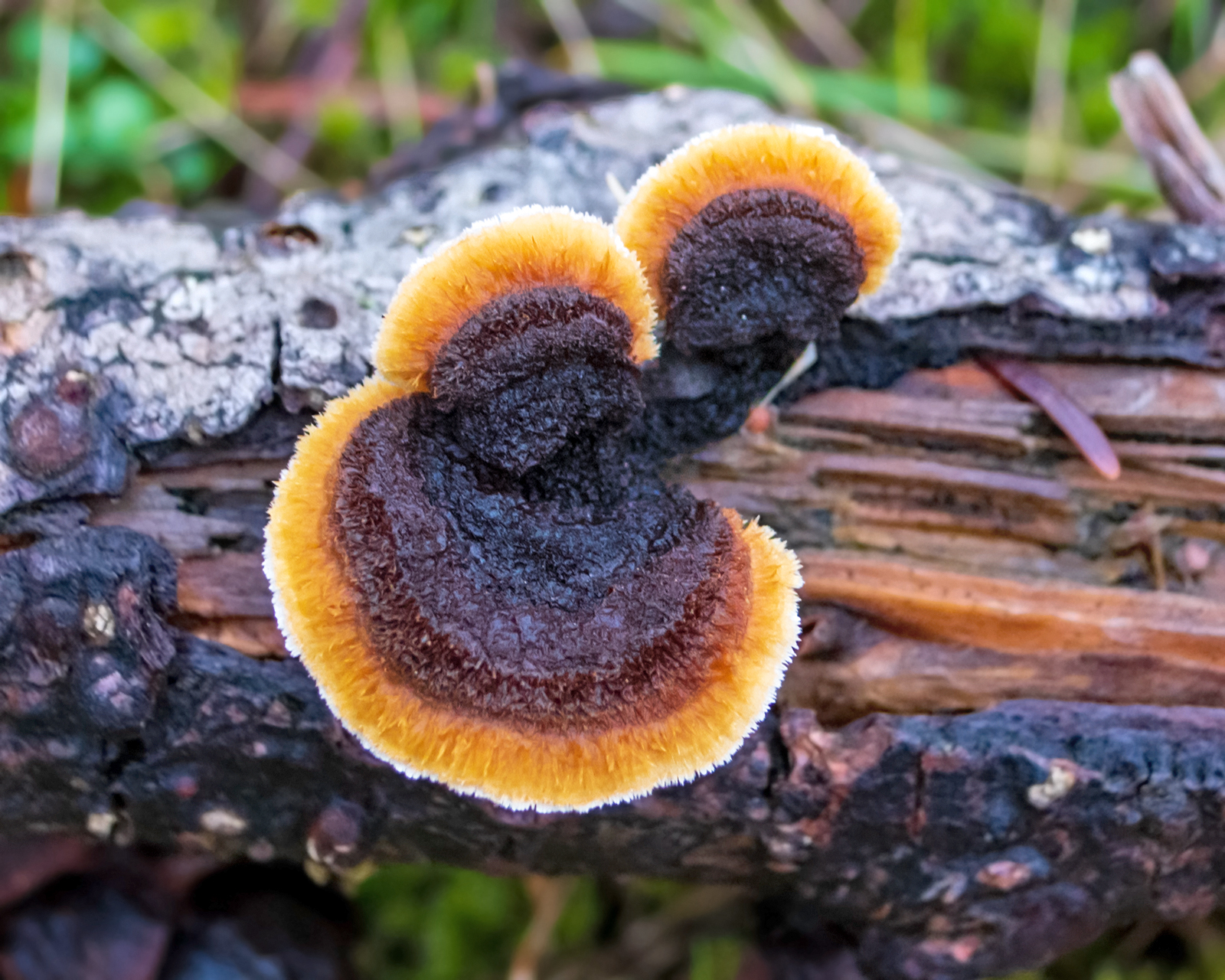
A young Rusty-Gilled polypore, Gloeophyllum saepiarium.

And it's still raining. Mushroom weather.

~~~~~~~~~~~~~
Siguiendo con las fotos de hongos. Salí a buscar pájaros, y regresé a casa con más fotos de hongos. Como era de esperar; sigue lloviendo a diario. (Pero sí encontré unos pajaritos. Las fotos quedan por procesar.)

Estos hongos son algunos de los que vi en las laderas arriba de las cataratas.
  1. Amanita muscaria. Muy venenoso, muy bello.
  2. Un hongo color de chocolate. Pluteus cervinus, el hongo de los venados, tal vez.
  3. Un grupo de pequeños creciendo en madera podrida.
  4. Un hongo muy pequeño, con laminillas, translúcido. ¡Y muy lustroso!
  5. Este crece en un grieta en un tronco mojado.
  6. Hongo medio escondido entre musgos Hylocomium splendens.
  7. Políporo de laminillas rojizas, juvenil, Gloeophyllum saepiarium.
Los meteorológicos se pueden ir de vacaciones. Va a llover casi todos los dias en lo que resta del mes. Los hongos están felices.


Tuesday, November 07, 2023

Fungi in search of a good home

 Some mushrooms like soil, others look for wood. But not just any wood; it has to be the right kind, the right age, even the right location. But how do they find it, in a broken environment? For example, in a forest where there are scattered logs, some conifers, some deciduous, some green, some old and dry, some exposed, many hidden under a thick coating of moss. And the mushrooms which grow on these logs drop their spores vertically from gills or pores on the underside, sometimes barely millimetres away from the wood; how, then, do they manage to find a good home on the right sort of log many metres away?

Rusty gilled polypore,Gloeophyllum saepiarium, almost flat on the log.

Rusty gills on the end of a log; here the spores have a better chance, it seems.

Dyer's polypore, Phaeolus schweinitzii, on the ground under dead wood.

The spores are formed in the gills or pores; when they are ready, they are expelled into the space between the gills and gravity pulls them down. And then? 
Once the spore has fallen below the bottom edge of the mushroom cap, and is clear of the gills, it strikes air that is not still. Even on what looks like a windless day, there are always slight breezes. While a human may not feel them, they are usually strong enough to be felt by a spore that is only about a hundredth of a millimetre long. These micro-breezes may pick up the spore and carry it higher into the air and away from the parent mushroom. The spore may come to rest a metre or a kilometre or even further away from the mushroom. (AustralianFungi)
And this helps, too: 
Here we show that evaporative cooling of the air surrounding the pileus (the cap) creates convective airflows capable of carrying spores at speeds of centimeters per second. Convective cells can transport spores from gaps that may be only 1 cm high and lift spores 10 cm or more into the air. This work reveals how mushrooms tolerate and even benefit from crowding and explains their high water needs. (PNAS)

Crowded gilled mushrooms on a log.

Witches' butter forms its spores on the surface of the jelly. This allows the spores also to be carried by rain.

Witches' butter, Tremella mesenterica, on maple. It grows only on deciduous wood.

~~~~~~~~~~~~~~~
A algunos hongos les gusta vivir en el suelo; otros buscan sitios en madera. Pero no cualquier madera: son exigentes, y tiene que ser la madera de su tipo favorito, de la edad adecuada, y hasta en el ambiente preferido. Pero, ¿cómo la van a encontrar, en un sitio variable? Por ejemplo, en un bosque donde hay troncos caídos, algunos coníferos, otros de hoja caduca, algunos todavía verdes, otros bien secos, algunos expuestos al aire y al sol, otros bajo una gruesa cobija de musgos. Y los hongos que crecen en estos troncos dejan caer sus esporas desde laminillas o poros en la superficie inferior, donde a veces apenas milímetros les separa de la madera. ¿Cómo es, entonces, que logran instalarse en otro sitio en un tronco adecuado tal vez a muchos metros de distancia de su origen?

Fotos:
  1. Un políporo, Gloeophyllum saepiarium, creciendo casi pegado al tronco.
  2. Otros de la misma especie en el extremo del tronco; aquí parece que las esporas tienen mejor posibilidad de viajar.
  3. Un políporo, Phaeolus schweinitzii. Este está creciendo en el suelo debajo de madera muerta.
Las esporas se forman dentro de las laminillas o los poros; cuando están listos, se lanzan al espacio entre las laminillas y caen al aire libre. ¿Y entonces?

Una vez que la espora ha caído debajo del borde del sombrero y queda libre de las laminillas, se encuentra en aire inquieto. Aun en lo que parece un dia sin viento alguno, siempre hay una brisa ligera, que aunque no la puede sentir un humano, normalmente es suficientemente fuerte como para que la sienta una espora que mide apenas un centésimo de un milímetro. Estas mini-brisas pueden levantar la espora, llevarla para arriba y transportarla lejos del hongo original. La espora puede depositarse a un metro, un kilómetro, o aun más lejos del hongo. (AustralianFungi)

Y esto puede ser de ayuda también:
Aquí demonstramos que el enfriamiento por evaporación del aire que rodea el sombrero crea corrientes de aire por convección que son capaces de llevar las esporas a velocidades de varios centímetros por segundo. Zonas convectivas pueden transportar las esporas desde espacios que miden solamente 1 cm. verticalmente y levantarlas 10 cm. o más al aire. Este trabajo demuestra como es que los hongos toleran y hasta reciben beneficio por vivir apiñados; también explica su necesidad de una suficiencia de agua. (PNAS)

Foto:
    4. Hongos con laminillas creciendo amontonados en un tronco.
    5. La "mantequilla de brujas", Tremella mesenterica, forma sus esporas en la superficie de la masa gelatinosa. Esto permite que las esporas se dispersan con la lluvia. Estas estan creciendo en un tronco de arce. Vive únicamente en madera caducifolia.


Monday, January 30, 2023

Fans, eggs, and a yellow ball

 At the edge of a little woodland, a recently-fallen dead branch came down with its crop of fungi.

One end of the branch.

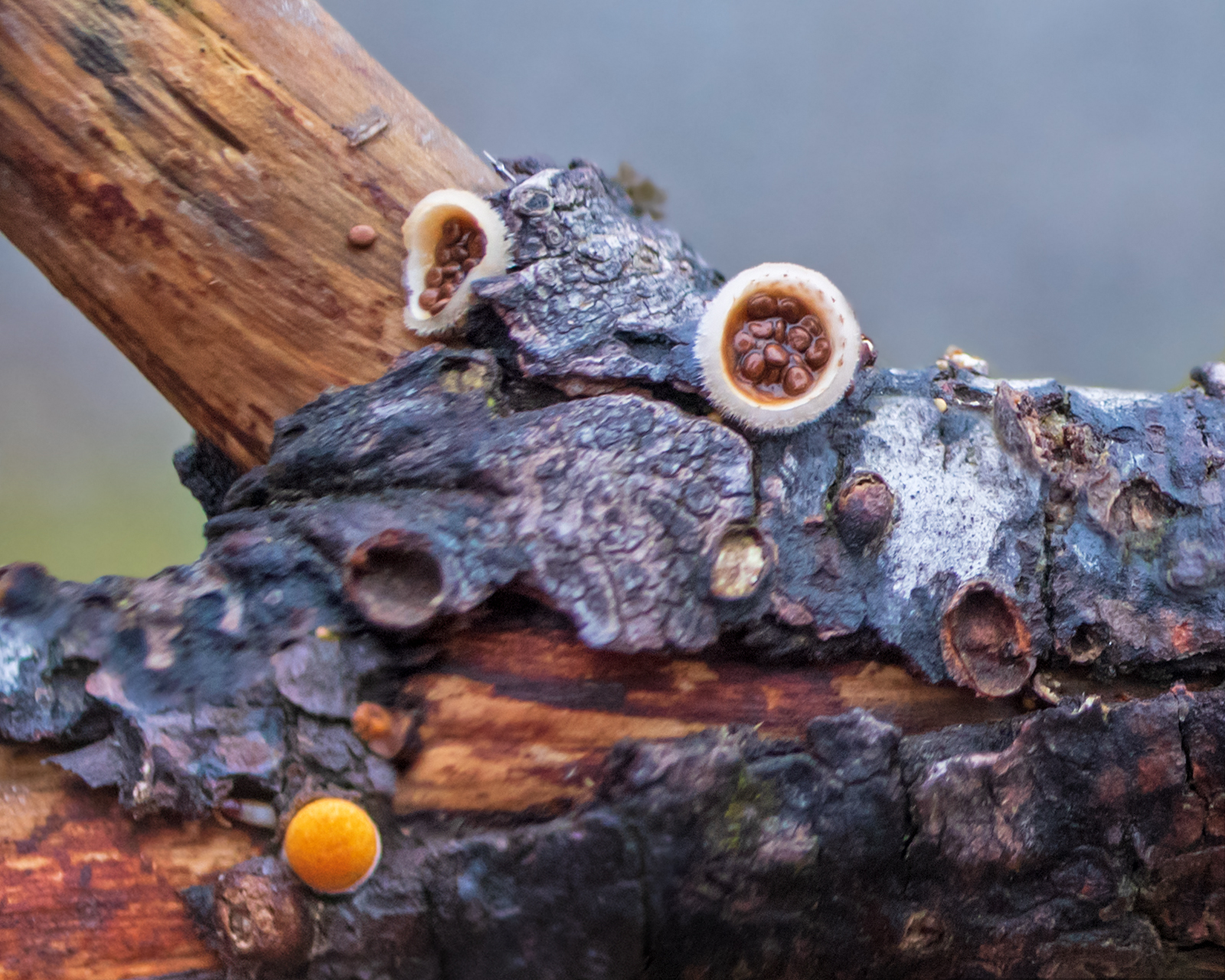
Seen on this end: Rusty-Gilled polypore, keeping a lookout, two birds' nests full of "eggs", the beginnings of a liverwort, another birds' nest, empty, and that yellow thing, unidentified.

3 Rusty-Gilled polypore fans. Gloeophyllum saepiarium.

These are all tiny; the branch is little more than 3 cm. across at its widest point. The birds' nests are a fraction of that.

Birds' nests, yellow ball, and what is that poking out from under the bark beside it?

I can't identify that tiny, pinhead yellow ball with a white foot. The colour of orange jelly or witches butter, but so perfectly rounded, and a bit fuzzy looking.

UPDATE: I've been told that the yellow ball is an immature birds' nest, a younger version of the two above it.

Zooming in on a bird's nest. Looks like a bowl of beans in broth on a frilly placemat.

The "eggs" are spore cases, peridioles. When it rains, drops will splash them out to start new nests. One is already freed, to the left of the twisted nest.

~~~~~~~~~~~~~~~~~~~~~~~~~
Al borde de un bosquecito, una rama caída, ya muerta, trae su carga de una variedad de hongos.

Foto #1: Un extremo de la rama. Con un hongo poliporo "de agallas rojizas" que mantiene vigilancia sobre el camino, dos hongos nido llenos de "huevos", una hepática apenas empezada, otro nido de ave, pero sin huevos, y esa pelotita amarilla que no pude identificar. Todo esto muy pequeñito; la rama, a lo más, mide 3 cm. de diámetro.

Foto #2: Otros tres abanicos del poliporo, Gloeophyllum saepiarium.

Foto #3: Los hongos nido, la pelotita amarilla, y ¿qué será esa cosa que se asoma desde debajo de la corteza a la izquierda?

No puedo identificar esa pelota amarilla. Tiene el color de jalea anaranjada, Dacrymyces chrysospermus, o de mantequilla de brujas, Tremella mesenterica, pero tan perfectamente redonda, y con ese base blanco.

*Puesta al dia: Ahora me han dicho que la pelotita amarilla es uno de los mismos hongos nido, en su forma inmadura.

Foto #4: Un hongo nido en macro. Parece un plato de caldo con frijoles grandes, sobre un mantelito individual. Los "huevos" son sacos de esporas, llamados periodolos. Cuando llueve, gotas de lluvia botarán estos periodolos fuera del recipiente, listos para empezar nuevos nidos. Se ve uno, ya libre, al lado izquierdo del nido torcido.


Tuesday, February 08, 2022

Undecided

I stopped to take a few more photos of the Rusty-gilled polypores, Gloeophyllum sepiarium, and this time, I remembered to look at the underside of one of the larger ones.

And yes, they have gills!

The thing is, these are polypores. And polypores have pores; that's in their name, poly + pore, many pores. The spores are released from these pores, falling down into the soil or wood.

Pores on the underside of a red-belted polypore, under the microscope.

So why do we still call these polypores if they have gills? Because they do have pores, mixed in among the gills. Sometimes many, sometimes few, but the pores are there. Sometimes the gills grow long, to look like the "teeth" of a toothed mushroom; as if they haven't decided yet where they fit in the classification index. 

Turning it over, it remained firmly attached to its log; it was stiff and leathery. When I released it, it bounced back without cracking.


Right-side up again.

~~~~~~~~~~~~~~~~~~~~~~~~~

Me detuve para sacar más fotos de los hongos Gloeophyllum sepiarium, el poliporo de laminillas color rojo oxidado, y esta vez los volteé para ver la parte inferior.

Foto 1. Un hongo, mostrando las laminillas.

La cosa es que estos son poliporos. Y los poliporos tienen poros. Está en el nombre; muchos poros. Las esporas salen de estos poros, cayendo sobre la tierra o madera donde crecerán los nuevos honguitos.

Foto 2: Los poros de un poliporo de cinta roja, vistas bajo mi microscopio.

Pues, si estos hongos tienen laminillas, ¿porqué los clasificamos entre los poliporos? Porque sí tienen los poros, pero están mezclados entre las laminillas. A veces hay pocos, a veces muchos, pero siempre los hay. A veces las laminillas se hacen largas, pareciendo a los "dientes" de los hongos dentudos. Como si este honguito no se haya decidido en que parte del índice de especes quiere pertenecer.

Al voltear el hongo, se mantuvo firmemente adherido a su tronco. Tenía una textura como de cuero, tieso, y cuando lo solté, regresó a su forma anterior, sin agrietarse.

Tercera foto: Aquí está, de vuelta ya en su postura normal.
 

Powered By Blogger