Showing posts with label Oyster Bay Shoreline Park. Show all posts

Thursday, March 12, 2026

Busy, busy; spring is coming!

On an ancient piling holding back the dike at Oyster Bay, a swarm of yellow jackets are setting up housekeeping.

Western Yellowjacket, Vespula pennsylvanica European paper wasp, Polistes dominula.

These pilings have been here since the 1920s or '30s. Most have almost rotted away.

Many of the yellowjackets were crawling about deep down in these cracks.

And at the top of the piling, a tiny spider caught himself a fly. I caught up with him as he carried it down a blackberry cane to his lair on the bank.

Zebra spider, Salticus scenicus.

~~~~~~~~~~~~~
En uno de los pilotes antiguos que retienen el dique en Oyster Bay, un enjambre de avispas se están consruyendo un nido.

    1. Avispa europea, Polistes dominula. 

    2. Estos pilotes han detenido el dique desde los años entre 1920 y 1940. Casi todos están ya bien podridos.

    3. Muchas de las avispas estaban en el centro del pilote, entrando y saliendo de estas grietas.

    4. Y la punta del pilote una arañita saltarina capturó una mosca. Aquí la está llevando a su escondite, usando una rama de mora como puente. Araña cebra, Salticus scenicus.

Monday, March 09, 2026

Marching lichens

Coming up from the beach at Oyster Bay through the dunes towards the little woods, I found that the lichens and mosses have expanded their footprint; they've moved out of deep shade and into the open area at the edge of the dunes. These mosses, lichens, and mushrooms were all growing in semi-shade; I found some out in the open, far from the trees.

Lichen agaric, Lichenomphalia umbellifera. The dark green coating on the wood is the algal component of the lichen.

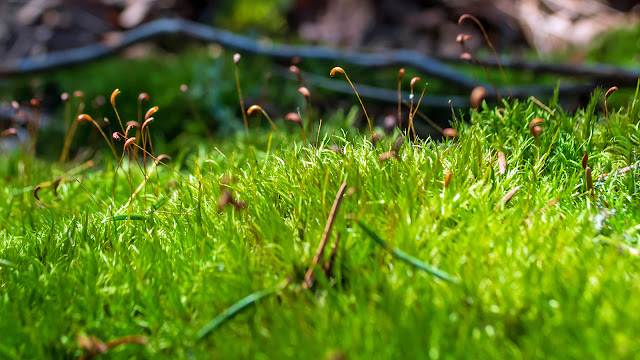
Moss sporophytes and two species of Cladonia lichens.

An old log covered with pixie-cup Cladonia lichens.

Rusty-gilled polypore, Gloeophyllum sepiarium. AKA Conifer Mazegill

An old, twisty log end, wrapped in moss and Cladonia lichens.

~~~~~~~~~~~~~~

Subiendo desde la playa en Oyster Bay, cruzando las dunas hacia el bosquecito, descubrí que los musgos y líquenes han extendido su territorio; donde antes se veían en la sombra profunda bajo los árboles, ahora han colonizado la orilla de las dunas, con poca sombra.

  1. Lichenomphalia umbellifera. La masa verde oscuro que cubre la madera es el componente algal del lichen; los honguitos son el cuerpo fructífero de este liquen.
  2. Esporofitos de musgo y dos especies de líquenes Cladonia
  3. Tronco viejo cubierto de líquenes copa de hada, Cladonia sp.
  4. Políporo, Gloeophyllum sepiarium.
  5. Tronco torcido envuelto en musgos y líquenes Cladonia.

Monday, October 27, 2025

Laughing Gym and Poison Pie?

First mushrooms of the season from the Oyster Bay little woods. All summer it was too dry, and I didn't see even one there. And now they're all over.

These are big mushrooms. I've tentatively identified them as "Laughing Gym", Gymnopilus ventricosus. It is reputed to be hallucinogenic.

They grow on logs and stumps.

Another big 'shroom. The Western Painted Bolete, Suillus lakei.

It stains easily, turning brown when touched. And it's bluish towards the bottom of the stalk.

These next three photos are of similar mushrooms. Or maybe they're all the same species. Hard to tell, really. Image searches turn up a long list of possibles; small, white, gilled mushrooms with flattish caps that change as they age. A poisonous Amanita sp. is among the look-alikes, as is the Poison Pie.

Unidentified. These ones are wet from the morning's rain.

Google image search defines these as "Poison Pie", Hebeloma crustuliniforme. They were slimy on top.

Another white "umbrella" mushroom.

I've posted all these to iNaturalist; so far, nobody has weighed in.

Next: on to the mushrooms from the museum, in two batches; lawn mushrooms and those I found in the museum 5 acre (2 hectares) forest.

~~~~~~~~~~~~~

Estos son los primeros hongos que veo desde el principio del verano en el bosquecito de Oyster Bay. En todo el verano no había ni uno. Ahora, ya que ha estado lloviendo, los hay por todas partes.

    1. Estos son hongos grandes. Creo que son los que llaman "Gimnasio hilarante (o que se rie)", Gymnopilus ventricosus. Tiene fama de ocasionar alucinaciones.

    2. Crecen en madera vieja, de troncos y tocones.

    3.Otro hongo grande; este es uno de los boletales, que tienen poros en vez de laminillas, el Boletal Pintado Occidental, Suillus lakei.

    4. Se mancha facilmente, volviéndose café al tocarlo. Y tiene un tinte azul en el extremo inferior del tallo.

Las tres fotos siguientes son de hongos muy similares. O puede ser que son todos de la misma especie; es difícil saber con certeza. Una búsqueda por imagen da como resultado una lista larga de honogs posibles; hongos pequeños, blancos, con laminillas y sombreros algo aplanados. Y que cambian de forma y otras características al envejecer. Entre ellos se nombra uno de los Amanita sp., que es venenoso, al igual como el muy parecido "Pastel venenoso".

    5. Sin identificación. Estos están mojados después de la lluvia matutina.

    6. Con la búsqueda por imagen de Google, repetida con información sobre el sitio, sale el "Pastel venenoso", Hebeloma crustuliniforme. Estos estaban algo gelatinosos.
   
    7. Otro, sin identificación. Otro de los típicos hongos en forma de paraguas.

He subido las fotos a iNaturalist, pero hasta ahora, nadie ha añadido alguna identificación.

Siguiente: los hongos que vi en el terreno del museo, en dos grupos; los que crecen en el césped, y los que encontré en el bosquecito (2 hectáreas) atrás del estacionamiento.


Wednesday, April 16, 2025

Underfoot

I found Blue Eyed Marys blooming today in the Oyster Bay meadow; from my elevated view, standing on my own two feet, they were just a sprinkling of blue specks on the ground.

Blue Eyed Mary, Collinsia parviflora. The large leaves are wild strawberry.

Growing thickly together. The red stems are hairy.

All around the blue-speckled patches, the ground is covered with this tiny, tiny moss, dry and a bit scratchy to lie on. (To take the photos; they were too small for kneelers)

Racomitrium sp., maybe Elongate Rock Moss, R. elongatum. The green leaf is a new blade of grass.

And the tide was low: sandy findings next.

~~~~~~~~~~~~~~
Hoy encontré las flores "María de los Ojos Azules" en la pradera de Oyster Bay. A primera vista, mientras yo estaba de pie, apenas se veía una salpicadura de puntitos azules entre las hierbas en el suelo.
  1. "María de los Ojos Azules", Collinsia parviflora. Las hojas más grandes son de fresa silvestre.
  2. Así crecen, todos apilados. Los tallos rojos llevan pelos.
  3. Alrededor de las flores, el suelo está cubierto con este musgo pequeñísimo; se sentía seco y algo rasposo al acostarme encima. (Para sacar las fotos; son tan chicos que no los alcanzaba a ver claro de rodillas.) Son Racomitrium sp., tal vez  R. elongatum. La  hoja verde es una hoja nueva de pasto.
Y la marea estaba muy baja; lo que vi en la arena, mañana.


Sunday, March 23, 2025

Medicine for my eyes

I've been peering at tinies, straining to see distant birds against the light, sorting photos of millimetre-long lichen squamules; now I need a long view, sea and sky and faraway mountain peaks, to rest my eyes.

View from the dike, Oyster Bay. Looking northeast towards the BC mainland.

From the shore beyond the dike. The snowy peaks are on the mainland, the nearest 100 km away. With one of those distant birds; a gull in the clouds.

I always pause to look at Mittlenatch Island in the centre of the strait. It stands alone, refusing to wear the coastal rainforest green.

Zooming 'way in. You can almost see the big California sea lions resting along the water line. They'll be there until mid-summer.

Mitlenatch Island (11 km. from my spot on the shore) lies in a rain shadow; rain falls here, and over on the islands behind it, but rarely on Mitlenatch. So it is mainly bare rock, with a top dressing of grasses. There are even flowering cacti!

Now, back to those lichens.

A Skywatch post.
~~~~~~~~~~~~~~

He estado examinando flores miniaturas, tratando de ver pájaros contra la luz en la distancia, revisando fotos de escamas de liquen midiendo uno o dos milímetros; ahora necesito refrescar los ojos con una vista amplia. Mar y cielo y nieve en las montañas lejanas; medicina para ojos cansados.
  1. Vista desde el dike en Oyster Bay, mirando al noroeste, hacia el continente.
  2. Vista ahora desde la playa. Las montañas nevadas están en el continente; la más cercana a unos 100 kilómetros de esta isla.
  3. Siempre me detengo a mirar la isla Mittlenatch, situada en el centro del estrecho, a 11 km. desde esta playa. La isla se encuentra bajo una sombra de lluvia; recibe menos de la mitad de la cantidad de lluvia que cae aquí o en las islas del otro lado del estrecho, con el resultado de que la isla consiste principalmente de roca expuesta, con hierbas bajas adornando las grietas en la roca. ¡Hasta hay cactus que florecen cada verano!
  4. Haciendo zoom. Casi se pueden ver los leones marinos de California que duermen en las rocas a la orilla; permanecerán en estas rocas hasta mediados del verano.
Y ahora, regreso a los líquenes.

Tuesday, February 11, 2025

Meadow plants under snow

It's slow going, walking through new snow. Especially when last summer's flowers keep making me stop. Like walking through an art gallery; stop, stare, go on to the next, repeat...

Queen Anne's lace and grasses in the Oyster Bay meadow.

Yarrow among the logs.

Gumweed (on the right) and yarrow.

The same Queen Anne's lace, from a different angle.

Yarrow with hats

And yet more hatted yarrow.

It's 9° below zero tonight. The snow on the ground is crispy; it crunches underfoot.

~~~~~~~~~~~~~
Las hierbas que en verano cubrían la pradera y las dunas de Oyster Bay, ahora en invierno me hacen detenerme para admirarlas contra la nieve virgen.
  1. Zanahoria silvestre, Daucus carota. Aquí se conoce como "Encaje de la Reina Ana".
  2. Milenrama, Achillea millefolium.
  3. Grindelia integrifolia, aquí conocida como hierba goma. Y, a la izquierda, más milenrama.
  4. La misma planta de zanahoria silvestre, vista desde otro ángulo.
  5. Milenrama con sombreritos de nieve.
  6. Y más milenrama.
Esta noche estamos a 9 grados bajo cero. La nieve por encima lleva una capa de hielo, crujiente bajo mis botas.


Saturday, November 16, 2024

Last of the 'shrooms?

 I keep finding mushrooms. The first three of these are from Oyster Bay, this week.

This looks like an Amanita, but I've never seen one that drooped like this before.

LBM, with gills and scaly stalk.

Mixed media; yarrow, dead leaves, wild strawberry leaves (green), moss, grass, old wood, and these brown mushrooms.

This one's a leftover from the summer, in Brown's Bay. A guttating polypore on the end of a log.

It's still raining, but they're expecting snow by Monday. We may be nearing the end of mushroom season.

~~~~~~~~~~~~~~~~~
Sigo encontrando hongos. Los primeros tres aquí crecían en el bosquecito de Oyster Bay esta semana.
  1. Se parece a un Amanita sp., pero nunca antes he visto uno que se haya derretido de esta manera.
  2. Otro hongo LBM, con agallas y con un tallo escamoso.
  3. "Medios mixtos". Una foto con todo: hojas de milenrama, hojas muertas, hojas verdes de fresa silvestre, musgos, pasto, madera quemada, y esos hongos cafés.
  4. Esta foto se me había olvidado. Encontré el políporo este verano en Brown's Bay. La producción de estas gotas de agua desde el interior del hongo se llama gutación.
Y sigue lloviendo, pero pronostican que habrá nieve el lunes. Puede ser que llegamos al fin de la temporada de hongos.


Tuesday, October 15, 2024

A profusion of fungi

So many mushrooms! I went out yesterday down a trail I hadn't followed before, alongside the Quinsam River, and stuffed the camera with another several dozen, mostly different species than the ones from the Oyster Bay little woods; every area has its own mix.

Processing, processing ... And I've still got to check the museum grounds at the end of my street.

Anyhow, these are some of the ones from Oyster Bay last week.

Cystodermella sp., possibly C. granulosa.

The same mushroom in a field of lichens (2 species) and mosses (2, too).

Log topper: Cladonia lichens, 2 mosses, a scattering of LBMs, and Lichen agarics; 2 of the parasol mushrooms, and quite a bit of the non-fruiting stage; that dark green smear on wood.

More of the LBMs. Possibly Xeromphalina sp.

Mushroom in the grass.

The same mushroom, flipped. Unidentified, but I know it's not a Russula, because the stem didn't snap, it tore.

Just another LBM. (Semi-official classification; Little Brown Mushroom)

Next: on to the Quinsam River trail: shrooms, critters, fall colour, and a peaceful birdie.

~~~~~~~~~~~~~~~~
¡Tantos hongos! Visité ayer un sitio donde no había caminado antes, siguiendo el rio Quinsam, y llené la cámara con docenas de fotos de hongos, muchos de tipos no vistos en el bosquecito de Oyater Bay. Cada sitio tiene su propia mezcla de especies.

Procesando fotos, procesando ... Y todavía me falta ver que ha brotado este mes alrededor del museo al final de mi calle.

Estos son algunos de los que vi en Oyster Bay la semana pasada.
  1. Este probablemente será un Cystodermella sp., posiblemente C. granulosa
  2. El mismo hongo rodeado de líquenes (2 especies) y musgos (2).
  3. Cubriendo un troncón viejo: líquenes Cladonia sp., 2 especies de musgo, hongos LBM (hongos pequeños de color café), y Lichenomphalia umbellifera, presente como dos de los honguitos en forma de paraguas, y en la forma sin cuerpos fructíferos, algas verdes de color oscuro que cubren la madera podrida.
  4. Otro grupo de los LBM, posiblemente Xeromphalina sp.
  5. Un hongo, con una hoja caída.
  6. El mismo hongo, ahora de cabeza. No lo pude identificar, solo que sé que no es un Russula. porque el tallo no se rompió como si fuera una gis, sino que se separó a lo largo del tallo.
  7. Otra variedad de LBM.
En seguida: vamos al sendero al lado del rio Quinsam; hay hongos, bichitos, colores de otoño, y un pajarito muy tranquilo.

Saturday, October 12, 2024

Yes, it's a lichen

With the onset of wet weather, the little wood at Oyster Bay is bursting out with mushrooms. I was happy to find these; I missed them last fall.

Lichen agaric mushrooms, Lichenomphalia umbellifera.

One website calls it a lichen. The next calls it a mushroom. It depends how you look at it.
lichen: any of numerous complex plantlike organisms made up of an alga or a cyanobacterium and a fungus growing in symbiotic association on a solid surface (such as on a rock or the bark of trees) (Merriam-Webster dictionary)
Most lichens form what looks like a single organism, whether a plant-like growth or a crust or dust. The lichen agarics, instead, grow with the cyanobacterium surrounding the fungal symbiont. So what we see are the mushrooms with the blue-green alga, Coccomyxa sp., coating the rotting log around them. They never grow separately.
This kind of partnership is what constitutes a lichen, and Lichenomphalia umbellifera is, indeed, a lichen—one that produces a gilled mushroom. When mushrooms are not being produced, the lichen is inconspicuous, dark green, and crust-like. (MushroomExpert)

One lichen agaric. The algal component is hidden under the moss.

~~~~~~~~~~~~~~~
Al llegar la temporada de lluvias, el bosquecito de Oyster Bay se ha llenado de hongos. Estuve feliz al hallar estos; no los vi el otoño pasado.

Foto #1: Lichenomphalia umbellifera.

En un sitio web, los llaman líquenes. En el que sigue, son hongos. Todo depende de como los miras.
Los líquenes son organismos complejos formados por la unión íntima –simbiosis– de un hongo y, al menos, un organismo fotosintético: un alga verde (clorofícea) o una cianobacteria. (LiquenCity)

La mayoría de los líquenes forman al parecer un solo organismo, ya sea en forma de planta, o como costra o polvo. Los Lichenomphalia umbellifera, en cambio, crecen con el alga verde (la cianobacteria) alrededor del simbionte (el hongo). Lo que vemos son los honguitos en un tronco (crecen en madera podrida) cubierto del alga verde. Nunca se encuentran por separado.

Este tipo de asociación es lo que constituye un liquen, y Lichenomphalia umbellifera es, en verdad, un liquen—uno que produce un hongo con laminillas. Cuando no se están produciendo los hongos, el liquen es poco llamativo, de un verde oscuro, y en forma de costra. (MushroomExpert)
Foto #2: Un solo hongo de Lichenomphalia umbellifera. El alga está escondida bajo el musgo.

Wednesday, May 01, 2024

The meadow awakes

 End of April. In the protected meadow at Oyster Bay Shoreline Park, the first leaves and flower buds raise their heads above the dry moss. There's yarrow, just leaves, so far; white flowers so tiny they're just specks; the first nodding heads of meadow grasses, hints of miners' lettuce and red sorrel. The wild strawberries are in full bloom.

Wild strawberry. As found, with grass and stems from last year, beginnings of this year's diversity.

At the side of the path, a clump of large, yellow flowers with big leaves dominates the scene.

Puget balsamroot, Balsamorhiza deltoidei.

I had seen these here 5 years ago. It's good to see they're still holding their own.
Deltoid balsamroot is an S2 provincially imperiled species that is red-listed, which means it is at high risk of being endangered or lost in the near future. Its current distribution is limited to populations scattered throughout Victoria, Cowichan and Campbell River. (Invasive Species Council of BC)
Also red-listed:
This park is also home to Coastal triquetrella (Triquetrella californica) moss. This is an S1S2 provincially critically imperiled species that is also red-listed. This species’ current distribution in BC is known only in two populations; Campbell River and Galiano Island. It was found on the sandy backshores of Oyster Bay Shoreline Park ... (ISCBC)
I don't know if this is the tiny, dry moss that covers the ground in the meadow; an observer on iNaturalist found it on the dunes just across the dike from the meadow.

The people at ISCBC were here two years ago, clearing out invasive species; the horrible (but delicious) Himalayan blackberry, Scotch broom, and purple deadnettle (which I didn't realize was also invasive.) Thanks, guys!

~~~~~~~~~~~~~
Finales de abril. En la pradera protegida del Parque Costal de Oyster Bay (Oyster Bay Shoreline Park), las primeras hojas y botones de flores se alzan sobre el musgo seco. Hay milenrama (Achillea millefolium), solamente las hojas por ahora; unas florecitas blancas, tan pequeñas que apenas se presentan como puntitos blancos; las primeras cabezas de gramíneas, brotecitos de lechuga del minero (Claytonia sibirica) y de aceredilla (Rumex acetosella). Las fresas salvajes ya llevan sus flores abiertas.

Foto: Fresa salvaje, rodeada de varias plantas, tallos secos de pasto y hierbas del año pasado, y los brotes nuevos de una pradera muy diversificada.

A un lado del camino, una planta con grandes hojas, y flores amarillas como de girasol, domina la escena.

Foto: Raiz balsámica deltoidea, Balsamorhiza deltoidei.

Había visto estas flores aquí hace 5 años. Me da gusto verlas aquí todavía.
La raiz balsámica deltoidea es una especie en peligro en la provincia, incluída en la Lista Roja, lo cual quiere decir que está muy cerca de estar amenazada o perdida en el futuro cercano. En el presente, su distribución se limita a poblaciones separadas en Victoria, Cowichan, y Campbell River. (Invasive Species Council of BC)
También está en la Lista Roja:
Este parque también hospeda el musgo Triquetella californica. Esta es una especie amenazada criticalmente en la provincia, también en la Lista Roja. La distribución en la provincia al presente se conoce en solamente dos sitios: Campbell River y la isla Galiano. Lo encontraron entre la arena al lado de la playa de Oyster Bay Shoreline Park ... (ISCBC)
No sé si este es el musgo seco, muy pequeño, que cubre el suelo en la pradera; un observador de iNaturalist lo encontró justo al otro lado del dique que separa la pradera de las dunas.

Un grupo de parte de ISCBC trabajaron aquí hace dos años, arrancando plantas de las especies invasivas, mora de Himalaya (terrible, pero las bayas son deliciosas), brezales escoceses, y ortiga muerta purpúrea (yo no sabía que esta hierba común era invasiva). ¡Gracias!


Saturday, April 01, 2023

"Styling" the rocks

 I do love a good rock. This is part of the breakwater at Oyster Bay.

The tide is low. Barnacle colonies mark the usual tidal level.

The long, dangling white streak is gull poop. I had to scramble over the rocks to confirm this. And from there, I arrived down at the outer shore, where I found more dangling rock decor.

Seaweed anchored to the protected side of the rock. Green algae cover the outer sides.

This is a reddish-brown alga, soft and moist, even in full sun, when the rock it's attached to has completely dried. It seems to prefer spots away from direct wave action, and I usually see it growing like this, with each one well separated from its neighbour.

This bit of sponge seemed to have been placed (by the retreating waves) as an element of decor in its own right.

Bit of dried sponge, propped against a driftwood log. As found.

Barnacles, next.

~~~~~~~~~~~~~~~
Me encantan las rocas. Estas en la primera foto forman parte del rompeolas de Oyster Bay. La marca blanca, que parece algo colgado de la roca, resultó ser heces de gaviota. Me tuve que trepar sobre las rocas para asegurarme que así fue.

Y desde allí bajé a la playa en la parte exterior del rompeolas, y encontré otras decoraciones de las rocas; estas son algas marinas marrones. Están suave y flexible, húmedas aun cuando la roca está expuesta al sol y todo alrededor se ha secado. Crecen en la parte más protegida de la roca, siempre con cada individuo separado de los demás. Los lados más expuestos a la acción de la roca están cubiertos de algas verdes.

Y al borde de la zona intramareal, como si se hubiera colocado allí a propósito para decorar el sitio, encontré un pedazo de esponja reseca.

Mañana, unos bálanos.


Thursday, February 16, 2023

Microclimate, with moss

 It's always dark in the little wood at Oyster Bay. Out in the meadow or on the dunes on the far side, the sun may be blazing down; behind the barrier of the trees, only a few stray rays penetrate. This small bit of land (about 1/2 hectare) has its own microclimate. The other day, there was ice on the puddles outside and the wind was vicious. Down the trail into the wood, there was no wind, and it felt warmer. (It wasn't, but without the wind chill, it felt better.) On a hot summer day, it's cool under its shade. And darker still, with all the deciduous trees in full leaf.

It's a quiet place, a secret place. In summer, birds chatter on the outside edges; in the shade, nothing moves. The ground is a burial place for ancient logs, some still intact, many just crumbled brown shards. Here and there, a bit of ancient metal surfaces, a rusty spike, a thick cable, leftovers from its history as a logging camp, a century ago.

It's a good place to look at moss and lichens. And mushrooms, too. And maybe, hopefully, some day again, some slime molds. The camera isn't happy about them; it's too dark, it says. But some of the moss catches a bit of sunlight in the afternoon, when the sun is low enough to filter through the branches.

An open area near the edge of the wood receives a bit of sunlight.

Moss on a log at the edge of the woods, with its sporophytes.

And on another log.

A closer look. The tall sporophytes produce spores, which will become the next generation of moss.

Moss and Cladonia lichens on the cut end of an old log. And an old spider web.

~~~~~~~~~~~~~~~

El bosquecito de Oyster Bay siempre está en penumbra. Allá afuera en la pradera, o en las dunas del otro lado, la luz del sol puede estar fulgurante; pocos rayos penetran la cerca de árboles. Este trocito de tierra — más o menos media hectaria — tiene su propio microclima. Hace unos dias, había hielo en los charcos afuera, y el viento era despiadado. El viento no entraba al bosque, y se sentía menos el frio. Y en un dia caluroso de verano, bajo la protección de las hojas hay alivio. También es más oscuro en esa temporada, cuando las hojas de los árboles de hoja caduca cubren todo.

Es un sitio callado, un sitio secreto. En el verano, los pajaritos cantan entre los arbustos en sus bordes; adentro, en la sombra, nada se mueve. En el suelo, viejos troncos están esparcidos o enterrados, algunos todavía intactos, otros desmoronados hasta dejar solo pequeños trozos de color café oscuro. A veces se asoman de la tierra piezas de metal, tal vez un grueso cable torcido, o un clavo grande, dejado aquí hace cien años, cuando el sitio era un campo de madereros.

Es un buen lugar para observar los musgos y los líquenes. Y también los hongos. Y tal vez, espero, algún moho mucilanigoso otra vez. Mi cámara no está tan contenta con el sitio; demasiado oscuro, me dice. Pero en la tarde, cuando el sol ha bajado suficientemente como para colarse entre las ramas, baña un musgo u otro con un rayo pasajero.

Fotos:

  1. Un espacio abierto cerca de la orilla del bosquecito.
  2. Un musgo en un tronco con sus esporofitos.
  3. En otro tronco.
  4. Acercándome más al mismo tronco. Los esporofitos que se alzan arriba de las hojas del musgo producen esporas que darán lugar a la próxima generación.
  5. En el extremo cortado de un tronco viejos, hay musgo y líquenes Cladonia. Y una vieja telaraña.


Powered By Blogger