Showing posts with label microclimate. Show all posts

Monday, January 20, 2025

Cliff, non-conformist

This was strange. Unexpected and confusing.

The sun was shining; where you stood in its light, you could feel the gentle heat. Otherwise, along the edges of the lakes (Upper Campbell and Buttle) the temperature was near freezing. In spots, where the shadows hadn't seen sunshine all day, a light coating of frost or sometimes snow dusted the ground.

Along the upper end of Upper Campbell Lake and the bottom of Buttle Lake, the highway follows the east shore, heading almost directly south. This is an area of high, stony cliffs, facing west here; the afternoon sun hits them full on, even in winter.

One of these cliff faces, just one, was producing ice. It coated the vegetation in the shallow ditch beside the road. Above, the rock was clear, but wet; isolated drips fell onto the frozen plants below, probably from melting ice farther up. Moss and plants closer to the rock were untouched, ice-free. 

This was the only icy spot. It was in a bad spot for parking; the road was narrow, without a shoulder, and trucks could be expected to barrel around the curve at any moment. The nearest pullout was over a kilometre away in both directions. So I drove on, then back, then back again, looking for more ice. There was none, and I finally eased the car into a spot between guard posts, too close to the drop off for comfort, but it was the best I could manage.

And the icicles weren't following the rules. Some hung directly down, as gravity demands; but others hung at strange angles, up to a 30° angle off the vertical. Why?

See:

Ferns in ice. The moss is ice-free.

Ice-covered  branches.

Insane icicles.

Another fern. Ice coats one hanging vine; the others, on the right, are ice-free. Go figure.

Rose hips in ghostly shrouds.

And all the way to the middle of Buttle Lake, there was not a spot of ice on any of the rock faces. Or on the ground below them. Just on this one, with its own personal microclimate.

~~~~~~~~~~~

Esto era algo extraño, inesperado.

Era una tarde asoleada; se te detenías donde la luz del sol te llegaba, sentías un calor suave. Aparte de eso, en las orillas de los lagos Upper Campbell y Buttle, la temperatura andaba cerca de 0°C. En sitios en sombra, donde la luz no había tocado en todo el dia, el suelo llevaba una leve capa de nieve o de escarcha.

Desde el centro del lago Upper Campbell, hasta el centro del lago Buttle, la carretera sigue la orilla occidental, dirigiéndose hacia el sur. En este rumbo, el  agua llega hasta el pie de peñascos altos, con sus caras hacia el oeste; el sol de la tarde les pega directamente, aun en invierno.

Uno de estas pilas de piedra producía hielo. Uno solamente. El hielo cubría las hierbas que crecen en la zanjita al lado de la carretera. Arriba, la roca estaba mojada, pero sin hielo. De allí, gotitas aisladas de agua, probablemente producidas por hielo que se descongelaba, salpicaban las plantas congeladas. El musgo que cubre la faz de la roca, y algunas plantas más protegidas se quedaban sin hielo.

Este era el único lugar con hielo. Era un sitio no apropriado para estacionarme; la carretera es angosta, sin acotamiento, y en cualquier momento se podría esperar algún camión minero manejado a la máxima velocidad permitida. El primer sitio donde se había proveído un espacio para permitir el paso estaba a más de un kilómetro en ambas direcciones. Así que seguí adelante, di vuelta cuando pude, pasé por enfrente, y volví a pasar. Esto, sin ver hielo en ningún otro sitio. Por fin, me arrimé lo más que pude, estacionando el coche en el mero borde de la caída al agua. No muy seguro, pero, ni modo.

Y los carámbanos no obedecían las reglas. Algunos colgaban apuntando directamente hacia el suelo, como exige la gravedad, pero otros apuntaba en varias direcciones, hasta a unos 30° de lo vertical. ¿Porqué?

Fotos:

  1. Helechos cubiertos de hielo, y musgos sin hielo, en la faz de la roca.
  2. Ramitas completamente cubiertas.
  3. Carámbanos locos.
  4. Otro helecho. El hielo cubre por completo una de las ramas colgantes; otras, al lado derecho, quedaron completamente libres.
  5. Escaramujos (rojos) en sudarios de fantasmas.
Y en todo el camino, desde aquí hasta la mitad del lago Buttle, no hubo ni un solo pedazo de hielo en ninguna de las rocas. Solamente en este sitio, con su microclima muy personal.

Thursday, February 16, 2023

Microclimate, with moss

 It's always dark in the little wood at Oyster Bay. Out in the meadow or on the dunes on the far side, the sun may be blazing down; behind the barrier of the trees, only a few stray rays penetrate. This small bit of land (about 1/2 hectare) has its own microclimate. The other day, there was ice on the puddles outside and the wind was vicious. Down the trail into the wood, there was no wind, and it felt warmer. (It wasn't, but without the wind chill, it felt better.) On a hot summer day, it's cool under its shade. And darker still, with all the deciduous trees in full leaf.

It's a quiet place, a secret place. In summer, birds chatter on the outside edges; in the shade, nothing moves. The ground is a burial place for ancient logs, some still intact, many just crumbled brown shards. Here and there, a bit of ancient metal surfaces, a rusty spike, a thick cable, leftovers from its history as a logging camp, a century ago.

It's a good place to look at moss and lichens. And mushrooms, too. And maybe, hopefully, some day again, some slime molds. The camera isn't happy about them; it's too dark, it says. But some of the moss catches a bit of sunlight in the afternoon, when the sun is low enough to filter through the branches.

An open area near the edge of the wood receives a bit of sunlight.

Moss on a log at the edge of the woods, with its sporophytes.

And on another log.

A closer look. The tall sporophytes produce spores, which will become the next generation of moss.

Moss and Cladonia lichens on the cut end of an old log. And an old spider web.

~~~~~~~~~~~~~~~

El bosquecito de Oyster Bay siempre está en penumbra. Allá afuera en la pradera, o en las dunas del otro lado, la luz del sol puede estar fulgurante; pocos rayos penetran la cerca de árboles. Este trocito de tierra — más o menos media hectaria — tiene su propio microclima. Hace unos dias, había hielo en los charcos afuera, y el viento era despiadado. El viento no entraba al bosque, y se sentía menos el frio. Y en un dia caluroso de verano, bajo la protección de las hojas hay alivio. También es más oscuro en esa temporada, cuando las hojas de los árboles de hoja caduca cubren todo.

Es un sitio callado, un sitio secreto. En el verano, los pajaritos cantan entre los arbustos en sus bordes; adentro, en la sombra, nada se mueve. En el suelo, viejos troncos están esparcidos o enterrados, algunos todavía intactos, otros desmoronados hasta dejar solo pequeños trozos de color café oscuro. A veces se asoman de la tierra piezas de metal, tal vez un grueso cable torcido, o un clavo grande, dejado aquí hace cien años, cuando el sitio era un campo de madereros.

Es un buen lugar para observar los musgos y los líquenes. Y también los hongos. Y tal vez, espero, algún moho mucilanigoso otra vez. Mi cámara no está tan contenta con el sitio; demasiado oscuro, me dice. Pero en la tarde, cuando el sol ha bajado suficientemente como para colarse entre las ramas, baña un musgo u otro con un rayo pasajero.

Fotos:

  1. Un espacio abierto cerca de la orilla del bosquecito.
  2. Un musgo en un tronco con sus esporofitos.
  3. En otro tronco.
  4. Acercándome más al mismo tronco. Los esporofitos que se alzan arriba de las hojas del musgo producen esporas que darán lugar a la próxima generación.
  5. En el extremo cortado de un tronco viejos, hay musgo y líquenes Cladonia. Y una vieja telaraña.


Thursday, December 09, 2021

Protected zone

Microclimates: the inside of a burnt-out stump is protected from wind, warmer, maybe drier than the outside. This little stump is on the hillside above Lake Hoomak.

Hollow stump, with moss, lichens, salal,and evergreen ferns.

On the outside of the stump, the lichen is a Cladonia species. On the inside a dust lichen, probably a Lepraria species, covers the burnt sections. Moss grows on the broken rim, where moisture collects.

~~~~~~~~~~~~~~~~~~~~~~~~~~~~~~
Un tocón de un arbolito, habiendo perdido el centro, crea varios microclimas: dentro, está protegido de los vientos, menos frio, más seco; afuera recibe el impacto de los vientos y la lluvia que estos vientos cargan. Este toconcito está en la ladera arriba del lago Hoomak.

En el exterior, lleva líquenes Cladonia. Adentro, un liquen de polvo, probablemente de una de las especies de Lepraria, cubre la parte quemada. Y el borde superior, donde se detiene el agua, sostiene musgos. Alrededor, hay helechos perennes y salal (Gaultheria shallon).

Monday, January 09, 2017

Mini-micro havens

It snowed again yesterday afternoon. Then the snow turned to rain. Our streets were black, then white, then black again. But just a few miles away, on the mainland, the black is bad news; there, it's black ice. And the snow keeps falling.

Closer to home, if I drive over the hill that borders the shore, I find snow, six inches deep, undisturbed, and frozen hard enough to walk on without leaving a mark.

New forest coming, under snow.

Here on Vancouver Island, we live in a microclimate, its temperature and humidity determined by the encircling ocean currents, northbound from the warm North Pacific Current. Our summers are cool and wet, and our winters are usually mild (and wet; we don't tan, we rust.) Some years, there's no snow at all.

But microclimates have their own microclimates. Our shoreline strip is one. The backside of the hill is another. Forested areas have their own variants, depending on height of trees, direction of the slope, extent of logged areas, nearby rivers, roads and their traffic, and other circumstances.

And then there are the mini-microclimates. The warm zones around blades of grass, the wells at the base of stumps, hollow logs, even the ruts in old car tracks. Each imperfection in the surface shapes the wind currents, captures or blocks the sunshine, funnels off the rainwater. And in these mini-climates, plants and animals wait out the cold weather.

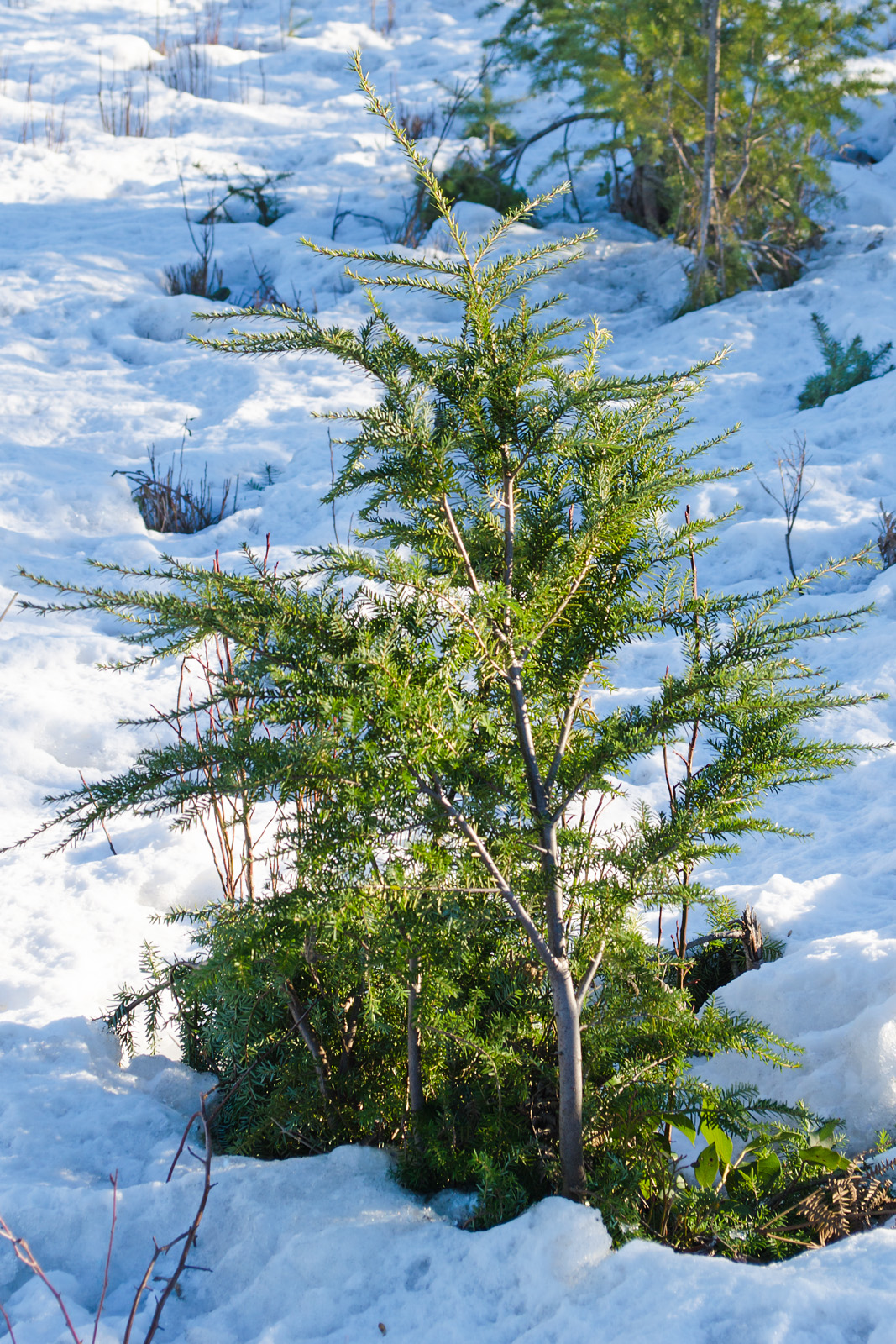
Baby Douglas fir and shrubs, each in its own warm well.

Each living plant affects its climate in various ways. It absorbs sunlight, which otherwise bounces off the surface of the snow. It deflects drying winds. And its own living processes produce a minimal amount of heat. Enough to melt the snow up against the branches, and provide cover for other small plants.

An old stump in its own mini-climate, harbouring evergreen salal.

Two more stumps. With lichen, salal, and bare twigs of deciduous shrubs. These will have an early start to their spring growth.

A few small trees and shrubs share a warm spot.

Even a rock can build a mini-climate. It absorbs more warmth from the sun than the surrounding earth, which is cooled by air pockets and seeping ice melt. The rock radiates this extra heat into the snow around it.

Snow on the side of the road, tossed up by a snowplow. Even this can create a disturbance in air flow and sunlight. The lump itself, exposed to the wind, is frozen hard, but the sunny surface is slowly melting, making that icicle.

A side road, unmarked on the map, with ruts and tracks of a dog or coyote, made before the snow froze hard. The forested and ferny areas are just warm enough to melt off the snow before it freezes.

And there's another mini- or really, not so mini - microclimate, usually unseen. Underneath that frozen snow cover, the ground is protected from freezing winds, and stays just above freezing. And there, the little creatures wait out the winter, sleeping or burrowing deep into the warmish earth.

Back at home, a few of my spring crocuses are pushing through the wet soil, hidden in a mini-climate of their own between a wall and a staircase.

Powered By Blogger