Showing posts with label evergreens. Show all posts

Thursday, December 30, 2021

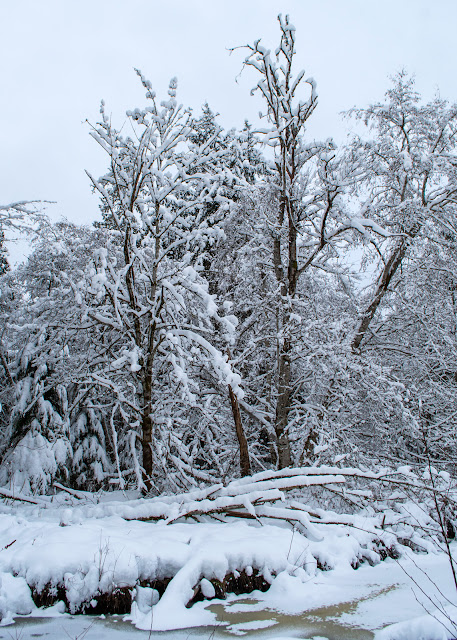
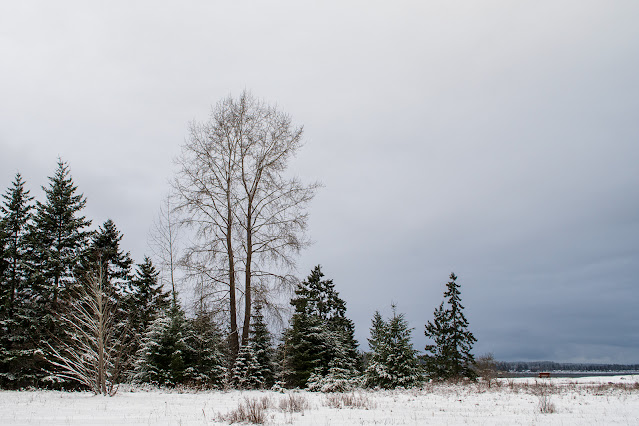
Outlined in white

Snow brings out the varied shapes of trees.

Deciduous trees and beaver-downed alders.

Oyster Bay meadow.

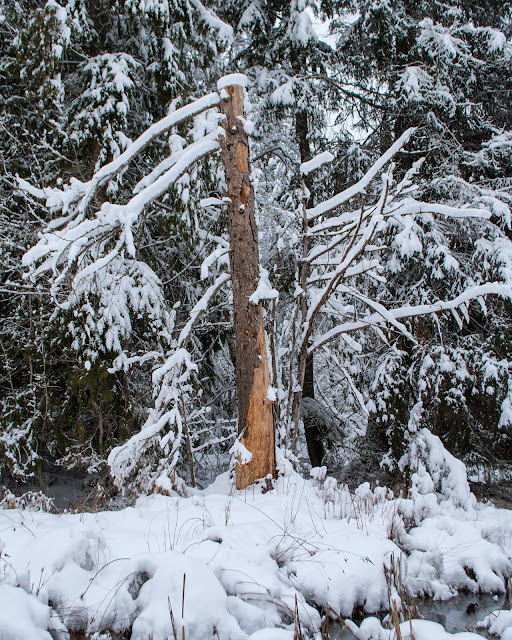
Wildlife snag with snow cap.

Older tree, with new saplings.

I never noticed before; most of the branches on the right side (from this angle) are missing. Or never grew. Wind patterns? 

~~~~~~~~~~~~~~~~~~~~~

La nieve destaca las formas variadas de los árboles.
  1. Alisos tumbadas por los castores, y árboles de hoja caduca en pie.
  2. El prado de Oyster Bay.
  3. Un tronco muerto, habitat y fuente de alimento de animales y pájaros, con sombrerito de nieve.
  4. Árboles perennifolios, viejo y jovenes.
No lo había notado antes: este árbol ha perdido la mayor parte de sus ramas del lado derecho visto desde este punto. O nunca crecieron. ¿Qué sería la causa? ¿La dirección de los vientos, tal vez?

Sunday, August 01, 2021

Evergreens of Paradise Meadows

Still on the hill, at Paradise Meadows: a few of the trees. Most of the trees at this elevation (1100 m.) are different species than the ones we see at sea level.

From the Paradise Meadows brochure: "... typical high elevation species, most not found at lower elevations: yellow cedar, Chamaecyparis nootkatensis (rather than redcedar); mountain hemlock, Tsuga mertensiana (rather than western hemlock); amabilis fir, Abies amabilis (rather than Douglas-fir); ... subalpine fir, Abies lasiocarpa." (I have added the species names.)

The two pines, white pine and shore pine, as is the western hemlock, are also found lower down.

I'm not sure which these are; not without a close inspection with a key in my hand.

The edge of the forest, by the Centennial Loop.

Completely festooned by lichens.

Moss patterns on the trunks.

~~~~~~~~~~~~~~~~~~~


Más fotos de las Praderas Paraíso; árboles alrededor del primer círculo. La mayoría de los árboles aquí en la montaña son de especies diferentes de los que vemos al nivel de mar.

Del folleto distribuído por las Praderas Paraíso: " ... especies típicas de las elevaciones mayores, por la mayor parte que nos se encuentran a altitudes menores: cedro amarillo, Chamaecyparis nootkatensis (en vez de cedro rojo); hemlock de montaña, Tsuga mertensiana (en vez de hemlock del oeste); abeto amabilis, Abies amabilis (en vez de abeto de Douglas); ... abeto subalpina, Abies lasiocarpa." (Yo he añadido los nombres científicos.)

Los dos pinos, pino blanco y pino de la costa, tanto como el hemlock del oeste, que también se hallan aquí, se encuentran igualmente en elevaciones menores.

No puedo identificar los árboles de estas fotos, ya que no los pude examinar de cerca, y con una clave en mano.

Segunda foto: un árbol completamente cubierto de líquenes colgantes.

Tercera foto: musgos en los troncos formando diseños regulares.

Monday, August 20, 2018

Looking back, looking up

It was long ago. Long, long ago. Our car had a wide ledge behind the back seat, with the rear window slanting down over it. It was my bed when we were travelling. I lay there watching the tops of the trees slide by, watching the night settle in, turning the greens into blacks against a blue-black sky.

Looking back. Campbell River, 76 km.The overpass is a logging road.
 
Dad slept during the mornings, then drove through the afternoon and night. We averaged, back then, about 300 miles a day, crossing and re-crossing the continent on two-lane highways. My brothers slept on the back seat, Mom nodded off in front. I watched the sky and the tree line.

Bridge over a creek

A few years later, Dad drove a '34 Dodge. The back-seat ledge was too small, and I was too big by then, anyhow. I sat behind Dad, leaning forward against his seat, (no seat belts in those days!) watching the road while he drove. In the blue distance, a glow in the sky meant we would be passing a town, a moving light was a car coming our way. There weren't many of those.

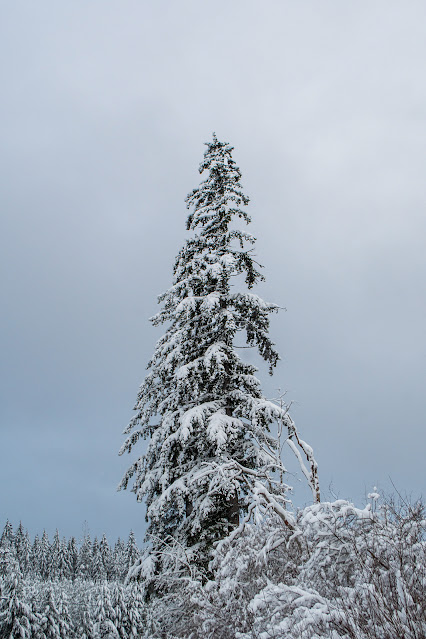
The trees lose their upper greenery in the winter storms.

Down the west coast, the skyline featured hills clad with evergreens. Then there were the flats through Arizona and New Mexico; here I watched the heat shimmers over the road, and the scrub bushes sprinkled across the dry land. Cotton fields down the Mississippi, urban sprawl up the east coast. I missed my treetops.

Sky and spikes over Rooney Lake (down in the valley)

I grew up, drove my own cars, watched the skyline up and down the continent; rocky hills in Mexico, green jungles in Guatemala, towering mountains in Oregon, beckoning glaciers in the north country; here the glow on the horizon at night was the northern lights.

Dropping into the Woss valley. The town is surrounded by tall peaks, 1600 m (5250 feet) and higher. I don't know which ones these are.

Time runs on. I'm back more or less where I started. And I drive with one eye on the treetops and the mountains ahead. They draw me on, around the next bend, over the next hill, deep into the valleys; I want to stop to look, to delight in the view, but the road holds me in a hypnotic grip.

Snags, tall trees, and a logging truck warning.

I drove to Woss for coffee and a sandwich a couple of days ago. Three hundred kilometres round-trip. An expensive sandwich. The ever-changing skyline made it worth my while. Nearing Woss, I stopped several times to take its photo.

Down, down, down. The valley is deep.

As long as the hills stay green, I can drive forever.

Criss-cross skies. Contrails and blowing clouds.

A Skywatch post.

Friday, August 17, 2018

Nursery

Life goes on ...

When a tree dies, it comes alive, more so than in its life.

Living trees are made up of about 5% living tissue, but when certain species die, they become literal garden beds of new life. These otherwise “dead” trees contain five times more living matter than when they were growing upright. (Garden Collage magazine)

And its useful life can extend as long as its "live" growth period. A 100-year-old tree dies; then it invites in a host of other organisms, and stands or lies there for another 100 years, gradually disintegrating. By the time it finally disappears, it may have nurtured a small forest of its own.

In any old stand of trees in our rainforest, we find nurse logs in different stages of decay and re-incarnation.

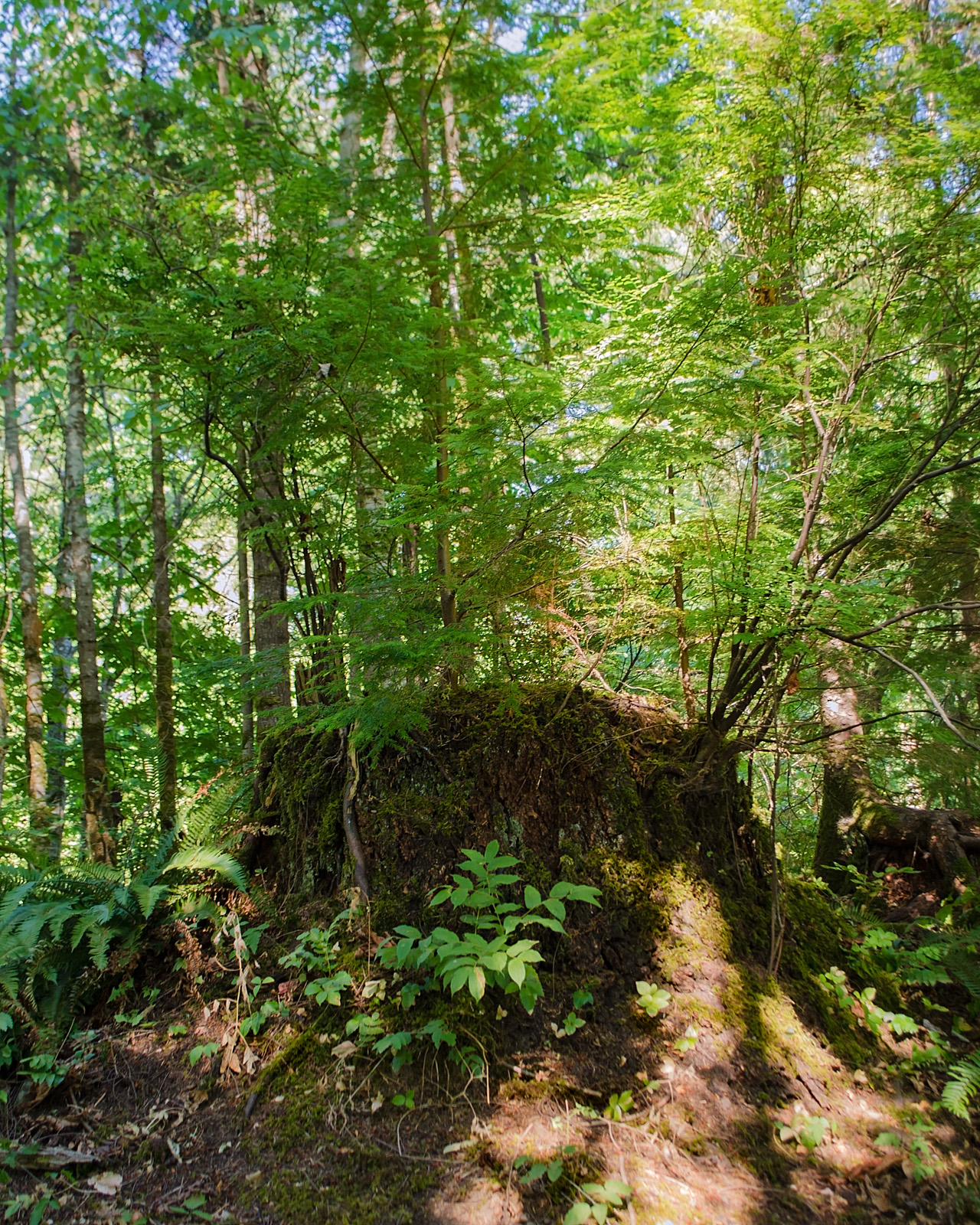
An old forest giant. I estimated it from a distance at about 2 - 3 metres diameter. Our Douglas firs have been known to reach up to 15 feet across.

This old stump supports several small trees, maple and fir, growing from the top, plus a few huckleberry bushes and a layer of moss. On its flanks, ferns, red-berry elder and salal have taken root, as well as the ever-present moss. 

The old stump lifts seedlings above the undergrowth into the light and retains a more consistent level of moisture, winter and summer, than the forest floor. In deep forest, they may provide almost the only suitable habitat for huckleberry bushes, which need air and light.

Look to the right; there's another old nurse log, mostly gone by now; the tree grown out of it has extended its roots over the edge and down into the soil. They will support the new tree on stilts even when the nurse has disappeared.

Another, much smaller, second- or third-growth stump supports three new trees. Their roots encase the old stump, by now too fragile to hold the weight on its own. Other residents: moss and a large colony of spiders.

Three more firs on a badly-decayed nurse log. The one in back is just getting started, with its top dressing of moss, where seeds will find the perfect planting bed, warm, moist, and sunlit.


Monday, January 09, 2017

Mini-micro havens

It snowed again yesterday afternoon. Then the snow turned to rain. Our streets were black, then white, then black again. But just a few miles away, on the mainland, the black is bad news; there, it's black ice. And the snow keeps falling.

Closer to home, if I drive over the hill that borders the shore, I find snow, six inches deep, undisturbed, and frozen hard enough to walk on without leaving a mark.

New forest coming, under snow.

Here on Vancouver Island, we live in a microclimate, its temperature and humidity determined by the encircling ocean currents, northbound from the warm North Pacific Current. Our summers are cool and wet, and our winters are usually mild (and wet; we don't tan, we rust.) Some years, there's no snow at all.

But microclimates have their own microclimates. Our shoreline strip is one. The backside of the hill is another. Forested areas have their own variants, depending on height of trees, direction of the slope, extent of logged areas, nearby rivers, roads and their traffic, and other circumstances.

And then there are the mini-microclimates. The warm zones around blades of grass, the wells at the base of stumps, hollow logs, even the ruts in old car tracks. Each imperfection in the surface shapes the wind currents, captures or blocks the sunshine, funnels off the rainwater. And in these mini-climates, plants and animals wait out the cold weather.

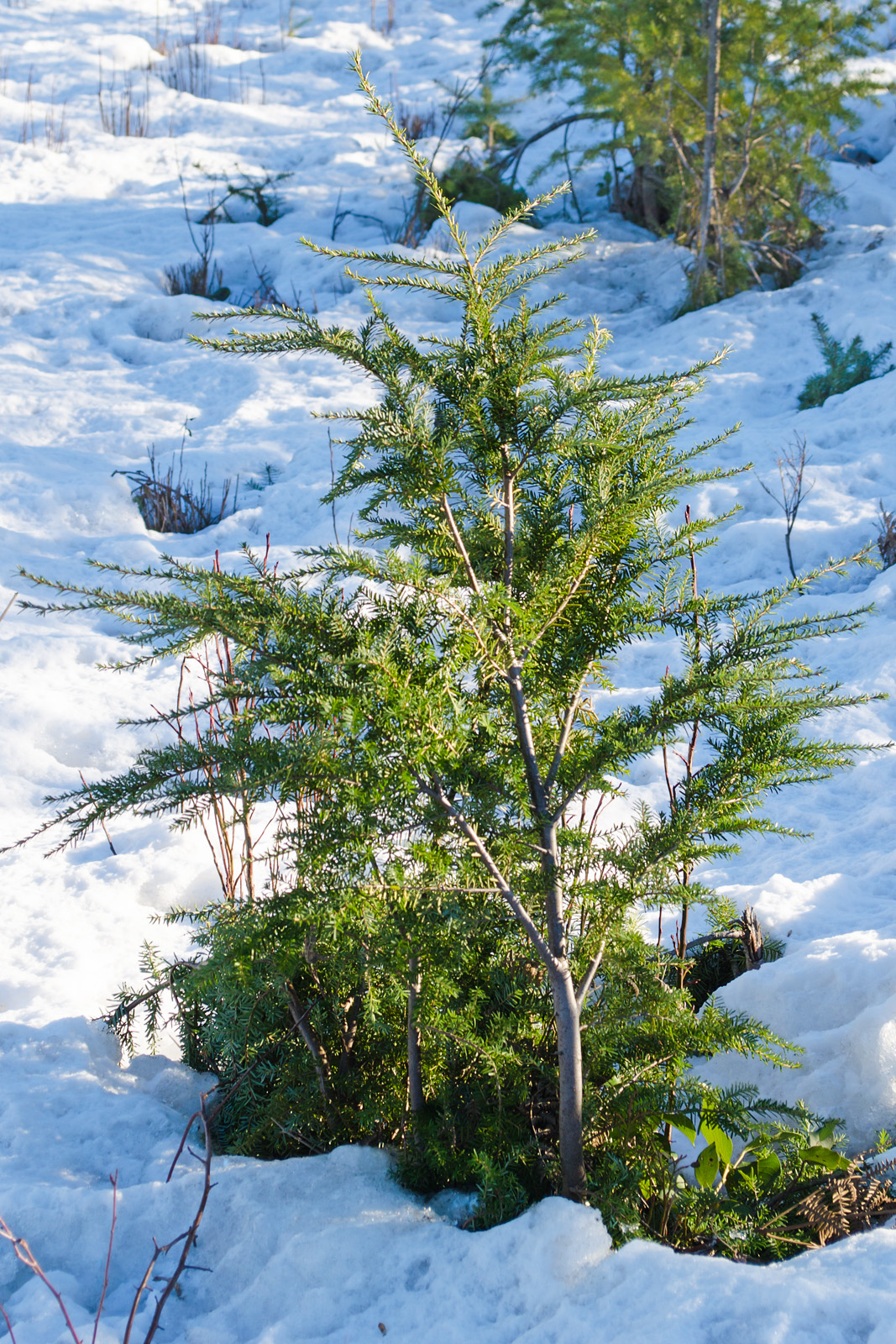
Baby Douglas fir and shrubs, each in its own warm well.

Each living plant affects its climate in various ways. It absorbs sunlight, which otherwise bounces off the surface of the snow. It deflects drying winds. And its own living processes produce a minimal amount of heat. Enough to melt the snow up against the branches, and provide cover for other small plants.

An old stump in its own mini-climate, harbouring evergreen salal.

Two more stumps. With lichen, salal, and bare twigs of deciduous shrubs. These will have an early start to their spring growth.

A few small trees and shrubs share a warm spot.

Even a rock can build a mini-climate. It absorbs more warmth from the sun than the surrounding earth, which is cooled by air pockets and seeping ice melt. The rock radiates this extra heat into the snow around it.

Snow on the side of the road, tossed up by a snowplow. Even this can create a disturbance in air flow and sunlight. The lump itself, exposed to the wind, is frozen hard, but the sunny surface is slowly melting, making that icicle.

A side road, unmarked on the map, with ruts and tracks of a dog or coyote, made before the snow froze hard. The forested and ferny areas are just warm enough to melt off the snow before it freezes.

And there's another mini- or really, not so mini - microclimate, usually unseen. Underneath that frozen snow cover, the ground is protected from freezing winds, and stays just above freezing. And there, the little creatures wait out the winter, sleeping or burrowing deep into the warmish earth.

Back at home, a few of my spring crocuses are pushing through the wet soil, hidden in a mini-climate of their own between a wall and a staircase.
Powered By Blogger