Showing posts with label huckleberries. Show all posts

Saturday, April 05, 2025

Down by the riverside

Promissory notes.

Huckleberry flowers. If there are pollinators, there will be red berries in mid-summer.

Early shoots of red elderberry. A fast grower; the white flowers will be along in short order.

Cow parsnip has a lot of growing to do, big flower heads to build.

Another salmonberry flower, with a couple of buds. Will the berries be orange or red? Check back later.

The first flower buds of miners' lettuce, aka spring beauty, soon to line the trails with a dusting of white stars.

~~~~~~~~~~~~~~~~~
Promesas ...
  1. Las flores de arándanos rojos (huckleberry, Vaccinium parvifolium). Si se  presentan los insectos polinizadores, habrá bayas rojas a medio verano.
  2. Las primeras hojas de saúco rojo (Sambucus racemosa). Este arbusto se desarrolla rapidamente; pronto aparecerán las flores blancas, seguidas en poco tiempo por las bayas rojas.
  3. La pastinata de vaca, Heracleum maximum, es una planta bastante grande; hasta estos primeros brotes son grandes, las umbelas de flores blancas también lo serán.
  4. Otra flor de salmonberry. Las frutillas serán o rojas o anaranjadas.
  5. Los primeros botoncitos de Claytonia sibirica, "la lechuga del minero". Las flores en poco tiempo pintarán los bordes del camino de blanco.


Thursday, July 04, 2024

Pick your own dessert

 BCParks' "Recreation Sites" on Vancouver Island don't offer many amenities. Parking, picnic tables, fire pits, boat launch, an outhouse; that's about it. Not counting the view, of course, or the birdsong, or the scented breeze ... Little Bear Bay offers, as well, dessert. Free.

I picked a double handful of huckleberries; sweet and juicy. Topped them off with orange salmonberries, a little on the tart side, so far;  a few more days of sunshine and they'll be as sweet as honey.

Salmonberries, Rubus spectabilis

Most salmonberries are red, but the orange ones, I've found, have a flavour all their own, but the sweetness varies with the weather.

And there will be salal. Not at the moment, but later: bring your buckets!

Salal flowers and unripe berries.

These bushes are loaded! A representative patch; the whole area is surrounded by these.

The berries, later, will be as large as the flowers, a deep, almost black purple. And sticky; the whole cluster of berries, stem and all, is sticky. It's hard to separate the soft berries from the stem. No matter; my mom used to harvest the whole lot, stem and leftover bracts and all.  She boiled the mass down, and strained it through a jelly bag (in her kitchen, an old, well-washed pillowcase, hung on a broom handle between two chairs.) The resulting purple juice made a delicious jelly, perfect in PBJ sandwiches.

The bears will probably get the bulk of these ones. If you see a bear stained purple around the snout, you'll know where he's been.


Little Bear River estuary, low tide. The yellow-green area is underwater at high tide.

Tomorrow: Trapped!

~~~~~~~~~~~~~~

Los "Sitios de Recreación" del Departamento de Parques BC ofrecen un mínimo de amenidades: estacionamiento, mesas de picnic, hogueras, rampa para embarcaciones, letrina rústica: nada más. Eso, si no tomas en cuento las vistas, o el canto de las aves, o el aire perfumado de bosque y mar ... La Bahía del Osito (Little Bear Bay) ofrece, además, postre. Gratis.

Coseché arándanos rojos (Vaccinium parvifolium) hasta llenarme las dos manos. Jugosos y dulces. Encima, salmonberries (Rubus spectabilis); en este sitio, las frutas son anaranjadas. Estas estaban todavía un poco ácidas; dales unos dias más de sol y estarán dulces como la miel.

  1. R. spectabilis. La mayoría de las frutas de esta especie son rojas, pero las anaranjadas, creo, tienen un sabor especial. Son más o menos dulces, según el clima.
  2. Y habrán bayas de salal, Gaultheria shallon. Todavía no, pero más tarde, ¡toneladas! Aquí, las flores y bayas inmaduras (les llamamos verdes, pero sin embargo son rojas). 
  3. Los arbustos llenos de bayas verdes. Un grupo representativo; todo el sitio está rodeado de esta planta.

    Las bayas, ya maduras, serán del tamaño de las flores, y un color morado casi negro. Y pegajosas; todo el ramito de bayas, con todo y tallo, es pegajoso. Es difícil separar las bayas blandas del tallo. No tiene importancia; mi mamá recogía todo, las bayas con el tallo y las brácteas y todo. Hervía la masa entera, y la pasaba por una coladera de jaleas. (En su cocina, esta consistía en una vieja funda de almohada, bien lavada, llena de la masa de salal, y colgada de un palo de escoba atorada en dos sillas. El jugo morado que resultaba rendía una jalea deliciosa, perfecta en los sandwiches de crema de cacahuate y jalea.

    Estos, aquí, los comerán los osos. Si alguna vez ves un oso con el hocico morado, ya sabrás donde andaba.
  4. El estuario del rio "Little Bear" con la marea baja. La zona amarilla queda bajo el agua cuando sube la marea.
Mañana: ¡Atrapada!

Wednesday, January 20, 2021

Summer at Eve River

I knew I had it somewhere!

This is a photo of the Eve River bridge, taken from the same point as the rainy day photo I posted a couple of days ago. But this one was in mid-summer, two years ago.

Huckleberries, Eve River.

Grey, rainy, gloomy days have an end. Sunshine always comes back. Today's news is a reminder of that.

~~~~~~~~~~~~~~~~~~~~~~

Sabía que tenía esta foto en alguna parte, pero me tomó hasta esta tarde en encontrar donde la había puesto.

Es la puente sobre el rio Eve, tomada desde el mismo punto de la foto que subí el otro dia, del rio en un día de lluvia. La saqué a medio verano, hace dos años.

Los días grises, tristes, lluviosos tienen fin. Saldrá el sol otra vez, siempre. Las noticias de hoy son un recordatorio.


Tuesday, June 30, 2020

I beat the bears to these

The huckleberries are ripe!

Red huckleberries, Vacciunium parvifolium

They're slightly acid, but sweet. I picked only two handfuls, leaving the rest for the bears and birds.

The bush these came from.
~~~~~~~~~~~~~~~

Los "huckleberry" rojos son una especie de arándano nativo a la costa del Pacífico. Ayer encontré un arbusto lleno de frutas.

La fruta es un poco ácido, pero dulce. Me comí dos puños de fruta, y dejé los demás para los osos y los pájaros.

Tuesday, May 19, 2020

Better than toilet paper

Earlier today, I posted a link on my Facebook page; "Why your immune system needs a forest".

A quote from Yale School of Forestry and Environmental Studies included in the short article caught my attention: "Even though we have reduced most of the forests of the world to charcoal, toilet paper, building material and dust, the remaining forests still offer us an incredible immune boost."

Charcoal, toilet paper, building material and dust. I'm glad that I live where there is still live forest a few minutes from home.

I don't know about my immune system, but the forest makes me feel good all over.

These three photos are from the hillside partway up Mount Menzies.

Huckleberry bush, ferns, and mossy trunk.

Steep slope. The understory is mostly salal, Oregon grape, ferns, and huckleberry bushes.

Burnt-out stump on the hillside above me. With more huckleberries on top.

~~~~~~~~~~~~~~~~~~~~~~

Esta tarde subí un link a mi página Facebook: "Porque tu sistema inmunológico necesita un bosque".

Allí hallé esto, de parte de La escuela Yale: "Aunque hayamos reducido la mayoría de los bosques del mundo a carbón, papel de baño, material de construcción, y polvo, los bosques que nos quedan nos ofrecen un estímulo inmunnológico increible."

Carbón, papel de baño, material de construcción, y polvo. Estoy feliz por vivir donde todavía encuentro bosques vivos a pocos minutos de mi casa.

No sé lo que le hacen a mi sistema inmunológico, pero estar en el bosque me hace sentir muy bien.

Estas tres fotos las saqué en la ladera del Monte Menzies. Las plantas del sotobosque son en su mayor parte huckleberry (arándanos rojos), mahonia, y salal; todos producen bayas que son favoritas de osos y pájaros.


Friday, August 17, 2018

Nursery

Life goes on ...

When a tree dies, it comes alive, more so than in its life.

Living trees are made up of about 5% living tissue, but when certain species die, they become literal garden beds of new life. These otherwise “dead” trees contain five times more living matter than when they were growing upright. (Garden Collage magazine)

And its useful life can extend as long as its "live" growth period. A 100-year-old tree dies; then it invites in a host of other organisms, and stands or lies there for another 100 years, gradually disintegrating. By the time it finally disappears, it may have nurtured a small forest of its own.

In any old stand of trees in our rainforest, we find nurse logs in different stages of decay and re-incarnation.

An old forest giant. I estimated it from a distance at about 2 - 3 metres diameter. Our Douglas firs have been known to reach up to 15 feet across.

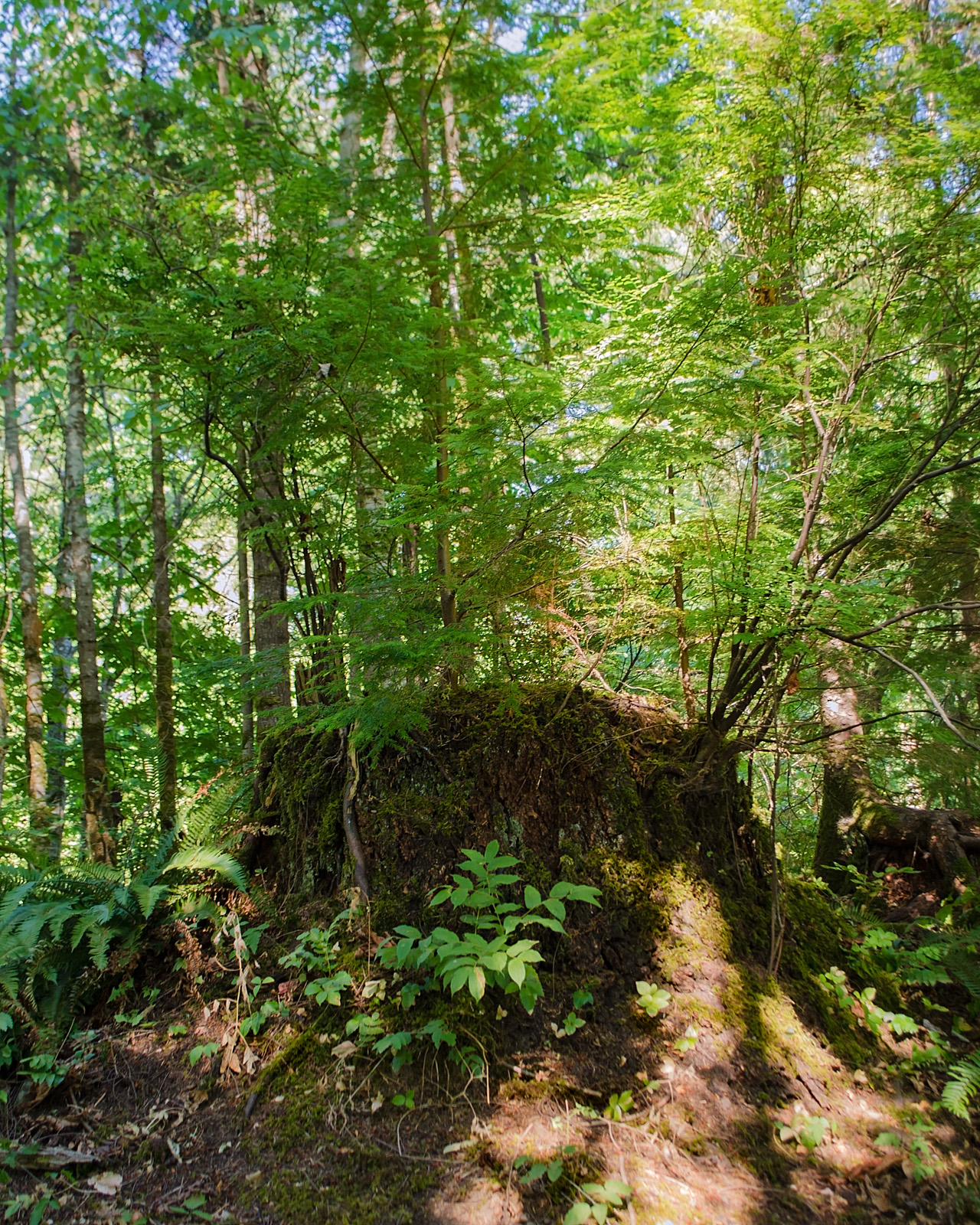
This old stump supports several small trees, maple and fir, growing from the top, plus a few huckleberry bushes and a layer of moss. On its flanks, ferns, red-berry elder and salal have taken root, as well as the ever-present moss. 

The old stump lifts seedlings above the undergrowth into the light and retains a more consistent level of moisture, winter and summer, than the forest floor. In deep forest, they may provide almost the only suitable habitat for huckleberry bushes, which need air and light.

Look to the right; there's another old nurse log, mostly gone by now; the tree grown out of it has extended its roots over the edge and down into the soil. They will support the new tree on stilts even when the nurse has disappeared.

Another, much smaller, second- or third-growth stump supports three new trees. Their roots encase the old stump, by now too fragile to hold the weight on its own. Other residents: moss and a large colony of spiders.

Three more firs on a badly-decayed nurse log. The one in back is just getting started, with its top dressing of moss, where seeds will find the perfect planting bed, warm, moist, and sunlit.


Tuesday, August 02, 2016

Of pie and slug yummies.

Mom used to make a pie in the summertime; graham cracker crust filled with vanilla custard mixed with an assortment of berries picked that afternoon in the bush; huckle-, salmon- and thimble-berries, red and orange, juicy, seedy and a little tart, nuggets of taste and colour in the blandness of the custard.

I remembered those pies as I walked the Leiner River trail, carrying a huckleberry branch lopped off by the trail maker, picking and eating the ripe berries as we went. The bush provides.

My son asked about some of the mushrooms we passed: could we eat those? I recognized Russulas, which we had eaten up north. They tasted and had the texture of erasers, I told him, and he lost interest. But there were many others, food for slugs and bears, not for us, not without a specialist to pronounce them safe.

Collybia, I think. Possibly edible. With slug bites.

Typical clearing floor: evergreen twigs, needles, and cones, mosses, wild blackberry leaves, a huckleberry branch. And mushrooms. A slug has been eating a couple of them.

The same mushrooms, from ground level.

Something broke this one off.

Two unidentified mushrooms posing as siamese twins, with a wild blackberry twig growing through them.

Slug eye view. Same mushrooms. (Gilled bolete? Edible?)

On a disintegrating log. Unidentified. The cap of the one on the left has been nibbled on.

Strange, blobby polypores. Shelf fungi that forgot how to make shelves. (Maybe when the tree went from vertical to horizontal.)

Pretty yellow slug, a mushroom eater. One of many. This one's on our picnic table.

We're still here on the Leiner River trail.


Thursday, June 30, 2016

Ripe berries!

It's huckleberry season!

I tried a few. They're sweet and juicy now.

Tiny red jewels in an emerald and lime-green forest.

And I saw my first Saskatoons of this year.

Serviceberry, aka Saskatoon, almost ripe.


Powered By Blogger