Showing posts with label forest floor. Show all posts

Wednesday, November 03, 2021

Rainforest carpet

The forest around the shores of Lake Roberts, away from the edges where the sun shines, are, at a human eye level, brown and dark: tall, closely packed trunks of Douglas fir and cedar, with a carpet of Oregon beaked moss and evergreen sword ferns, and here and there the little lights of huckleberry leaves. Earlier in the year, vanilla leaf and starflowers grew among the ferns; now in November, all that remains of them are brown, shrivelled leaves.

Stump with huckleberry crown, brown trunks.

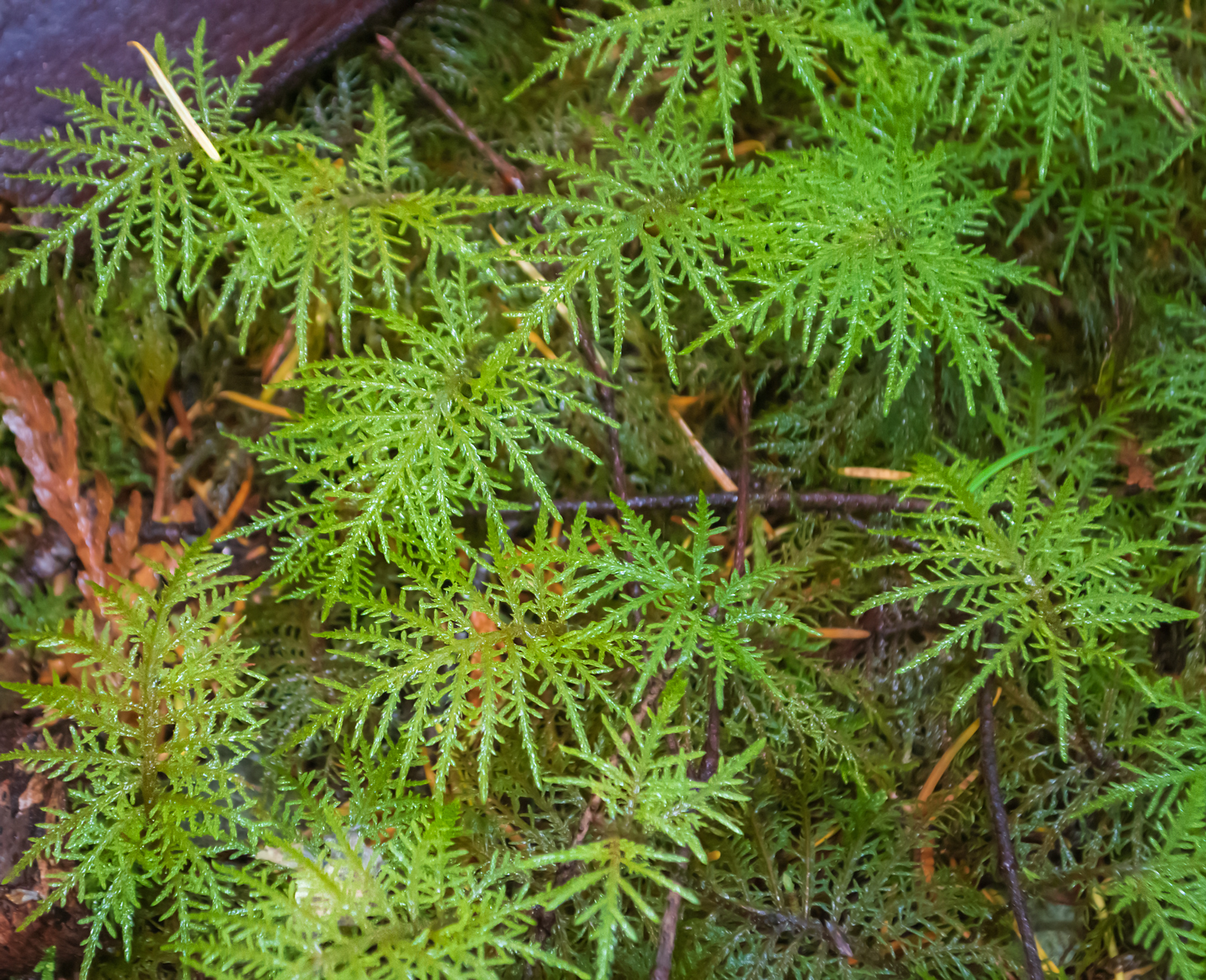
Oregon beaked moss, Kindbergia oregana Step moss, Hyclomium splendens.

Delicate, fern-like leaves of step moss

And this month, now that the rains have returned, the forest floor is covered with flat-topped orange mushrooms, so many that, walking among the trees, I had to be careful where I put my feet to avoid crushing them.

Unidentified orange caps.

Slugs love them.

More mushrooms, other species, tomorrow.

~~~~~~~~~~~~~~~~~~~~~~~
El bosque alredededor del lago Roberts, aparte del borde donde le llega el sol, donde crecen árboles de hoja caduca, son, al nivel del ojo humano, de color café, y algo oscuro; una multitud de troncos de abetos de Douglas y cedro. Abajo, una alfombra verde, hecha del musgo Kindbergia oregana y los helechos perennes. Los arbustos de huckleberry proveen lucecitas verdes de adorno. En el verano, entre los helechos se encontraban Achlys, hoja de vainilla, y flores estrella; ahora en noviembre tan solo les quedan algunas hojas muertas.

Fotos: 1. El bosque, con un tronco cortado, desbaratándose, con su planta de huckleberry encima.

2 y 3. El musgo Kindbergia oregana.

Y ahora que ha vuelto a llover, el suelo está cubierto de hongos de sombrilla anaranjada, plana. Tantos hay que tuve que caminar con mucho cuidado para no aplastarlos.

Fotos 4 y 5. Los hongos. Uno está medio comido; obra de una babosa.

Mañana habrá más hongos, de otras especies.


Sunday, April 11, 2021

Busy trees

It's a quiet place. Peaceful. The wind whispers in the tops of the trees; a half-fallen tree creaks, shifting position. Below the moss enforces silence. Nothing moves.

It's deceptive. It's the quiet of life hard at work.

Second- or third-growth forest; trees standing, half fallen, fallen, and turned into soil. Near Rock Bay.

"It is important to remember that, under natural conditions, a tree remains part of the forest ecosystem long after its death.  ... If left undisturbed by humans, a dead tree may remain standing in the forest for up to half the time it stood while alive. A tree's ecological importance continues as it breaks apart and falls to the ground or after it topples, and eventually all its nutrients are cycled back into the soil to be taken up by new plants." (From Wildlife & Trees in British Columbia, Part 1.)

Trees alive, dead, standing, half down. Miller Creek

Would this next photo count as "undisturbed by humans"? Or is it humans disturbed by blowdowns?

Miller Creek campground after a windy spell. There were dozens of trees down, some across the road.

~~~~~~~~~~~~~~~~~~~~~~~~~~~~~~
El bosque vive en paz. Arriba, entre las ramas, la brisa mueve las hojas, susurrando.  Un árbol medio caído cruje, ajustando su postura. Allá abajo, los musgos imponen silencio. Nada se mueve.

Es una decepción. El silencio de la vida trabajando arduamente.

Primera foto: un bosque con árboles de pie, cayéndose, caídos, y devueltos a la tierra.

"Es importante recordar que bajo condiciones naturales un árbol sigue siendo parte del ecosistema del bosque por largo tiempo después de su muerte. ... Si se deja sin interferencia humana, un árbol muerto puede mantenerse de pie en el bosque por hasta la mitad del tiempo de su vida. La importancia ecológica de un árbol continua mientras se desbarata y cae al suelo, o cuando se cae entero, y por fin todos sus nutrientes se vuelven al suelo para sostener a nuevas plantas." (Tomado del libro, Wildlife& Trees in BC.)

Segunda foto: árboles vivos, uno muerto, árboles de pie, y medio caídos.

Y la tercera foto: ¿Esto cuenta como "sin interferencia humana"? ¿O como "humanos con interferencia del bosque? Después de un viento fuerte, muchos árboles habían caído, estos sobre los retretes del sitio de campamento, y algunos cortando el camino.


Sunday, March 28, 2021

Little green balls

The rainforest floor is a living thing. Here, on a base of decaying wood, old, crumbly leaves, last year's evergreen needles and cones, broken twigs and scraps of bark, fungi and mosses intertwine, their roots and hyphal threads digging deep, binding the fragile soil together. Slime molds hide in crevices; lichens colonize surfaces from rocks to wood living and dead. Scurrying through the inch-high forests, busy springtails, mites, and spiders search for food; slugs and snails slide over the surface, eating algae and mushrooms.

It's a complex world down there. Nothing is ever just one thing.

Small stump (under a foot tall), with grass, moss, mushrooms, lichen, and green algae.

Mushrooms, moss, dark green algae and well-rotted wood.

Mushrooms, Cladonia pixie-cup lichen, moss, and algae. The leaves are red sorrel.

I was curious about that dark green coating on the oldest, dampest, most sheltered wood, and zoomed in on it.

Tiny green balls, from yellow-green to a deep blue-green.

This grows only in the darkest, most protected areas of the forest floor; at the bottom of stumps, on the shady side, on the underside of mushy logs, deep under overhanging evergreen branches. On an old log, half buried, half turned into soil, moss covers the exposed top, mushrooms and lichen grow down the sides, and under it all, where the sun never shines, there's this coating of damp, slimy green stuff.

In the photos, zooming in (and I took a hand microscope to the woods to double-check) it looks like it's made up of tiny balls. Just in case it was really miniature leaves, I brought a bunch of sticks home and looked at them all under the microscope.

Looks like balls. I can't see stems. The white spots are reflections of the lights of the microscope.

I'm assuming its a variety of algae. I can't find it on the web, possibly because I don't know what to look for.

What else was down there. tomorrow.

~~~~~~~~~~~~~~~~~~~
El suelo de un bosque pluvial es un ser vivo. Aquí, sobre un base de madera podrida, hojas viejas, desbaratadas, los conos y agujas de árboles de hoja perenne caídos hace un año, ramitas rotas y fragmentos de corteza de árbol, una variedad de hongos y musgos se entrelazan, sus raices y hilos de hifa enterrándose hondamente, fusionando los elementos frágiles del suelo. Los mohos mucilaginosos se esconden en las grietas; los líquenes colonizan superficies desde piedra hasta madera, viva o muerta. En estos bosquecitos de unos cuantos centímetros de altura, animalitos corren de un lado para otro; colémbolos (brincacolas o saltadores), arañitas y garrapatas muy ocupados en buscar comida; babosas y caracoles deslizándose por encima, comiendo algas y hongos.

Es un mundo muy complicado. Nada existe por sí solo. 

Las fotos: 1. un tronquito, con musgos, hongos, líquenes, pastos, algas verdes.

2. Musgos, hongos, y algas verdes.

3. Y ahora con líquenes Cladonia "taza de duendecillo".

4. Más de cerca. Ese alga verde; pelotitas verdes.

Me llamó la atención ese organismo verde que se ve solamente en las partes más protegidas, más húmedas, más escondidas de la madera podrida. En un tronco caído, ya viejo, medio enterrado, bien suavizado, la parte superior, expuesta a la luz, llevará su bosque de musgos; en los lados y las grietas, crecen una variedad de líquenes. Y abajo, donde nunca pega el sol, donde las ramas de los árboles de hoja perenne lo mantiene en sombra perpetua, aquí crecen estas bolitas verdes.

5. Me traje varios pedazos de esa madera a casa para mirarlos bajo el microscopio. Sí, parecen pelotitas. No veo ningún tallo ni raices. (Las manchas blancas en la foto son reflejos de las luces del microscopio.)

Creo que es alguna especie de alga. Pero no lo encuentro en mis libros, ni en la red.

Que más vi allí, queda para mañana.


Tuesday, May 19, 2020

Better than toilet paper

Earlier today, I posted a link on my Facebook page; "Why your immune system needs a forest".

A quote from Yale School of Forestry and Environmental Studies included in the short article caught my attention: "Even though we have reduced most of the forests of the world to charcoal, toilet paper, building material and dust, the remaining forests still offer us an incredible immune boost."

Charcoal, toilet paper, building material and dust. I'm glad that I live where there is still live forest a few minutes from home.

I don't know about my immune system, but the forest makes me feel good all over.

These three photos are from the hillside partway up Mount Menzies.

Huckleberry bush, ferns, and mossy trunk.

Steep slope. The understory is mostly salal, Oregon grape, ferns, and huckleberry bushes.

Burnt-out stump on the hillside above me. With more huckleberries on top.

~~~~~~~~~~~~~~~~~~~~~~

Esta tarde subí un link a mi página Facebook: "Porque tu sistema inmunológico necesita un bosque".

Allí hallé esto, de parte de La escuela Yale: "Aunque hayamos reducido la mayoría de los bosques del mundo a carbón, papel de baño, material de construcción, y polvo, los bosques que nos quedan nos ofrecen un estímulo inmunnológico increible."

Carbón, papel de baño, material de construcción, y polvo. Estoy feliz por vivir donde todavía encuentro bosques vivos a pocos minutos de mi casa.

No sé lo que le hacen a mi sistema inmunológico, pero estar en el bosque me hace sentir muy bien.

Estas tres fotos las saqué en la ladera del Monte Menzies. Las plantas del sotobosque son en su mayor parte huckleberry (arándanos rojos), mahonia, y salal; todos producen bayas que son favoritas de osos y pájaros.


Monday, December 09, 2019

Soaked leaves

Under the shelter of bigleaf maples and Douglas firs, where the sunshine never reaches, the forest floor becomes a layered bed of wet leaves, broken twigs, leaf skeletons, fir cones, fir needles. In the winter, it never dries out, even on sunny days.

In the rain yesterday, its colours (brown, dark brown, red-brown, and brown) were intensified, glowing.

Mushroom hiding under wet bigleaf maple leaves.

Slug dinner, with springtail, surrounded by leaves: salal, alder, fragments of bigleaf maple. And maple seed "wings". Douglas fir needles and cones.

A small mushroom makes a good umbrella.


Saturday, January 12, 2019

Wild forest floor

I grew up on Vancouver Island, in the northwest coastal forests, dense, lush, and silent, only marginally tamed along the edges. Across a creek that ran under my bedroom, a creek we crossed on a fallen tree, crawling (me) or dancing (my brothers) according to our sense of balance and scorn of danger, and through a hollow log that traversed a salmonberry thicket, we came out onto a fern- and moss-blanketed cathedral: unlogged Douglas firs, yards across at the base, towering high into the rainy clouds overhead. My brothers would race on through; I tended to find a dryish log and sit there a while, just listening.

On the Ridge Trail, I followed a sort of trail off the main trail; a deer track, maybe, looking for mushrooms. There were none visible, and I didn't want to disturb the moss, but stepping carefully around mossy roots and huge ferns, I got a brief flashback to my childhood wanderings. This was the forest floor I knew of old.

Healthy forest, mixed evergreen and deciduous, probably third-growth, after two or more loggings.

The trees on the ground are as essential to the health of the forest as the standing timber; they provide nutrients and shelter to new growth and the animals that make it their home. The moss on top soaks up the rain, releasing the moisture slowly to the thin layer of soil underneath; these forests sit on rock, sometimes barely under the surface duff. Without the moss, they would dry and burn with the first lightning stroke.

Evergreen fern.

It's not an ecosystem hospitable to humans, my brothers notwithstanding; any human trails are made with chain saws, constant monitoring, frequent traffic. Abandoned for a year or two, they disappear.

Sometimes I wonder at the early explorers who made their slow way across the continent, following ridges like this one, rivers like the one in the valley below, clambering at every step over slippery logs, stumbling into hidden holes, sinking through wood that seemed solid and turned out to be mostly wet rot, trying to find a dry, flattish spot to sleep after an exhausting day. Or at today's firefighters; at least they have helicopters and chain saws, but it's still a daunting task.

Much of Vancouver Island is logged off now, sometimes repeatedly. Entire mountain sides lie open to the sun and wind, the moss dry and brittle, the ferns dying. With the added burden of a warming climate, they are a bonfire waiting for the first match. I'm not looking forward to our next fire season.


Powered By Blogger