Showing posts with label fallen trees. Show all posts

Monday, February 06, 2023

Road closed

The sky was blue, in spots. The sun shone brightly; a nice change from the daily rain. Along the highway, hemmed in by tall evergreens, I was still in shadow, even in the early afternoon. The sun lies low on the horizon in February here, at 25° above the horizon at noon. Through a gap in the trees, I saw that the sun warmed the far side of the river; I crossed and went down the river-side trail.

On the trail, I was still in deep shade, but where light filtered in, colours glowed.

Evergreen fern and moss at the base of a tree.

The trail makes a loop here, crossing and re-crossing side channels of the river. I took the upper branch of the loop, but soon found my way blocked.

End of the road.

The tree had been standing on the bank, and had snapped off, leaving the roots still in the ground. As I retraced my steps and took the lower trail, I started to notice how many trees had been freshly downed over the last few months. Most exposed their shallow roots, going down without breaking until they hit ground; the soil is soggy and soft after a wet winter.

Then there was this one:

Booby trap?

On the far side, I stopped to look at it again:
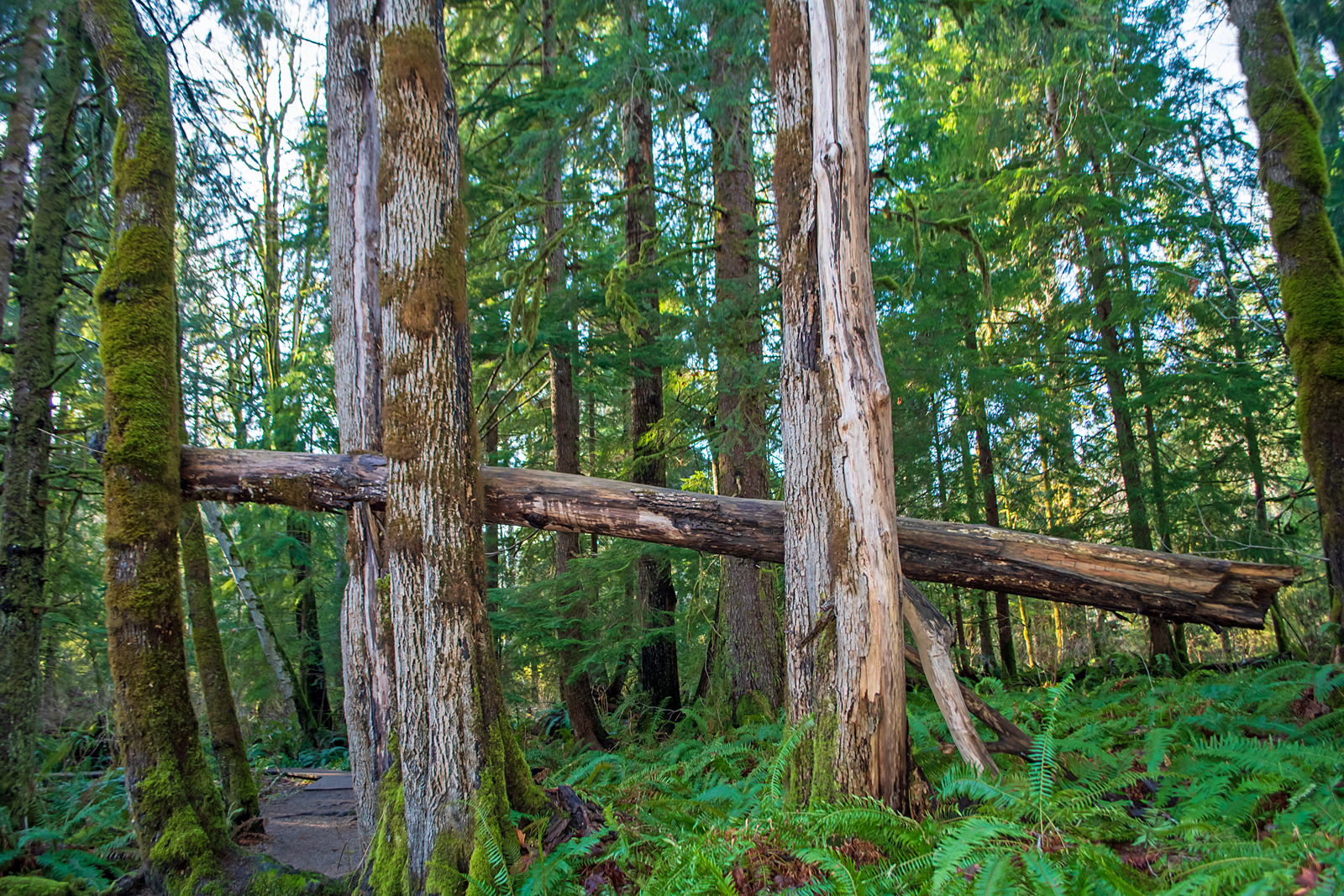
Hard hat zone.

This one has been there for a few years, evidently. It snapped at the base, and the upper end has been sawed off where it crossed the trail. And there it hangs, held only by a couple of branch stubs.

More logs, these fallen into the water.
Slanted light, picking out last year's maple leaves.

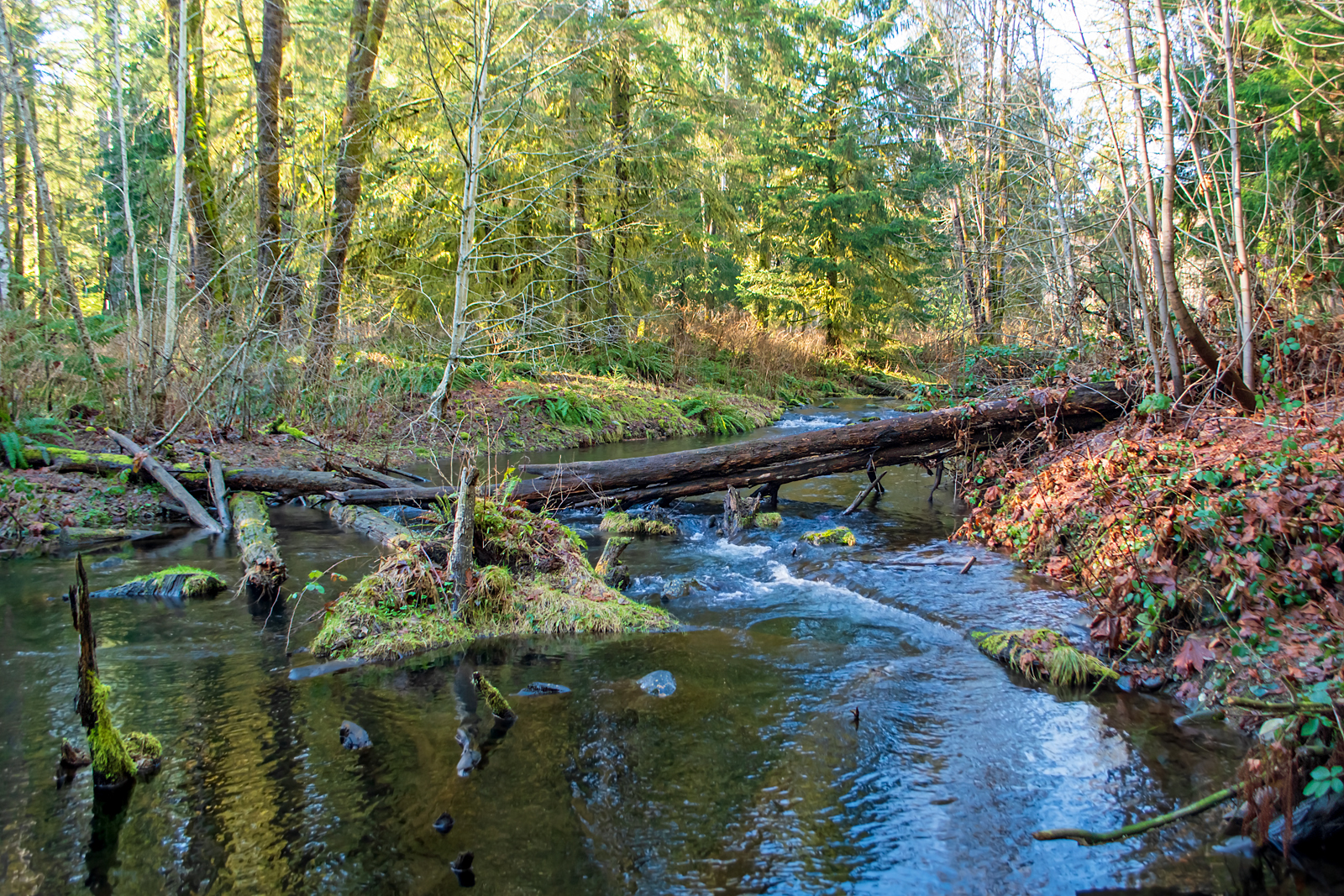
Quiet stream, with another new-fallen tree making a bridge of sorts.

The top of the tree fallen over the bridge is just visible on the far right. And no, that isn't a bear on the far left. Just a stump. But I think the figure in the distant centre, beyond the fisherman, is a Sasquatch. Really.

Poking around, looking at fallen logs and root masses sent me off down another tack. About that, tomorrow.

~~~~~~~~~~~~~~~
El sol brillaba. En el cielo se veían areas azules, un cambio bienvenido después de semanas de lluvias diarias. En la carretera, sin embargo, cercada como está por bosques de coníferos, estábamos todavía en sombra; el sol en este mes de febrero apenas llega a 25° arriba del horizonte a mediodía. En una brecha entre árboles, vi que el sol iluminaba el lado opuesto del rio. Crucé un puente y tomé el sendero que baja por la orilla del agua.

El sendero seguía en la sombra, pero donde se intercalaban rayos de luz, los colores resplandecían.

Foto #1: Un helecho perenne y musgos a la base de un árbol.

El sendero hace un círculo aquí, cruzando y volviendo a cruzar ramas laterales del rio. Tomé la rama superior, pero pronto la hallé bloqueada.

Foto #2: El final del camino.

El árbol había crecido en la mera orilla del agua, y se había roto a la base, sin desenterrar las raices. Regresé al sendero original, fijándome mientras iba en cuantos árboles se habían caído recientemente. La mayoría llevaban consigo las raices, poco hondas, dejándolas expuestas al aire, cayendo sin romperse hasta que dieran con el suelo; la tierra está mojada y sin cohesión; ha sido un invierno lluvioso.

Uno era éste:

Foto #3: ¿Trampa cazabobos?

#4: Volví a mirarlo desde el otro lado: Area de Cascos.

Este, parece que ha estado aquí por unos años. Se rompió cerca de la base, pero luego lo han cortado los que mantienen los senderos, dejando el camino sin peligro. Y allí cuelga, fijado en su sitio por solamente un par de restos de ramas.

Más troncos, éstos caídos al agua:

#5: Con la luz filtrado por el bosque iluminando las hojas de arce del año pasado.

#6: Otro árbol recién tumbado hace algo así como un puente. Al lado derecho se ve, apenas, el tronco del árbol que cayó sobre el puente. Y no, eso no es un oso al lado izquierdo. Pero la figura en el centro, entre el bosque atrás del pescador es un Sasquatch. De veras.

Y el estar mirando troncos caídos me llevó a descubrir otras cosas. Las dejo para mañana.

Wednesday, September 14, 2022

Well, that was a short walk

In my search for non-smoky air, I went to the Sayward turnoff, gave up, and headed back south. The Dalrymple Creek trail, just south of the turnoff, beckoned; maybe under the trees, among the ferns, the air would smell green.

Not quite. The last time I walked the trail, two years ago, everything was damp, down there in the deep shade. Now it's all dry. The moss crunches underfoot, the air smells of dying evergreen needles. The creek bed holds a slow trickle of water between dry stones.

Still green and brown.

And everywhere trees were down. Freshly fallen logs lay on top of others, also still showing recently-broken wood. The trail makes a loop; I took the upper leg, and soon found the trail blocked by a tree, still bearing green needles, but broken in long sections. I returned to the lower trail. And there, too, a fallen tree stopped me.

Awkward

I decided not to crawl under the log.

Even on the truncated walk, I found many shelf fungi.

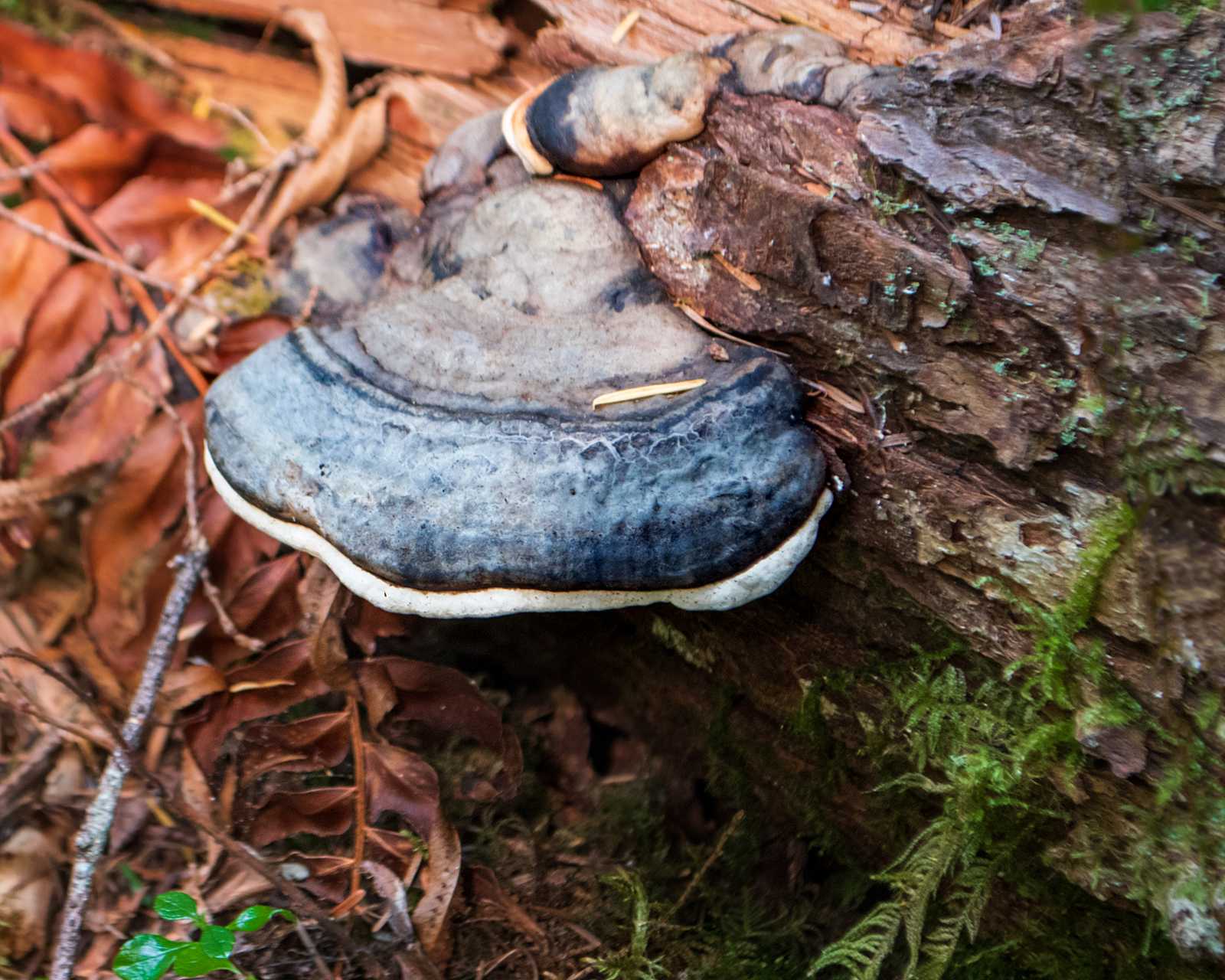
They're more blue than black here.

Red-belted polypore, Formitopsis pinicola.

And another. I managed to get low enough to see the underside of this one.

Stacked shelves.

There were no other mushrooms; it is too dry. The huckleberries are ripe, but flavourless this year.

Links to a previous visit: 
  1. The creek, when it held water.
  2. The trees.
~~~~~~~~~~~~~~~~~~~~~~~~~~~~~
En la búsqueda de aire sin humo, fui hasta donde la carretera sale para Sayward, sin éxito; me di por vencida y volví hacia el sur. Y allí el sendero del riachuelo Dalrymple, me llamó; tal vez allí, bajo los árboles, entre los helechos, habría olor a "verde".

Pues no. La última vez que visité todo estaba húmedo; ahora está seco, sequísimo. El musgo cruje bajo mis pies, el aire huele a hojas muertas. En el riachuelo, un lento chorrito de agua se cuela bajo las piedras secas.

Foto: el bosque. Sigue verde.

Y dondequiera, había árboles caídos. Troncos recién tumbados descansan sobre otros que todavía muestran madera apenas rota. El sendero hace un círculo; tomé la ruta que subía el cerro, pero pronto encontré el camino bloqueado por un árbol caído, todavía con todas sus hojas, pero roto en secciones por el golpe. Regresé al camino al lado del riachuelo. Y allí también había otro tronco.

Foto: el sendero, con un tronco grande caído encima.

Tendría que gatear para seguir adelante. Desistí.

Pero en ese tramo cortito, hubo muchos hongos políporos.

Fotos: Fomitopsis pinicola.

No hubo otros hongos; está demasiado seco. Los arándanos rojos están maduros, pero este año no tienen sabor.

Links: la visita hace dos años. El riachuelo, cuando hubo agua. Y los árboles.

Sunday, April 11, 2021

Busy trees

It's a quiet place. Peaceful. The wind whispers in the tops of the trees; a half-fallen tree creaks, shifting position. Below the moss enforces silence. Nothing moves.

It's deceptive. It's the quiet of life hard at work.

Second- or third-growth forest; trees standing, half fallen, fallen, and turned into soil. Near Rock Bay.

"It is important to remember that, under natural conditions, a tree remains part of the forest ecosystem long after its death.  ... If left undisturbed by humans, a dead tree may remain standing in the forest for up to half the time it stood while alive. A tree's ecological importance continues as it breaks apart and falls to the ground or after it topples, and eventually all its nutrients are cycled back into the soil to be taken up by new plants." (From Wildlife & Trees in British Columbia, Part 1.)

Trees alive, dead, standing, half down. Miller Creek

Would this next photo count as "undisturbed by humans"? Or is it humans disturbed by blowdowns?

Miller Creek campground after a windy spell. There were dozens of trees down, some across the road.

~~~~~~~~~~~~~~~~~~~~~~~~~~~~~~
El bosque vive en paz. Arriba, entre las ramas, la brisa mueve las hojas, susurrando.  Un árbol medio caído cruje, ajustando su postura. Allá abajo, los musgos imponen silencio. Nada se mueve.

Es una decepción. El silencio de la vida trabajando arduamente.

Primera foto: un bosque con árboles de pie, cayéndose, caídos, y devueltos a la tierra.

"Es importante recordar que bajo condiciones naturales un árbol sigue siendo parte del ecosistema del bosque por largo tiempo después de su muerte. ... Si se deja sin interferencia humana, un árbol muerto puede mantenerse de pie en el bosque por hasta la mitad del tiempo de su vida. La importancia ecológica de un árbol continua mientras se desbarata y cae al suelo, o cuando se cae entero, y por fin todos sus nutrientes se vuelven al suelo para sostener a nuevas plantas." (Tomado del libro, Wildlife& Trees in BC.)

Segunda foto: árboles vivos, uno muerto, árboles de pie, y medio caídos.

Y la tercera foto: ¿Esto cuenta como "sin interferencia humana"? ¿O como "humanos con interferencia del bosque? Después de un viento fuerte, muchos árboles habían caído, estos sobre los retretes del sitio de campamento, y algunos cortando el camino.


Powered By Blogger