Showing posts with label Dalrymple Creek Trail. Show all posts

Wednesday, September 14, 2022

Well, that was a short walk

In my search for non-smoky air, I went to the Sayward turnoff, gave up, and headed back south. The Dalrymple Creek trail, just south of the turnoff, beckoned; maybe under the trees, among the ferns, the air would smell green.

Not quite. The last time I walked the trail, two years ago, everything was damp, down there in the deep shade. Now it's all dry. The moss crunches underfoot, the air smells of dying evergreen needles. The creek bed holds a slow trickle of water between dry stones.

Still green and brown.

And everywhere trees were down. Freshly fallen logs lay on top of others, also still showing recently-broken wood. The trail makes a loop; I took the upper leg, and soon found the trail blocked by a tree, still bearing green needles, but broken in long sections. I returned to the lower trail. And there, too, a fallen tree stopped me.

Awkward

I decided not to crawl under the log.

Even on the truncated walk, I found many shelf fungi.
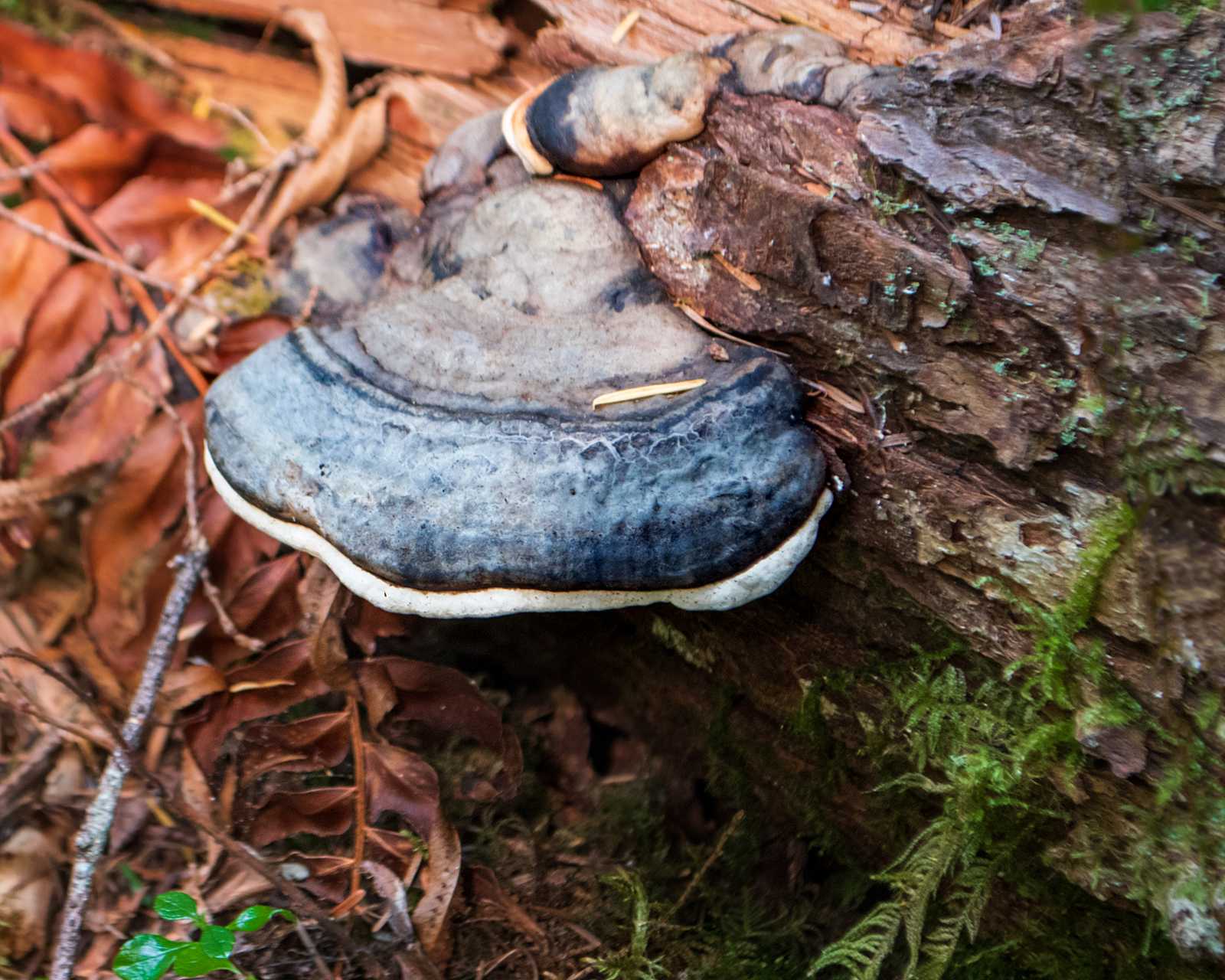
They're more blue than black here.

Red-belted polypore, Formitopsis pinicola.

And another. I managed to get low enough to see the underside of this one.

Stacked shelves.

There were no other mushrooms; it is too dry. The huckleberries are ripe, but flavourless this year.

Links to a previous visit: 
  1. The creek, when it held water.
  2. The trees.
~~~~~~~~~~~~~~~~~~~~~~~~~~~~~
En la búsqueda de aire sin humo, fui hasta donde la carretera sale para Sayward, sin éxito; me di por vencida y volví hacia el sur. Y allí el sendero del riachuelo Dalrymple, me llamó; tal vez allí, bajo los árboles, entre los helechos, habría olor a "verde".

Pues no. La última vez que visité todo estaba húmedo; ahora está seco, sequísimo. El musgo cruje bajo mis pies, el aire huele a hojas muertas. En el riachuelo, un lento chorrito de agua se cuela bajo las piedras secas.

Foto: el bosque. Sigue verde.

Y dondequiera, había árboles caídos. Troncos recién tumbados descansan sobre otros que todavía muestran madera apenas rota. El sendero hace un círculo; tomé la ruta que subía el cerro, pero pronto encontré el camino bloqueado por un árbol caído, todavía con todas sus hojas, pero roto en secciones por el golpe. Regresé al camino al lado del riachuelo. Y allí también había otro tronco.

Foto: el sendero, con un tronco grande caído encima.

Tendría que gatear para seguir adelante. Desistí.

Pero en ese tramo cortito, hubo muchos hongos políporos.

Fotos: Fomitopsis pinicola.

No hubo otros hongos; está demasiado seco. Los arándanos rojos están maduros, pero este año no tienen sabor.

Links: la visita hace dos años. El riachuelo, cuando hubo agua. Y los árboles.

Thursday, September 10, 2020

Tree blankets

 Moss, again.

Tree dangler; Isothecium myosuroides.

This moss hangs from branches on almost every older tree. It's given a variety of common names: my guide book calls it cat-tail moss. Others call it slender mouse-tail moss, tree moss (although it may grow on rock, too) and variable moss.

Step moss, again. Hylcocomium splendens.


And step moss with a pair of mushrooms.

~~~~~~~~~~~~~~~~~~~~

Musgos, otra vez. El primero se cuelga de casi todos los árboles viejos en bosques cerrados. Lo llaman musgo cola de gato, o cola delgado de ratón, o musgo de árbol, entre otros nombres comunes.

El musgo que sigue es el musgo de escalones, el "step moss". Y dos honguitos, sin identificación.

Wednesday, September 09, 2020

Brooms in the canopy

 And here's another sign from the Dalrymple Creek trail:

This one I had to clean up a bit to be able to see the mistletoe photo.

Sign text: Tree Parasites. Mistletoe, Witches Broom. Weyerhaeuser. 14.

Weyerhaeuser is the wood products company that left this patch of forest uncut, and provided the signage and pamphlets. 14 probably refers to the section in the now lost pamphlets.

I looked for the mistletoe in the trees near the sign, but didn't find any, possibly because it is near the tops of the trees, too far away to see without aid. Or loggers boots.

But 'way up there, there were clusters of witches' broom.

Witches broom in the canopy.

Mistletoe causes the tree to grow fat branches; there may be a few in this photo.

The sign is wrong: mistletoe is a parasite. Witches' broom is not. Mistletoe is a plant that grows on the tree, mostly underneath the bark, taking nutrients and water from the tree. The shoots that bud out of the branches produce the seeds and expel them away from the host tree.

Witches' broom is part of the tree itself, a response to stress, in this case the challenge of the mistletoe, but it could also originate with other stressors.

A view of Dalrymple Creek. Notice the tangles of witches' broom at upper right.

~~~~~~~~~~~~~~~~~~~~~~

Un letrero en el bosque nos advierta de la presencia de parásitos de los árboles.

Dice el letrero: Parásitos de árboles. Muérdago. Escoba de brujas. Weyerhaeuser. 14.

Weyerhaeuser es la compañia maderera que nos dejó los anuncios y los folletos (que ya no existen). 14 sería el número de la sección en el folleto que explica el letrero.

El letrero se equivoca. Muérdago es un parásito; la escoba de brujas, no.

El muérdago es una planta que crece a base del árbol; la mayor parte de la planta se esconde bajo la corteza. Allí toma los elementos nutritivos y el agua que necesita directamente del árbol. Los brotes que salen al aire producen sus semillas y las lanzan fuera del ámbito del árbol invadido.

Busqué alrededor del letrero para ver si podría hallar el muérdago, pero no lo vi. Creo que estaba allá lejos, arriba en la fronda.

La llamada "escoba de bruja" no es un parásito, sino la respuesta del árbol a un estrés, en este caso, el muérdago, pero podría ser, en otros sitios, algún otro problema, sea hongos, insectos, y otros organismos.

En las fotos se puede ver el lío de ramas que constituye la escoba de brujas.


Tuesday, September 08, 2020

Just trunks

Most of the forests accessible from roads on Vancouver Island have been logged off several times; the trees are mostly small and often close together. In a few places, small pockets of second-growth forests can still be found. Dalrymple Trail winds through one of these; the forest was replanted sometime in the middle of last century.

Most of these trees are Douglas-fir. They are tall trees; from ground level, the view is mostly trunks. Up above, the branches allow some sunlight to penetrate, so the understory hosts a fair crop of huckleberry and salal bushes, besides the usual ferns and mosses. But the trunks are what commanded my attention.

So tall, so straight! The trunk passes through the branches of the smaller surrounding trees, spreading its own branches far above.

Rugged, deeply furrowed bark, with minor fire damage.

Old Douglas-firs are very fire-resistant, due largely to the protective bark that
develops with age. In contrast, the thin bark of young trees offers little protection,
even from low-intensity fires. The thin bark begins to thicken and develop vertical
fissures as trees mature. (Dept. of Natural Resources, WA)

Fire is always a threat to our trees, whether as a result of human interference or started by lightning strikes. (I have seen, on a mountain side across the valley, where lightning struck the forest, and a tall tree burst into flames. Luckily, this was during a heavy rainstorm, and the fire was quickly drenched.) Once a fire is going, the smaller trees are vulnerable; the old Douglas firs shrug it off.

One of the few signs that were readable on the trail. The #7 probably refers to the long-gone explanatory pamphlets.

The bottom of a fire-scarred trunk.

Detail of that trunk.

So stripy! The black stripes are burnt bark. The warm brown lines are undamaged bark. And the greens: on the far right, there's moss, a dull, green. The pale green and greenish yellow stripes are a dust lichen, one of the Lepraria species.

Many older trees wear a coating of this tiny lichen. It appears as dust on the surface, and does not produce fruiting bodies, like other lichens, but spreads as the powdery dust blows or washes away.

~~~~~~~~~~~~~~
La mayoría de los bosques en la isla de Vancouver han sido cosechados varias veces; los árboles de ahora son relativamente chicos y cercanos el uno del otro. (Piensa palillos de dientes en una cajita.) En algunos lugares grupos de árboles de crecimiento secundario todavía existen. El sendero Dalrymple serpentea por uno de éstos; los árboles fueron sembrados allá por mediados del siglo pasado.

La mayor parte de estos árboles son los Douglas-fir, Pseudotsuga menziesii, Son árboles muy altos; desde el suelo, la vista consiste principalmente de troncos. Allá arriba, los ramos permiten la entrada de un poco de sol, así que aquí abajo, crecen los arándanos rojos y los arbustos de salal, además de los helechos y musgos que siempre se encuentran. Pero eran los troncos que más me llamaban la atención.

Los Douglas-fir ancianos son muy resistentes al fuego, lo que es un constante peligro en estos bosques, si por actividades de los humanos, o por relámpagos. He visto, en una montaña al otro lado del valle donde vivía, cuando un relámpago pegó en un árbol alto, y de inmediato el árbol estalló en llamas. Por suerte, estaba lloviendo fuertemente, y el agua pronto apagó el fuego.

La corteza gruesa de los Douglas-fir los protege, y aunque árboles más pequeños se queman, los grandes aguantan.

En estos troncos, en las últimas fotos, se ven las manchas negras donde el fuego quemó la parte exterior de la corteza sin dañar al árbol. Las partes color café muestran el color natural de la corteza.

Las rayas verdes son, a la derecha, en un verde oscuro, musgo. Y las demás, en verde claro, son de un liquen muy fino, como un polvo, que es muy frecuente en troncos viejos en la sombra. Son del género Lepraria.


Sunday, September 06, 2020

Multicoloured shelves

Dalrymple Trail, in the shadow of H'Kusam Mountain, is a short trail through deep second-growth forest, featuring huge trees and logs, mostly Douglas Fir. At one time, signs and brochures pointed out features of the trail; the brochures were in a box at the start of the trail, now rusted, locked, and empty. Most of the signs are so worn down by time and moss that they can't be read. Those that can, mostly seem to refer to numbered points in the explanatory brochures, now non-existent.

Old wood, tall trunks, burnt bark, moss, tree parasites, and fungi. That's what I found on the walk. Oh, and huckleberries. I picked and ate several handfuls. Seedy, but sweet.

First: a bunch of Red-belted polypores; they were everywhere.

Red-belted polypore, Formitopsis pinicola

This shelf fungus comes in a wide range of colours. Here, I found more red and blue than I usually see.

On the end of a cut log, new shelves sprout.

Blue-black, with dangling moss

Mostly red

Black with yellow rims

Black, brick-red, yellow/orange. On the log: lichen, moss, and, I think, liverworts.

~~~~~~~~~~~~~~~~~

El sendero "Dalrymple" (refiriéndose a un hombre que vivía en su choza solitaria en el bosque a mediados del siglo pasado) es un caminito entre bosques secundarios en la sombra del monte H'Kusan, donde se encuentran grandes árboles, en su mayor parte, abetos "Douglas". Hace algún tiempo, la historia natural del bosque se daba por medio de letreros y folletos; los folletos estaban en una caja al principio del camino, ahora podrida, cerrada con candado, y vacía. Los letreros son difíciles de leer, ya que el tiempo, la lluvia, y el musgo los han obscurecido. Y parece que en vez de traer explicaciones, se referían a secciones numeradas de los folletos desaparecidos.

Vi madera vieja, troncos altísimos, cortezas quemadas, parásitos de árboles, musgos, y hongos; muchos hongos, casi todos del grupo de los poliporos. Y arándanos rojos; me comí muchos; dulces, y llenos de semillas.

Estas fotos son de los poliporos "de cinta roja", Fomitopsis pinicola. Vienen en una variedad de colores; aquí llevan más azul y rojo de lo que veo normalmente.


Saturday, September 05, 2020

Brown hairy mushroom

 I found this mushroom in a weedy cleared space between parking space and picnic benches in the forest, in full sun.

Looks like an Armillaria

Although it looks like one of the honey mushrooms, these grow in clumps. This was almost alone; there was one smaller one a few feet away.

~~~~~~~~~~~~~~~~
Encontré este hongo en un espacio abierto hecho para estacionamiento en el bosque, en pleno sol.

Se parece a los hongos de miel, Armillaria sp., aunque ellos acostumbran crecer en grupos, todos saliendo de un solo punto. Este andaba solo, aparte de otro, mas pequeño, también solitario, a la distancia, aproximadamente de un metro.


Friday, September 04, 2020

Amanita

On a walk in the shadowy north woods, at Dalrymple Creek, in the shadow of H'Kusam Mountain, the first thing that met me on the trail was this cheerful mushroom.

One of the Amanitas.

A cheerful colour, but deadly poisonous, whichever species of Amanita it is.

And then there were hundreds of shelf fungi. Photos starting tomorrow.

~~~~~~~~~~~~~~~~~~~~~

Hacia el norte, seguí un caminito entre el bosque, un sendero en la sombra del monte H'Kusan, un lugar que he visto al pasar, y hasta ahora me detuve a ver a donde iba.

A la entrada al bosque me esperaba este hongo alegre. Amarillo y blanco; parece inocente. Es un Amanita, y muy tóxico.

Más adentro del bosque encontré cientos de hongos de madera.  Mañana empiezo a subir fotos.


Powered By Blogger