Showing posts with label fire. Show all posts

Tuesday, September 08, 2020

Just trunks

Most of the forests accessible from roads on Vancouver Island have been logged off several times; the trees are mostly small and often close together. In a few places, small pockets of second-growth forests can still be found. Dalrymple Trail winds through one of these; the forest was replanted sometime in the middle of last century.

Most of these trees are Douglas-fir. They are tall trees; from ground level, the view is mostly trunks. Up above, the branches allow some sunlight to penetrate, so the understory hosts a fair crop of huckleberry and salal bushes, besides the usual ferns and mosses. But the trunks are what commanded my attention.

So tall, so straight! The trunk passes through the branches of the smaller surrounding trees, spreading its own branches far above.

Rugged, deeply furrowed bark, with minor fire damage.

Old Douglas-firs are very fire-resistant, due largely to the protective bark that
develops with age. In contrast, the thin bark of young trees offers little protection,
even from low-intensity fires. The thin bark begins to thicken and develop vertical
fissures as trees mature. (Dept. of Natural Resources, WA)

Fire is always a threat to our trees, whether as a result of human interference or started by lightning strikes. (I have seen, on a mountain side across the valley, where lightning struck the forest, and a tall tree burst into flames. Luckily, this was during a heavy rainstorm, and the fire was quickly drenched.) Once a fire is going, the smaller trees are vulnerable; the old Douglas firs shrug it off.

One of the few signs that were readable on the trail. The #7 probably refers to the long-gone explanatory pamphlets.

The bottom of a fire-scarred trunk.

Detail of that trunk.

So stripy! The black stripes are burnt bark. The warm brown lines are undamaged bark. And the greens: on the far right, there's moss, a dull, green. The pale green and greenish yellow stripes are a dust lichen, one of the Lepraria species.

Many older trees wear a coating of this tiny lichen. It appears as dust on the surface, and does not produce fruiting bodies, like other lichens, but spreads as the powdery dust blows or washes away.

~~~~~~~~~~~~~~
La mayoría de los bosques en la isla de Vancouver han sido cosechados varias veces; los árboles de ahora son relativamente chicos y cercanos el uno del otro. (Piensa palillos de dientes en una cajita.) En algunos lugares grupos de árboles de crecimiento secundario todavía existen. El sendero Dalrymple serpentea por uno de éstos; los árboles fueron sembrados allá por mediados del siglo pasado.

La mayor parte de estos árboles son los Douglas-fir, Pseudotsuga menziesii, Son árboles muy altos; desde el suelo, la vista consiste principalmente de troncos. Allá arriba, los ramos permiten la entrada de un poco de sol, así que aquí abajo, crecen los arándanos rojos y los arbustos de salal, además de los helechos y musgos que siempre se encuentran. Pero eran los troncos que más me llamaban la atención.

Los Douglas-fir ancianos son muy resistentes al fuego, lo que es un constante peligro en estos bosques, si por actividades de los humanos, o por relámpagos. He visto, en una montaña al otro lado del valle donde vivía, cuando un relámpago pegó en un árbol alto, y de inmediato el árbol estalló en llamas. Por suerte, estaba lloviendo fuertemente, y el agua pronto apagó el fuego.

La corteza gruesa de los Douglas-fir los protege, y aunque árboles más pequeños se queman, los grandes aguantan.

En estos troncos, en las últimas fotos, se ven las manchas negras donde el fuego quemó la parte exterior de la corteza sin dañar al árbol. Las partes color café muestran el color natural de la corteza.

Las rayas verdes son, a la derecha, en un verde oscuro, musgo. Y las demás, en verde claro, son de un liquen muy fino, como un polvo, que es muy frecuente en troncos viejos en la sombra. Son del género Lepraria.


Wednesday, September 27, 2017

Smoke gets in your tentacles

I had a kitchen fire today. My fault entirely; I had made huevos rancheros for breakfast: two eggs, over easy, layered on a fried corn tortilla, smothered in hot sauce. Served with fresh coffee. I carried my food over to the table and ate, forgetting to turn off the burner under the frying pan. When I looked up, there was a haze of smoke over my head.*

I ran to the stove to turn it off, and as I reached for the fry pan, it burst into flames. And then I did another stupid thing; I grabbed the nearest thing, the French press full of fresh water for the next cup of coffee, and threw it on the fire. Smoke and steam billowed out, black oil spattered everywhere. But the fire was out, and I turned off the burner.

The smoke was so thick, I was choking, my eyes were streaming. I opened all the doors and windows and went outside until I could tolerate being inside again. Then, for the rest of the morning, I scrubbed. The stove, the counter, the fridge, the cupboard doors, the wall, the windows, everything glass in the whole apartment, the shelves, the collectibles ... It seemed that everything I looked at had a grey smoke film.

When I was working on the glass, I wiped down the sides of the aquarium. Then I noticed that all the anemones inside had shut down; even the usually happy pink-tipped anemones were puckered green blobs. The smoke had filtered down into the water.

I removed about a quarter of the water, and replaced it. The anemones opened up again.**

Pink-tipped green anemone, on the beach. Out of water, but still wet, and happy about life. No smoke.

And that make me think of the situation over this summer, where much of BC was on fire, when smoke hung over our island for weeks, hiding even Quadra Island, three kilometres away.

What effect did this have on our coastal waters? On the myriad critters who live, breathe, and eat underwater? And worse, what effect did it have on the intertidal animals, exposed to smoke in the air, smoke in the water?

*Another stupidity: I'd turned off the smoke alarm the other day, when it started screaming over the home-made soup boiling (not burning) on the stove. I'd forgotten to turn it back on again.***

**And now, I'll go out and bring home a whole tank full of fresh seawater for my poor intertidal critters.

***Next time, I'll set a timer if I have to turn off the smoke alarm. Or maybe I'll just stop making soup.


Wednesday, July 08, 2015

Yes, that's the moon

(Update and correction: No, that's the sun. Wrong time of day for the moon, wrong shape, too.*)

BC is on fire again. CBC News reports that there are more than 180 wildfires active in the province today, and more are expected every day until it rains. The one small fire that started in Vancouver is out, but we are getting smoke from other nearby fires, some quite large. Our skies are grey, an orangey, greeny, sickly grey, not the cool blue-grey of a rainy day. The air stings the back of my throat; a day ago, I stayed inside with everything shut tight, to keep the smoke at bay. Yesterday, I went to IKEA, where it was cool and the air is filtered.

On the way home, I looked in my rearview mirror and saw the moon shining through that grey sky. I stopped the car and took a couple of photos.

Yes, that's the moon. (No. The sun.)

I took a photo with the tops of the trees, just to show it wasn't a kid's balloon.

I'm inside again, with everything shut tight. I can still smell the smoke.

*Thanks, Jen.

Tuesday, August 10, 2010

Fires in BC; final glimpse

One more post about the fires, before I move on to other things.

Friday, I drove back from Bella Coola, crossing the burning zone in daylight. This is what I saw:


Somewhere between Tatla Lake and Alexis Creek. Looks like an interface fire.

As I approached the fire zone, I came to the end of a long line of parked cars and trucks, and a flagger. The helicopters were dropping retardant on the road, he told me; we would have to wait. About an hour, he said.

Eventually, the all-clear was given, and we all drove on into the smoke.


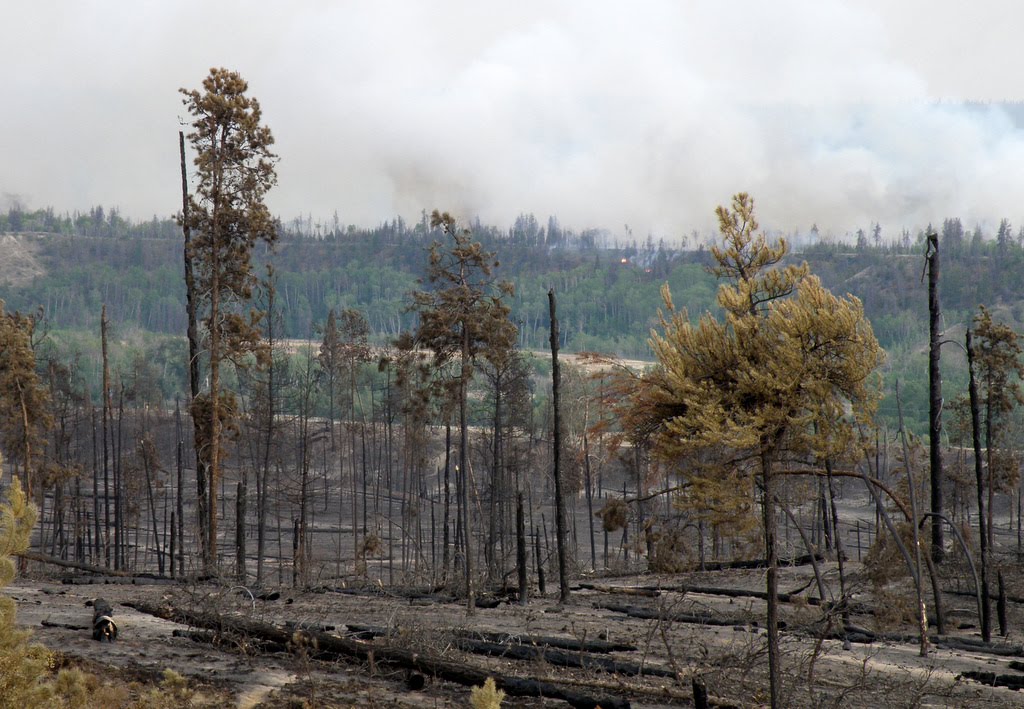
The blackened remains of a forest, with fires burning behind the next hill.


Another burnt area, the fire doused before it finished off the trees. They're dead, though. The fire is now following a side road along the ridge.


Scenic drive. Once.


Smoke from the next still-green patch.

Another line-up; another flagger. This time, we had to wait for an escort through Bull Canyon. After a while, a police car emerged from the smoke, with a string of cars behind it. The policeman saw them on their way, parked and consulted with the flagger. She waved us forward then, and instructed each one of us as we came up: "You can go on alone, but drive fast, don't slow down, don't stop, don't wait to take photos. It's hot down there!"


Down that hill is Bull Canyon. And the flagger, just around the corner.

I behaved. I so wanted to take photos; the scene was indescribable. Fires, smoke, helicopters swinging through the smoke, trailing round bags of water and retardant. Machinery and more fires, small and tall. A stage setting for Dante.

Beloved Bull Canyon, where I have so often stopped for the night, for the pleasure of listening to the river in the dark, of seeing the stars overhead as though I could reach up and pick one to take home, of watching the pistachio-green river in the morning light; now the trees are gone, the hill scorched and bare. I got a brief glimpse of the river; a muddy orange colour, half ash, half red retardant.

I remembered the pair of sassy chipmunks who stole the Rice Krispies bars we were saving for the kids' desserts; how they raced away along the fence, but soon came back to see if there was more. The present generation will be their great-great-grandkids. I wondered what happens to them in a quick fire? Do they burrow into the soil? Do they race up the trees only to be trapped, to be cooked or to suffocate? Do they run to safety? Is there safety?

Birds can fly out of danger; bears can cover an amazing amount of territory; so can the deer. I would like to think the chipmunks have a way to escape. I doubt it.

The Chilcotin is a harsh environment, beautiful but deadly, with baking summers, vicious winters, stony soil, alkali water, hordes of famished mosquitoes. And fires. I love it, but I could never live there. I greatly admire those who have the guts and strength to endure and even prosper on this land.

~~~~~~

Next: greenery and flowers. Cool rivers. Not on fire.

Friday, August 06, 2010

Fire in BC: the wisdom of the elders

Thursday evening. It's starting to rain, just a sprinkle. We sit outside under a pair of old cedars, talking about fire and smoke. The Bella Coola old-timers reminisce about previous years' rounds of fires, compare notes: fewer fires this year than last, but more area burning now; lightning strikes, burnt zones, helicopter drops; where the smoke is worst this week, where it's raining, what roads to avoid tomorrow.

Fire is an old neighbour for residents of BC's forested zones. A grumpy old neighbour, tolerated from long acquaintance, sometimes appreciated for those little acts of kindness on his good days, sometimes even relied on for jobs we can't handle on our own.

Firefighters distinguish between "interface fire" and ordinary forest fire. The interface fire is one where the forest comes close enough to populated areas for the fire to spread from one to the other. These fires are attacked with every means available. They are the ones that generate newspaper stories and evacuations. "Pure" forest fires, on the other hand, are controlled with little fanfare, or sometimes left to burn themselves out.

One of the men under the cedars mentioned that about 400 fires are burning right now in BC. That is out of an average of around 2000 for the year, 1200 already this year, a bit more than half caused by lighting. Of these, only 3 have caused evacuations this week. Firefighting crews are working on about 100 of the fires; the others will be fine on their own.

The worst problem for most of BC, even the urban centres, is the smoke. It doesn't just hang around over the fires. It spreads everywhere. Air quality is down; people with health risks (which includes Laurie, with lung problems) are being warned to stay indoors, near their air purifying systems. Vancouver is rated "moderate" at level 5; Williams Lake, where I had planned to stay last Monday, is off the chart (1-10) at 11, or "very high". I don't think I'll stop there tomorrow, either.

I'll be driving home again, over the fire zone. The only "interface fire" I will be seeing is the Alexis Creek/Bull Canyon one. I don't think it threatens homes, but the firefighters try to keep it off the road. The other day when they called a closure, it was to allow helicopters to dump loads of fire retardant on the road itself.

Crews have been hard at work along the rest of the road, clearing dry brush and trees too close to the fences along the sides, piling it in widely-spaced mounds, making, with the road in the centre, a fire break, a boundary that fires are unlikely to jump.


Brush pile and "Chilcotin" fence

But the fire, within its limits, is a good thing. Remember the beetles? They survive the severe Chilcotin winters, well protected under the bark of the trees they will attack in the spring. Cutting out the dead wood and hauling it away only spreads the infection.
"... in recent years, more than five times as much timber has been lost to insects and disease than has been consumed by wildfire." (Prescribed Fire)
Burning kills the beetles. It kills most of the trees, too, but there's an up side even to that.


Burned-off forest, Heckman Pass. 2009 fire.

A pine tree grows to maturity, and produces a crop of seed-bearing cones. Some hang on the trees, some the squirrels eat, some fall to the ground, with or without the tree itself.


Dry cones, dry earth, dead tree. Waiting for the fire.
"Fire is the mechanism by which the forest is continually regenerated," ... Fires consume dead, decaying vegetation accumulating on the forest floor, thereby clearing the way for new growth. Some species, such as the jack pine, even rely on fire to spread their seeds. The jack pine produces "seratonous" (resin-filled) cones that are very durable. The cones remain dormant until a fire occurs and melts the resin. Then the cones pop open and the seeds fall or blow out. (Evolving in the Presence of Fire, NASA)
That bare, blackened stand of dead trees? That was last year's fire, left to burn itself out. Next year, it will be brightened up by a thick stand of fireweed, and hummng the songs of many happy pollinating insects. Indian paint brush and dwarf lupins will line the banks of rivulets; mosses will round out the shapes of fallen trees, trap soil for the next crop of trees.


Fireweed, Coquihalla highway.

The next year, the fireweed will shelter tiny evergreen seedlings. By the time the last of the burnt wood has fallen, the fireweed will have moved on, and the new forest will be head-height. And there will be no pine beetles.

Wednesday, August 04, 2010

Through fire and water

We had 29 major fires going when I was ready to pack the car Sunday night, so I checked the highway report before I took the suitcase out. There was a problem; the highway that I would have to take, the only road west, was closed because of fire. I unpacked a few things and stayed home.

Monday morning, an update announced a detour, with a flagger at either end. This, I could handle; I loaded the car and started off.

Usually, when I get past Hope, at the end of the Fraser Valley, I notice a difference in the air. Vancouver smog lifts and disappears. Not this time; up into the mountains, over the Coquihalla highway, the sky was grey and distant hills were hidden behind smoky clouds. Over the summit, the smoke thickened and became acrid, choking. The fire was far to the west, beyond the mountains, across the river; I hadn''t expected it to be a problem on this highway.


Smoke over the green Nicola Valley


Sunshine forcing its way through the smoke

Near Williams Lake, the sun turned blood red, blazing through the smoke. Ahead was another source of redness: under a billowing black cloud, a lick of flame along the hill tops.


Fire ahead. South of Lac La Hache

I had thought of staying over in Williams Lake, but the smoke was too thick; I took the Bella Coola highway west, barely stopping for gas. To  my left and to my right, the hills smoked. Night fell; the blackest night I have ever seen on the Chilcotin, where usually the northern sky sends up a faint shimmer behind the treetops, even on moonless nights, and where the stars hang overhead, almost close enough to touch. Not this night; it was like driving through black velvet, the world reduced to the cone of my headlights, where moths and flies risked and lost their lives. At intervals I passed a homestead with one or two lights still burning; they were quickly swallowed up in the smoke. And every few turns of the road, I saw a dull red glow to the south.


Fire beyond the hills

Lee's Corners, where I had hoped to find shelter, was closed. A tall flame burned on the hill behind. I phoned Laurie from the pay phone, since there's no cell coverage on the road. (It was just about 10 PM.) I drove on into the night. In Alexis Creek, a policeman told me the road was open again; I could go straight through to Tatla Lake.

Straight through the fire, that was; on either side of the road for miles, large fires burned, some feeding on mounded piles of slash, pushed away from the trees by firefighters, some crawling along the ground from tree to tree to tree, still untamed. The nearest fires were close enough to toss a stone from the road into.

Halfway to Tatla Lake, it started to rain. Lightning had been flashing off and on all night, but now the storm broke. The water came down in bucket-loads. I couldn't see the road, and had to creep along, following the line of grass at the edge. (In Nimpo Lake, to the east, campsites were flooded, roofs sprung leaks, hail battered tents.) I crawled into Tatla at 1 AM, found the motel open, had to describe my journey to the men playing poker in the common room, and holed up for the night.

In the morning, the air was clear and fresh, the sky blue, clouds white. My car, however smelled of smoke.


Tatla Lake, from Graham's Inn, where I had breakfast.

Next; more about forest fires; what we do about them, and some - yes - benefits.

Fire in BC; the culprits

Every summer, our BC forests burn. Not all of them, of course; the mountains are still green, our logging trucks still carry wood to market. But there are always fires.

My daughter and son-in-law arrived yesterday in Bella Coola from a motorcycle exploration with a new sighting; a lightning-struck tree, the dead wood at its foot fuel for a spreading flame. They had separated the pieces, stomped out the fire, covered it with earth. But there was a branch higher up, on fire and perilously close to a beetle-killed tree.

Here, as soon as he got his gear off, s-i-l phoned it in, with the GPS coordinates. It will be taken care of, like the other 29 major, dozens of minor, fires.

Lightning is usually the match that starts the fire going. Once, during a lightning storm, we saw a tree on the opposite mountain face suddenly burst into flame. A couple of minutes later, as the rain pounded down, the fire sputtered and went out.

If lightning usually brings rain, why, then, do our forests continue to burn? Blame it on the beetles.


Beetle-killed tree

Mountain pine beetles lay their eggs under the bark of pine trees. The larvae hatch, and eat their way through the inner bark, where the sap that feeds the tree runs. Enough beetles, and the tree turns dry and brown, then dies.


More beetle kill

The next generation of beetles lays eggs in a neighbouring tree; the plague spreads rapidly. Some of our forests are sprinkled with beetle-kill; here and there, whole hillsides, whole mountain sides, even, are dead or dying. The wood is dry, the needles oily; a tiny flame can turn a whole tree into a torch. Underneath, dead wood and bone-dry needles litter the forest floor.


Forest floor, West Chilcotin

On top of that, BC's interior is naturally dry country. So summer after summer, we send out the firefighters, prepare to evacuate, warn older people and people with lung or heart problems to stay inside, and hope for rain. Lots of rain, not just a sprinkle here and there.

My adventure, next. When depends on my internet connection.

Tuesday, August 03, 2010

BC on fire!

Seen from the road near Alexis Creek:


Details later; I'm on a really slow internet connection, in Tatla Lake. And it's 2 in the morning.

Tuesday, February 27, 2007

Addendum to Good Planets, "Fire"

Over at Dzonoqua's Whistle, I read that she had planned to send a photo for last Saturday's "Good Planets" edition, but ran into problems.

It's probably better this way; on her blog, she has the full story, plus 2 photos. And very worth reading.

She explains:
"I planned to post this for Good Planets Carnival, but Blogger wouldn't load pix. The theme was Fire, so I thought of this place that was so completely and utterly devastated. But in a very short(in forest years) 75 years, nature, with a boost of replanting, has remade itself. The mosses, lichens, fern, shrubs, herbs, bugs, slugs, amphibians, fungus, were NOT seeded--go take a look for yourself what they've been able to accomplish."
Click on over there and read the rest.

See you later!
Powered By Blogger