Showing posts with label saltwater aquarium. Show all posts

Thursday, July 24, 2025

Tiny orange lifers

I went down to the local aquarium this morning. And I have a few photos to process. One, though, even though it's not as clear as I would like, made my day.

One of the volunteers, knowing that I was interested in hermits (I've been in before) showed me something he'd discovered; tubeworm hermits! So tiny that they were barely visible; specks of orange among the stones and shells.

Discorsopagurus schmitti in calcareous tubeworm spirals.

These tiny hermits are among the few species whose abdomen is not coiled to fit in a snail shell. (Any rule Ma Nature makes, Ma Nature breaks.) Instead, they use tubeworm shells, which, entire, are fixed to the substrate, or broken snippets of the empty tubes.

These are females; the females live in attached tubes, and catch their food as it floats by. Males borrow bits of broken tubes, and wander about in search of females. The aquarium guy has seen one walking around, but though we searched today, he was too well hidden. Maybe next time ...

A mass of these tubeworms, alive and trolling for food.

The aquarium pumps in "live" water from just off-shore; it comes with tiny organisms, juvenile species, eggs ... They never know what's going to show up here. There are new discoveries every day.

~~~~~~~~~~~~~

Visité el acuario del pueblo esta mañana, y regresé con algunas fotos. Una, aunque no salió tan bien como hubiera querido, me hizo el dia.

Uno de los voluntarios, sabiendo que me fascinan los cangrejos ermitaños (no es mi primera visita) me mostró algo que había encontrado recientemente; ¡ermitaños que viven en tubos de los gusanos tubícolos! Tan pequeños eran que apenas podíamos ver unas motitas anaranjadas entre las piedras y conchas.

Foto: Discorsopagurus schmitti

Estos ermitañitos son unos de los pocos cuyo abdomen no forma un círculo para poder acomodarse dentro de una concha de caracol marino. Usan, en cambio, los tubos hechos por gusanos tubícolos; frescos, se encuentran adheridos al sustrato; también se pueden usar tramos de los tubos rotos.

Estos en la foto son hembras; viven en tubos fijos, y pescan su comida cuando pasa en la corriente. Los machos se visten con pedazos de tubos rotos, y así libres, andan en busca de hembras. El voluntario había visto uno de estos, pero aunque lo buscamos hoy, se quedaba escondido. Tal vez otro dia ...

Foto: Un grupo de gusanos tubícolos, algunos con sus tentáculos extendidos.

El acuario obtiene su agua "viva" directamente de la corriente cercana. Llega con organismos pequeños; primeras etapas de especies locales, huevos, y más .... Nunca saben que es lo que va a aparecer mañana.

Thursday, August 24, 2023

Sisters under the skin

The sea cucumbers are Echinoderms, like the starfish. And the sea urchins and the sand dollars. Not something you would expect, looking at them; the starfish tribe lie flat with their 4 to 26 arms spread out, and the sea cucumber is a soft, squishy, flexible tube, like a cucumber that's gone bad in the vegetable crisper.

And the urchins and sand dollars are hard-shelled round beasties, the sea urchin all over spikes, the sand dollar a flat, hard black circle. Nothing at all like the cucumber.

But looking more closely, the family traits surface. First, the internal skeleton that gives them the name Echinoderm: echino = spiny, derm = skin. They all have some sort of spiny, calcium carbonate skeleton inside the skin. In the urchins and sand dollars, the spines are hard and obvious, not so much in the starfish, but still giving our purple stars a hard, prickly top. In the sea cucumbers, this skeleton is reduced to tiny plates, or ossicles, in the fleshy skin.

And they're all laid out in a five-rayed shape. Again, this is obvious in the starfish and sand dollars, not so much in the urchins unless you look closely. And the cucumber? Look at the tube feet. They lie in 5 double rows along the length of the body.

And they all have that central, 5-sided mouth. The sea cucumber mouth is surrounded by tentacles which can capture food and push it into the mouth.

Giant sea cucumber, from the underside, showing the mouth and its tentacles. With a kelp crab. And two scaleworms.

There are a bunch of these giant cucumbers in the aquarium this year. This one is about a foot long (30 cm.); they may grow up to 50 cm. long.

And this one has its lodgers. Red commensal scaleworms; they most commonly live with these sea cucumbers. They eat the cucumbers leftovers, and don't harm the cucumber at all. When danger threatens, says the encyclopedia, they hide inside the cucumber's mouth.

Red commensal scaleworm, Arctonoe pulchra.

The scaleworms I've seen before are attractive little beasties, with brown patterned circular scales. This one's Latin name includes "pulchra", "beautiful".

~~~~~~~~~~~~~~

Los pepinos de mar son equinodermos, como las estrellas de mar. Y como los erizos y los dólares de arena. No es algo esperado, al mirarlos; las estrellas son algo planos, con los brazos, de 4 a 26, estirados hacia los lados, mientras que el pepino es un tubo blando, flexible, algo así como un pepino que olvidaste en el fondo del refrigerador hasta que se pudrió.

Y los erizos y los dólares de arena son duros, redondos, el erizo como una pelota con espinas, el dólar como una moneda negra, algo peluda. En nada se parecen a los pepinos.

Pero si miramos más de cerca, se ven las características de la familia. Primero, tienen un esqueleto de carbonato de calcio dentro de la piel, lo que le da el nombre al filo, Echinodermata. Echino = espinoso,  dermata = piel. Todos estos animales tienen algo como un esqueleto formando parte de la piel. En los erizos y dólares, este esqueleto es fuerte y prominente, y en las estrellas de mar les da una capa fuerte pero flexible. En los pepinos de mar, se ha reducido a pequeños osículos envueltos en la piel.

Y todos están organizados en una forma pentaradial, o sea que se divide en 5 secciones. Esto se ve claramente en las estrellas de mar y los dólares de arena, no tanto en los erizos sin observar con atención. ¿Y el pepino? Mira los pies ambulacrales. Están distribuidos en 5 lineas dobles a lo largo del tubo. 

Y todos tienen una boca central con 5 divisiones. En el pepino, la boca está rodeada de tentáculos que son pies ambulacrales modificados. Con ellos captura los alimentos y los dirige hacia la boca.

Fotos:

  1. Un pepino de mar gigante, desde abajo, mostrando la boca y sus tentáculos. Con un cangrejo kelp, y dos poliquetos con escamas. Hay varios de estos pepinos en el acuario este verano. Este mide unos 30 cm.; puede crecer hasta los 50.
  2. Y este pepino de mar tiene sus huéspedes. Son lombrices poliquetos con escamas comensales, de la familia de los polinoidos. Viven comunmente con esta especie de pepinos de mar. No le hacen daño en absoluto; se alimentan de los restos que deja el pepino. En momentos de peligro, dice mi enciclopedia, se refugian dentro de la boca del pepino. Los poliquetos con escamas que he visto anteriormente son animalitos atractivos, con sus escamas circulares con diseños en color café. Este, el Arctonoe pulchra, hasta anuncia su belleza con el nombre científico.

Wednesday, August 23, 2023

Two hungry stars

When I think of starfish, what comes to mind first are the purple or orange ones, Pisaster ochraceus, we find sheltering in the overhang under rocks at low tide. They're the first on the list in my Encyclopedia, too.  But then it goes on to describe another 46 species of stars, from the delicate brittle stars to the voracious sunflower star. Many of these are subtidal; a few show up at the bottom of the intertidal zone.

These two are spending the summer in the little local aquarium.

Brittle stars on a sponge-coated stone.

This photo shows the underside, with the star-shaped mouth of the brittle star, so called because when touched, they will shed parts of their arms. These are maybe about a hands-breadth across; that's if you could ever get a live one to lie flat with its arms outstretched; they're squirmy and fast-moving when alarmed. The orange things are orange cup corals, Balanophyllia elegans.

Sunflower star, Pycnopodia helianthoides. Also the underside, showing off his tube feet and his hungry mouth

These sunflower stars can grow up to a metre across, and "may have up to 26 arms bearing a grand total of 15,000 tube feet!" (From Marine Life of the Pacific Northwest) I count 19 arms on this one. I didn't try to count tube feet.

~~~~~~~~~~
Cuando pienso en una estrella de mar, las primeras que vienen a la mente son las estrellas comunes anaranjadas o moradas, Pisaster ochraceus, las que encontramos cuando la marea está baja, escondidas bajo las rocas. En mi enciclopedia ilustrada, también son las primeras descritas. Pero luego siguen otras 46 especies de estrella, desde las estrellitas miniaturas y frágiles Ofiuroideos hasta las gigantes estrellas depredadores girasol.

Estas dos están pasando el verano en el acuario local.

Fotos:
  1. Estrellas frágiles (así se llaman porque cuando se encuentran en peligro, se deshacen de los brazos.) Aquí se ve el lado inferior, con la boca en forma de estrella blanca. Estas estrellas miden tal vez el tamaño de una mano; eso es si alguna vez logras hacer que una estrella viva se quede quieta por un segundo y que estire los brazos. Los organismos anaranjados son corales marinos, Balanophyllia elegans.
  2. Estrella girasol, Pycnopodia helianthoides, también vista desde abajo, mostrando los pies ambulacrales y la boca. Estas estrellas pueden crecer hasta medir un metro de diámetro y "¡pueden tener hasta 26 brazos llevando un total de 15.000 pies ambulacrales!" (Del enciclopedia Marine Life of the Pacific Northwest) En esta, conté 19 brazos. No se me ocurrió tratar de contar los pies ambulacrales. 


Saturday, August 19, 2023

The watchers

 I dropped in to the little aquarium, mostly to say hello to the hermit crabs. They were busy doing what hermit crabs love best (after eating); standing at the window, in this case their glass wall, watching the world go by.

Blackeyed hermit, Eupagurus armatus in a moonsnail shell

Widehand hermit, Pagurus tenuimanus

And then there was more to see, some critters I'd never seen before. There will be photos.

~~~~~~~~~~~~
Pasé por el pequeño acuario, primeramente para ver a los cangrejos ermitaños. Estaban esperando, haciendo lo que más les gusta (después de comer): pararse junto a la ventana, que en este caso es la pared de su tanque, y observar al mundo.

Fotos:
  1. Ermitaño de ojos negros, Eupagurus armatus vistiendo una concha de caracol luna.
  2. Ermitaño de manos anchas, Pagurus tenuimanus.
Hubo más. Inclusive algunas criaturas que no había visto antes. Habrá fotos.


Sunday, May 28, 2023

Foot full of water. With eyes.

 The local aquarium opened for the summer season a week ago. A mini-aquarium, one small room full of large, multi-species tanks, it houses animals and algae collected locally in the spring; they will spend the summer in a safe, comfortable setting, and be returned to their home in the fall.

I spent some time yesterday watching a moon snail plow through the sand.

Moon snail, Neverita lewisii, top view.

This snail is the largest of the moon snail family. This one's shell, visible only in part, is about the size of a baseball. As it moves about, the foot (the soft body, or mantle; it's a monopod, all one foot), flows smoothly over the shell and the sand, sometimes almost completely engulfing the shell.

On the front end (the propodium: pro- in front, podium- foot) there are two sharply-pointed tentacles, sensory organs that detect light and chemicals in the water. Off to the side, there is another structure, like a pipe with a black border on the rim. This is a siphon, which brings in water to flow over the gills between the inner part of the shell and the mantle, where the snail extracts oxygen from the water.

Face to face with the moon snail.

Watching the moon snail spread out, you wonder how it manages to retreat into its shell, or even if this is possible. It is: the foot is full of sinuses, hollow passages where water can be taken in to expand the foot, or expelled to shrink it down to the size of the shell cavity, a separate system from the siphon/gills arrangement. The snail can spread out up to 4 times the width of the shell; that's mostly water.

Rear view. The foot is wrinkled, as it expels some of the water from its foot.

If the snail is threatened, by a voracious sunflower star, for example, it retracts quickly into the shell and snaps shut the door, a flat, semi-transparent shield that fits the opening of the shell. It can't stay this way for long; it can't "breathe" while the siphon is locked inside.

The mouth is on the underside of the foot. Like those of other snails, it has the conveyor belt of sharp teeth, the radula.

~~~~~~~~~~
El acuario local abrió sus puertas, empezando su 2023 temporada, la semana pasada. Es un acuario muy pequeñito, apenas un cuarto lleno de tanques grandes; aquí animales y algas nativas, recogidas hace poco en las aguas próximas, pasarán el verano, protegidos y cómodos. En el otoño, los regresarán a los sitios de donde vinieron.

Pasé un rato ayer mirando un caracol luna mientras se deslizaba sobre la arena.

Foto: # 1: El caracol, visto desde arriba. Neverita lewisii.

Este caracol es el más grande de toda la familia de caracoles luna. La concha de ésta, envuelta en la carne (el pie), medía más o menos como un beisbol. El pie (también llamado el manto) fluye sobre la arena y su propia concha suavemente; a veces cubre casi por completo la concha.

En frente (en el propodio, desde pro- frente, podio- pie) lleva dos tentáculos puntiagudos, que son órganos sensoriales, captando la luz y los sabores de sustancias químicas en el agua. A un lado, hay un sifón, que parece un tubito con el borde marcado en negro. Aquí entra agua para pasar sobre las branchias ubicadas entre el manto y la superficie interna de la concha, permitiendo la extracción de oxígeno del agua.

Foto #2: Cara a cara con el caracol.

Viendo como se extiende el caracol, parece difícil que pueda retraerse por completo dentro de la concha. Pero lo logra porque el tejido del pie está lleno de canales llamados senos, donde entra el agua para aumentar el tamaño del pie, o de donde se puede exprimir, para que el animal quepa dentro de la concha. Este sistema no forma parte del sistema del sifón/branquias. El caracol luna se puede extender hasta a 4 veces el diámetro de la concha; la mayor parte de esto es agua.

Foto #3: Visto desde atrás. Se ve arrugada la parte final, de donde se ha exprimido algo del agua.

Si el caracol percibe alguna amenaza, como por ejemplo la estrella girasol, se mete rápidamente dentro de su concha y cierra la puerta, el opérculo, que es una placa semi-transparente del tamaño y forma de la apertura en la concha. No se puede mantener por mucho tiempo así, porque esto también cierra el sifón, impidiendo que el caracol pueda obtener oxígeno.

La boca no se ve en estas fotos; está en la planta del pie, y contiene la rádula con muchos dientes, como otros caracoles marinos.


Thursday, March 02, 2023

Sisters under the shell

I was a minute too late. I had come to add ice to my aquarium, and saw a pair of periwinkle snails doing what pairs of snails do, on the glass wall where I would have a chance of a photo. I was too late; by the time I got back with the camera, they were going their separate ways, each trailing a blobby string of mucus.

I followed the larger of the two, then, as he ambled over to inspect a limpet; there is always a good meal of algae on the roof of a limpet.

"Hello, little limpet. Mind if I look for algae on your shell?"

And then he munched his way over the limpet, mouth working busily. And over the other side. She (sex assigned for convenience) didn't mind at all, and kept on eating as if nothing was weighing her down, nothing dragging her off the glass.

"Thanks!"

Watching the two of them, both scraping away at the glass with their rasping radulae, both waving a pair of tentacles with small eyespots at the base, both moving along on their whitish feet (the snail going faster now, but the limpet can keep up if she wants to); if it weren't for the shape of their shells, they could be brothers. Or sistren.

Scene at the bottom of the tank. Snails eating a slice of kelp.

~~~~~~~~~~~~~~
Llegué tarde. Iba a añadir hielo al acuario, cuando vi una pareja de caracoles acoplados. Pero cuando regresé (corriendo) con la cámara, ya se habían separado e iban en direcciones opuestas, cada uno trayendo consigo un hilo de moco.

Seguí al más grande, mientras se deslizó sin prisa hasta donde una lapa estaba comiendo alga en la pared. Siempre hay alga en la concha de una lapa, más que lo que el caracol hallaba en el vidrio.

Fotos:

#1: El caracol y la lapa. Le dice — ¿Me permites cosechar las algas en tu concha?

Y se montó a la lapa, y se veía como se movía su boca, limpiando la concha de la lapa. Y luego cruzó al otro lado y siguió su camino, todavía raspando el vidrio. A la lapa no le importó; siguió comiendo como si no sintiera el peso del caracol, como si no se le hiciera difícil seguir pegado a la pared.

#2: Los dos separados ahora.

Mirando los dos, ambos raspando el vidrio con sus rádulas, los dos agitando sus dos tentáculos con los ojitos en la base, ambos deslizándose sobre sus patas únicas blancas (el caracol se movía más rapidamente por el momento, pero la lapa le puede alcanzar si tiene ganas): si no fuera por la forma de sus conchas, se podría decir que eran hermanos. O hermanas.

#3: Una escena al fondo del acuario. Caracoles comiendo una rebanada de quelpo.


Saturday, January 28, 2023

Leavings, left and taken

 Someone found the crab leavings before I did. On the cut end of a log, they left the carapace of a helmet crab:

Telmessus cheiragonus. Also known as "bristly crab". Because it's bristly.

I don't know that I've ever seen one of these alive, only their molted carapaces. They live in kelp beds and, the Encyclopedia says, are "one of the fastest moving Pacific Northwest crabs." The molted carapaces are lightweight compared to our usual shore crabs, the same size. They feel fragile.

Then there was this, laid out neatly on a frayed log:

Abdominal plate of a female crab.

No, not the same species. This is just the abdominal plate, and it was bigger than the whole helmet crab carapace. Too large to be a shore crab, too.

The crab was a female. The males' abdominal plates are narrow arrows coming from a broad base. The females have a wide, rounded covering; it will protect the eggs when she's in berry.

I turned the abdomen over. Not so pretty. When she molts, the crab leaves behind several of her internal organs; the esophagus, the stomach lining, part of her intestine, the framework of her gills and the pleopods. She will grow all of these new, from scratch.

Inside of the abdominal plates. Pleopods.

At home, I looked at those pleopods under the microscope.

5 of the pleopods on the right.

Males only have two pleopods on each side. Females have 4, and they are biramous; they each have an extra branch. She attaches her eggs to these appendages, and waves them about in the water to keep them clean and oxygenated.

A dozen years ago (so long ago!) I posted a video of a female shore crab in berry, cleaning her eggs and pumping water around them.

Here it is, again;

I left the helmet crab carapace where I found it, for the next beachcomber.

~~~~~~~~~~~~~~~~~~~~~~~~~~~
Alguien las encontró antes de que yo llegara. Y me las dejó encima de troncos. Primero, la muda de un cangrejo "casco", Telmessus cheiragonus.

Foto #1: La muda, nada más el caparazón superior. También se conoce este cangrejo como el "erizado".

No sé si alguna vez haya visto uno de estos cangrejos en vivo, sino solamente las mudas. Viven en los bosques de quelpos y son, según comenta mi Enciclopedia, "uno de los cangrejos del noreste Pacífico que se mueve con más rapidez." Las mudas son más ligeras que las de nuestros cangrejos de la costa, que son del mismo tamaño. Se sienten como si serán frágiles.

Y luego hubo esto:

Foto #2: La placa abdominal de una muda de cangrejo hembra, dejado sobre un tronco viejo.

No, no es la misma especie. Esta placa abdominal es más grande que la muda entera del primer cangrejo.

Esta fue una hembra. Las placas abdominales de los machos son angostas, puntiagudas, saliendo de una base amplia. Las hembras llevan una placa amplia, redondeada; aquí es donde lleva protegidos sus huevos.

Volteé el abdomen. No era tan fácil de comprender. Cuando muda, el cangrejo deja atrás muchos de sus órganos interiores: el esófago, el interior del estómago, algo del intestino, la forma de las branquias, y los pléopodos, que se ven aquí. Volverá a crecer todo esto nuevecito.

Foto #3: El interior del abdomen, con los pléopodos.

Foto #4: En casa, miré esos pléopodos bajo el microscopio. Aquí se ven 5 de los del lado derecho.

Los machos solo tienen 2 pléopodos en cada lado. Las hembras tienen 4, y estos tienen 2 ramas cada uno. Fija sus huevos a los pelos de estos pléopodos y los agita en el agua para mantenerlos limpios y provistos de oxígeno.

Hace 12 años subí un video de un cangrejo de la costa hembra llevando huevos, limpiando y agitándolos. Aquí lo subo otra vez.

Video: "In Berry"

Dejé la muda del primer cangrejo allí sobre el tronco para la próxima persona que visitara la playa.


Thursday, January 05, 2023

More haste, less speed.

 Sometimes I'm in just too much of a hurry.

I was doing the routine aquarium cleanup. I hadn't brought in fresh seawater for a while, because of the rain, but the filter was doing its job, and I periodically tested the salinity and added filtered water as needed. And now it was time to clean the filter itself. While I was at it, I washed the sand on the floor of the aquarium and removed a bucket-load of mucky water, which I replaced with chilled, filtered water, and after checking the salinity again, added sea salt to bring it up to the level my critters like.

All routine. But it was late, and I was in a hurry, so I just added the salt to the tank and stirred it around. (Stirring doesn't bother the residents; they're intertidal beasties and they actually seem to like it. Feels like home.)

But really, I should have dissolved the salt in water before I added it. Some of the salt collected, undissolved, on the floor. And a few minutes later, my big polychaete worm crawled out of the sand and stretched out, reaching for the top. He seemed lethargic, too, and stiff; just getting out of the sand, but not attempting to swim.

Oops!

I took a few photos while I watched him; I'm always trying to get a face shot, showing his four eyes. And then, because he was barely moving, I carefully removed him from the tank and put him in a tray with some of the old, dirty water. And he perked right up.

Well, there are the eyes. Blurry because he was moving behind fogged-over glass. But all 4 are there.

Mid-section view as he was leaving the sand.

And in the tray. It's 19 cm. across; that makes him about 45 cm. long. He's very active now.

He was fine in the old water, so I filtered out the muck and put him in the bucket. (Good thing I hadn't dumped it yet!) And left him overnight. In the morning, when all the rest of the tank critters looked happy and busy, I moved Mr. Worm back to the tank. And he was fine with it. Next time I checked, he was burrowing into the sand; only the last bit of his tail, waving about, was still visible.

~~~~~~~~~~~~~~~~~~~~~~~~~

Hay veces cuando por ahorrar tiempo, lo pierdo.

Estaba haciendo la limpieza normal del acuario. No había traído agua de mar nueva por un tiempo a causa de la lluvia, pero el filtro mantenía el agua limpia, y seguido yo medía la salinidad del agua y añadía agua filtrada según fuera necesario. Y ahora era hora de limpiar el filtro mismo. Al mismo tiempo, lavé la arena en el fondo, y saqué una cubeta de agua contaminada, la cual reemplacé con agua filtrada, y después de medir la salinidad, añadí sal marina para llegar a la solución más cómoda para mis criaturas.

Todo esto es cosa de rutina. Pero se me hacía tarde, y tenía prisa, así que añadí la sal directamente al acuario y la mezclé allí. (Ese movimiento de agua no causa molestias a mis animales; son invertebrados de la intramarea y parecen contentos con ello. Les parece que están en casa.)

Pero debía haber disuelto el agua en agua antes de añadirla. Parte de la sal quedó sin disolver sobre la arena. Y en unos pocos momentos, el polyqueto grande que vive en la arena, salió y se extendió para arriba, como si buscara escapar. Parecía un poco adormecido también, y tieso. Salía de la arena, pero no intentaba nadar como suele hacer.

Siempre estoy buscando oportunidades de sacarle una foto, esperando algún dia lograr una foto de sus cuatro ojos. Saqué la cámara mientras le observaba. Y entonces, ya que apenas se movía, le saqué del tanque con cuidado, y lo metí en un recipiente con algo del agua sucia. Y se recuperó de inmediato.

Fotos:

  1. La cara contra el vidrio. Se le ven los 4 ojos, si algo borrosos.
  2. Vista del cuerpo y las parapodias mientras salía de la arena.
  3. Todo el poliqueto en el recipiente. El recipiente mide 19 cm. por 29, lo que hace que el poliqueto mide aproximadamente 45 cm. Y ahora está muy activo, nadando.
Estaba tan bien en el agua sucia que pasé toda la cubeta por un filtro de café — ¡que bien que no la había tirado todavía! — y dejé el animal allí toda la noche. En la mañana, viendo que todos los otros residentes del acuario se veían contentos y activos, regresé el pobre Sr. Poliqueto al tanque. Y no tuvo problema; cuando miré pasado un rato, ya se había enterrado en la arena otra vez; lo único que quedaba fuera fue la colita, agitándose.

Friday, December 09, 2022

Busy doings underwater

It has been raining off and on. The snow here in town is mostly washed away, except for the muddy piles alongside the roads. And the sun sets at 4:19 these days. Not that you'd notice; it has been hidden all day behind heavy clouds.

These are good days to stay home and watch the goings-on in my aquarium.

A green isopod, Idotea wosnesenskii, on eelgrass.

These isopods live on rockweed and kelp. Most of them, and certainly this one when I first saw him, are the colour of the kelp they live on, a muted yellow-green. I do try to keep some kelp or rockweed in the aquarium, but it never lasts long. What does thrive in the tank is the Pacific rose seaweed, and this isopod has been hanging out in its deep pink shelter. When he arrived, on a handful of rockweed, he was green, but with all the rose seaweed he's been eating, he's turned this dull wine colour.

Hairy hermit, Pagurus hirsutiusculus.

The colours on his shell are patches of various algae; the deep red, as far as I can tell, is the crust stage of a leaf alga, possibly Turkish towel.

Grainy hand hermit, Pagurus granosimanus.

The collection underfoot is made up (as is much of the sand on the shore) of the remains of critters who, in this case, have grown up, lived, and died in the aquarium. Several species of limpets, one alive. At least 4 species of snail, a periwinkle, an Asian mud snail, a small carnivorous snail, and the big one, in import, that the hermit is wearing, plus fragments of many others. A piece of the molted pincer of a biggish crab. There are several anemones, the orange-striped green anemone, of which all that can be seen are the whitish tentacles. The little tube at the far left, I think, is the proboscis of a carinate dovesnail.

The hermits and crabs are scavengers. I feed them a variety of foods; a prepared shrimp/algae pellet, bug larvae pellets, dried seaweeds, dried slices of kelp stipe, dried shrimp, fresh or frozen sea lettuce. They clean out any shells where the owner has died, as they do in the wild. They also tidy up anything else organic that ends up in the water, so today I experimented by giving them a tiny piece of chicken gristle. That was 6 hours ago. Every time I've looked since, (including a minute ago) there were 3 or 4 hermits busy taking it apart, sometimes fighting over it. And the last time I looked, a carnivorous dove snail.

They are so spoiled!

~~~~~~~~~~~~~~~~~~~~~~~
Ha estado lloviendo, en ratos. Aquí en el pueblo, la lluvia ha derretido toda la nieve, aparte de las acumulaciones de nieve y lodo al borde de cada calle. Y el sol se pone a las 4 con 19 minutos. No es que lo hemos notado; ya todo era oscuro a causa de las nubes densas.

Estos son dias en que apetece quedarme en casa observando las actividades de las criaturas en mi acuario.

Foto: un isópodo de quelpos, Idotea wosnesenkii, trepándose en hierba marina, Zostera sp.

Estos isópodos viven en los quelpos o en Fucus spp., un alga parda. La mayoría, como éste, la primera vez que lo vi, toman el color del alga, un verde amarillento o pardo. Trato de tener siempre algo de esta algas en el tanque, pero no duran mucho. Lo que sí prospera es el alga roja, Rhodymenia pacifica, que tiene un color rosa fuerte, el isópodo ha estado viviendo y comiendo entre esta alga, de allí que ha tomado este color vino oscuro.

Fotos: dos ermitaños, el "peludo" y el de "manos granosas".

El suelo debajo de sus patas se compone, como también las playas donde nacieron los ermitaños, de los restos de criaturas que nacieron, vivieron, y murieron en el acuario. Hay conchas de 4 especies de caracoles marinos: los bígaros, una Batillaria attramentaria - el caracol de lodo asiático, un caracol carnívoro, y la concha grande que lleva el ermitaño, éste uno comprado, originario de quien sabe donde. Además hay muchos pedacitos de otros caracoles. Hay varias especies de lapas, una viva. Varias anémonas, las anémonas verdes de rayas anaranjadas, de lo que lo único que aquí se ven son los tentáculos. Y parte de la muda de un cangrejo. El tubito que se ve a la izquierda es el probóscide de un caracol Alia carinata.

Los cangrejos y los ermitaños son carroñeros. Les doy una variedad de alimentos: gránulos preparados conteniendo algas y camarón, gránulos de larva de insecto, algas secas, quelpo reseco hecho en casa, camarones secos, lechuga marina fresca o congelada. También, de costumbre, vacían y limpian las conchas de cualquier animalito que se haya muerto. En sus aguas natales, también se ocupan de cualquier material orgánico que llega a caer al agua. Así que hoy hice el experimento de regalarles con un pedacitito de cartílago de pollo. Eso hace más de seis horas. Desde entonces, cada que los voy a ver, hay tres o cuatro ermitaños ocupados en deshacerlo y hasta peleándose si uno parece estar comiendo de más. Hace un poco, también hubo un caracol carnívoro, el Alia carinata.

¡Tan consentidos son!


Wednesday, December 07, 2022

Chance encounter

 Sometimes you're just in the right place at the right time ... Passing my aquarium on the way to start supper, I caught a glimpse of a naked hermit sheltered in the rosy seaweed. Supper forgotten.
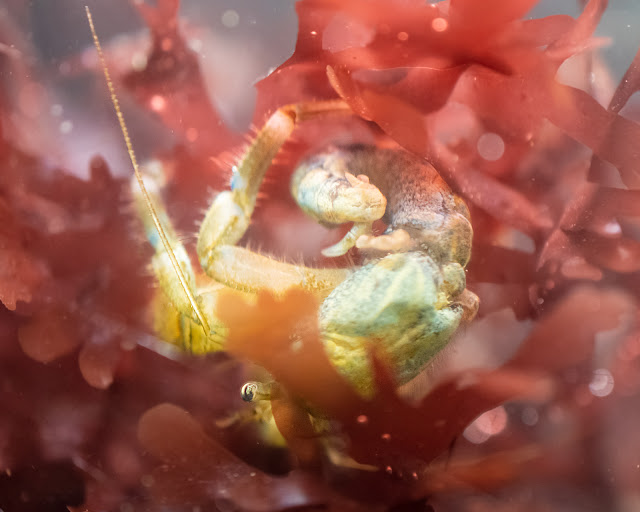
A hairy hermit, Pagurus hirsutiusculus, without the protective shell.

Think about crabs. "True" crabs, they call them; the crabs you see scuttling sideways on the shore. They have a soft body encased in a hinged hard exoskeleton, the carapace on top, the abdomen beneath, sort of like a clamshell. When they grow and need to molt, they open this shell and back out, leaving the perfectly formed crab shape behind.

Hermit crabs don't have the hard covering for the abdomen, which is much larger than that of the "trues". The upper body is encased in a hard casing, but the abdomen hangs out, looking like a sausage, soft and juicy, a tempting taste treat for fish and crabs and shorebirds. So they wear a borrowed shell for protection.
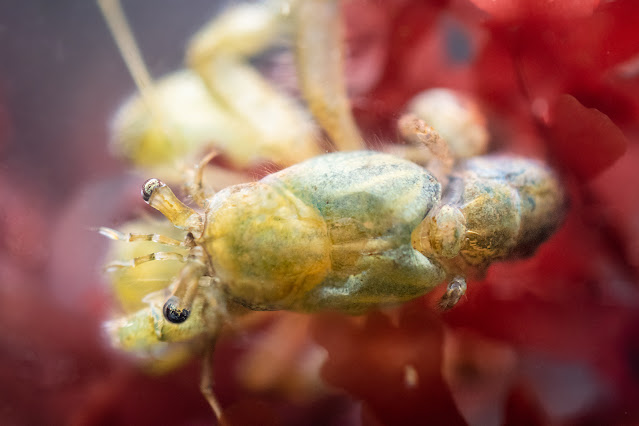
Freshly-molted hermit, showing the upper carapace, two tiny grasping legs, and the front end of the soft abdomen.

As a hermit (or crab) grows, the exoskeleton becomes a tight fit. It doesn't grow with the critter inside, so there comes a moment when he pulls himrself free and backs out, pulling the eyes down out of the eyestalks, the legs and pincers out of their chitinous coating; even the antennas are retracted, leaving the antenna shape behind, attached to the old body shell.
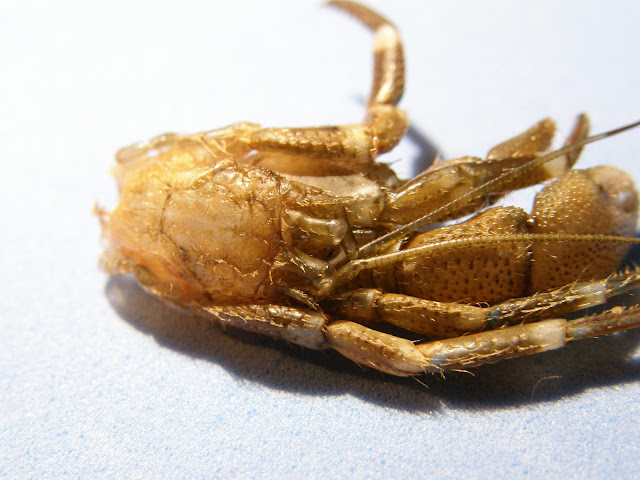
Dried abandoned hairy hermit molt. (2010)

And now the hermit is in danger. He's soft all over; not only that dangling abdomen looks good to eat.  So he heads up, away from the always hungry crabs beneath. He climbs a blade of eelgrass, or, as here, drifts on the seaweed.

Like a butterfly just out of the chrysalis, who rests in the sunlight, slowly unfolding and stretching out her wings until they are stiff enough to fly, the hermit waits in his safe place. He takes in water and swells out before the new carapace hardens, he waits until he feels strong enough to brave the dangers below in his search for a new shell to enclose that vulnerable abdomen.
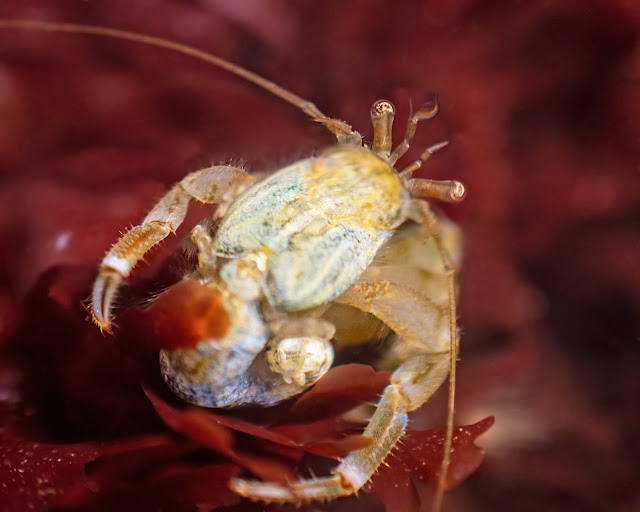
His colours are pale at this stage, and free of algae and grunge.

My bad: trying to get a clear photo, I moved the seaweed and he fell off, down to the sand. Down where a crab lurked. I quickly rescued him, and set him to rest safely in a small bowl of water, then searched the tank for shells that looked about the right size for him. (Normally, he would do this when he was ready and able to run from the crab.)

And he rested only a few minutes, then chose a shell and moved in.
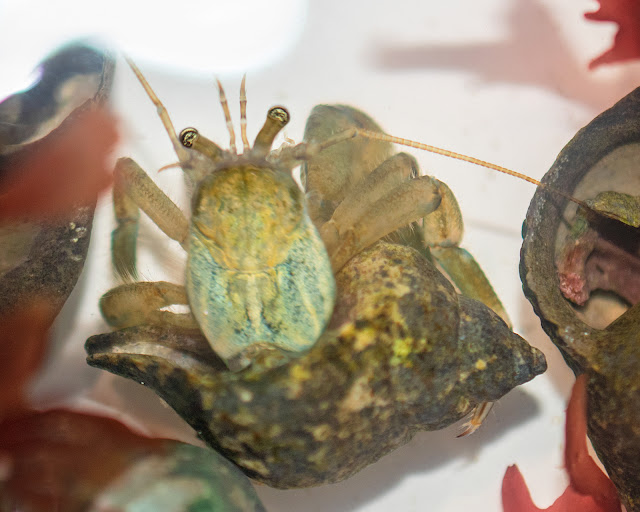
This one looks about right. Body hardened, abdomen protected. Ready to roll!

I gave him some time to settle in, then returned him and the other shells to the tank. And he ran off, happily, to look for food. Needed a pick-me-up after all that work!

~~~~~~~~~~~~~~~~~~~~~~~~~~~~~~~~~~~~
A veces el azar te sitúa en el preciso momento y lugar ... Iba a la cocina para preparar la cena, pero pasé el acuario y vi un ermitaño desnudo. Se me olvidó lo de la cena.

Foto #1: El ermitaño, un ermitaño "peludo", Pagurus hirsutiusculus, escondido entre las algas marinas.

Considera los cangrejos. Un cangrejo "verdadero", como les llaman: los cangrejos que ves corriendo lateralmente en la playa. Tienen un cuerpo blando, encerrado dentro de un exoesqueleto quitinoso articulado, el caparazón arriba, el abdomen abajo, algo así como la concha de una almeja. Cuando crecen y les llega la necesidad de mudar, abren este exoesqueleto y se retiran, despegándose hacia atrás, dejando en la playa la forma perfecta del cangrejo ausente.

Los cangrejos ermitaños no tienen la corteza dura para el abdomen, y éste es mucho más grande que el de los cangrejos "verdaderos". El cuerpo anterior está cubierto de un caparazón, pero el abdomen se cuelga sin protección. Parece algo así como un chorizo, y así lo ven los cangrejos, los peces, hasta los pájaros costeros, un chorizo delicioso. Por lo tanto, los ermitaños esconden ese abdomen dentro de una concha de caracol prestada.

Foto: un ermitaño recién mudado, mostrando el caparazón, dos patitas que sirven para fijarse a la concha prestada, y la parte anterior del abdomen.

Cuando crece un ermitaño, o por cierto, un cangrejo, este exoesqueleto llega a quedarle chico, incómodo. No crece con el animalito por dentro, y viene el momento cuando se separa buscando la libertad, retirando los ojos de los pedúnculos oculares, las patas y las pinzas de sus formas, hasta las antenas de su corteza, dejando la forma de la antena todavía haciendo parte del viejo exoesqueleto.

Foto: una muda de un ermitaño P. hirsutiusculus, resecada.

Y ahora está en una situación peligrosa. Todo el cuerpo recién mudado es blando; ahora parece buen alimento para los cangrejos y otros depredadores. El ermitaño se escapa, subiendo por las hierbas o escondiéndose entre las algas donde no le alcancen los cangrejos.

Como una mariposa recién eclosionada de su crisálida descansa en el sol, estirando y desdoblando las alas, esperando a que estén suficientemente rígidas para poder volar, el ermitaño espera en su lugar protegido. Toma agua, y se hincha antes de que su piel se vuelva dura, un nuevo exoesqueleto, espera hasta que se siente capaz de arriesgarse allá abajo, donde tiene que buscarse una nueva concha.

Foto: un ermitaño recién mudado tiene los colores claros, las patas limpias, sin algas.

Y fue culpa mia; tratando de sacar una foto, arrimé el alga, y el ermitaño se cayó al suelo, donde peligraba su vida por la presencia de un cangrejo. Lo rescaté de prisa, y le puse en un platito con agua donde nada de amenazaba. Luego le busqué una variedad de conchas más o menos de un tamaño que le quedaría. (Normalmente, el mismo haría esto cuando se sentía con fuerzas.) 

Esperó unos cuantos minutos, y luego escogió una concha y se insertó en ello.

Foto: el ermitaño en el plato, con su nueva concha.

Le dejé un tiempecito para descansar, y luego lo regresé al tanque. Y se fue muy contento a buscar algo que comer. Después de todo ese trámite, tenía hambre.


Friday, December 02, 2022

December Happy file folder

 And now we do have snow! While I wait for the snowplows to come by*, I'm digging into the "Things that Make me Happy" file again.

Snow makes me happy, so I'll start off with this, from last year:

Snow piled at the edge of the Elk Falls parking lot. Higher than my car.

Ice crystals on moss on a cement block. Two weeks ago.

An amphipod pausing for a second to look at me.

Red-tipped Lipstick Cladonia lichen in an old, old log.

Detail of a vintage tin mirror frame from Mexico.

An anchored sailboat in the mist. Campbell River estuary.

*Why I wait for the snowplow. I'm on a sidehill; the street at either end of my block is steep and slippery, even in rain. In an emergency, I can get out: I do have the snow tires on and a shovel in back. But I'd rather not have to dig myself out, and save my energy, instead, for walking in a snowy wonderland.

~~~~~~~~~~~~~~~~~~~~~~~~~~~~~~~~

¡Ahora sí que nevó! Mientras espero a que pase el quitanieves**, estoy mirando otra vez mi archivo de "Cosas que me hacen feliz".

  1. La nieve siempre me trae felicidad, así que empiezo con esta foto, del año pasado. La nieve amonotonada en el estacionamiento de las cataratas Elk. Un montón más alto que mi coche.
  2. Cristales de hielo cubriendo musgos en un bloque de cemento. Esto de hace dos semanas.
  3. En el acuario, un anfípodo se detiene un segundo para mirarme.
  4. Unos líquenes Cladonia spp., probablemente el llamado "Lapiz labial", en un troncón viejo.
  5. Detalle de un marco de espejo de hojalata (el marco) que mi hija me trajo de México hace años.
  6. En el estuario del rio Campbell, un barco velero duerme en la neblina invernal.
**Porque me quedo esperando el quitanieves: este lugar es puro cerro, subiendo precipitadamente desde la carretera al lado de las playas. Mi calle sale por ambos extremos a caminos empinados, bien resbalosos, aun cuando apenas está lloviendo. Bajo nieve, los coches patinan. Si hay emergencia, puedo salir, ya que tengo llantas para la nieve, y una pala en el maletero. Pero prefiero no tener que excavar el coche y en cambio ahorrar energías para caminar en un paraíso de nieve.

Wednesday, November 09, 2022

Mostly hermits.

A few hermits:

Hairy hermit, Pagurus hirsutiusculus. Blue knees, dotted-line antennae, green stripy eyes.

Grainy hand hermit, Pagurus granosimanus. Blue spots all over the legs and pincers, orange antennae, red eyes.

"Grandpa". The oldest and largest of the hermits in a heavy shell. A grainy-hand.

A group shot. They all get along fine together. Two hairy hermits, one periwinkle, an amphipod, an orange-striped green anemone, a branch of hydrocoral, rose algae (Rhodymenia spp.), and something with black and cream strips and a bit of orange; I can't identify it. Oh, and all those white specks are swimming copepods.

And the sun is shining on snow. Nice!

~~~~~~~~~~~~~~~~~~~~~~~~~`
Unas fotos de cangrejos ermitaños.
  1. Un ermitaño "peludo"; Pagurus hirsutiusculus. Tiene rodillas azules, las antenas verdes con puntos blancos, y los ojos verdes con rayas negras.
  2. Un ermitaño "de manos granosas"; Pagurus granosimanus. Las patas están cubiertas de protuberancias azules, las antenas son anaranjadas y los ojos rojos.
  3. "El abuelo". El ermitaño más viejo, y más grande.
  4. Compañeros, Se llevan muy bien. Dos ermitaños "peludos", un bígaro, un anfípodo, una anémona verde con rayas anaranjadas, una ramita de hidrocoral, una alga "color de rosa" Rhodymenia spp., y algo con lineas negras y color crema, con una mancha anaranjada: este no lo puedo identificar, Y todos esos puntitos blancos son copépodos.
Y salió el sol, haciendo brillar la nieve. ¡Lindo!

Monday, November 07, 2022

Periwinkles and dovesnails

I never tire of watching my intertidal snails going about their business. They're busy little critters, always on the move, up and down the walls, in and out of the water, over rocks and seaweeds and other animals. I've even seen them sliding along on the underside of the water surface itself.

These are among the tiniest in my aquarium:

Littorina scutulata, Checkered periwinkle, eating.

There are two species of tiny periwinkles found on our shores in the upper intertidal zone, the Sitka periwinkle, and this, the Checkered. They are very much alike at first glance; I may have some of each in the tank. But the Sitka periwinkle has a rounder shell, and its tentacles are black. And it spends a lot of its time out of the water and can even drown if it stays in too long. In my tank, they hang out just under the edge and when I drop them back in the water, they wake up and head for the air again.

The checkered periwinkle comes out of the water at night; on the shore, it follows the tide in and out. It eats algae (here cleaning it off the aquarium walls) and diatoms. And I was surprised to learn that they, as well as the Sitkas, eat the black lichen, the "sea tar", that grows along the upper edge of the intertidal zone as well.

And there's this: "The constant scraping of littorinid (periwinkle) radulas has been estimated to scrape as much as 1 cm off of intertidal rocks per 16 years." (WallaWalla.edu) That's the rocks themselves! So it should take them about 4 years to wear down my glass aquarium walls. If they stick to one small area, that is, and don't waste time on the shells and stones on the floor.

Periwinkle eating algae on the shell of a hermit crab.

And there are the dove snails:

Carinate dovesnail, Alia carinata

These are mostly about 8 mm. long, although they can grow to 1 cm. They are carnivores, eating worms and chewing through shells of other mollusks. I see them on the walls, but not scraping away as the periwinkles and limpets do, but waving about their siphons, searching for the scent of food.

These never leave the water. I often see them hanging out in couples.

I've never seen one stretch out and coil his foot like this before.

Dovesnail and amphipod.

And more critters, tomorrow.

~~~~~~~~~~~~~~~~~~~~~~~~~~~~~~~~
Nunca me canso de contemplar los caracoles intramareales en mi acuario. Son animalitos muy activos, siempre ocupados limpiando las paredes, paseando, saliendo al aire y regresando al agua, trepándose a las rocas y las algas y los otros animales. ¡Hasta los he visto boca arriba, deslizándose en la parte inferior de la superficie del agua!

Estos son unos de los más pequeños en mi acuario:

Foto #1: Un bígaro cuadriculado, Littorina scutulata, comiendo algas.

Hay dos especies de bígaros que se encuentran comunmente en nuestras zonas intramareales, el bígaro Sitkana, y éste, el bígaro cuadriculado. Son casi idénticos a primera vista, y puede ser que hay de las dos especies en mi acuario. Pero el "Sitka" tiene la concha más redonda, y sus tentáculos son negros. Y pasa la mayor parte de su vida fuera del agua; hasta se puede ahogar si se queda demasiado tiempo en el agua. En el acuario, se congregan en el borde. Cuando los dejo caer en el agua, se despiertan y empiezan el viaje al aire otra vez.

El bígaro cuadriculado sale del agua en la noche, y en la playa, sigue la marea mientras sube y baja. Come alga (y aquí me limpia las paredes del tanque) y diatomeas. Y me sorprendió aprender que ambas especies también comen líquenes, los líquenes negros (chapopote marino, los llamamos) que crecen el el borde superior de la zona intramareal.

Y pasa esto: "El raspado constante de la rádulas de las especies litorínidas (los bígaros) se ha estimado que quita hasta 1 cm. de las rocas intramareales cada 16 años." (de WallaWalla.edu) ¡Eso es de las mismas rocas! Calculando esto, les va a tomar como unos 4 años para hacer desaparecer las paredes de mi acuario. Bueno, si es que se limitan a raspar las paredes y no se distraen con las rocas y las conchas allá abajo.

Foto #2: Un bígaro comiendo algas en la concha de un ermitaño.

Y hay los caracoles "paloma", las Alia carinata:

Foto #3: Alia carinata.

Estos caracoles miden alrededor de 8 mm. de largo, aunque pueden llegar a 1 cm. Son carnívoros: comen gusanos y raspan las conchas de otros moluscos para llegar a la carne adentro. Los veo en las paredes, pero no están raspando las algas como lo hace los bígaros y las lapas, sino que se deslizan con el sifón extendido adelante, para discernir el olor de algo comestible.

Nunca salen del agua. Muchas veces los veo de dos en dos.

Foto #4: Nunca antes había visto que así extendieran y torcieran la pata.

#5: Un caracol "paloma" con un anfípodo.

Mañana, más fotos del acuario.


Powered By Blogger