Showing posts with label hermit crabs. Show all posts

Thursday, July 24, 2025

Tiny orange lifers

I went down to the local aquarium this morning. And I have a few photos to process. One, though, even though it's not as clear as I would like, made my day.

One of the volunteers, knowing that I was interested in hermits (I've been in before) showed me something he'd discovered; tubeworm hermits! So tiny that they were barely visible; specks of orange among the stones and shells.

Discorsopagurus schmitti in calcareous tubeworm spirals.

These tiny hermits are among the few species whose abdomen is not coiled to fit in a snail shell. (Any rule Ma Nature makes, Ma Nature breaks.) Instead, they use tubeworm shells, which, entire, are fixed to the substrate, or broken snippets of the empty tubes.

These are females; the females live in attached tubes, and catch their food as it floats by. Males borrow bits of broken tubes, and wander about in search of females. The aquarium guy has seen one walking around, but though we searched today, he was too well hidden. Maybe next time ...

A mass of these tubeworms, alive and trolling for food.

The aquarium pumps in "live" water from just off-shore; it comes with tiny organisms, juvenile species, eggs ... They never know what's going to show up here. There are new discoveries every day.

~~~~~~~~~~~~~

Visité el acuario del pueblo esta mañana, y regresé con algunas fotos. Una, aunque no salió tan bien como hubiera querido, me hizo el dia.

Uno de los voluntarios, sabiendo que me fascinan los cangrejos ermitaños (no es mi primera visita) me mostró algo que había encontrado recientemente; ¡ermitaños que viven en tubos de los gusanos tubícolos! Tan pequeños eran que apenas podíamos ver unas motitas anaranjadas entre las piedras y conchas.

Foto: Discorsopagurus schmitti

Estos ermitañitos son unos de los pocos cuyo abdomen no forma un círculo para poder acomodarse dentro de una concha de caracol marino. Usan, en cambio, los tubos hechos por gusanos tubícolos; frescos, se encuentran adheridos al sustrato; también se pueden usar tramos de los tubos rotos.

Estos en la foto son hembras; viven en tubos fijos, y pescan su comida cuando pasa en la corriente. Los machos se visten con pedazos de tubos rotos, y así libres, andan en busca de hembras. El voluntario había visto uno de estos, pero aunque lo buscamos hoy, se quedaba escondido. Tal vez otro dia ...

Foto: Un grupo de gusanos tubícolos, algunos con sus tentáculos extendidos.

El acuario obtiene su agua "viva" directamente de la corriente cercana. Llega con organismos pequeños; primeras etapas de especies locales, huevos, y más .... Nunca saben que es lo que va a aparecer mañana.

Saturday, August 19, 2023

The watchers

 I dropped in to the little aquarium, mostly to say hello to the hermit crabs. They were busy doing what hermit crabs love best (after eating); standing at the window, in this case their glass wall, watching the world go by.

Blackeyed hermit, Eupagurus armatus in a moonsnail shell

Widehand hermit, Pagurus tenuimanus

And then there was more to see, some critters I'd never seen before. There will be photos.

~~~~~~~~~~~~
Pasé por el pequeño acuario, primeramente para ver a los cangrejos ermitaños. Estaban esperando, haciendo lo que más les gusta (después de comer): pararse junto a la ventana, que en este caso es la pared de su tanque, y observar al mundo.

Fotos:
  1. Ermitaño de ojos negros, Eupagurus armatus vistiendo una concha de caracol luna.
  2. Ermitaño de manos anchas, Pagurus tenuimanus.
Hubo más. Inclusive algunas criaturas que no había visto antes. Habrá fotos.


Thursday, June 22, 2023

Tenuous hand?

 I promised you hermits.

Widehand hermit.

This is the same hermit I posted a few weeks ago, from the side. This view shows the reason for his name, Widehand, Elassochirus tenuimanus. It's a bit confusing, looking at the Latin name; "tenuis" means "thin, drawn out, meager, slim, slender". (Online Etymology Dictionary) And "manus" is, of course, "hand". But looking at it again, I see what they mean. The "hand" is wide, because it's flattened out, thin, in other words.

Smaller hermit, on a sand dollar. Possibly a blackeyed hermit. The sand dollar is very much alive, walking on his hundreds of tiny, black tube feet.

~~~~~~~~~~~~~~~
Les prometí ermitaños.

#1: Un cangrejo ermitaño "de mano ancha", Elsasochirus tenuimanus. Subí una foto de este ermitaño hace unas semanas, pero visto desde el lado. Aquí, visto de frente, se ve porque le llamamos "de mano ancha". Aunque el nombre scientífico, E. tenuimanus, parece contradictorio, pues en Latín, "tenuis" quiere decir "delgado, tenue, reducido". Pero mirándolo otra vez, lo entiendo; la "mano" será ancha, pero solo porque en la dimensión opuesta está bien aplastada.

#2: Un ermitaño más pequeño encima de un dólar de arena. Puede ser que es un ermitaño "de ojos negros". El dólar de arena está vivo y activo, caminando sobre sus millares de pies tubulares negros.


Friday, March 03, 2023

Fighting crabs

 A few years ago, on a hot summer afternoon, I was watching the tide roll in over a rocky breakwater. As the water rose between the rocks, crabs started to come out from their hiding places. More crabs and more, where a few minutes ago there had been no sign of life, just the hot, bare rocks.

The water rose until it reached a dried kelp stipe, cast up to bake on the rocks. And this surprised me: immediately the crabs attacked it; all the crabs, jostling and scrambling over each other to get at this dried kelp. More came out from hiding, dozens and dozens more, all of them grabbing at the stipe, fighting for a spot, pushing each other out of the way, tearing off bits and eating them. As the tide covered more of the length of kelp, so did the crabs until there was no kelp to be seen, just this dancing mass of crabs.

I should have thought of this sooner. My hermit crabs like kelp, too, and I would bring them fresh kelp from the shore. But cut kelp quickly turns slimy; I could feed them only a small piece and throw away any extra. And then, last fall I remembered the happy crabs.

So now I slice a long stipe into thin circles and dry it. And every couple of days I give the hermits and crabs a couple of dried slices. The first batch lasted them all winter; now they're starting on a stipe I dried a couple of weeks ago. 

Hairy hermit and his kelp treat.

One of the tiniest hairy hermits, with his scrap of kelp.

And a watchful crab, ready to fight for her meal, if necessary.

~~~~~~~~~~~~~~~~~~
Hace unos años, en un verano caluroso, estaba en un rompeolas mirando mientras subía la marea. Cuando el agua empezó a cubrir las rocas, aparecieron los cangrejos que hasta entonces habían estado bien escondidos, fuera del alcance de los rayos del sol. Más cangrejos, muchos cangrejos, donde hacía poco no se veían señales de vida, solamente esas piedras resecas.

El agua subió hasta que alcanzó un tramo del estipe de quelpo ya bien seco, tostado por el sol allí expuesto sobre las rocas. Y esto me sorprendió; en cuanto el agua tocó el quelpo, los cangrejos lo atacaron; todos los cangrejos, con gran entusiasmo empujándose, trepándose uno encima del vecino para llegar a este pedazo de quelpo seco. Salieron más de sus escondites, docenas más, todos tratando de agarrar el quelpo, peleando con los que se pusieron en su camino, defendiendo su sitio con ánimo mientras arrancaban pedazos para comer. Mientras la marea cubría más del quelpo, también lo hicieron los cangrejos, hasta que no se veía nada del alga, solamente esa masa pululante de cangrejos.

No sé porque no pensé en esto antes. A mis cangrejos ermitaños también les gusta el quelpo, y yo les traía pedazos desde la playa. Pero el quelpo cortado pronto se hace baboso, y solamente les podría dar un pedacito y tirar todo lo demás. Hasta que el otoño pasado, me acordé de esos cangrejos felices.

Y ahora me traigo todo un estipe largo, lo corto en rebanadas delgadas, y lo pongo a secar. Y cada dos o tres dias les doy una o dos rueditas de quelpo a mis criaturas. El primer estipe nos duró todo el invierno; ahora empiezan con el segundo. Y muy felices están.

Fotos: 
  1. Un ermitaño "peludo" Pagurus hirsutiusculus, con su pedazo de quelpo.
  2. Uno de los más pequeñtos, también comiendo quelpo.
  3. Y un cangrejo hembra, algo preocupada por pensar que yo le puedo quitar su hallazgo. Lo defenderá con esas pinzas, si llega el caso.


Tuesday, October 18, 2022

A grainy hand and 3 hairies

Interlude. Between outings to forest and shore, I come home to a dozen busy hermit crabs wanting dinner. Sometimes they even pose for photos.

A grainy-hand hermit, Pagurus granosimanus.

Eating dried kelp.

There are 5 medium-sized hermits, both grainies and hairies. The grainy-hand hermits grow up to 2 cm. long, counting the shell they've chosen; hairy hermits are just a bit smaller.

They're picky about the shells they use. I bought a package of these imported white shells; nice, clean shells with a wide opening, not too heavy. The grainy-hand hermits like them but the hairies won't touch them; they prefer whelk or periwinkle shells, or even the invasive mud-flat snail shells.

I'm not really sure how many baby hairy hermits there are; I count a half-dozen any day, but some of these, at least, grew up in the tank, and I have seen some so small I only knew they were hermits by the way the shell moved. Snails inch themselves along; hermits scuttle.

One of the larger of the tinies, a hairy hermit about 5 mm. long, shell and all.

They all love dried kelp. I cut off chunks for them about 2 cm. long.

About as small as the camera can capture. Another hairy hermit, Pagurus hirsutiusculus.

This one was perched on a small barnacle which had attached itself to a mussel. The white strands are the mussel's byssal threads, by which it has glued itself to the wall of the aquarium. Each thread is about the diameter of a human hair. Off to the right side, there's a copepod female carrying her egg sac. The red dot is her one eye.

~~~~~~~~~~~~~~~~~~~~~~~~~~~~
Intermedio. Entre vueltas por los bosques y las playas, regreso a casa donde me esperan mis cangrejos ermitaños, queriendo cenar. A veces hasta se detienen para que les saque una foto.

Fotos:

#1. Un ermitaño de mano granosa, Pagurus granosimanus.
#2. Comiendo quelpo resecado. (Y mojado ahora, claro.)

Hay 5 ermitaños de tamaño mediano,  Pgranosimanus y P. hirsutiusculus, los peludos. Los granosimanus crecen hasta unos 2 cm. de largo, con todo y concha; los peludos son un poquito más chicos.

Son algo quisquillosos en lo que respeta a las conchas que deciden ocupar. Les compré un paquete de estas conchas importadas, limpias y blancas, con boca amplia, no muy pesadas. Los ermitaños de mano granosa las usan, pero los peludos ni los tocan; prefieren conchas de bocina o bígaro e inclusive del caracol invasivo Batillaria attramentaria.

No sé por cierto cuantos de los ermitaños peludos juveniles viven en el acuario; puedo contar, cualquier dia, una media docena, pero algunos de ellos crecieron aquí en el acuario, y he visto algunos tan miniaturos que solamente los reconocí por su manera de moverse. Los caracoles se arrastran paso por paso: los ermitaños corretean.

#3. Un ermitaño peludo juvenil. Mide aproximadamente 5 mm con todo y concha.
#4. Les gusta el quelpo seco. Les corto pedacitos de como 2 cm. de largo.
#5. Este es a lo más pequeño que mi cámara puede captar. Otro ermitaño peludo. Se había subido a un balanito, el cual a su vez se había fijado a un mejillón. Los hilos blancos son los bisos del mejillón, con los cuales se ha adherido a la pared del acuario. Cada biso tiene el diámetro de un pelo humano. Al lado derecho se puede ver un copépodo hembra llevando su saco de huevos. El puntito rojo es su único ojo.


Thursday, June 16, 2022

Showy

I stopped by our local (tiny) aquarium, and took a few photos, near the open door where the light was adequate. It is stocked every summer with local species, which are returned to their site of origin in the fall. 

And though all the animals are local natives, there were critters I have not seen before, all decked out in fiery colours:

Bright orange and red hermit. With orange antennae. In a large shell, and wearing a pink-tipped anemone.

I think this is a blackeyed hermit, Pagurus armatus. They are subtidal hermits, which may be why I have never seen them in the intertidal zone. They grow to 4.5 cm. long.

And then there's this one with red and white antennules. The same species, or another? 

Orange is a common colour for our subtidal hermits.

And a small community:

Orange, red, pink, and green, against a blue background.

The large tube on the right is the neck of a bottle, covered with encrusting sponges; a brittle star is inside, waving a couple of legs at us. It's probably the daisy brittle star, Ophiopholis aculeata; I do find these in our intertidal zone. There's another under the bottle. 

On the left, perched on a shell, there's a small orange tunicate, maybe a sea peach. Lower down, two anemones. On the stone, a a pink encrusting sponge. The two spiny spikes at the bottom may be the legs of a feather star.

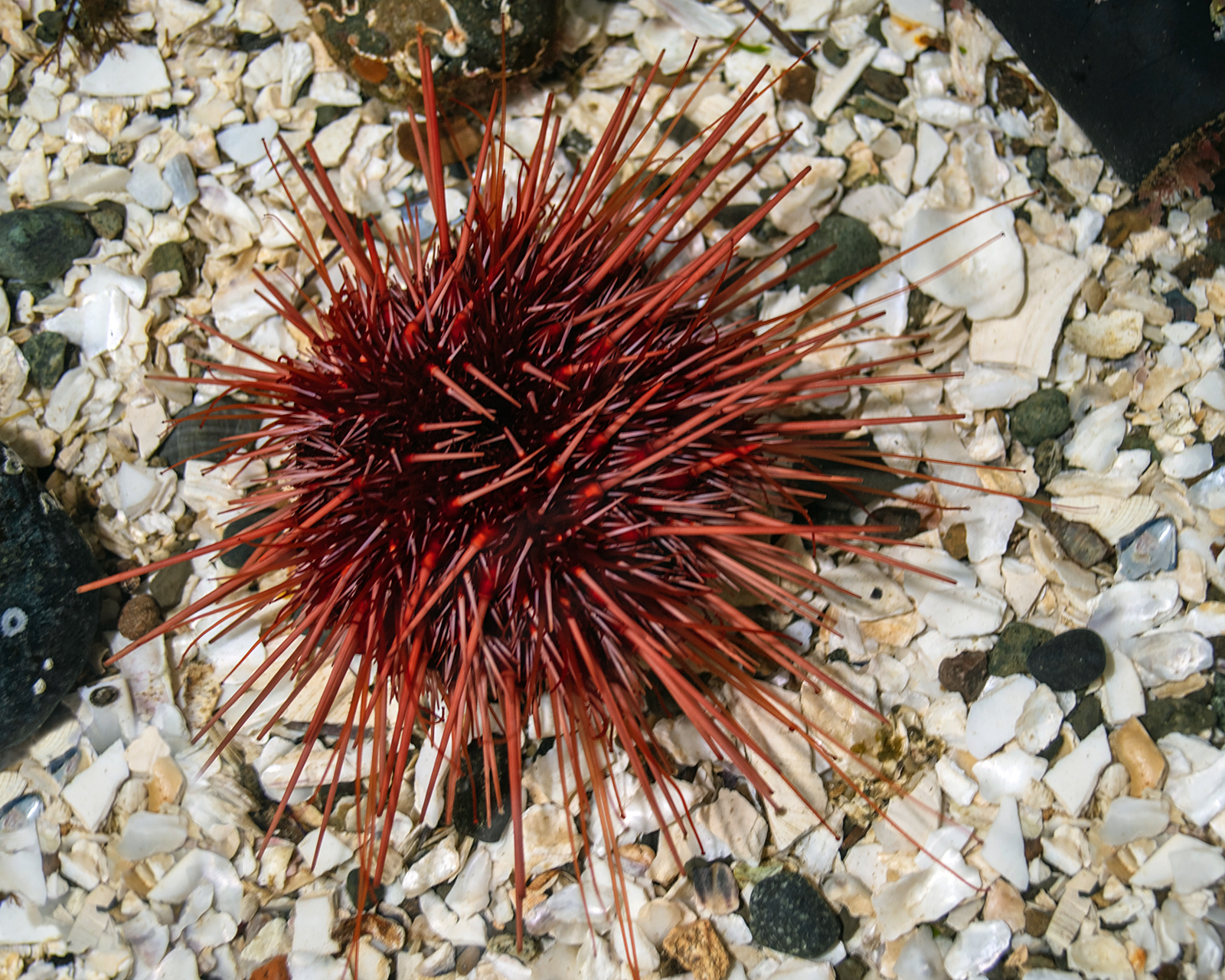
And this I do recognize; there are hundreds of them on any local beach, near the bottom of the intertidal zone.

Red sea urchin, Strongylocentrotus franciscanus.

~~~~~~~~~~~~~~~~~~~~~~~~~~~~
Visité nuestro acuario local, muy pequeño, donde cada verano se llena de animales de nuestras playas y el mar, todos nativos a la región. En otoño, se vuelven a su stitio de origen y el acuario se mantiene cerrado todo el invierno.

Aunque los animales viven aquí cerca, había varios que yo no había visto antes, todos luciendo sus colores de fuego.

Foto # 1: Un ermitaño anaranjado con rojo, y con antenas anaranjadas, llevando de adorno una anémona de puntas color de rosa. Creo que es el ermitaño de ojos negros, Pagurus armatus. Estos son ermitaños que viven en la zona submareal, que puede explicar porque no los he visto. Son ermitaños grandes, que llegan hasta 4.5 cm. de largo.

Foto #2: Y este tiene anténulas con rayas rojas y blancas. No conozco la especie. El anaranjado es un color muy común entre nuestros ermitaños submareales.

Foto #3: Una pequeña comunidad. El tubo a la derecha es la boca de una botella, toda cubierta de esponjas encrustantes, anaranjadas, rojas, y cafés. Adentro hay una estrellita quebradiza, probablemente la estrella quebradiza margarita, Ophiopholis aculeata; si encuentro estas en nuestra zona intramareal. Hay otra debajo de la botella.

A la izquierda, pegada a una concha, hay un tunicado anaranjado; tal vez sea un "durazno de mar". Más abajo, dos anémonas. En la piedra, una esponja encrustante color de rosa. Y las dos patas espinadas al fondo pueden ser, tal vez, las de una estrellita plumosa.

Foto # 4: Esto sí que lo conozco; hay cientos de estos en cada una de nuestras playas, cerca del extremo inferior de la zona intramareal. Un erizo de mar rojo, Strongylocentrotus franciscanus.


Sunday, December 29, 2019

Micro beasties

I bought myself another microscope. A cheap one, for students, with low magnification, but like the even cheaper one I'd had a few years back (that didn't last long), with the ability to take photos. The one I had been using up to now was for my eyes only.

Tonight, I set it up and collected some stuff from my aquarium; a teaspoonful of sand, a fragment of seaweed, a few empty (or so I thought) shells, and one of the smaller hermit crabs. Arranged them on plastic lids, since they needed to be kept in water, shoved them under the 'scope, and tried to focus. It's a bit difficult when your target keeps running away; even the seaweed was carrying mini-critters on the move.

Pacific rose seaweed, Rhodymenia pacifica. With worm and snails.

This delicate (but oh, so durable in my tank) seaweed is a sheet with one layer of cells. Here, each cell is visible. The fragment was about 3 mm wide. The worm, that looked like a hair, but crawled about slowly, is about as wide as one seaweed cell. Even through the microscope, I didn't recognize the dark patches, but once I blew up the photo, I see that they're all snail shape. No wonder I always have a batch of new tiny snails climbing the walls!

Another snail. Shell only, abandoned in the sand.

This was in the teaspoon of sand. The snail shell is about as large as the larger sand grains. Still tiny. With everything under a film of water, the microscope LED lights produce glitter. I edited out what I could without destroying what is underneath, but the tiniest white specks are moving critters, all constantly in random motion, sort of like a swarm of midges. Some of the brighter patches of light were pulsating, squirming something-or-others. I managed to see a couple of worms and something with legs before they hid under the sand grains again. Some of the sand grains were bouncing; there was something busy underneath.

On an old cluster of empty barnacle shells, a colony of orange-striped green anemones has settled in.

One of my smaller hermit crabs.

I've been wanting to get a good look at these hermits for a while. They look like hairies (Pagurus hirsutiusculus), but never seem to grow up to the expected size. Maybe I'm not giving them enough time. This one certainly looks like a hairy; banded green antennae, blue marks on the legs. But those two rows of lumps on the pincer arm look interesting: I'll have to examine more of these little guys.

A couple of periwinkles.

And a tiny snail, half the size of the smallest periwinkle, on the move. With sand grains for size.
This is fun! Let it rain!


Tuesday, August 06, 2019

Meanwhile, back in the tank ...

I've been too busy; travelling, running errands, catching up on paperwork (a form of procrastination to put off dealing with more challenging paperwork), gardening; all the things I do during a "lazy" summer. Sometime, weeks ago, I took a break and sat down by the aquarium to visit the hermits. And forgot to post the photos.

So here they are. Hermits and a crab.

Poor crabby. He must have tangled with one of the larger crabs, probably trying to hold onto his supper. He's lost a pincer. Luckily, he's got plenty of legs and mouthparts that can serve as spoons and forks, and the next molt, he'll get his pincer back.

Deep in the tank, colours are muted. It's like seeing through a light fog. Here, a hairy hermit looks back at me from her perch on Pacific rose seaweed growing on a stiff red alga. Pacific rose can grow from fragments left after it has been weeded out. I tear out whole handfuls every time I change the water.

A grainy hand hermit with colourful algae decorating his shell..

One of the tiny orange hermits in a brand-new shell. The seaweed here is broken, half-rotted rockweed. Good eating, the hermits say.

Grainy hand hermit (left) and small hairy hermit (right) on eelgrass.

Saturday, July 27, 2019

Rainbow under rocks

The Willow Point beach is rocky; hard, round rocks, mostly cemented into the substrate. In the lower intertidal zone, they are often covered with green sea lettuce and rockweed. Where there is sandstone, it is pitted with green anemone holes. And everywhere there are barnacles, scuttling crabs, and tiny black snails. At the water's edge while the tide was turning, I flipped rocks and combed my fingers through the rockweed. Slow going, but worth the effort.

Here are some of the beasties I saw, in no particular order.

A flatworm, flatworm eggs, and two amphipods. This flatworm kept flipping her edges up towards me, instead of slithering along, as they usually do. It almost seemed as though she were defending her eggs.

A small kelp crab. This one's not wearing the seaweed hat. There was another with it, wearing the hat, just one patch of green algae growing near the top of the head. It ran away before I could get down to their level.

Limpet, periwinkle snail (or hermit in a periwinkle shell), two flatworms, and a pretty orange-striped green anemone, without the green.

Three limpets. Limpets wander about, lifting the forward edge as if to see where they're going. As soon as I touch them, they clamp down and cement themselves to the rock. These ones are still on the move.

Limpets, a whelk, and 6 of the tiny yellow or orange hermit crabs in periwinkle shells.

I haven't been able to identify these hermits. They are always tiny, and brightly coloured. I had at first thought they were greenmark hermits, Pagurus caurinus, which are the right size, but they have unbanded antennae; these little guys have green and white bands on their antennae.

Catching a few rays: there's a starfish, or maybe several starfish under this rock.

A fat ribbon worm. At the upper right, there's a small polychaete that I didn't see until I blew up the photo.

A two-toned polychaete.

This was the highlight of my afternoon. This worm has a blue front end, but the rear half is a bright pink. If you look closely (click on the photo to enlarge it) you can see the four eyes on the head. It's about 18 inches long. (More or less, these worms shrink and stretch continuously.)

There's a wandering ribbon worm, Paranemertes peregrina, with its purple back and cream belly, at the lower left, and a tiny greenish worm at the lower right.


Wednesday, July 24, 2019

Bubbles

Little green shore crab, bubbling at me.

In the shadows, assorted whelks, periwinkles, and hermit crabs in periwinkle shells. Also another tiny crab in a clamshell.

The tide was very low, and I've got a pile of photos of critters to process, including one that was a lifer for me. Coming up tomorrow.

Saturday, February 23, 2019

About broken shells

The lighting around my aquarium always varies, from morning sunshine to rainy-day blues, to snowy whites, to indoor yellows. I take a few photos at random, just to check the lighting of the moment. This was one of them.

Hermits (3; can you find the 3rd?), holdfast, red algae, broken shells, marine "snow".

The littlest hermit, in the centre, has a couple of big holes in his shell; from one angle, I can see through and out the other side. He seems happy enough in it.

That orange mass is the remains of an old kelp holdfast. I added it to the tank months ago, still wearing its outer skin, and populated with diatoms and assorted bits. The hermits cleaned it completely in a day or two, as usual. Now it looks bare; just the clean, orange twigs, but every time I pull it out, thinking to discard it, there are several hermits and a clan of amphipods on it, so they must be finding something to eat there. And I put it back.

The big shell in the back is a moon snail shell I added two summers ago. It was intact then, but even without wave motion and rolling rocks to break them, shells gradually disintegrate in salt water, so that picking up the shell now, even gently, causes edges to break off. About half the shell is gone now. This deterioration of a shell provides calcium for the living snails' shells.

To build shells, organisms extract calcium ions (Ca2+) and carbonate ions (CO32-) from seawater, which combine into the solid crystals of calcium carbonate (CaCO3) that shells are made of.  (Woods Hole Oceanographic Institution)

Acidity in the water (such as the water I'd brought home from the "improved" boat launch) causes shells to dissolve more rapidly, both on leftover shells and the growing shells of live snails. A new study by Woods Hole OI examined the effects of rising CO2 on marine invertebrates. Some tolerate it, others don't. Some don't survive, as their shells provide less protection from predators and other stresses.

Ries and colleagues found that species with more protective coverings on their shells and skeletons—crustaceans, the temperate urchins, mussels, and coralline red algae—are less vulnerable to the acidified seawater than those with less protective shells, such as conchs, hard clams, and tropical urchins.
All of the test organisms continued to create new shell throughout the experiment, Ries said, but some suffered a net loss of shell because older, more massive portions of their shells dissolved under the highest CO2 conditions. (Woods Hole)

Just another reason to monitor the acidity of my aquarium.

(Also see: As The Oceans Become More Acidic, Sea Snail Shells Could Dissolve.)

Tuesday, April 03, 2018

Three hermits

There are a pair of fat, green polychaete worms in my aquarium, and a tiny, tiny, tiny crab, so small I only discovered him because he, as crabs do, lifted a shell many times his size and weight. So I grabbed the camera, set up the lights and reflectors, and spent an hour staring into the tank.

So the worms went into hiding, and the crab never came out. Never mind; the camera kept busy, anyhow.

For starters, here's a trio of hermits.

Hairy hermit, Pagurus hirsutiusculus, getting her exercise. Hermits love to climb, the more challenging the slope, the better.

Hanging out with buddies, an anemone and a limpet, on a carpet of multicoloured algae.

One of the tinies. About the size of a long-grained rice grain. These littles are so light, I've found them several times climbing halfway up the glass wall of the aquarium, holding on to specks of algae.

Next, I think, a passel of amphipods.


Tuesday, February 27, 2018

Under a glaring sun

Where the intertidal flats are mostly flat slabs of sandstone, critters that usually hide in the sand under rocks when the water recedes, quickly burrowing deeper when their rocks are flipped, either just put up with unfiltered sunlight, or cling tightly to the underside of what few stones are available. There's nowhere to run.

A half-dozen hermit crabs and a Wosnesenski's isopod struggle to stay in the shade of a trio of mussels. I replaced their stone roof gently where I found it.

The sand is a thin dusting on the sandstone. There's no shelter for the critters that can't run and hide elsewhere.The anemones here are under about a half-inch of water.

The green algae, the red seaweed, and the anemones don't mind the sunlight. Even at full tide, they're exposed to it, just slightly shaded by the clear water.
This green algae is probably the same one that pollutes my aquarium, always growing first on the walls closest to the light. The pink-tipped green anemones also benefit from sunlight; they do not photosynthesize, being animals, but carry symbiotic algae in their tissues; these algae produce enough food for themselves and some over for the anemone that hosts them.

Tuesday, November 29, 2016

Nose to the glass

A few random aquarium shots, taken while I waited for a hermit to try on a new shell.

"First dibs!"

Very small crab, just outside his present burrow underneath an oyster.

These crabs always amaze me. I knew he was digging under the oyster before he appeared at his front door, because the whole oyster was bouncing up and down. And the oyster is at least 10 times his length and width, thick and solid. And yet, the crab, standing on his tippy-toes, bounces the whole thing on his back.

I weighed a rock that a crab lifted a couple of years ago; the rock was at least 100 times the crab's weight!

Tiny hermit in an unusual shell. It looks like two broken shells cemented together.

In the second-hand shop, looking over used shells. Someone chose the polka-dot one, and is wearing it today.

Val, festooned as usual, with broken shells and a red algae scarf.

Barnacle eater, looking for the barnacle patch after I moved it. A channelled dogwinkle, probably. The shell is a deep, purplish blue.

Algae-eating snails, like the mud snails and the limpets, move along the glass, their jaws moving rhythmically, cleaning off microscopic algae as they go. Looking closely, I can even see the radula, the belt of tiny teeth inside the mouth.

These predatory snails just hurry about their business; their mouth is never seen on the glass. When they reach a barnacle, they extend a proboscis with the scraping radula* on its tip, bore through the barnacle's shell, inject digestive juices, and then suck out the semi-liquid mess. From an observer's point of view, all that can be seen is a snail stuck on a barnacle, and then later, an empty barnacle shell.

*Microscopic photos and diagrams of this can be found on A Snail's Odyssey.
Powered By Blogger