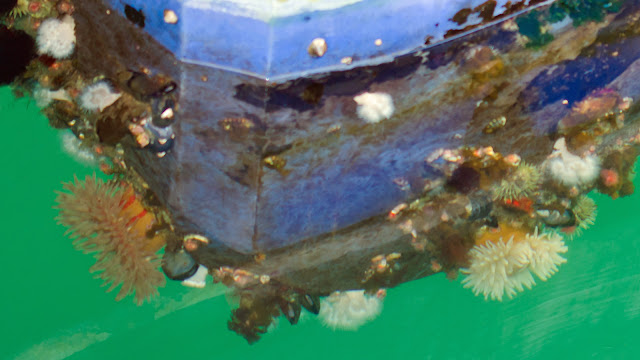
Showing posts with label sponges. Show all posts

Thursday, June 16, 2022

Showy

I stopped by our local (tiny) aquarium, and took a few photos, near the open door where the light was adequate. It is stocked every summer with local species, which are returned to their site of origin in the fall. 

And though all the animals are local natives, there were critters I have not seen before, all decked out in fiery colours:

Bright orange and red hermit. With orange antennae. In a large shell, and wearing a pink-tipped anemone.

I think this is a blackeyed hermit, Pagurus armatus. They are subtidal hermits, which may be why I have never seen them in the intertidal zone. They grow to 4.5 cm. long.

And then there's this one with red and white antennules. The same species, or another? 

Orange is a common colour for our subtidal hermits.

And a small community:

Orange, red, pink, and green, against a blue background.

The large tube on the right is the neck of a bottle, covered with encrusting sponges; a brittle star is inside, waving a couple of legs at us. It's probably the daisy brittle star, Ophiopholis aculeata; I do find these in our intertidal zone. There's another under the bottle. 

On the left, perched on a shell, there's a small orange tunicate, maybe a sea peach. Lower down, two anemones. On the stone, a a pink encrusting sponge. The two spiny spikes at the bottom may be the legs of a feather star.

And this I do recognize; there are hundreds of them on any local beach, near the bottom of the intertidal zone.
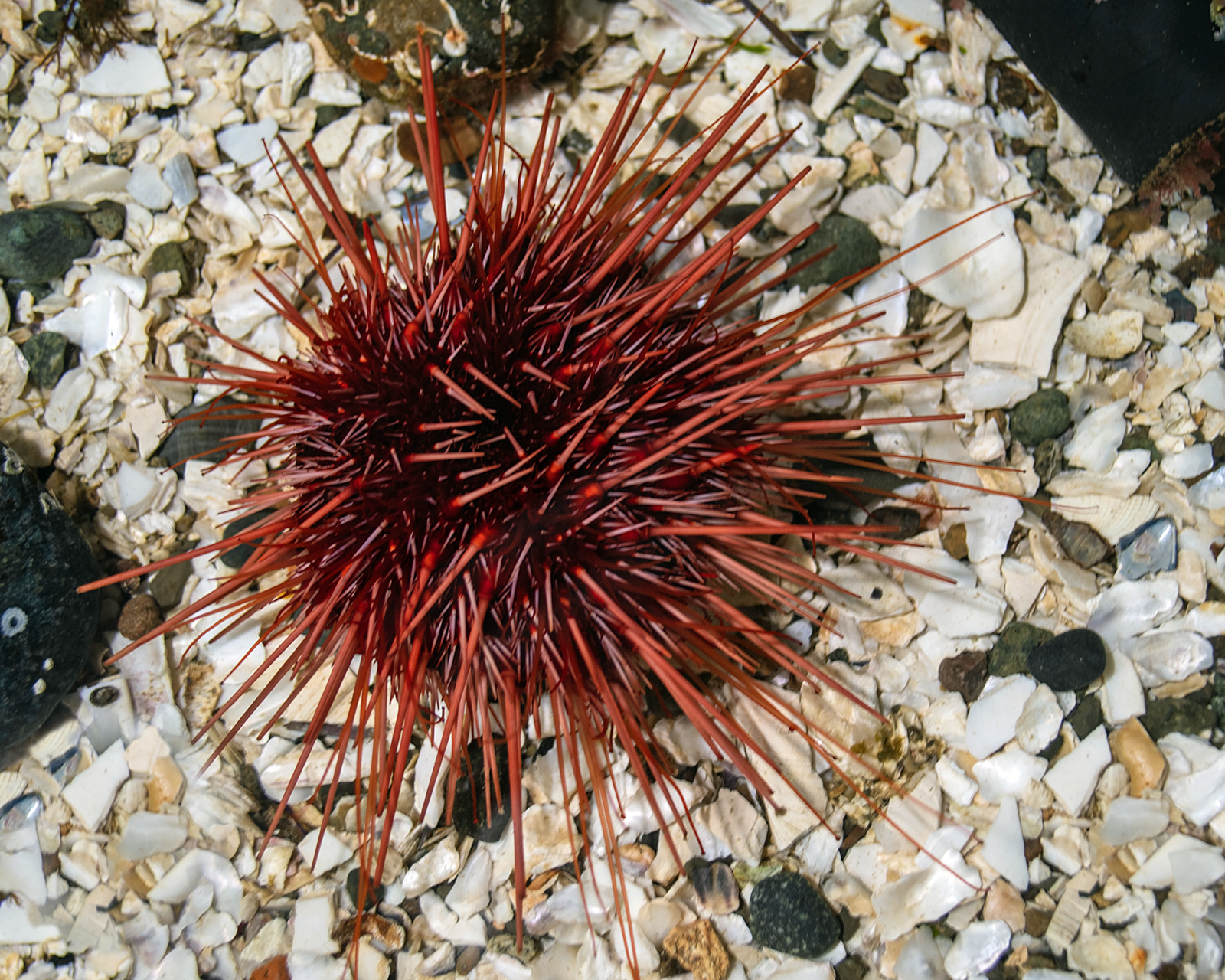
Red sea urchin, Strongylocentrotus franciscanus.

~~~~~~~~~~~~~~~~~~~~~~~~~~~~
Visité nuestro acuario local, muy pequeño, donde cada verano se llena de animales de nuestras playas y el mar, todos nativos a la región. En otoño, se vuelven a su stitio de origen y el acuario se mantiene cerrado todo el invierno.

Aunque los animales viven aquí cerca, había varios que yo no había visto antes, todos luciendo sus colores de fuego.

Foto # 1: Un ermitaño anaranjado con rojo, y con antenas anaranjadas, llevando de adorno una anémona de puntas color de rosa. Creo que es el ermitaño de ojos negros, Pagurus armatus. Estos son ermitaños que viven en la zona submareal, que puede explicar porque no los he visto. Son ermitaños grandes, que llegan hasta 4.5 cm. de largo.

Foto #2: Y este tiene anténulas con rayas rojas y blancas. No conozco la especie. El anaranjado es un color muy común entre nuestros ermitaños submareales.

Foto #3: Una pequeña comunidad. El tubo a la derecha es la boca de una botella, toda cubierta de esponjas encrustantes, anaranjadas, rojas, y cafés. Adentro hay una estrellita quebradiza, probablemente la estrella quebradiza margarita, Ophiopholis aculeata; si encuentro estas en nuestra zona intramareal. Hay otra debajo de la botella.

A la izquierda, pegada a una concha, hay un tunicado anaranjado; tal vez sea un "durazno de mar". Más abajo, dos anémonas. En la piedra, una esponja encrustante color de rosa. Y las dos patas espinadas al fondo pueden ser, tal vez, las de una estrellita plumosa.

Foto # 4: Esto sí que lo conozco; hay cientos de estos en cada una de nuestras playas, cerca del extremo inferior de la zona intramareal. Un erizo de mar rojo, Strongylocentrotus franciscanus.


Sunday, June 12, 2022

Under the donut shop

I took a short detour this afternoon, downtown, looping through a small dock area, peering between floats and under ramps.

Where the sun managed to reach, and where the waves stopped dancing, I caught a few glimpses of a vibrant community.

Plumose anemone, Metridium senile.

Back in the shade, there's a glassy bulb, possibly a tunicate. And a branch that may be a hydroid.

A small lion's mane jelly, Cyanea capillata

This was a youngster, only about a hands'-breadth across, and swimming actively, folding itself up, then opening again rhythmically.

Spreading out, heading under the wharf. With a green sea urchin.

On the bottom of a float (blue) and the pipes under a cabin.

So many critters! So many colours and shapes! I can't identify most of them, but there's a beautiful purplish feather-duster worm, limpets, orange and pink sponges, another plumose anemone, and something bright orange that may be the lips of a scallop.

And everywhere, there were tiny fish, breaking the surface so that it looked as if it were raining.

With the reflection of a donut shop.

Present, but too dark or too blurred by waves, hundreds of green sea urchins, mussels and barnacles, many orange starfish, a kelp crab and another two, too well hidden to identify, a fair number of chitons. And a kid fishing for shrimp. Who scared them all away.

Oh, and a big seal. Photos tomorrow.

~~~~~~~~~~~~~~~~~
Tomé un desvío corto esta tarde. Pasando por el centro, di una vuelta por un pequeño muelle, buscando entre los flotadores y debajo de las rampas. Donde alcanzaba la luz del sol, y donde las olas dejaban de bailar, llegué a ver señas de una comunidad vibrante.

Fotos:
1.  Una anémona plumosa, Metridium senile. En la sombra hay algo que parece un foco; posiblemente sea un tunicado. Y lo que parece una rama de árbol puede ser un hidroide.

2. Una medusa melena de león, Cyanaea capillata. Muy chica aun; apenas medía unos 10 cm. Iba nadando, estirándose y encogiéndose repetidamente.

3. Aquí está estirada. Con un erizo de mar verde.

4. Debajo de un flotador (azul) y en la tubería debajo de una cabaña. ¡Tantas criaturas! ¡Y de tantos colores y formas! No puedo identificar la mayor parte de ellas, pero se ve un gusano plumero color mora, lapas, esponjas anaranjadas y color de rosa, otra anémona plumosa, y algo anaranjado brillante que posiblemente sean los labios de una vieira.

5. Y dondequiera había un banco de pececitos, tocando la superficie del agua hasta que parecía que estaba lloviendo. Aquí están unos con los reflejos de una tienda de donas.

También hubo, pero escondidos en lo oscuro, o borrosos bajo las olas, cientos de erizos de mar verdes, mejillones y bálanos, muchas estrellas de mar anaranjadas, un cangrejo "kelp" y otros dos, sin poderlos identificar por estar bien escondidas, y bastantes quitones. Y un muchacho que pescaba camarones. Los cuales se habían hecho escasos.

Y también una foca grande. Mañana subo las fotos.


Tuesday, January 25, 2022

Cold water lovers

The first time I visited Brown's Bay was in February of 2016, and I arrived after sunset. It wasn't until August of the same year, on my third visit, that I discovered the communities of critters on the underside of the docks. Since then, I've looked at them several times, always in warm weather, always hampered by bright sunlight glinting off the surface of the water.

This Sunday, on the spur of the moment, I turned down the Brown's Bay road again. The snowplow had cleared the road and it was passable, if potholed, as usual. There was ice on the creeks that ran under the road, and the two mini-lakes were frozen over and covered with snow. I passed a couple of trucks coming out (them). At the bay, two people were passing the restaurant, which was closed, as was the RV park; it's the off season. The couple left soon, and I had the silent docks to myself. And the critters, which were much easier to see without all that glare.

On every blue float under the docks, large, white anemones stood out.

Giant plumose anemones, purple-tentacled feather-duster worms, mussels and limpets and something with a pink mouth, a scallop, maybe. 

A couple more of those plumose anemones, Metridium farcimen.

These anemones can be distinguished from the short plumose anemone by the lobes of its tentacular crown. The short one is not lobed, and only grows to about 10 cm. tall. These ones can grow up to 1 metre, although the ones I saw under the docks were probably about 20 to 30 cm.

More anemones and more of those feather-duster worms, Eudistylia vancouveri.

About the worms: my Encyclopedia says.
"The parchment tube secreted by this feather-duster is thick and rubbery, providing excellent protection from current or wave action. ... Pilings and floats are particularly favoured habitats. The Vancouver feather-duster was first described from Vancouver Island ..."

The tide was going out, and the water swirled, creating eddies and ridges. Here, the currents create a pale pattern. 

A beige and brown anemone.

I'm not sure of the species of this anemone, but one I saw in that first August visit was almost identical except for red stripes on the column. It may be the painted anemone, Urticina crassicornis; "widespread and variably coloured," says the Encyclopedia, showing a photo of one like this, beige and brown.

In the shadows deep under the dock, something pink (sponges, maybe) and red hides.

On my way back to shore, I looked over the side at the shallow tidal floor, and saw an orange starfish.

Muddy flats, the starfish, and something else on the left, possibly a small sunstar.

A poor photo, but after the long die-off of starfish, I'm always glad to see another.

And by now my hands were aching with the cold and there was no feeling in the shutter finger; I had to look at it to see where to press. Still early, but it was time to head home. I kept my fingers in the heater vent until the road conditions needed a firm two-handed grip on the steering wheel.

~~~~~~~~~~~~~~~~~~~~~~~~~


La primera vez que vi Brown's Bay fue en febrero de 2016, y había llegado después de la puesta del sol. No fue hasta agosto del mismo año, en la tercera visita, que descubrí las comunidades de animales que viven en la parte inferior de los muelles. Desde entonces, los he examinado varias veces, siempre en tiempo de calor, siempre desvenajada por la luz brillante que se refleja desde la superficie del agua.

Este domingo por puro capricho, tomé el camino a Brown's Bay otra vez. Las máquinas quitanieves habían limpiado el camino, y se podía pasar, aunque, como siempre, está lleno de baches. Había hielo en los riachuelos que pasan debajo del camino, y los dos laguitos estaban congelados y cubiertos de nieve.Me crucé con dos camiones que iban saliendo, y ya en Brown's Bay, una pareja estaban mirando el restaurante, cerrado ahora, al igual que el campamento, ya que estamos en invierno. La pareja se fue, dejándome a solas en el silencio del sitio. Bueno, con la compañia de los invertebrados debajo del muelle, los cuales se veían mucho mejor ahora en la luz gris de invierno, sin el deslumbramiento solar.

En cada flotador azul debajo de los muelles, se encontraban anémonas blancas grandes.

Fotos:

Primera: anémonas "emplumadas gigantes", gusanos plumeros con tentáculos morados, mejillones y lapas, y algo con boca color de rosa, una vieira, tal vez.

Segunda: otras dos anémonas. Son Metridium farcinem.

Estas anémonas se distiguen de la más pequeña "emplumada corta" por los lóbulos de la corona de tentáculos. La corta no tiene estos lóbulos, aparte de que no alcanza a más de 10 cm. de alto; la "gigante" puede crecer hasta a un metro, aunque estas en el muelle medían como unos 20 a 30 cm.

Tercera foto: más de las anémonas y los gusanos plumeros, Eudistylia vancouveri.

Acerca de los gusanos, mi Encyclopedia dice:

El tubo apergaminado que secretan estos gusanos plumeros es grueso y parecido al cuero, y proveen una protección excelente contra la acción del corriente o de las olas. ... Los pilotes y flotadoras son entre sus habitats preferidos. El plumero Vancouver se describió por primera vez en la isla de Vancouver.

Cuarta foto: se estaba bajando la marea, creando remolinos en el agua. Aquí, los corrientes pintan un diseño en verdes.

Quinta foto: una anémona en café y beige claro.

No estoy segura de la especie de esta anémona, pero una que vi en 2016 fue casi idéntica aparte de que tenía rayas rojas en la columna. Puede ser la anémona "pintada", Urticina crassicornis. Dice la Encyclopedia que es "común y de colores muy variados", y muestra una foto de una como esta, en café y beige claro.

Sexta foto: en las sombras bien abajo del muelle, aparecen múltiples manchitas en colores de rosa y rojo. Tal vez serán esponjas.

Camino a la tierra firme otra vez, desde el puente miré el plano intramareal bajo agua, y vi una estrellita de mar.

Séptima foto: La estrellita y algo más, tal vez un sol.

La foto es borrosa, pero desde la muerte de tantas y tantas estrellas de mar, siempre me hace feliz encontrar una.

Y ya me dolían las manos por el frio, y no tenía sentido en el dedo que presiona el obturador; tenía que estarlo mirando para poder sacar una foto. Todavía era temprano, pero era hora de irme a casa. Mantuve los dedos insertados en la apertura del calentador del coche hasta que me fue necesario poner ambas manos firmamente en el volante por las condiciones del camino.


Wednesday, April 28, 2021

Still tidepooling

Life on a bald rock; here there is no seaweed to hide the community. Most of the mobile animals have gone into hiding to wait out the exposure at low tide, but the sessile critters brazen it out.

Bryozoans and sponges, mainly

The white patches with a grid are the remains of an encrusting bryozoan. As far as I can tell without a microscopic examination, the dark orange patches are living; looking closely, you can see a regular pattern of tiny darker spots, the "mouths" of each individual animal.

The yellowish jelly is a sponge. Again, looking closely, you can see circles marked out where dust on the surface has caught the light; these would mark the outline of
 the intake holes of the sponge.

The smooth, round, whitish balls are probably eggs, probably of one of the dovesnails, Alia sp. There are two of these in the photo. I have only seen them once before on these shores.
See this photo on iNaturalist, snail and eggs, found just south of here.

Also present: one slowpoke hermit crab: of the tiny ones with yellowish legs, wearing a periwinkle shell; several periwinkles (or hermit crabs with borrowed shells); and many tiny spiral tubeworms.

I am surprised to find no barnacles.

Zooming in

I cropped and inset the photo to show those two snails, and the mouths of the sponge. The inset shows the grid of the bryozoans, living, dead but still solid, and the empty walls of individual boxes.

~~~~~~~~~~~~~~~~

Sigo examinando lo que encuentro en las pozas intramareales. Esta comunidad vive en una piedra sin la protección de algas marinas, expuesta al sol cuando la marea baja. Los animalitos que pudieron se fueron a esconder en las sombras hasta que regrese el agua, pero los que viven fijos en su sitio tienen que aguantar la luz y la sequía.

Las manchas blancas en forma de red son los esqueletos de briozoos encrustantes. Hasta donde puedo determinar sin acceso a un microscopio, la gelatina anaranjada consiste en los animales vivos; se puede ver, acercándonos, los puntos organizados en forma regular; las "bocas" de cada animal. 

La gelatina amarillenta es una esponja; aquí, acercándonos, podemos ver unos círculos de puntitos luminosos donde el polvo capturó la luz. Estos círculos marcan el borde de cada boca de la esponja.

Las pelotitas blancas, lisas probablemente son los huevos de un caracol marino. Creo que pueden pertenecer a los dos caracolitos en la foto, de una especie que solamente he visto una vez anteriormente. Pueden ser, creo, un caracol paloma, una de las Alia. Encontré una foto del caracol, con huevos, en un sitio un poco al sur de aquí; aparece en iNaturalist.

Me sorprende no encontrar bálanos.

Aumenté la foto y la corté para ver mejor esos dos caracoles, y las bocas de la esponja. El recuadro muestra la red de los briozoos, vivos, muertos, y reducidos a las paredes de cada cajita.

Wednesday, December 02, 2020

A tasty orange

Last week's storms had tossed up many sponges with the torn seaweeds. Some were shredded, dead, sun-bleached, white, as I usually find them after a windstorm. But this week, most were still bright orange.

Orange finger sponge, Isodictya rigida, as found. On a bed of shredded rockweed, sea lettuce, turkish towel, and eelgrass.

I brought home a couple of pieces, one white, one still orange, and put them in the aquarium to see what my critters thought of them.

Orange (and white) finger sponge. With crab hiding underneath, hermit climbing in back.

The hermits climbed the white specimen, taking a few nibbles, then went back to eating the kelp stipe I'd brought them.

The larger crab (seen beneath the orange sponge) ripped big chunks off the orange sponge and ate them; an orange powder floated off into the water as he ate. That was in the first hour; after that, he and the other crabs went back to eating kelp. They've ignored both pieces of sponge ever since, and the orange piece is retaining its colour. I wonder if it's still alive; how can you tell, with sponges?

Central Coast Biodiversity says that dorid nudibranchs and blood stars eat this sponge. It looks like crabs are not so inclined. My little sea urchin has not made a move in its direction, either.

~~~~~~~~~~~~~~~~~

Las olas y el viento habían aventado muchas esponjas, despegadas de su sitio en el fondo, hacia la playa, donde, arrastradas por el viento, terminaron en la parte superior de la playa, entre montones de hierbas y algas marinas hechas trozos. Algunas de las esponjas eran como las encuentro comunmente, rotas, blancas, blandas, muertas. Pero muchas eran nuevas, con su color fuerte anaranjado sin disminuir.

Me traje dos pedazos, uno anaranjado, el otro blanco, a casa para ver que hacían mis animales con ellos, y los coloqué en el acuario.

Allí, los ermitaños se treparon al pedazo blanco, tomando una u otra mordida, después regresando al kelp que también les había traído; allí se han quedado, comiendo kelp.

El cangrejo grande (que en la foto se ve escondido debajo de la esponja) arrancó grandes pedazos de la esponja grande, y se los comió; la esponja emitió un polvo amarillo mientras el cangrejo comía. Esto al principio, pero pronto perdió interés y se fue con los otros cangrejos a comer kelp. Desde entonces, los dos pedazos de esponja se mantienen sin cambio. (¿Estará viva la esponja amarilla? ¿Cómo se puede saber, con las esponjas, que son enteramente pasivas?

Central Coast Biodiversity dice que los nudibranquios y algunas estrellas de mar, (las estrellas sangrientas) comen estas esponjas. Parece que los cangrejos y ermitaños no cuentan entre sus predadores. Y mi pequeño erizo de mar no se ha acercado, tampoco.

Thursday, August 20, 2020

Under the water line

 The wharf, on the sunny side, is a quiet place, a watery parking lot. There are a few people, gulls, a dog or two, maybe even a cat. Sometimes a heron.

But on the underside; that's another story. There's more busy and crowded biodiversity there than in the entire city of Ankh-Morpork*.

Plumose anemones, sponges and much more, on the side of a float.

At first glance, this is a mess. Too much going on; too crowded, too many shapes. So I've added labels to the photo. It might be a good idea to click on it to bring it up to full size.

There's even a nudibranch!

Another anemone, same species, with friends.

And here it is, with labels. Help me out here!

And another photo, from a wharf edge in full sun:

A few barnacles grow above the water line, in the splash zone.

And here it is, labelled:

The worms like the dark better.

Summing up: there are anemones, sponges, tunicates, barnacles and mussels and limpets, assorted feather duster worms, at least one nudibranch, a sea urchin, hydroids, assorted algae. Present, but not visible, are a full contingent of amphipods, copepods, assorted worms out of tubes, assorted worms in tubes, snails, bryozoans, probably some isopods, maybe a few shrimp. The usual crabs are not the one here, which I think, seeing only the underside, is probably a shore crab; the usual crabs are kelp crabs, longer-legged for crawling on floaters, and an olive-green colour which makes them hard to see. 

But there is still more! I'll upload a few more photos tomorrow.


*Which includes trolls, dwarfs, golems, werewolves, vampires, banshees, gnolls, gnomes, Wee Free Men, zombies, talking dogs, ditto ravens, gargoyles, elves, goblins, orcs, Death, incarnated auditors, the 5 horsemen, bogeymen, and humans, just taking into account the "intelligent" (although not necessarily wise) species. And not counting the yeti, who is wise enough to stay up in the snows.

~~~~~~~~~~~~~~

En el muelle, todo es tranquilo; al fin es un estacionamiento, aunque sea sobre agua. Hay algunas personas, gaviotas, uno que otro perro, tal vez hasta un gatito. Y a veces una garza.

Abajo del agua, ya es otra cosa. Hay un ecosistema tan diverso, tan lleno, que es difícil verlo o describirlo.

En estas fotos, tomadas al lado de dos flotadores, hay: anémonas, esponjas, un nudibranquio, cientos (aunque solo se ven algunos) de anélidos, uricordados (tunicados), lapas, mejillones, cirrípedos, hidroides, y un cangrejo. Y muchas algas, rojas y verdes, que se intermezclan con los anélidos que viven en tubos y, abiertos, se confunden con los hilitos de alga.

Hay mas animales aquí que no se pueden ver, pero por cierto están escondidos bajo el alga: anfipodos, copepodos, más anélidos, briozoos, caracoles, probablemente unos isopodos, y camarones. Los cangrejos que veo a seguido no son como el que aparece en la foto, un cangrejo que más bien se halla entre las piedras en la playa, pero un cangrejo "kelp" que tiene las patas larguísimas para mejor agarrarse a los flotadores, y de un color verde oliva, que lo hace muy difícil de ver entre el alga.

¡Hay más! Subo más fotos mañana.

Friday, March 06, 2020

Dock critters

Went for a quick walk on the docks today, under a heavy, overcast sky. But there was no wind, and the water was still and clear. And there were anemones and sponges and red flowering worms ...

A small Giant plumose anemone, Metridium farcimen, about 6 inches tall.

This anemone was on the float under a dock office. Along the log base there's a profusion of seaweeds, sponges pink and yellow, red feather-duster worms, barnacles and mussels. I think I saw a crab leg, or at least something leggy.

Black pipe (plastic?) with tube worms, a small short plumose anemone (different species than the one above), barnacles, and a sea urchin (half hidden).

The plumose anemones, both Giant and Short, can be white, brown, or a red brick colour. The Giant may  grow up to 1 m. tall, in the right conditions. The Short will only reach about 4 inches. They're easily distinguished even when small, because the Giant has a deeply-lobed crown. The Short here is the same species as the one in my aquarium, which is brown.

Down at the very bottom, the starfish are feeding. These are leather stars, Dermasterias imbricata.

After the die-off of so many of our purple starfish, this area was almost abandoned. A few big sunstars wander about, I've been told, but I haven't seen any. It's good to see the leather stars moving in. I saw 4 from one float today.

~~~~~~~~~~~~~~~~~~

Fui al muelle a buscar criaturas marinas. El agua estaba clara y sin olas, y pude encontrar una variedad de anémonas, lombrices, y más.

La primera foto es una anémona "Plumero Gigante", que crecía en la base de una oficina en el muelle. A su lado, hay lombrices plumeros, con sus tentáculos color rojo, y varias esponjas, rosas y amarillas.

La segunda foto es un grupo de animales y hierba en la tubería bajo el muelle. Aquí hay otra anémona, pero de otra especie, mucho más pequeña. La Gigante tiene muchos lóbulos en la corona de tentáculos; la segunda (Plumero Corto) tiene una corona sencilla. Esta es de la misma especie de la que vive en mi acuario.

En el mero fondo, se ven las estrellas de mar. Estas son Estrellas de Cuero.

Thursday, March 08, 2018

Sand trap

Another find on the same flat beach:


Unidentified sponge, as found at the top of the intertidal zone.

At home, dried and cleaned up. Sand still fills many of the pores. 7 inches diameter.

The sponge had evidently been ripped out of its home and tossed up by the waves. It was still damp, and on the underside, where the sunshine didn't reach, it was orange. The green spots seem to be the green algae that grows on everything. Once the sponge was dry, the orange colour disappeared.

Sponges are difficult to identify, especially out of context. (The Encyclopedia lists 26 undetermined sponges after their photos of named species.) I think this may possibly be an Orange Finger sponge, Neoesperiopsis rigida, a sponge I remember seeing on the underside of a local dock. They may be quite varied in shape and colour: INaturalist has a series of photos demonstrating this: pale orange, pink, brownish, but not green; long and skinny, or in rounded clumps.

A sponge is an animal that is basically a filtration device. The "fingers" are hollow; water flows in through the porous walls and is pumped out through the larger upper opening. Food particles, tiny plankton, shreds of organic material, get filtered out along the way.

A closer look at some of the "fingers".

Sunday, January 21, 2018

Old photo and weather report

I'm still poring over old photos, looking for overlooked goodies. In a photo of sponges and mussels, found on a rock at a very low tide on White Rock beach, I discovered other members of their community.

Sponges, mussels, large plumose anemones (Metridium senile), at least 4 species of seaweed, several tiny snails, and a pretty white whelk. And maybe, down in the shade, another anemone or two.

The wind is still howling and shrieking outside. My windows are rattling; sometimes the raindrops hit so hard they sound like pebbles. It's a very good time to be sitting inside sorting photos.

Chia goes outside to do her business; she doesn't like kitty litter. And she doesn't mind the rain, but tonight, she comes in meowing and swats at me, as if the wind were my fault.

The wind knocked down one of the bird feeders. I went out to refill it and tie it more securely; there were no birds to be seen. I came in, hung up my jacket, and looked out the window. There was a bird on the feeder already. And they were busy at it all afternoon, in spite of the wind. How they manage to steer in this wind, I can't imagine.

Monday, July 03, 2017

Where the living is green

In the intertidal zone, worms and snails live happily in sand. Crabs and fish live under rocks; limpets live on top. Crabs and  isopods like a seaweed blanket. But under a layer cake of sand, rocks, weed, it's party time; everybody mingles.

Lower intertidal zone, Simms Creek area. 

Calcareous tubeworms, spiral tubeworms, orange-legged hermit, bryozoans, limpet, assorted seaweeds, two pecies of snails, encrusting sponge.

More bryozoans, snail, hermit.

Encrusting sponge, with snails.

Grainy-hand hermit, Pagurus granosimanus.

Green mottled star, spiral tubeworms, bryozoans and sea urchin

Leather star and bryozoan. With hermit, snails, tubeworms.

Hermit (hiding), limpet, sea urchin, two kinds of snails.

Clingfish.


Monday, March 06, 2017

Under the wharf, it's spring.

The tide was low, the sun was shining, and there was no wind; the perfect time to visit the docks and peer underneath the floats again. The water was smooth and clear, exposing the communities clustered along pipes and logs.

This year, or maybe this time of year, the sea urchins were out in full force. I hadn't seen them here before.

Under a floating office. Green sea urchins, about a couple of inches across.

More urchins, several scallops encrusted with weeds and worms, barnacles and a feather-duster worm, on a plastic pipe under the ramp.

A rusty pipe and a rope underneath the ramp. Sea urchins again, purple and beige feather duster worms, a red sponge (on the whitish pipe on the left) and a larger, greyish sponge. On the far left, a mass of tubeworms. At the top right, a brilliant red feather duster.

There were several masses of jelly, probably egg masses. This one was on a piling partly exposed by the low tide. I touched it; it was soft, but firm, not sticky.

This was down on the bottom, underneath a float. It's about a hand's width across. An anemone, but not one I recognize.

I have visited the docks several times during the winter, peering down the gaps between pilings, squinting between logs. All I have seen in the water were fish, maybe because of the lack of light, or possibly some of the summer residents have retreated to more sheltered locations. I'm glad to see the crowds coming back.


Sunday, May 01, 2016

Fishing boat dock, revisited.

Last November, I explored the docks where the fishing boats tie up, peering down into the water between the dock and boat sides, and between the old creosoted pilings. The winter has come and gone; the sun shines down the cracks and into the dark crevices again. I retraced my steps yesterday.

There was a stiff breeze, strong enough to blow my jacket over my head when I bent over; the open water was white-capped. The docks danced on the waves, bouncing against the pilings, making squeaking, creaking noises; cables under stress whined, old wood groaned. I had to be cautious, poking my head down gaps over dark water, careful not to let a swaying dock pin my hand against a piling.

Last winter, I found shrimp, kelp, red rock, and black-clawed crabs, purple starfish, yellow sponges, anemones, and a nudibranch. And styrofoam. Too much styrofoam.

This spring, the population mix has changed.

There were still kelp crabs, most quite large.

A large kelp crab on a piling, half underwater. From the way she holds her abdominal plate, half open, I think she's in berry, carrying a mass of eggs. What looks like a lump on her right shoulder (our right) is probably an effect of the water; when she moved about, it disappeared. The blobs on the lower left are styrofoam-coated gunk.

Mussels, along the bottom of a boat. With pieces and dust of stryrofoam.

Around almost every piling, the edges of the dock were covered with brownish, matted weed and these pink and yelllow lumps. I think they may be peach ball sponge, or something similar.

Some of the sponges were a vivid orange. I don't know if these are colour morphs of one species, or three different sponge species.

A circle of twisty, lumpy chains. I saw only one, and couldn't get closer. The circle is about 2 inches across. Eggs, but of what species?

On one of those rubbery boat fender balls, large barnacles have lived and died, leaving empty shells.

These, rescued from an old rope, are pinkish.

I saw no shrimp, though I looked carefully. There were many tiny, darting fish, several orange starfish, down deep; one looked like a leather star or cookie star, with short, wide arms. I couldn't find any purple stars.

Above the water line, there's this:

Old wood, rust, cracked paint, and an opportunistic weed, going to seed.

And there's still too much styrofoam.

Powered By Blogger