Showing posts with label giant plumose anemone. Show all posts

Saturday, April 26, 2025

Where the sun shines

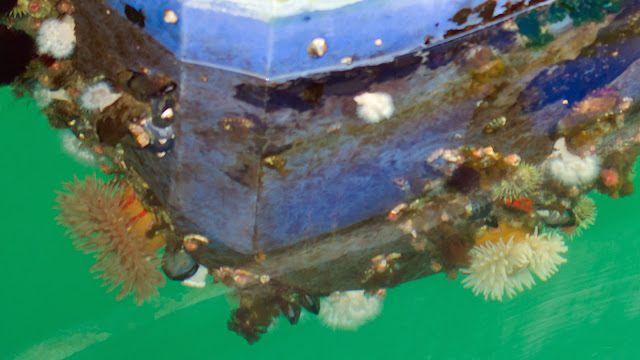
It was a good day for it; sunny and bright, not a cloud in the sky; perfect lighting for peering under docks to see what's living there now. Unfortunately, when I got to Brown's Bay, there was a brisk wind and the water was dancing and painting abstract patterns. And maintenance had scraped whole communities off the floats. (Necessary, and some critters can relocate, but I wish ...) There were still a few sheltered spots; I found them.

Giant plumose anemones on a pipe with an unusual pink tinge.

On the wooden base of a float; plumose anemone, green sea urchins and a jelly swimming by.

Most feather duster tube worms look purmplish in their shadowy underwater homes. This one caught an unusually bright ray of light. The yellow is probably a sponge.

Group of feather duster worms, Eudistylia vancouveri.One shows up red.

A winged kelp with a pronounced stipe, Alaria marginata. In the upper part of the photo, they're attached to the dock base; underneath, they float free. They grow up to 3 metres long.

Harbour seal, Phoca vitulina. There were three of them this day, just hanging around waiting for fisher folk to come back with their catch.

~~~~~~~~~~~~~~~~
Era un dia ideal para sacar fotos de criaturas debajo de los muelles; asoleado, brillante, el cielo azul, sin  nubes; se necesita buena luz para ver claro esas comunidades acuáticas. Lástima fue que cuando llegué a Brown's Bay, se había levantado una brisa fuerte, haciendo bailar las olas, pintando diseños abstractos. Además, los encargados del mantenimiento del sitio habían limpiado los flotadores. Algo necesario en una marina, y muchos de los organismos se pueden encontrar albergue en las rocas, pero una lástima de todas maneras.

Pero buscando, buscando, encontré unos pocos sitios protegidos.
  1. Anémonas Metridium senile, en un tubo. El tinte color de rosa no lo he visto antes.
  2. En la madera debajo de un muelle, vi otra anémona blanca y un par de erizos verdes de mar. Una pequeña medusa pasaba, nadando lentamente.
  3. Los gusanos tubícolas normalmente parecen ser oscuros, en tonos de color púrpura, sobre todo en las oscuridades donde viven. Un rayo fuerte de luz solar iluminó este, mostrando su fuerte color rojo. Lo amarillo probablemente sea una esponja.
  4. Un grupo de estos gusanos, Eudistylia vancouveri.
  5. Algas marinas, quelpos de doble alas, Alaria marginata. En la parte superior de la foto, están adheridas a la base del muelle; abajo, flotan libremente. Estas algas llegan a unos 3 metros desde su base.
  6. Una foca, Phoca vitulina. Había tres este dia, dando vueltas perezosamente, esperando que regresaran los pescadores con las cabezas y entrañas que desecharán al limpiar su pesca del dia en el sitio proveído en el muelle para esta tarea.


Friday, May 12, 2023

White crowns and purple feather-dusters

 About those purply worms ...

It was a bright, clear day, with barely a ripple on the water; just the kind of day to be poking around under docks.

Brown's Bay. The docks float on these blue tubs, a comfortable home for a variety of critters.

I like this muddled view. Dock planks, reflections of overhead structures, algaes and anemones underwater, overlaid by those reflections.

Most of the tubs carry the giant plumose anemones and a scattering of green sea urchins.

Urchins, anemones, and a wide-open scallop mouth.

The Giant Plumose anemone, Metridium farcimen, is white or brown, sometimes with a brown column and white tentacles. It can be distinguished from the Short Plumose by the lobed tentacular crown, as seen here, as well as by its size; it grows up to 1 m. tall, whereas the Shorts barely reach 10 cm. It likes low current sites, such as in this protected bay.

The scallop, probably the Giant Rock scallop, Crassadoma gigantea, (Update: Swimming scallop, Chlamys rubida) has an orange mantle, and if you look closely, a row of tiny eyes along the rim.
The abundant eyes of a giant rock scallop (Crassadoma gigantea) are backed with tiny mirrors that reflect light, unlike our eyes that use lenses to bend and focus light. The mirror in each eye has multiple layers to gather different wavelengths of light, and reflect that light onto a double-layered retina. (Jim Auzin's Photography)

Looking at me, looking at it.

And now, the worms.

Vancouver feather-duster worms, Eudistylia vancouveri, growing on a chain.

These are large tube worms, growing to 10 cm. long. In normal lighting, they look almost black, but bright sunlight brings out the purple and blue colouring.

Feathery red algaes to go along with the feather-duster worms.

A giant acorn barnacle, feeding.

In deeper water. A brown anemone with its white crown.

These long ribbed kelps attach to the tubs and float out into the sunlight.

On the way back to dry land, I leaned over the railing of the walk to look at the seaweeds growing on the sea floor. Tiny fish circled and swooped over them, echoing the flight of the swallows overhead.

Red and green algaes, eelgrass, and fish.

Next: clambering over rocks.

~~~~~~~~~~~~~
Acerca de esos gusanos plumero ...

Un dia de sol, con mucha luz y el agua casi sin olas; un dia ideal para andar rebuscando debajo de los muelles.

Foto #1: Brown's Bay. Los muelles se sostienen encima de estos botes flotantes azules, donde se encuentran comunidades de criaturas marinas.

#2: Me gustó esta foto toda revuelta, con las tablas del muelle, los reflejos de las estructuras arriba, y varios niveles de criaturas debajo, algunas vistas por medio de los reflejos.

#3: En la mayoría de los flotadores crecen las anémonas gigantes plumosas, y varios erizos de mar verdes. Aquí además hay una vieira de rocas con la boca abierta.

La anémona gigante plumosa, Metridum farcimen, es blanca o color café, a veces con la columna café y la corona blanca. Se diferencia de la anémona corta en que los tentáculos de la corona forman lóbulos, y además por el tamaño, ya que pueden crecer hasta 1 metro de largo, mientras que las otras llegan apenas a 10 centímetros. Les gustan los sitios con baja corriente, tales como esta bahía quieta.

La vieira, Chlamys rubida, tiene el manto anaranjado, y si te fijas bien, verás una hilera de ojitos en los labios.
Los ojos abundantes de una vieira de rocas (Crassadoma gigantea) tienen al fondo espejitos que reflejan la luz, en contraste con nuestros ojos que usan lentes para flexionar y enfocar la luz. El espejo en cada ojo tiene varias capas para captar la luz de distintas longitudes de onda, y reflejan esa luz hacia una retina de dos capas. (Jim Auzin's Photography)
#4: La vieira, mirándome.

#5: Y ahora, los gusanos. Son los gusanos plumero de Vancouver, Eudistylia vancouveri, y están creciendo fijados en una cadena en el agua. Estos gusanos, normalmente se ven casi negros, pero cuando la luz del sol les llega, se ven sus colores vívidos, morado o azules.

#6: En la misma cadena, unas algas rojas con filamentos finos.

#7: Un bálano gigante, buscando su comida.

#8: A la base de un pilote, las anémonas son más grandes. Aquí se ve una con la columna color café y la corona blanca.

#9: Estos quelpos se adhieren a los flotadores, y extienden sus largas hojas hacia el sol.

#10: Camino a tierra firma de nuevo, me detuve para mirar las algas al fondo del agua; algas rojas y verdes, y las hierbas Zostera. En el agua por encima, estos pececitos daban vueltas, como si copiaban los vuelos de las golondrinas en el aire arriba.

Mañana: algunas rocas.


Tuesday, January 25, 2022

Cold water lovers

The first time I visited Brown's Bay was in February of 2016, and I arrived after sunset. It wasn't until August of the same year, on my third visit, that I discovered the communities of critters on the underside of the docks. Since then, I've looked at them several times, always in warm weather, always hampered by bright sunlight glinting off the surface of the water.

This Sunday, on the spur of the moment, I turned down the Brown's Bay road again. The snowplow had cleared the road and it was passable, if potholed, as usual. There was ice on the creeks that ran under the road, and the two mini-lakes were frozen over and covered with snow. I passed a couple of trucks coming out (them). At the bay, two people were passing the restaurant, which was closed, as was the RV park; it's the off season. The couple left soon, and I had the silent docks to myself. And the critters, which were much easier to see without all that glare.

On every blue float under the docks, large, white anemones stood out.

Giant plumose anemones, purple-tentacled feather-duster worms, mussels and limpets and something with a pink mouth, a scallop, maybe. 

A couple more of those plumose anemones, Metridium farcimen.

These anemones can be distinguished from the short plumose anemone by the lobes of its tentacular crown. The short one is not lobed, and only grows to about 10 cm. tall. These ones can grow up to 1 metre, although the ones I saw under the docks were probably about 20 to 30 cm.

More anemones and more of those feather-duster worms, Eudistylia vancouveri.

About the worms: my Encyclopedia says.
"The parchment tube secreted by this feather-duster is thick and rubbery, providing excellent protection from current or wave action. ... Pilings and floats are particularly favoured habitats. The Vancouver feather-duster was first described from Vancouver Island ..."

The tide was going out, and the water swirled, creating eddies and ridges. Here, the currents create a pale pattern. 

A beige and brown anemone.

I'm not sure of the species of this anemone, but one I saw in that first August visit was almost identical except for red stripes on the column. It may be the painted anemone, Urticina crassicornis; "widespread and variably coloured," says the Encyclopedia, showing a photo of one like this, beige and brown.

In the shadows deep under the dock, something pink (sponges, maybe) and red hides.

On my way back to shore, I looked over the side at the shallow tidal floor, and saw an orange starfish.

Muddy flats, the starfish, and something else on the left, possibly a small sunstar.

A poor photo, but after the long die-off of starfish, I'm always glad to see another.

And by now my hands were aching with the cold and there was no feeling in the shutter finger; I had to look at it to see where to press. Still early, but it was time to head home. I kept my fingers in the heater vent until the road conditions needed a firm two-handed grip on the steering wheel.

~~~~~~~~~~~~~~~~~~~~~~~~~


La primera vez que vi Brown's Bay fue en febrero de 2016, y había llegado después de la puesta del sol. No fue hasta agosto del mismo año, en la tercera visita, que descubrí las comunidades de animales que viven en la parte inferior de los muelles. Desde entonces, los he examinado varias veces, siempre en tiempo de calor, siempre desvenajada por la luz brillante que se refleja desde la superficie del agua.

Este domingo por puro capricho, tomé el camino a Brown's Bay otra vez. Las máquinas quitanieves habían limpiado el camino, y se podía pasar, aunque, como siempre, está lleno de baches. Había hielo en los riachuelos que pasan debajo del camino, y los dos laguitos estaban congelados y cubiertos de nieve.Me crucé con dos camiones que iban saliendo, y ya en Brown's Bay, una pareja estaban mirando el restaurante, cerrado ahora, al igual que el campamento, ya que estamos en invierno. La pareja se fue, dejándome a solas en el silencio del sitio. Bueno, con la compañia de los invertebrados debajo del muelle, los cuales se veían mucho mejor ahora en la luz gris de invierno, sin el deslumbramiento solar.

En cada flotador azul debajo de los muelles, se encontraban anémonas blancas grandes.

Fotos:

Primera: anémonas "emplumadas gigantes", gusanos plumeros con tentáculos morados, mejillones y lapas, y algo con boca color de rosa, una vieira, tal vez.

Segunda: otras dos anémonas. Son Metridium farcinem.

Estas anémonas se distiguen de la más pequeña "emplumada corta" por los lóbulos de la corona de tentáculos. La corta no tiene estos lóbulos, aparte de que no alcanza a más de 10 cm. de alto; la "gigante" puede crecer hasta a un metro, aunque estas en el muelle medían como unos 20 a 30 cm.

Tercera foto: más de las anémonas y los gusanos plumeros, Eudistylia vancouveri.

Acerca de los gusanos, mi Encyclopedia dice:

El tubo apergaminado que secretan estos gusanos plumeros es grueso y parecido al cuero, y proveen una protección excelente contra la acción del corriente o de las olas. ... Los pilotes y flotadoras son entre sus habitats preferidos. El plumero Vancouver se describió por primera vez en la isla de Vancouver.

Cuarta foto: se estaba bajando la marea, creando remolinos en el agua. Aquí, los corrientes pintan un diseño en verdes.

Quinta foto: una anémona en café y beige claro.

No estoy segura de la especie de esta anémona, pero una que vi en 2016 fue casi idéntica aparte de que tenía rayas rojas en la columna. Puede ser la anémona "pintada", Urticina crassicornis. Dice la Encyclopedia que es "común y de colores muy variados", y muestra una foto de una como esta, en café y beige claro.

Sexta foto: en las sombras bien abajo del muelle, aparecen múltiples manchitas en colores de rosa y rojo. Tal vez serán esponjas.

Camino a la tierra firme otra vez, desde el puente miré el plano intramareal bajo agua, y vi una estrellita de mar.

Séptima foto: La estrellita y algo más, tal vez un sol.

La foto es borrosa, pero desde la muerte de tantas y tantas estrellas de mar, siempre me hace feliz encontrar una.

Y ya me dolían las manos por el frio, y no tenía sentido en el dedo que presiona el obturador; tenía que estarlo mirando para poder sacar una foto. Todavía era temprano, pero era hora de irme a casa. Mantuve los dedos insertados en la apertura del calentador del coche hasta que me fue necesario poner ambas manos firmamente en el volante por las condiciones del camino.


Powered By Blogger