Showing posts with label Brown's Bay road. Show all posts

Friday, September 23, 2022

Deciding on a name

 It's been a long, hot, dry summer here in the rainforest. But it rained last night, briefly and scantly. But it was rain! And today, the skies are our normal grey, the humidity is 85%, and it's 13°C. Feels like fall, finally!

I'm still searching for spiders for Arachtober. Meanwhile, here's Lake Nameless.

Green water, with hidden heron.

This is from last April, while the salmon berries were just putting out their first leaves. The lake is beside the route to Brown's Bay, one of two lakes too small to earn names. This one, from Google maps, has a sort of dolphin shape; should I rename it Dolphin Lake?

Google maps image.

I was trying to get close enough for a photo of a heron, but I took one step into that salmonberry thicket, and immediately sunk up to my ankles in sticky mud. I managed to escape without losing a shoe; I was lucky. Maybe I should name it Booby Trap Lake, instead.

~~~~~~~~~~~~~~~~~~~~~~~~~~~

Ha sido un verano largo, caluroso, y seco aquí en los bosques pluviales de la isla. Pero, por fin, llovió anoche. Unos momentos de lluvia escasa, pero sí que fue lluvia. Y hoy el cielo es del color normal: gris. La humedad está a 85 porciento, y la temperatura es 13°. Empieza a tener señales de otoño. ¡Ya era hora!

Sigo buscando arañas para el mes de Arachtober.  Por mientras, aquí está una foto de un laguito sin nombre. Esto es en el mes de abril pasado, cuando las primeras hojas de "salmonberry" arbustos apenas brotaban. El lago está situado al lado del camino a Brown's Bay, uno de dos laguitos tan pequeños que no han recibido nombre. Este, mirado en Google Maps, parece un delfín; creo que le llamaré Lago Delfín.

O tal vez no. Trataba de llegar a la orilla para sacar una foto de una garza, pero al dar un solo paso bajo esos arbustos, me hundí hasta los tobillos en lodo pegajoso. Logré escapar sin perder un zapato; tuve suerte. Tal vez sería mejor llamar el lago "Trampa Cazabobos"


Tuesday, January 25, 2022

Cold water lovers

The first time I visited Brown's Bay was in February of 2016, and I arrived after sunset. It wasn't until August of the same year, on my third visit, that I discovered the communities of critters on the underside of the docks. Since then, I've looked at them several times, always in warm weather, always hampered by bright sunlight glinting off the surface of the water.

This Sunday, on the spur of the moment, I turned down the Brown's Bay road again. The snowplow had cleared the road and it was passable, if potholed, as usual. There was ice on the creeks that ran under the road, and the two mini-lakes were frozen over and covered with snow. I passed a couple of trucks coming out (them). At the bay, two people were passing the restaurant, which was closed, as was the RV park; it's the off season. The couple left soon, and I had the silent docks to myself. And the critters, which were much easier to see without all that glare.

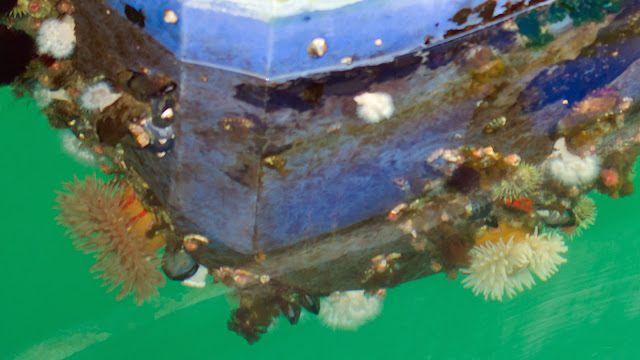
On every blue float under the docks, large, white anemones stood out.

Giant plumose anemones, purple-tentacled feather-duster worms, mussels and limpets and something with a pink mouth, a scallop, maybe. 

A couple more of those plumose anemones, Metridium farcimen.

These anemones can be distinguished from the short plumose anemone by the lobes of its tentacular crown. The short one is not lobed, and only grows to about 10 cm. tall. These ones can grow up to 1 metre, although the ones I saw under the docks were probably about 20 to 30 cm.

More anemones and more of those feather-duster worms, Eudistylia vancouveri.

About the worms: my Encyclopedia says.
"The parchment tube secreted by this feather-duster is thick and rubbery, providing excellent protection from current or wave action. ... Pilings and floats are particularly favoured habitats. The Vancouver feather-duster was first described from Vancouver Island ..."

The tide was going out, and the water swirled, creating eddies and ridges. Here, the currents create a pale pattern. 

A beige and brown anemone.

I'm not sure of the species of this anemone, but one I saw in that first August visit was almost identical except for red stripes on the column. It may be the painted anemone, Urticina crassicornis; "widespread and variably coloured," says the Encyclopedia, showing a photo of one like this, beige and brown.

In the shadows deep under the dock, something pink (sponges, maybe) and red hides.

On my way back to shore, I looked over the side at the shallow tidal floor, and saw an orange starfish.

Muddy flats, the starfish, and something else on the left, possibly a small sunstar.

A poor photo, but after the long die-off of starfish, I'm always glad to see another.

And by now my hands were aching with the cold and there was no feeling in the shutter finger; I had to look at it to see where to press. Still early, but it was time to head home. I kept my fingers in the heater vent until the road conditions needed a firm two-handed grip on the steering wheel.

~~~~~~~~~~~~~~~~~~~~~~~~~


La primera vez que vi Brown's Bay fue en febrero de 2016, y había llegado después de la puesta del sol. No fue hasta agosto del mismo año, en la tercera visita, que descubrí las comunidades de animales que viven en la parte inferior de los muelles. Desde entonces, los he examinado varias veces, siempre en tiempo de calor, siempre desvenajada por la luz brillante que se refleja desde la superficie del agua.

Este domingo por puro capricho, tomé el camino a Brown's Bay otra vez. Las máquinas quitanieves habían limpiado el camino, y se podía pasar, aunque, como siempre, está lleno de baches. Había hielo en los riachuelos que pasan debajo del camino, y los dos laguitos estaban congelados y cubiertos de nieve.Me crucé con dos camiones que iban saliendo, y ya en Brown's Bay, una pareja estaban mirando el restaurante, cerrado ahora, al igual que el campamento, ya que estamos en invierno. La pareja se fue, dejándome a solas en el silencio del sitio. Bueno, con la compañia de los invertebrados debajo del muelle, los cuales se veían mucho mejor ahora en la luz gris de invierno, sin el deslumbramiento solar.

En cada flotador azul debajo de los muelles, se encontraban anémonas blancas grandes.

Fotos:

Primera: anémonas "emplumadas gigantes", gusanos plumeros con tentáculos morados, mejillones y lapas, y algo con boca color de rosa, una vieira, tal vez.

Segunda: otras dos anémonas. Son Metridium farcinem.

Estas anémonas se distiguen de la más pequeña "emplumada corta" por los lóbulos de la corona de tentáculos. La corta no tiene estos lóbulos, aparte de que no alcanza a más de 10 cm. de alto; la "gigante" puede crecer hasta a un metro, aunque estas en el muelle medían como unos 20 a 30 cm.

Tercera foto: más de las anémonas y los gusanos plumeros, Eudistylia vancouveri.

Acerca de los gusanos, mi Encyclopedia dice:

El tubo apergaminado que secretan estos gusanos plumeros es grueso y parecido al cuero, y proveen una protección excelente contra la acción del corriente o de las olas. ... Los pilotes y flotadoras son entre sus habitats preferidos. El plumero Vancouver se describió por primera vez en la isla de Vancouver.

Cuarta foto: se estaba bajando la marea, creando remolinos en el agua. Aquí, los corrientes pintan un diseño en verdes.

Quinta foto: una anémona en café y beige claro.

No estoy segura de la especie de esta anémona, pero una que vi en 2016 fue casi idéntica aparte de que tenía rayas rojas en la columna. Puede ser la anémona "pintada", Urticina crassicornis. Dice la Encyclopedia que es "común y de colores muy variados", y muestra una foto de una como esta, en café y beige claro.

Sexta foto: en las sombras bien abajo del muelle, aparecen múltiples manchitas en colores de rosa y rojo. Tal vez serán esponjas.

Camino a la tierra firme otra vez, desde el puente miré el plano intramareal bajo agua, y vi una estrellita de mar.

Séptima foto: La estrellita y algo más, tal vez un sol.

La foto es borrosa, pero desde la muerte de tantas y tantas estrellas de mar, siempre me hace feliz encontrar una.

Y ya me dolían las manos por el frio, y no tenía sentido en el dedo que presiona el obturador; tenía que estarlo mirando para poder sacar una foto. Todavía era temprano, pero era hora de irme a casa. Mantuve los dedos insertados en la apertura del calentador del coche hasta que me fue necesario poner ambas manos firmamente en el volante por las condiciones del camino.


Wednesday, May 20, 2020

As far as I could go

I woke up this morning thinking of the rocks at the south end of Brown's Bay. So I had to go see them again.

End of the road.

Getting there.

And I walked too far, and climbed over too many rocks, and I'm tired. I'm going to bed. There will be photos, starting tomorrow.

~~~~~~~~~~~~~~~~~~~~~~~~

Me desperté esta mañana pensando en las rocas al sur de la Bahía Brown's. Así que tuve que ir a verlas otra vez.

Y caminé demasiado y me trepé en tantas piedras, que ahora estoy cansada y me voy a la cama. Mañana habrá fotos.

Tuesday, September 24, 2019

No name creek

Flowing into a no-name lake.

Tumbling down from the bank above the road,

pouring under the road, and winding down to the lake.

Scenes in a rainforest. A rainforest built on ancient piles of rock, mostly vertical. Everywhere we go, there's running water, trickling over cliff faces, oozing through the moss, scouring the boulders. Racing, pouring, seeping, falling, tunnelling. A constant undertone to the voice of the forest, the murmuring of the leaves, the scraping of branches.

On any road, like this one, the drop down to Brown's Bay from the highway, I pass dozens of little creeks bursting out into the open where the road made a gash in the forest. This one falls into the end of a tiny lake with no name on the map; just another of the puddles that dot the island.

From the other end of the lake, a darker line on the satellite view on Google Maps meanders down the hill to Brown's Bay, then disappears. Underground, under the man-made roads and parking lots, evidently, because then the creek appears on the beach, flowing into the salt chuck, where they all end up.

Wednesday, June 12, 2019

Daisy whites

Sometimes it takes a little thing to point out how much we are polluting our environment. I stopped to take photos of daisies beside the highway north. They were covered in dust and pockmarked. Even the bees were dusty.

Then, high on the cliffs above Brown's Bay, 4 kilometres from the highway as the crow flies, I stopped at another daisy patch. Not a speck of dust in sight, even though the road (not frequently travelled, but still) was gravel and bare dirt.

Daisies and unidentified fly. As shot; no cleanup needed. No dust.

Daisy with syrphid fly.

Cropped from previous photo. I think that fly is transparent: I can see the individual florets of the daisy in the "yellow" stripes on the fly's abdomen. Again, no touch-ups needed.

One daisy, many buds. And another syrphid fly.


Monday, June 10, 2019

Underwater at Brown's Bay, take 2

It's been three years since I visited Brown's Bay. That day, the water was calm, the surface still. On the plastic floats underneath the docks, I found a collection of plumose anemones and other tentacled critters.

This time, I saw them again, but the tide was coming in, the water racing, the docks rocking, and the wind ruffled the surface; the white anemones were visible only as whitish blurs, the rest of the underwater communities almost invisible. But there were a few sheltered spots, between boats and the dock, under the edges of the restaurant's outdoor seating. And I found something (I think) that's in all the books, but that I have never seen before.

Under a much-faded bumper ball, a group of what I think must be goose-neck barnacles. With magenta lips.

The assorted kelps attached to the underside of the restaurant float made a pleasant contrast to the deep greens of the water.


Seersucker kelp (top right) and (maybe) broad-winged kelp, with a fringe of another seaweed.

Deeper underwater, bull kelp and much-frayed blades of another one or two kelps.

Moon jelly.

In deeper shade, on the back side of a float, a few white plumose anemones, a large barnacle, other anemones (the ones I saw in 2016 had red stripes on a beige column. It's too dark to see them here. 

The gravel road in is much improved since the last visit; there are a few potholes, but nothing big enough to swallow a tire. I'll plan a drive down again soon.


Thursday, December 28, 2017

Snowy outing

They promised us more snow. We got rain. Feeling slightly cheated, I took the highway north until the rain turned to falling snow.

Brown's Bay Road, 22 km. north of Campbell River. Chains required: I didn't drive down.

Random highway shot.

The streaky lines on the trees are falling snow.

Side road. No tracks; nobody's likely to drive down here until the spring.

Young evergreens beside the road.

The north woods are never entirely silent; the trees whisper among themselves constantly, murmuring comments on the wind and the rain. Snow hushes them, though. This afternoon, the only sounds were the crunch of my shoes on fresh snow, and the occasional "plop!" as a branch shook off its burden.


Sunday, February 07, 2016

Lake X

"Brown's Bay Resort", the sign said. Only 5 km. off the main highway north. It was after sunset, and I should have been heading home, but what's 5 km?

An hour's drive, it was, there and back. The road is potholed gravel, sometimes one lane only. It winds through dark forest, past rocky outcrops covered with moss, over rushing creeks, and passes two tiny lakes glittering through the trees.

The last of the light. 5:45 PM. 

The lakes are pictured on Google maps, but have no names. This one's a small triangle; I was standing on the bottom edge.

By the time I got to Brown's Bay, the stars were out. I looked around, and drove back home for supper.

I'll be back, in daylight.

A Skywatch post.
Powered By Blogger