Showing posts with label bull kelp. Show all posts

Friday, October 23, 2026

Some rocks. And boats. And green, green water.

Before I was caught by those first red mushrooms, I had stopped at the end of Brown's Bay to look at water and rocks; blue-grey photos on a blue-grey afternoon, to contrast with the bright maple leaves on the hills. Well, not quite all grey; colour did sneak in here, too.

Viewing platform at the south end of Brown's Bay. End of the road. The hills are on Quadra Island.

Rocks at the end of the Bay.

More of those rocks.

These rocks always leave me wondering. Trying to imagine the forces that shaped them over the millenia; how they formed 'way back then, bubbling out of the dancing, boiling, flowing rock-building lava. What then worked them over, scratching and gouging and cracking them, tossing in bits borrowed from the mountain tops, whitish boulders that stand out against the greenish grey and rusty brown of the base rock. And then, how the rambunctious ocean current here scours them so forcefully that after all those centuries underwater, no barnacles, no mussels, no oysters have managed to get a foothold. It's all bare rock, as far down as the eye can see. With a few ambitious limpets; very few.

A floating patch of bull kelp.

Colour comes back. Canada Coast Guard boat; Sir John Franklin, Offshore Fishery Science Vessel, carrying oceanographic labs. 

The end of the end of the bay. The forest grows on a thin skin of soil atop the rock.

Mid-tide. Underwater, the rocks exposed at low tide are visible. No barnacles here, either.

Fishing boats on the far shore. The moss covering the rocks is yellow after a dry summer.

~~~~~~~~~~~~~~~~~~~

Antes de que me distrajeron esos hongos rojos, me había estacionado donde termina el camino en Brown's Bay para mirar las rocas y el agua. Pensaba sacar fotos en los colores típicos de esta temporada; gris, con un poco de azul grisaceo. Harían buen contraste con los colores de los arces de hoja grande en el bosque. Bueno; no todo era gris; siempre hay algo para alegrar la vista.

    1. La plataforma final, desde las rocas al sur. Con la isla Quadra al otro lado del estrecho.

    2. Rocas que se extienden al agua.

    3. Y más rocas.

Estas rocas siempre me fascinan. Trato de imaginar las fuerzas que las formaron durante cientos de milenios; como brotaron, burbujeando, naciendo de la lava que bailaba, hervía, y se volvía piedra. Que después las esculpían, rallando y mordiendo y rompiéndolas, añadiendo piedras ajenas, traídas desde las cimas de las montañas, piedras pálidas que se destacan contra la roca base, en tonos de verde y café oscuro, Y luego, como las corrientes bulliciosas del oceano las azotan con tanta fuerza que aun después de todos esos siglos, no han logrado establecerse ni bálanos, ni mejillones, ni ostiones. La roca permance tan limpia hoy como cuando se formó. Apenas hay una que otra lapa atrevida; muy pocas.

    4. Quelpo flotando en la superficie.

    5. Un barco de la Guardia Costera Canadiense, Sir John Franklin, un buque científico, estudiando la pesquería, llevando a bordo un laboratorio oceanográfico.

    6. El bosque crece sobre una capa delgada de tierra sobre roca limpia.

    7. Se ve en el fondo la roca que se expone a marea baja. No hay animales aquí tampoco.

    8. Barquitos pesquero en la costa opuesta. El musgo que cubre las rocas es amarillo ahora después de un verano seco.


Wednesday, January 15, 2025

Wood, stone, sand, moss.

An hour among the logs on the beach and dunes south of Oyster Bay, looking at shapes and textures. All the wood was damp; it doesn't get a chance to dry out these days. So browns are browner, blacks are blacker. And the moss is neon.

Roots on the beach. I wonder what the cut was for.

Roots on the dunes.

Flaky. Each layer forms one of the annual tree rings, cut horizontally.

Knot among beach stones.

Moss in the cracks, and a branch scar. The cracks would be vertical if the tree were standing.

Not the same log. The lump may have been a burl.

On the beach, the waves have tossed up a tangle of red alder branches with bull kelp.

And there were fun fungi, and lichens. Next.

~~~~~~~~~~~~~~~~

Pasé una hora dando vueltas entre las dunas al sur de Oyster Bay, mirando los troncos y palos dejados por las mareas y las tempestades, observando sus formas y texturas. La madera toda estaba húmeda; en estos dias no hay tiempo en que se puede secar. Así que los colores cafés son más intensos, los negros son más negros. Y el musgo brilla como si tuviera una luz por dentro.

  1. Raices en la playa.
  2. Raices entre las dunas.
  3. Las capas anuales de la madera, desconectadas. En un corte horizontal en el árbol, formarán los anillos anuales.
  4. Un nudo de madera entre las piedras en la playa.
  5. Musgos en un tronco viejo, quemado. Las grietas correrían verticalmente en el árbol vivo.
  6. Otro tronco parecido, con menos musgo. Con un nudo desgastado.
  7. En la playa, las olas habían traído un enredo de ramas de aliso rojo con quelpo "toro" (Nereocystis luetkeana).
Y hubo hongos divertidos, y líquenes. Eso, mañana.

Sunday, November 10, 2024

Smells like fall

A decent camera is a treasure, and the internet is a magnificent medium for passing on the camera's discoveries, but they miss so much! The camera can never capture, nor the internet transmit the greater half of our world of sensation.

No camera can ever capture the aroma of dying cottonwood leaves underfoot, sweet, fresh, and slightly acid.

Nor the damp, spicy, woodsy smell of ripe Douglas-fir cones, still on the tree.

The camera never felt the bite of a chilly, salty breeze on a cheek; its nose and fingertips never tingled in the cold; no flying sea spray scented the air it breathed.

Did it hear the water nibbling at the rocks, the creak of the gulls' wings? Probably not.

The camera never smelled bull kelp drying on the shore.

Nor the blended aromas of salt-preserved wood and dying algae at the high tide line.

The camera never touched the rough, scratchy bark and lichens on an ancient apple tree.

Nor crushed a ripe yarrow seed head in the palm of its hand. It reminded me of an old sunny kitchen, redolent of spices — was that cloves? — and left my hand smelling of my grandmother's strong soap.

Oh, but it did get the spider in its web dangling from the yarrow stalk, which I hadn't seen. There's that.

~~~~~~~~~~~~
Una buena cámara es un verdadero tesoro, y el internet un medio que sirve para comunicar los hallazgos de la cámara, pero ¡hay tanto que se les pasa sin observar! La cámara jamás puede capturar, ni el internet puede transmitir, más de la mitad de lo que llena nuestro mundo.
  1. La cámara nunca puede conocer el aroma de las hojas caídas del álamo en nuestro camino, aroma dulce, fresco, algo acídico.
  2. Ni el olor de las piñas del abeto de Douglas que todavía cuelgan de las ramas, un olor como de madera vieja, picante.
  3. La cámara nunca sintió el mordisco del aire helado en la piel, ni el hormigueo en la punta de la nariz y de los dedos por el frío; nunca respiró aire cargado de espuma de mar. ¿Escuchó cuando las olitas salpicaban las rocas, u oyó el crujido de las alas de las gaviotas? Creo que no.
  4. Nunca conoció el olor de las algas "quelpo" que morían sobre las piedras de la playa.
  5. Ni las aromas mezcladas de madera curada con sal y algas marinas desintegrándose al nivel más alto de la playa.
  6. Nunca tocó la corteza y los líquenes en un viejo manzano; nunca se dió cuenta de su aspereza.
  7. Ni jamás machacó en la palma de su mano la cabeza ya madura de una milenrama. El aroma me recordaba una cocina asoleada, antigua, oliendo a especies como el clavo de olor. Yme dejó en la mano un recuerdo del jabón fuerte de mi abuelita.
Bueno, si capturó el imágen de la arañita en su telaraña, lo que yo no había visto. Eso, hay que reconocerlo.

Tuesday, April 25, 2023

All dressed in red.

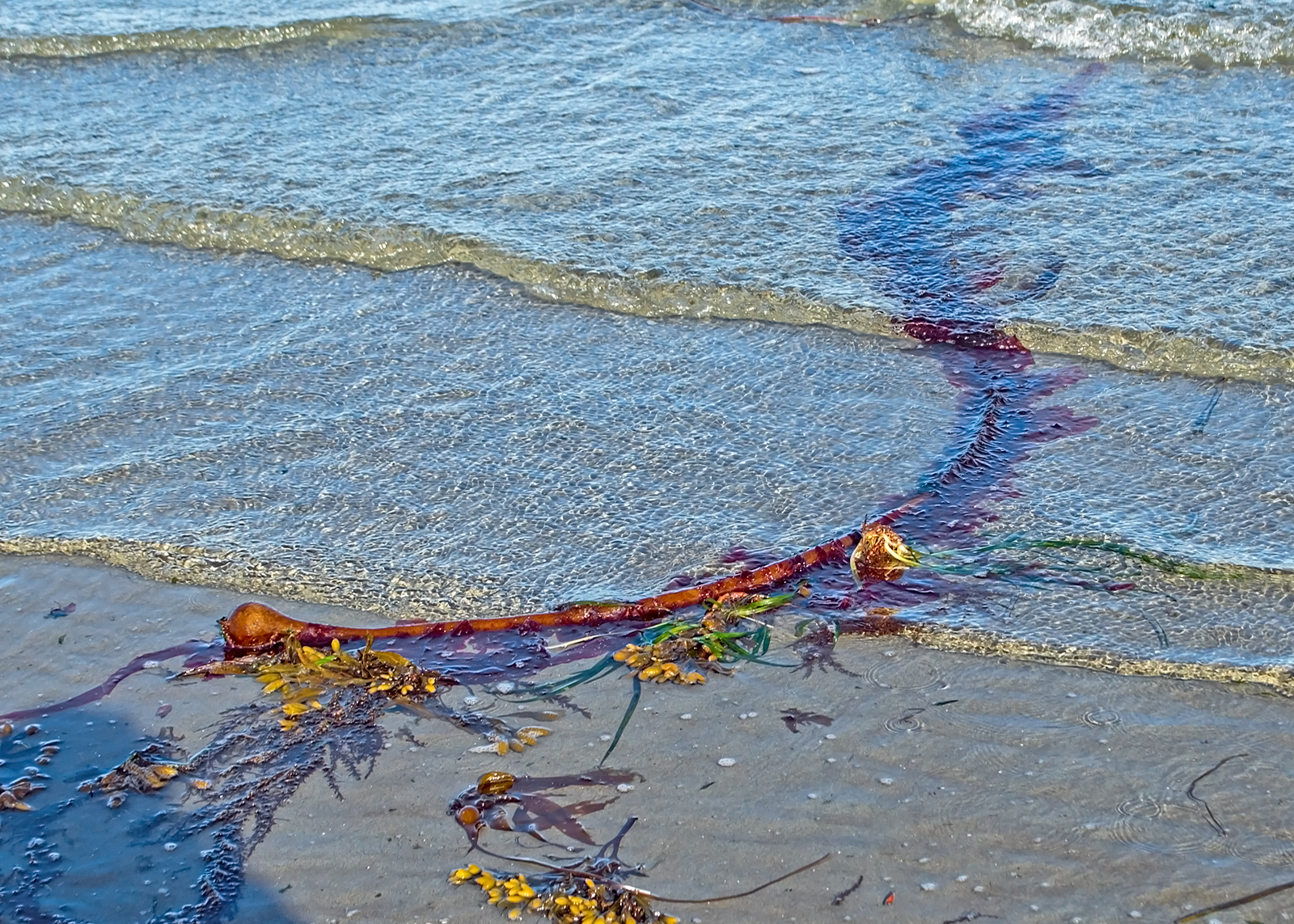
 A calm day, with quiet seas; small waves, whispering as they reached the sand, bringing with them sprigs of rockweed and sargassum, and the occasional baby bull kelp. And this one, all dressed in red.

Young kelp. The next wave will move it a few centimetres higher up the beach.

This was a small kelp, as these kelps grow, and it had lost its long blades. But it was growing a good batch of red nori, as a substitute. Accompanying it on its way onshore are a couple of eelgrass plants, besides the rockweed and sargassum.

Detail, showing the red algae attached to the stipe.

This is probably Bull-kelp Nori, Porphyra nereocystis, which grows only on the stipes of bull kelp. It is edible, dried and roasted, and can be found winter and spring. One of these days, I'll harvest some and try it.

As much of it as could be seen. I don't know if there was a holdfast.

From there I went to investigate anemones on the rocks. Photos tomorrow.

~~~~~~~~~~~~~~
Era un dia tranquilo; en la playa las olas llegaban suavemente, murmurando, trayendo consigo ramitas de Fucus y de sargazo, y a veces un quelpo muy pequeñito. Este era un poco más grande, y venía todo vestido de rojo.

Fotos: Un quelpo Nereocystis luetkeana con sus algas rojas, el nori Porphyra nereocystis. Acompañado con ramitas de Fucus y de sargazo.

Creo que este es el alga roja que crece casi siempre en los tallos del quelpo gigante. Es comestible, ya seca y tostada; alguna vez voy a cosechar una cantidad para probarla.

De allí fui a las rocas para buscar anémonas. Mañana subiré fotos.


Friday, March 03, 2023

Fighting crabs

 A few years ago, on a hot summer afternoon, I was watching the tide roll in over a rocky breakwater. As the water rose between the rocks, crabs started to come out from their hiding places. More crabs and more, where a few minutes ago there had been no sign of life, just the hot, bare rocks.

The water rose until it reached a dried kelp stipe, cast up to bake on the rocks. And this surprised me: immediately the crabs attacked it; all the crabs, jostling and scrambling over each other to get at this dried kelp. More came out from hiding, dozens and dozens more, all of them grabbing at the stipe, fighting for a spot, pushing each other out of the way, tearing off bits and eating them. As the tide covered more of the length of kelp, so did the crabs until there was no kelp to be seen, just this dancing mass of crabs.

I should have thought of this sooner. My hermit crabs like kelp, too, and I would bring them fresh kelp from the shore. But cut kelp quickly turns slimy; I could feed them only a small piece and throw away any extra. And then, last fall I remembered the happy crabs.

So now I slice a long stipe into thin circles and dry it. And every couple of days I give the hermits and crabs a couple of dried slices. The first batch lasted them all winter; now they're starting on a stipe I dried a couple of weeks ago. 

Hairy hermit and his kelp treat.

One of the tiniest hairy hermits, with his scrap of kelp.

And a watchful crab, ready to fight for her meal, if necessary.

~~~~~~~~~~~~~~~~~~
Hace unos años, en un verano caluroso, estaba en un rompeolas mirando mientras subía la marea. Cuando el agua empezó a cubrir las rocas, aparecieron los cangrejos que hasta entonces habían estado bien escondidos, fuera del alcance de los rayos del sol. Más cangrejos, muchos cangrejos, donde hacía poco no se veían señales de vida, solamente esas piedras resecas.

El agua subió hasta que alcanzó un tramo del estipe de quelpo ya bien seco, tostado por el sol allí expuesto sobre las rocas. Y esto me sorprendió; en cuanto el agua tocó el quelpo, los cangrejos lo atacaron; todos los cangrejos, con gran entusiasmo empujándose, trepándose uno encima del vecino para llegar a este pedazo de quelpo seco. Salieron más de sus escondites, docenas más, todos tratando de agarrar el quelpo, peleando con los que se pusieron en su camino, defendiendo su sitio con ánimo mientras arrancaban pedazos para comer. Mientras la marea cubría más del quelpo, también lo hicieron los cangrejos, hasta que no se veía nada del alga, solamente esa masa pululante de cangrejos.

No sé porque no pensé en esto antes. A mis cangrejos ermitaños también les gusta el quelpo, y yo les traía pedazos desde la playa. Pero el quelpo cortado pronto se hace baboso, y solamente les podría dar un pedacito y tirar todo lo demás. Hasta que el otoño pasado, me acordé de esos cangrejos felices.

Y ahora me traigo todo un estipe largo, lo corto en rebanadas delgadas, y lo pongo a secar. Y cada dos o tres dias les doy una o dos rueditas de quelpo a mis criaturas. El primer estipe nos duró todo el invierno; ahora empiezan con el segundo. Y muy felices están.

Fotos: 
  1. Un ermitaño "peludo" Pagurus hirsutiusculus, con su pedazo de quelpo.
  2. Uno de los más pequeñtos, también comiendo quelpo.
  3. Y un cangrejo hembra, algo preocupada por pensar que yo le puedo quitar su hallazgo. Lo defenderá con esas pinzas, si llega el caso.


Friday, September 17, 2021

Tied in knots

The tide was high, the wind brisk, the waves bouncy. The beach near Salmon Point was just a narrow strip of stones between the water and the rocks of the breakwater. I was there to look at eelgrass and kelp, torn from their roots and holdfasts, all tangled and tossed up by the waves.

Tangle of fresh bull kelp and eelgrass.

A knot like this is full of interest; teasing out separate strands, I find mostly eelgrass, rockweed, sea lettuce, and kelp, with occasional fragments of Turkish towel or washcloth, and maybe some spaghetti-like brown algae. Living on the blades of kelp are bryozoan colonies, sometimes, if I'm lucky and sharp-eyed enough, with their tiny cryptic nudibranchs. Any holdfasts that show up house miniature worms and immature snails, possibly a baby starfish.

The eelgrass carries snails and amphipods, sometimes a stray hermit crab. And in season, there are a variety of snail and nudibranch eggs, all doomed to be tossed onto the stones to die and be sundried. Some of the eelgrass crumbles and disappears; some remains as blackish heaps, leaping with sand hoppers. 

The kelp stipes hold their shape for a long time, bleaching to a greenish yellow. Crabs and hermits love to eat this when it ends up back in the water.

Eelgrass and sea lettuce. Green blobs in the waves themselves are sea lettuce washing in.

~~~~~~~~~~~~~~~~~~~~~~~~~~~

La marea estaba a su máximo, la brisa algo fuerte, las olas caían en espuma sobre las piedras de la playa que ocupaban apenas unos metros entre el agua y el rompeolas de piedra. Yo estaba allí buscando hierba Zostera y quelpo, arrancados de sus raices y rizoides, hechos nudos y depositados por las olas sobre las piedras.

Primera foto: un nudo de quelpo Nereocystis luetkeana y de hierba Zostera en la playa cerca del Punto Salmón.

Un enredo como este tiene mucho de interés. Al separar cada hoja y estipe, encuentro en su mayor parte hierba Zostera, el quelpo, lechuga marina (Ulva sp.), sargaso vejigoso, con fragmentos de toalla turca, y otras algas pardas. En las hojas del quelpo viven colonias de briozoos, y a veces, si tengo suerte y los ojos no me fallan, con sus nudibranquios crípticos que comen los briozoos. Los rizoides que llegan al nudo protegen anélidos pequeñísimos y conchas marinas juveniles, y a veces una estrella de mar infantil.

La hierba Zostera marina lleva conchas marinas y anfípodos, y de vez en cuando un cangrejo ermitaño. En ciertas temporadas habrá huevos de varios nudibranquios y conchas marinas, todos destinados a morir sobre las piedras, tostarse en el sol, y o quedar como un montoncito de fibras negras donde saltan las pulgas de arena, o desmoronarse y desaparecer.

Los estipes del quelpo permanecen por largo tiempo, volviéndose suave y de un color amarillento. A los cangrejos y ermitaños les gusta comer esto, cuando por suerte cae otra vez en el agua.

Segunda foto: piedras, olas, y hierba Zostera. Las manchas oscuras dentro del agua son fragmentos de lechuga marina.


Monday, May 31, 2021

Anchors aweigh

Each beach has its own unique fingerprint, made up of sand and stone, animals large and small, plants and algae. This, that I've labelled "moon snail beach" in my files, is a mostly sandy beach after the top few metres of stone and crabs; clean sand, on a gentle slope, and home to a forest of young bull kelp.

Looking south. Salmon Point in the distance.

The green stuff is eelgrass and sea lettuce. Reddish brown; sargassum, bull kelp, winged kelp. Red: eyelet algae, red noodles. Two moon snail collars visible here.


Young kelp, under 2 metres long, holdfast to fronds.

The holdfasts are not roots; they don't provide nutrients, at least for the kelp, but serve to anchor the algae on the sea floor, glued somehow to rocks. Even in strong tidal surges and wave action, the stipe is strong enough to resist breaking, as long as the holdfast is attached to something heavy and solid enough. Unfortunately for this youngster, it chose the wrong location, and a stone far too small to stay put under the waves. It will end up tossed and drying high on the beach.

Kelp needs to establish itself in the subtidal zone; young ones that grow intertidally don't survive, but they do provide habitat and food for small invertebrates while they last.

Unwise choice of anchor stone.

These foolish kelp youngsters all picked the same small stone. Even in calm water, they had no hope of staying anchored to the bottom.

Winged kelp. This has been torn from its holdfast underwater. The holdfast will survive to grow another blade next year.

While the blades of kelp only live about a month or two, holdfasts can live and grow for up to ten years or more! (Catalina Sea Camp)


Red eyelet silk seaweed, covered in sand. This grows from the low intertidal zone downward.

A red noodle seaweed, attached to its holdfast.

This one can live in the low intertidal zone, as long as it remains attached to the stone.
 

~~~~~~~~~~~~~~~~~~~

Cada playa tiene su propias características, incluyendo si se basa en piedra o arena, los animales grandes y pequeños que allí viven, las plantas y las algas. Esta playa, a la cual he nombrado "playa de caracoles luna" en mis archivos en la computadora, se compone principalmente de arena, aparte de los primeros metros de la zona superior, que está cubierta de piedras y cangrejos. La arena se inclina ligeramente hacia el mar; allí, en la parte más baja, crece un bosque de algas kelp juveniles.

Primera foto: la playa, mirando hacia el sur. En la distancia, Salmon Point.

Lo verde en la foto es hierba marina Zostera, y lechuga de mar. Lo café es sargazo y kelp. Y las algas rojas son el alga "ojete de seda", Sparlingia pertusa, y espagueti rojo. Se ven dos cuellos de caracol luna. también.

Segunda foto; un alga kelp juvenil, midiendo menos de 2 metros, desde el rizoide hasta las láminas.

Los rizoides no son raices; no proveen nutrición al alga, sino que sirven como ancla fijada de alguna manera a las piedras bajo el agua. Aun cuando la fuerza de la marea y las olas es vigorosa, las estipes (el tallo) son suficientemente fuertes como para resistir sin romperse, siempre y cuando el rizoide esté fijo en algo pesado y sólido. Mala suerte fue para esta kelp juvenil escoger una piedrita que no le puede detener en su lugar. Terminará aventada y secándose en las piedras al lado del mar.

El alga kelp necesita establecerse en la zona submareal para sobrevivir. Estos jóvenes no vivirán, pero mientras proveen habitat y comida para animalitos invertebrados.

Tercera foto: sitio mal escogido. Varias algas se fijaron a una sola piedrita. Ni en aguas tranquilas esto le iba a servir.

Cuarta foto: kelp "con alas", separado de su rizoide, que sigue en el agua y producirá nuevas láminas el año que entra.

¡Mientras las láminas de kelp viven solamente uno o dos meses, el rizoide puede vivir y crecer por diez años o más! (de Catalina Sea Camp)

Quinta foto: el alga "ojete de seda" cubierta de arena. Esta alga vive tanto en la zona baja intramareal como en la submareal.

Sexta foto: un alga "espagueti rojo". Esta puede vivir aquí en la zona baja intramareal mientras sigue en contacto con la piedra.


Friday, May 14, 2021

The shapes of brown algae

 Just a few low-tide seaweeds:

A baby bull kelp. Cute, isn't it?

A flat-bladed rockweed, with beauty bush.

I have been confused by the rockweeds, finding different shapes, thin ones, long pointed rockweeds, wide-bladed ones, flat-bladed rockweeds, rockweeds with the characteristic bladders that kids like to pop. But I couldn't find, in my encyclopedia, more than two species of true rockweed (Fucus sp.; they have a distinct midrib. Dwarf rockweed, less common on our shore, has no midrib.)

A few years back scientists examined the DNA of various rockweeds, finding that our local ones were mostly all the same species, Fucus distichus. Turns out it is extremely variable as to shape, depending, it seems, on the habitat.

And the fat bladders are the mature reproductive structures. The one in the photo, then, is immature.

I think this is sea caulifower, Leathesia nana. On sea lettuce.

~~~~~~~~~~~~~~~~~~~~~~~~~~~
Unas pocas algas marinas:

Primera foto, un quelpo Nereocystis luetkeana, muy pequeño. (Crecen hasta 36 metros.)

Segunda foto: Sargazo vejigoso; Fucus distichus. Con "arbusto de belleza", Callithamnion pikeanum.

Me han dejado algo confusa los sargazos locales; vienen en una variedad de formas, delgados, o largos y puntiagudos, o con hojas anchas, hojas planas, o con las puntas infladas, haciendo los globos que los niños se apuran a reventar. Pero en mi enciclopedia encontraba nada más dos especies de sargazo "verdadero". (Fucus sp.,estos tienen un tallo central muy distinta. Otras dos especies, menos común en nuestras costas, son más pequeñas, y no tienen este tallo.)

Hace unos años, los científicos examinaron el ADN de varios de estos, y descubrieron que casi todos son de la misma especie, Fucus distichus. Resulta que es extremadamente variable en forma; parece que esto depende de su habitat.

¿Y las vejigas gordas? Son las estructuras reproductivas de las algas maduras. Así que la de la foto es todavía juvenil.

Tercera foto; la que llamamos coliflor marina, Leathesia nana. Descansa sobre una cama de lechuga marina.

Sunday, May 09, 2021

The rock eaters

See a sea urchin on the shore; a round ball covered with spikes. No apparent feet, eyes, grabbers; separated from the ground by all those spikes; how does such a critter manage to live? But they do, and they change the world around themselves.

Red sea urchin on beauty bush at low tide.

The spines are moveable. And beneath them, but extending out beyond them when wanted, are many tube feet with suction tips; with these, the urchin can walk, climb, collect food and convey it to its mouth on the underside. Or even hold rocks or shells or algae over itself; camouflage, perhaps, or protection.

Many of the sea urchins I saw on this low tide exploration were carrying clumps of hydrocorals, or sheets of sea lettuce. Some carried empty limpet shells or stones.

Red sea urchin in sandstone pit, wearing sea lettuce.

Then there's the mouth. On the underside, just a circular hole with five calcareous plates, called Aristotle's lantern. With these plates the urchin tears up its food. But it also tears into rock, digging holes for itself with them. Sandstone is a soft rock; this flat sandstone beach has many such pits.

They can even trap themselves in these holes:

Strongylocentrotus droebachiensis ... uses its strong Aristotle's lantern to burrow into rock, and then can widen its home with the spines. Usually, this sea urchin can leave its hole to find food and then return, but sometimes it creates a hole that gets bigger as it gets deeper, so that the opening is too small for S. droebachiensis to get out. (Wikipedia)

The plates wear down, of course, what with gnawing away at stone, but they grow back, being completely replaced by a couple of months growth. (Wish my teeth would do that!)

Red sea urchins typically live in small groups, of about 5 to 10 individuals. The greens, though are extremely gregarious:

Crowd of green sea urchins in a tidepool.

They eat algae, mostly brown algae; they love kelp, and are less fond of the green sea lettuce. And they can be responsible for devastating entire forests of the huge bull kelp, the largest of all the seaweeds. It seems strange; the forests are so dense, the kelp so tall and strong; how can a tiny, fragile critter have such an impact?

This is how; look at this photo:

Strength in numbers. Also present, a purple and a red urchin, and a leather star.

At the bottom of the low intertidal zone, all the areas still underwater were carpeted with these green urchins. They eat away at the holdfast of the kelp, releasing the tall stipes and fronds to be tossed up to dry on the shore, and leaving behind what are called "urchin barrens".

But we still have kelp because there's a food triangle: sea otters live in the kelp forests, eating the sea urchins that eat the kelp.

~~~~~~~~~~~~~~~~~~~~~

Mira un erizo de mar en la playa; una pelota cubierta de espinas. No se le ven pies, no tiene ojos, no se le ve nada con que agarrar su comida, mantenido aparte del suelo por todas esas espinas: ¿cómo es que llegan a sobrevivir en esas condiciones? Pero sí viven, y hasta cambian el mundo alrededor suyo.

Primera foto: un erizo de mar rojo sobre alga marina.

Las espinas se mueven. Y debajo de las espinas, pero capaces de extenderse más que las espinas, hay una multitud de pies tubulares, que terminan con ventosas; con ellos, el erizo puede caminar, trepar, capturar comida y llevarla a la boca que tiene en la parte inferior del animal. Y hasta puede agarrar cosas como conchas o algas o incluso piedras para sostenerlas por encima, tal vez como camuflaje, o protección.

Muchos de los erizos que encontré en este dia se cubrían con trozos de lechuga de mar o manojos de hidrocorales. Algunos cargaban conchas vacías de lapas o pequeñas piedras.

Segunda foto: un erizo rojo en una poza en la piedra, llevando lechuga de mar como sombrero.

Y considera la boca: es simplemente un agujero en la parte inferior, cubierto con cinco placas calcáreas, a las que llamamos en conjunto la linterna de Aristóteles. Con estas placas, el erizo mastica las algas que son su comida. Pero también las usa para romper piedra, haciendo hoyos en donde se puede refugiar. La arenisca es una piedra muy suave; en esta playa de arenisca se encuentran múltiples pocitos.

Les puede resultar un poco peligroso, cuando se llegan a atrapar en sus propios pozos:

Strongylocentrotus droebachiensis ... usa la linterna de Aristóteles para excavar la piedra, y luego puede ampliar la poza con sus espinas. Normalmente, el erizo puede abandonar la poza para ir a buscar comida y luego regresar, pero a veces hace un hoyo que se agranda mientras gana profundidad, con el resultado de que la apertura es demasiado chico para que el erizo pueda salir. (Wikipedia)

Las placas se desgastan, puesto que están royendo piedra, pero siguen creciendo hasta reanudarse completamente en un par de meses. (¡Ojalá mis dientes hicieran lo mismo!)

Los erizos rojos viven en pequeños grupos de 5 a 10 individuos. Los verdes, en cambio, son extremadamente gregarios.

Tercera foto: grupo de erizos verdes en una poza intramareal. 

Comen algas, principalmente algas cafés. Les gusta el quelpo, y no tanto la lechuga de mar. Y son capaces de destruir un bosque entero del quelpo grande, Nereocystis luetkeana. Parece extraño ¿cómo puede ser que un animalito tan pequeño, tan frágil, tener un impacto tan fuerte sobre estas algas gigantes?

Así: mira cuarta foto: un ejército de erizos verdes.

En la parte más baja de la zona intramareal, todo el agua llevaba un tapete de estos erizos. Comen los rizoides fijadores del quelpo, dejando que las olas lleven el resto a echarlo en la playa a secarse, dejando lo que llamamos desiertos de erizos.

Pero todavía tenemos quelpos. Porque hay un triángulo ecológico; las nutrias marinas que viven en los bosques de quelpos comen los erizos que comen las algas.

Wednesday, February 17, 2021

Riding their dinner

 Pair o' hermits ...

L. Grainy-hand hermit, Pagurus granosimanus. R. Hairy hermit, Pagurus hirsutiusculus. On kelp float.

I brought home a large float of bull kelp and added half of it to the aquarium. This photo is a couple of days later. Before the week was out, the hermits and crabs had eaten it all.

Old shells grow assorted species of algae. The hermit on the left is using a shell growing pink and green fuzz, which has attracted a couple of limpets. The hermits never seem to mind the extra weight; one is running about carrying an anemone almost as big as he is. Weight works differently underwater.

~~~~~~~~~~~~~~~~~~~~~~~

Dos cangrejos ermitaños; el de la izquierda es un ermitaño Pagurus de mano granulada. A la derecha, su amigo Pagurus peludo. Están parados en un flotador grande de kelp que traje a casa, corté a la mitad, y añadí al acuario. Dentro de una semana los ermitaños y los cangrejos se lo habían comido todo.

Las conchas viejas que usan los ermitaños atraen varias especies de alga marina. El ermitaño a la izquierda trae una concha pintada con algas color de rosa y de verde claro, y dos lapas se le han subido para comer el alga. Los ermitaños no parecen tener problema con el peso de más; hay uno que anda por ahí cargando una anémona casi tan grande como el ermitaño mismo. Las cosas pesan menos bajo el agua.

Tuesday, July 23, 2019

Red, white, green, and kelp coloured

A few seaweeds, large and small, wet and dry.

Coming in with the tide; a floating salad of torn sea lettuce, nori, Turkish washcloth, snippets of rockweed, and this glorious red branched seaweed.

In the summer, I see a lot of sun-bleached seaweeds well up on the shore. Most are white; newer ones are pale pink or cream. I don't remember seeing one where the bottom half was pure white, while the top still retains its full red colouring.

Laid out to dry in the sun. Fresh bull kelp.

Kelp is edible, and the floats and long stipes make good pickles, "they" say. Kelp is also very tough; I've tried cutting out a segment, using sharp, broken clamshells; almost impossible. Even the thin end of the stipes are too srong to break until they're half rotted. I must bring a knife to the beach to harvest a piece of the next fresh kelp I find. I'd like to try out that kelp pickle recipe.

Monday, June 10, 2019

Underwater at Brown's Bay, take 2

It's been three years since I visited Brown's Bay. That day, the water was calm, the surface still. On the plastic floats underneath the docks, I found a collection of plumose anemones and other tentacled critters.

This time, I saw them again, but the tide was coming in, the water racing, the docks rocking, and the wind ruffled the surface; the white anemones were visible only as whitish blurs, the rest of the underwater communities almost invisible. But there were a few sheltered spots, between boats and the dock, under the edges of the restaurant's outdoor seating. And I found something (I think) that's in all the books, but that I have never seen before.

Under a much-faded bumper ball, a group of what I think must be goose-neck barnacles. With magenta lips.

The assorted kelps attached to the underside of the restaurant float made a pleasant contrast to the deep greens of the water.


Seersucker kelp (top right) and (maybe) broad-winged kelp, with a fringe of another seaweed.

Deeper underwater, bull kelp and much-frayed blades of another one or two kelps.

Moon jelly.

In deeper shade, on the back side of a float, a few white plumose anemones, a large barnacle, other anemones (the ones I saw in 2016 had red stripes on a beige column. It's too dark to see them here. 

The gravel road in is much improved since the last visit; there are a few potholes, but nothing big enough to swallow a tire. I'll plan a drive down again soon.


Powered By Blogger