Showing posts with label intertidal seaweeds. Show all posts

Monday, April 27, 2026

Weedy

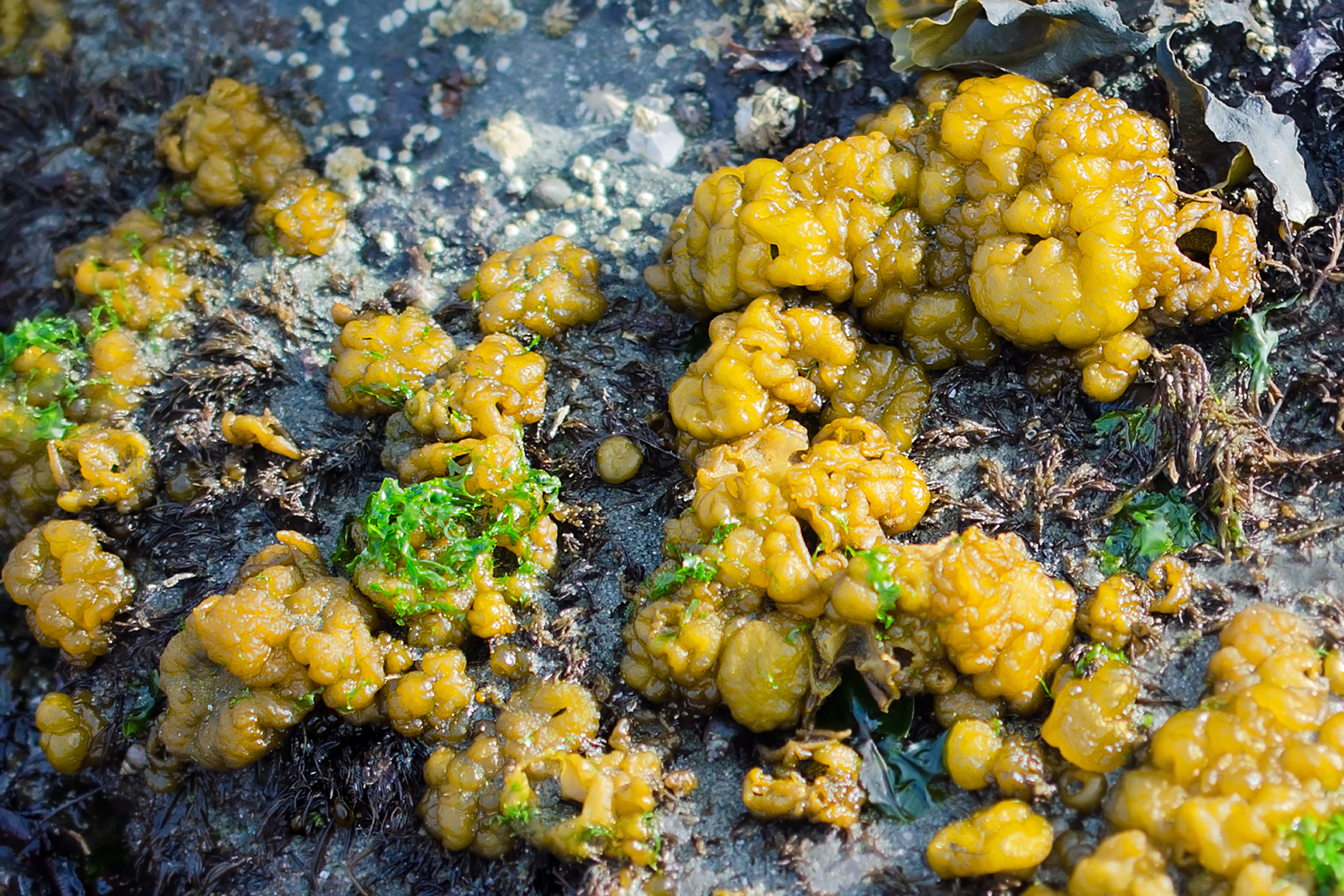
These are a few more photos from the low tide on Stories Beach last week. Mostly seaweeds, in this  batch.

Sea lettuce, Ulva sp. and a small kelp. The kelp holdfasts dig into the rock, penetrating (and making) cracks. The tiny "fingers", called haptera, secrete a glue that hardens on contact with sea water.

This area of the beach is thickly coated with a good mix of  seaweeds; sea lettuce, kelps, rockweed,  sargassum, an almost black,wiry, tough fiber, little yellowish, bubble-like sacs, and a spaghetti-like red alga. With the occasional fragment of Turkish towel and eelgrass. The crow had been digging through it all.

New sargassum stems. And fragments of sea lettuce; it's everywhere.

More seaweed-coated rocks.

Tidepool on the edge of the seaweedy area. Mostly sea lettuce here.

Tomorrow: things in holes.

~~~~~~~~~~~~~

Estas son fotos de un area de la zona intermareal que está cubierta de algas marinas.

  1. Lechuga marina, Ulva sp., y quelpo. Esta alga marina no tiene raices, pero se adhiere a la roca con un disco de adhesión, que penetra las grietas en la roca con estructuras parecidas a dedos finitos, llamadas hapteras. Al ponerse en contacto con una superficie sólida, producen un pegamento que se endurece en agua salada.
  2. Esta area de la playa está cubierta con una gran variedad de algas: Ulva sp. (lechuga marina); Fucus sp.; Sargassum muticum; una fibra dura, como alambres, casi negra; unas bolsitas amarillas; un alga roja parecida a espagueti; y fragmentos de toalla Turka y Zostera marina. El  cuervo había estado escarbando entre las piedras.
  3. Sargassum muticum.
  4. Otras rocas cubiertas de algas.
  5. Y una poza mareal donde termina el alga y empieza la arena.
Para mañana, animales escondidos.

Thursday, May 08, 2025

On the shady side of wet rocks.

So many different beaches; sandy, rocky, seaweedy, stony, steep, slippery, lumpy ... For this low tide day, I chose a smooth, flat, sandy one, for ease of walking. An unfortunate choice. The tide didn't go out far enough to reach the eelgrass beds, where little scuttling and sliding critters would find shelter. The sand reached to the edge of the water, and everything except sand dollars were already sheltering deep in the sand. And the sand dollars were hurrying, as fast as a sand dollar can hurry, to bury themselves.

But there were rocks. Good-sized rocks, mostly standing well apart; glacier droppings. Around each, the current has dug a shallow depression, and on the shaded side, it's business as usual, even at low tide. I went from rock to rock, checking out those tidepools.

From a few metres away, I could see movement; quick, darting dashes for cover; small fish startled perhaps by the vibration I was making in the sand, perhaps by my shadow. Crabs, maybe, heading for the deepest crevice under the rock. When I got to the edge of each pool, nothing was moving. I waited, sometimes, pretending to be another rock. The fish were more patient than I.

Seaweed doesn't hide. And anemones keep fishing as long as there's water.

Algae, red, green, brown. Turkish towel, sea lettuce, and Sargassum.

Burrowing anemones, green and palest pink. And one slow crab.

A salad bowl; Moon snail egg collar, with shredded sea lettuce and red, twiggy algae.

Two plumose anemones hanging from the rock. The water still covers their mouth, so they keep those tentacles spread open.

It's good to see healthy purple starfish again. More sea lettuce, red, bladed algae, and another green anemone.

A silvery plumose anemone, almost entirely out of water, tentacles retracted. Sea lettuce, and small, orange thingies; sponges?

Next: on/under the sand.

~~~~~~~~~~~~~~~~

Tantas playas, de tantos tipos distintos: arena, rocas, piedritas, algas marinas; resbalosas, firmes, inclinadas ... Para este dia de marea baja, escojí una playa arenosa, plana y firme, donde sería fácil de caminar. Una decisión desasertada. La marea no bajó suficientemente como para que alcanzara las areas donde crece la hierba Zostera, donde las criaturas activas pueden encontrar abrigo. Hasta la orilla, se extendió la arena, y todos los residentes, aparte de los dólares de arena, ya se habían escondido de la luz y el aire. Y esos dólares de arena se apuraban, tan rapidamente como un dólar de arena puede apurarse, para desaparecer también.

Pero hubo piedras. Piedras de buen tamaño, bien separadas; desechos de los glaciares. Alrededor, las corrientes han formado depresiones en la arena, y en la sombra, la vida sigue, aun a marea baja. Caminé de una a otra de estas rocas, examinando esas pozas de marea.

Desde una distancia de unos pocos metros, podía ver movimientos rápidos; pececitos tal vez asustados por la vibración de mis pasos, tal vez por mi sombra. O cangrejos, quizás, buscando la grieta más oscura bajo la roca. Cuando llegaba a la orilla de la poza, nada se movía. Esperé algunas veces, imitando la roca. Los peces demonstraban más paciencia que la que tenía yo.

Las algas marinas no se esconden. Y las anémonas siguen buscando alimento mientras haya agua.

  1. Algas marinas roja, verde, marrón. Toalla turquesa, lechuga de mar (Ulva sp.), Sargassum multicum.
  2. Anémonas Anthopleura artemisia, verdes y color de rosa pálida. Y un cangrejo sin apuros.
  3. Ensalada mixta. Un collar de arena, que es una masa de huevos producido por el caracol luna. Con algas verdes (lechuga de mar, Ulva sp.) y ramitas de un alga roja.
  4. Dos anémonas plumosas (Metridium senile) colgadas de una roca. Como el agua todavía les llega a la boca, siguen con los tentáculos abiertos.
  5. ¡Que bueno es ver las estrellas de mar sanas ahora! Ulva sp., un alga roja, y otra anémona verde.
  6. Otra anémona plumosa, esta con los tentáculos retraídos, ya que está fuera del agua. Las cosas anaranjadas pueden ser esponjas.
Para mañana: criaturas en la arena.

Monday, May 31, 2021

Anchors aweigh

Each beach has its own unique fingerprint, made up of sand and stone, animals large and small, plants and algae. This, that I've labelled "moon snail beach" in my files, is a mostly sandy beach after the top few metres of stone and crabs; clean sand, on a gentle slope, and home to a forest of young bull kelp.

Looking south. Salmon Point in the distance.

The green stuff is eelgrass and sea lettuce. Reddish brown; sargassum, bull kelp, winged kelp. Red: eyelet algae, red noodles. Two moon snail collars visible here.


Young kelp, under 2 metres long, holdfast to fronds.

The holdfasts are not roots; they don't provide nutrients, at least for the kelp, but serve to anchor the algae on the sea floor, glued somehow to rocks. Even in strong tidal surges and wave action, the stipe is strong enough to resist breaking, as long as the holdfast is attached to something heavy and solid enough. Unfortunately for this youngster, it chose the wrong location, and a stone far too small to stay put under the waves. It will end up tossed and drying high on the beach.

Kelp needs to establish itself in the subtidal zone; young ones that grow intertidally don't survive, but they do provide habitat and food for small invertebrates while they last.

Unwise choice of anchor stone.

These foolish kelp youngsters all picked the same small stone. Even in calm water, they had no hope of staying anchored to the bottom.

Winged kelp. This has been torn from its holdfast underwater. The holdfast will survive to grow another blade next year.

While the blades of kelp only live about a month or two, holdfasts can live and grow for up to ten years or more! (Catalina Sea Camp)


Red eyelet silk seaweed, covered in sand. This grows from the low intertidal zone downward.

A red noodle seaweed, attached to its holdfast.

This one can live in the low intertidal zone, as long as it remains attached to the stone.
 

~~~~~~~~~~~~~~~~~~~

Cada playa tiene su propias características, incluyendo si se basa en piedra o arena, los animales grandes y pequeños que allí viven, las plantas y las algas. Esta playa, a la cual he nombrado "playa de caracoles luna" en mis archivos en la computadora, se compone principalmente de arena, aparte de los primeros metros de la zona superior, que está cubierta de piedras y cangrejos. La arena se inclina ligeramente hacia el mar; allí, en la parte más baja, crece un bosque de algas kelp juveniles.

Primera foto: la playa, mirando hacia el sur. En la distancia, Salmon Point.

Lo verde en la foto es hierba marina Zostera, y lechuga de mar. Lo café es sargazo y kelp. Y las algas rojas son el alga "ojete de seda", Sparlingia pertusa, y espagueti rojo. Se ven dos cuellos de caracol luna. también.

Segunda foto; un alga kelp juvenil, midiendo menos de 2 metros, desde el rizoide hasta las láminas.

Los rizoides no son raices; no proveen nutrición al alga, sino que sirven como ancla fijada de alguna manera a las piedras bajo el agua. Aun cuando la fuerza de la marea y las olas es vigorosa, las estipes (el tallo) son suficientemente fuertes como para resistir sin romperse, siempre y cuando el rizoide esté fijo en algo pesado y sólido. Mala suerte fue para esta kelp juvenil escoger una piedrita que no le puede detener en su lugar. Terminará aventada y secándose en las piedras al lado del mar.

El alga kelp necesita establecerse en la zona submareal para sobrevivir. Estos jóvenes no vivirán, pero mientras proveen habitat y comida para animalitos invertebrados.

Tercera foto: sitio mal escogido. Varias algas se fijaron a una sola piedrita. Ni en aguas tranquilas esto le iba a servir.

Cuarta foto: kelp "con alas", separado de su rizoide, que sigue en el agua y producirá nuevas láminas el año que entra.

¡Mientras las láminas de kelp viven solamente uno o dos meses, el rizoide puede vivir y crecer por diez años o más! (de Catalina Sea Camp)

Quinta foto: el alga "ojete de seda" cubierta de arena. Esta alga vive tanto en la zona baja intramareal como en la submareal.

Sexta foto: un alga "espagueti rojo". Esta puede vivir aquí en la zona baja intramareal mientras sigue en contacto con la piedra.


Friday, May 14, 2021

The shapes of brown algae

 Just a few low-tide seaweeds:

A baby bull kelp. Cute, isn't it?

A flat-bladed rockweed, with beauty bush.

I have been confused by the rockweeds, finding different shapes, thin ones, long pointed rockweeds, wide-bladed ones, flat-bladed rockweeds, rockweeds with the characteristic bladders that kids like to pop. But I couldn't find, in my encyclopedia, more than two species of true rockweed (Fucus sp.; they have a distinct midrib. Dwarf rockweed, less common on our shore, has no midrib.)

A few years back scientists examined the DNA of various rockweeds, finding that our local ones were mostly all the same species, Fucus distichus. Turns out it is extremely variable as to shape, depending, it seems, on the habitat.

And the fat bladders are the mature reproductive structures. The one in the photo, then, is immature.

I think this is sea caulifower, Leathesia nana. On sea lettuce.

~~~~~~~~~~~~~~~~~~~~~~~~~~~
Unas pocas algas marinas:

Primera foto, un quelpo Nereocystis luetkeana, muy pequeño. (Crecen hasta 36 metros.)

Segunda foto: Sargazo vejigoso; Fucus distichus. Con "arbusto de belleza", Callithamnion pikeanum.

Me han dejado algo confusa los sargazos locales; vienen en una variedad de formas, delgados, o largos y puntiagudos, o con hojas anchas, hojas planas, o con las puntas infladas, haciendo los globos que los niños se apuran a reventar. Pero en mi enciclopedia encontraba nada más dos especies de sargazo "verdadero". (Fucus sp.,estos tienen un tallo central muy distinta. Otras dos especies, menos común en nuestras costas, son más pequeñas, y no tienen este tallo.)

Hace unos años, los científicos examinaron el ADN de varios de estos, y descubrieron que casi todos son de la misma especie, Fucus distichus. Resulta que es extremadamente variable en forma; parece que esto depende de su habitat.

¿Y las vejigas gordas? Son las estructuras reproductivas de las algas maduras. Así que la de la foto es todavía juvenil.

Tercera foto; la que llamamos coliflor marina, Leathesia nana. Descansa sobre una cama de lechuga marina.

Monday, May 03, 2021

Wooly brown carpet

The beach I chose for the low tide exploration this year is an an old glacier plain; an almost flat expanse of sandstone, interspersed with groups of large rocks, usually lined up as if shoved to the side by a sliding glacier, with a few large erratics near the low tide mark. The sandstone is scored in straight lines, some parallel to the shore, others heading straight out to the channel. Glacier tracks.

I've been here before, at mid-tide levels. Not often; the beach has not been easily accessible. The access point is at the end of a dead-end road with three houses on it, which in turn is an off-shoot of a slightly longer dead-end road. To reach the beach, I had to climb a parking barrier, then scramble down a rocky drop-off. Until now; now someone has made a short path skirting the fence and dropping down the side on easy steps. Nice!

Looking northish. Showing eroded slab of sandstone, long scratch mark. Note the green sea urchins at the base of the slab. More on these later.

Glacier tracks. With purple sea urchin.

Seaweed-covered  beaches can be tricky. It's hard to tell what's underneath, whether rolling rocks or sudden holes or slimy mud; I have fallen several times. luckily without too much damage. This flat sandstone beach is safer; there are few rocks, and the holes are shallow.

But there's always slippery seaweed. Even on this shore, my feet slip on the green and yellow seaweeds. But here, there's a carpet of a brown, scratchy, wiry seaweed. The patches are interspersed with areas where sea lettuce, rockweed, and bag algae grow, all very slippery underfoot. Mostly, I skirted these areas, walking confidently on the slip-proof carpet.

Looking south. With red sea urchin. The erratic at the left was just at the edge of the water when the tide turned.

The seaweed is called "beauty bush". I'm not sure why. It's brown, lumpy, shapeless except at a close view.

Beauty bush, Callithamnion pikeanum. With rockweed and big barnacles.

This is one of the coarser members of this family of red algae, and it is usually purplish brown to reddish brown in color. It is perennial and so extremely densely branched that it appears woolly. (E-Flora BC)
I broke off one branch to get a better look.

The little round branchlets almost look like evergreen cones.

My guide book, Marine Life of the Pacific Northwest, comments that it is "reminiscent of a miniature fir tree lying on its side."

In the upper intertidal zone, I find mainly tiny periwinkle snails, hermit crabs in periwinkle shells, the occasional whelk, and barnacles. And seaweed: mostly sea lettuce and sea hair, all very slippery underfoot.

The lower intertidal zone is another story. So much to see! Even a couple of lifers! Tomorrow, an ambitious chiton.

~~~~~~~~~~~~~~~~~~~~~~~~

La playa que escogí este año para el dia de la marea baja es una antigua llanura glacial: un campo casi completamente plano hecho de arenisca, entrelazada con grupos de piedras grandes, casi todos alineados, como si hubieran sido empujado a un lado por una montaña de hielo ambulante. Hay unos bloques erráticos cerca del nivel más bajo de la zona intramareal. Se ha cortado la arenisca en lineas rectas, a lo largo de la costa, o dirigiéndose directamente al mar. Huellas glaciales.

He visitado antes, al nivel mediano intramareal. No tan frecuentemente, porque la playa no ha sido de fácil acceso; se llega por un callejón sin salida, donde solamente hay tres casas; este callejón se deriva de otro callejón sin salida un tantito más largo. Para llegar a la playa había que trepar sobre una barda del estacionamiento, y luego hacerse camino entre rocas al nivel de la arena. Hasta ahora: esta vez descubrí que alguien ha hecho un senderito que evita la barda y baja por escalones a la playa. ¡Qué bien!

Primera foto: mirando al norte, mostrando el borde de la plancha de arenisca, y una grieta glaciar. Se ve un grupo de erizos de mar verdes al lado de la plancha. De estos, veremos más adelante. 

Segunda foto: una grieta glacial. Y un erizo de mar morado.

Las playas con muchas algas pueden ser peligrosas. No se puede ver lo que hay abajo, sea piedras rodantes u hoyos inesperados o lodo resbaloso; me he caído varias veces, por suerte sin mayores daños. Esta playa de arenisca, plana y sólida, es más segura. Hay pocas piedras y los hoyos son de poca profundidad.

Pero siempre hay algas marinas resbalosas. Aun en esta playa, mis pies se me van caminando sobre las algas verdes y amarillas. Pero aquí también hay un tapete de alga café, rasposa, como si fuera de alambre. Hay grandes areas donde crece la lechuga de mar, sargaso vejigoso, y alga de bolsita, pero les dí la vuelta, caminando con confianza sobre ese tapete anti-resbalante.

Tercera foto: mirando hacia el sur. Con un erizo de mar rojo. El bloque errático en el agua, estaba casi fuera por completo cuando la marea llegó a su punto más bajo.

La alga marina café se llama en inglés "arbusto de belleza", no me imagino porque.

Cuarta foto: "arbusto de belleza" con sargaso vejigoso, y unos bálanos grandes.

"Este es uno de los miembros más ásperos de esta familia de algas rojas, y casi siempre es de un color café morado a café rojizo. Es perenne y tan densamente ramificada que parece de lana." (De E-Flora BC)

Quinta foto: rompí una ramita para verla mejor. Las ramitas parecen conos de pino.

Mi libro guía, Marine Life of the Pacific Northwest, hace el comentario que "trae a la memoria un abeto caído."

En la zona superior intramareal de esta playa, encuentro caracoles de mar "bígaro", ermitaños en concha de bígaro, una que otra bocina, y bálanos. Y algas marinas de las resbalosas.

Aquí en la zona baja, la situación cambia. ¡Tantas cosa que hay! ¡Incluso algo que nunca había visto antes! Mañana, empiezo con un quiton muy valiente.

Monday, April 26, 2021

Too much to see

 It has been said that, "coastal BC has a greater species diversity than anywhere else in North America". (Raincoast Conservation Foundation, in BC’s coastal biodiversity: the highest in North America, an article that completely bypasses marine invertebrates, but does pay attention to seaweeds; "In British Columbia, more than 500 species of macroalgae have been recognized, making up about 4.5 % of the world’s total marine algal species.")

Nowhere is this biodiversity more apparent than on the intertidal plain. With every cautious step at low tide, I crunch the shells of tiny animals, slip on seaweeds pink, red, green, brown and yellow, send critters scuttling and splashing for shelter, or squirting small fountains at my legs as clams and worms retreat deep under the sand. A tidepool is a multi-coloured, multi-textured collage, too varied to be sorted out on the fly.

I am reduced to taking photos at random, hoping something will come into focus on my computer screen.

Tidepool about 2 inches deep; my shadow at the bottom right.

At first glance, examining this photo, I see 9 separate species of seaweed:

  • green sea lettuce
  • red bladed algae; smooth, wide, translucent blades.
  • pink crustose coralline algae, coating stones
  • a green hairy seaweed
  • a red seaweed, with stiff central blades, from which sprout thinner red "leaves"
  • rockweed
  • old eelgrass, with
  • encrusting fuzzy algae along the blades (or these may be hydroids, an animal)
  • yellowish algae coating an old clamshell and a snail (or hermit crab) shell.

But that's not all: under every stone, under every shred of seaweed, crabs and hermits, worms and small fish and assorted isopods and hunting whelks hide from the sunlight, and from my moving shadow. And, of course, hundreds of eggs. Among those not doing so good at hiding, I can see:
  • a burrowing anemone, Anthopleura artemisia,
  • snail shells which may house the original shell, or just as likely, a small hermit crab
  • several limpets
  • and a couple of legs of a kelp crab who thinks he's out of sight.

What looks like a single-culture mass of seaweed turns out to be another collage:

Bad (green) hair day.

In this photo the algae are the green hair, green sea lettuce, and that red-bladed alga. In the background; rockweed and a fuzzy brown seaweed. Snails and barnacles dot the rocks.

And I know I'm missing half of what's there!

~~~~~~~~~~~~~~~~~~~~~~~~~~~

Se ha dicho que —las costas de Colombia Británica contienen una mayor diversidad de especies que la que se presenta en todo lo demás del continente — (del sitio Raincoast Conservation Foundation, en un artículo que olvida por completo el reino de los inveterbrados marinos, pero si nota de las algas marinas, que —en las costas de Colombia Británica se han reconocido más de 500 especies de macroalgas, constituyendo aproximadamente un 4.5 porciento de las especies de algas marinas mundiales.) 

En ninguna parte se nota más esta diversidad de especies que en la zona intramareal. Con cada paso que doy, tan cuidadosamente, aplasto una variedad de animalitos, me resbalo sobre algas marinas rojas, verdes, amarillas, color de rosa o de café, espanto varios animales que se apuran a esconderse bajo las piedras o que, retirándose dentro de la arena, hacen pequeños fuentes que bañan mis piernas. Una poza intramareal hace un "collage" de una multitud de texturas y de colores, tan variado que no se puede capturar a simple vista.

Me veo forzada a sacar fotos al azar, esperando que al verlas en la pantalla, se puedan entender.

La primera foto es de una poza intramareal, más o menos de 4 o 5 cm. de profundidad. 

A primera vista, veo hasta 9 especies de algas marinas:
  • lechuga marina, Ulva spp.
  • una alga roja de hojas anchas, lisas, translúcidas
  • una alga coralina incrustante, color de rosa
  • una alga verde en forma de pelos
  • una alga roja con tallos tiesos, de los que brotan hojas delgadas
  • sargaso vejigoso, Fucus spp.
  • hierba marina Zostera madura, cubierta de
  • una alga encrustante a lo largo de las hojas (o puede ser un hidroide, o sea un animal)
  • una alga amarillenta creciendo en una concha abandonada de una almeja y en un caracol.

¡Pero eso no es todo! Bajo cada piedrita, bajo cada hoja de alga, se esconden cangrejos y ermitaños, gusanos y pescaditos, isópodos variados y bocinas cazadores, fuera de la luz fuerte del sol, y también huyendo de mi sombra. Entre los que no se escondieron perfectamente veo:
  • una anémona, Anthopleura artemisia
  • conchas de caracol marino, que pueden contener los caracoles mismos, o si no, cangrejos ermitaños
  • varias lapas
  • y un par de patas de un cangrejo "kelp" que cree estar bien escondido.

Segunda foto: lo que aparece una masa de una sola alga resulta ser otro collage. Las algas aquí son un pelo verde, lechuga marina verde, y la alga roja de hojas anchas. En el fondo se ven sargaso vejigoso y un alga café. Caracoles y bálanos toman el sol en las piedras.

Y por seguro, mucho se me pasa sin observar.


Sunday, May 05, 2019

Fish and Wildlife Habitat

On the shore at Oyster Bay ...

Old sign, with rusty staple marks. The logs are just above the tide line around the bay, and protect a variety of salt-tolerant dune plants and grasshoppers.

Detritus, scrambled, tossed ashore, and left to bake in the sun at the highest tide line. Rockweed bladders, so dry they crunched like potato chips when touched, floating miniature "peas", the bladders of sargassum seaweed, bits of dried algae and eelgrass, all very dry. And these tiny tubes, unidentified.

Not present in the photo; a couple of scraps of plastic. I took that out and carried it away, along with a handful of other pieces and too many chunks of styrofoam.

The tubes are hollow; at home a darning needle slid in one end and out the other of a 1 cm. scrap; there was nothing inside to slow it down. Under a bright light and the microscope, the tube is papery, and yellowish, with those circular rings. It's 1.5 mm. in diameter. A worm tube, maybe? A structure from a molted crab? A segmented worm with no innards? I don't know.

I brought some of the dry rockweed home. Soaked in salt water for a few minutes, it became soft and pliant again, but slightly slimy. My hermit crabs thought it was delicious.

A twisty piece of bleached stump. And wildlife: look for the wasp and the baby maple tree.

Monday, June 11, 2018

On Willow Point

The beach sometimes looks bare. A sprinkle of sand on sandstone, a few scattered rocks, a smear of sea lettuce, leftover tidewater; not much else.

Willow Point beach, looking towards Quadra Island and, in the distance, the mainland.

But slow down, crouch, look underneath rock overhangs, behind the stones ... the barren beach is full of life and colour.

Purple starfish, clinging to the bottom of a rock. With pink-tipped green anemones for company. And limpets and barnacles, of course.

An assortment of seaweeds. Green sea lettuce, yellowish rockweed, one (or two?) of the many stringy, bushy brown algae. a blob of sea cauliflower, and tasty-looking succulent seaweed, Sarcodiotheca gaudichaudii. (I love that name!)

Sea cauliflower with a garnish of sea lettuce, accompanied by rockweed leaves and brown alga shreds.

Rocks and mounds of brown algae, crawling with hermits and crabs, isopods and snails. Good feeding grounds for a pair of mallards, now leaving their unfinished dinner in haste because of that pesky photographer. (They came back as soon as I walked away.)


Friday, February 09, 2018

Blue sky and water, green critter food.

So the rain stopped. The sun showed up. Half unbelieving, I grabbed the camera and went to the beach.

Waves rolling in, long shadows. Looking north towards Oyster Bay.

The wind was brisk, and cold. But out of the shadows, it almost felt like spring. I unzipped my jacket.

Looking south. Although it is still early afternoon, 1:30 PM, the sun is dropping and the shadows are long.

Splash! Waves hitting rock at the northern tip of the breakwater.

Gull on the rocks.

And I got too close. 

I came home with a bag of freshly uprooted eelgrass, brought in by the waves, some Turkish towel, a shred of sea lettuce, two species of rockweed, a length of seersucker kelp, one small fragment of the invasive wire weed, Sargassum muticum, and a few branches of the beautiful sea braid, Plocamium cartilagineum. All except the kelp, which turned out to be past its sell-by date, went into the aquarium. All the hermits, some of the snails, and the crab have been feasting and climbing ever since.

There were also many lumps of some sort of spongy, but firm stuff. It looked sort of like a sponge, but none I had seen before. I collected a fair amount. At home, under a lens, it seems to have no structure, no sponge pores or canals. Under the microscope, it is a loose association of round cells, each seeming to be independent. There is still no structure to be seen.

I can't find it in my books, nor on the web. I'll try to get a decent photo this afternoon.

The hermits and snails loved it; they're working on their second clump now.

Wednesday, January 31, 2018

4-inch ecosystem

Inverterbrate aquarium photos usually have to be cropped and cleaned. From an inch or two away, the depth of field leaves most of the photo a blur, and the tiny swimmers in the water obscure the view. In today's photo, I cropped only the top 1/3, which was only bubbly water, and erased only a couple of scratches on the outside of the glass, which were not part of the animals' environment.

About 4 inches of aquarium front.

The spots in the water are bubbles from the pump and the air stone (the big blobs and the hard-looking rods), fragments of algae looking for a place to settle down, copepods (mostly tiny streaks in random directions) and leftover shrimp pellet fragments (these will feed the smaller anemones and the barnacles).

Animals present: two hairy hermits, eight pink-tipped green anemones (which look yellow under artificial light), three Asian mud snails (Batillaria attramentaria), one channeled dogwinkle (Nucella canaliculata), one limpet, barnacles (two species), several unidentifiable tentacles or worms or edges of half-hidden critters; some of these may be tiny orange-striped green anemones. A vague brownish shadow in the background, upper left, is the edge of the plumose anemone. The oyster shell on the right harbours a large flatworm on its underside. In the blurry sand and broken shells in front, a couple of amphipods blend in completely until they move.

The Japanese nassa snails have hidden themselves underneath the sand again.

Plants: bright green algae that grows on every surface, including the glass, pink encrusting algae on the oyster shell and the hermit's adopted shells, and - look! _ on the hairs on the hermit legs, orange algae (on the oyster and barnacle shells). On the rock in centre front, a deep red encrusting algae, probably the winter stage of Turkish washcloth (Mastocarpus papillatus). In back, the enthusiastic Rose seaweed (Rhodymenia californica), something orange, probably bits of leftover kelp holdfast, glimpses of eelgrass and sea lettuce.

This is why I keep a stool pulled up so that I can sit with my nose to the glass.

Friday, January 12, 2018

Chiton lips

"Woody", the green and blue chiton in my aquarium, spends most of his time plastered to a shell, a slow-moving, flattish, 2-inch-long mound blending into the background. If he has a "face", it's hidden. But for a moment, the other day, I caught him lifting the edge of his girdle, tasting the water.

Underside of the girdle, and the mouth, open. Also present: an amphipod, a mud snail, and a pink-tipped green anemone.

Woody does not have a head, as we understand the term. He has no eyes, tentacles, or brain here, just the mouth. (His shell does include light-sensitive spots, but around his mouth, there is no need, since it is usually clamped tight against the substrate.)

Like many other molluscs, chitons feed with a thin strap bearing rows of teeth known as the radula. The anterior rows are used up and discarded or swallowed and replaced by new rows moving forward like a conveyor belt. ... The chiton radula is noteworthy because one pair of cusps in each row is hardened with magnetite, which provides these teeth with a coating harder than stainless steel. They are the only molluscs that have magnetite-coated teeth. In fact, they are the only organisms known to manufacture such vast quantities of magnetite. (http://biology.fullerton.edu/deernisse/pubs/Eernisse_07_chitons_Tidepools.pdf)

Before I start to take photos through the glass, I scrub the inside walls; overnight, they develop a coating of green algae. A soft cloth removes most of it, but underneath that, there's always a more tenacious growth of yellowish-brown algae; for that, I use a green kitchen scouring pad, scrubbing and wiping with the cloth alternately. With a fingernail, I pry off harder lumps.

And even then, once I give up, the glass is still covered with these tiny pink dots, visible against the yellow flesh of the chiton. Pacific rose seaweed, trying to establish itself on every surface in the aquarium. When it grows on a shell, I can't rip or scrape it all off; it's tremendously tenacious. I tear off and discard double handfuls every time I clean the tank, but the glued-on "roots" are always left behind, ready to leap into action.

So fragile-looking, so delicate! And so strong!


Wednesday, November 01, 2017

Tide-wrack; October collection

Each stretch of shore, and each season, even each weather pattern, has its own assortment of toss-ups. Towards the end of October, after several days of wind and wild waves, the northern section of Oyster Bay had refreshed its collection, substituting kelps for the usual eelgrass fragments and sea lettuce salad.

Possibly a broad-rib kelp, Pleurophycus gardneri

The various kelps look as if they should be easy to identify by asking a few questions: do they have a stipe, and what's it like? Are they smooth, winged, frilled, or blistered? What is the holdfast like? Do they carry floats?

Once they land up on the beach, in fragments, they become confusing.

Blistered, with a stipe-like centre. Similar to seersucker kelp, but missing the 5 ribs.

Nice holdfast, with two stipes, one bearing a blistered and ribbed blade, one with a smooth blade.

Alien invader

I took the photo of that mess with the frog (I think that's what it's supposed to be), because I was annoyed at the intrusion. I carried the critter out, dumped it in the garbage. One less bit of plastic left on the beach.

But before I deleted the photo, I blew it up and looked at it closely, wondering what else was there in that hodge-podge of land-based and wave-tossed vegetation. See the little fly on the blade of kelp just above the neat, round leaf?

But there's more: I noticed first one, then another and another ... transparent segmented tubes, small and smaller, scattered here and there. I chopped them out of the larger photo:


What are they? Plant stems? Leftover worm tubes? Plastic trash? Now I'll have to go back and look for more.

Clamshell. At least this is easy to identify.

A small branch, riddled with shipworm tunnels.

The shipworm (Teredinidae) is a clam, disguised as a worm. It has a long, worm-like body, up to about a metre long, depending on the species. But it wears two hard, ridged clam shells on its head, and uses them to carve out its burrow in the wood, lining some of the burrows with a calcareous coating.

When shipworms bore into submerged wood, bacteria ... digest the cellulose exposed in the fine particles created by the excavation. (Wikipedia)

This one was a larger, fatter clam than most I see on these beaches, and the wood is fresh, (most Teredos eat rotting wood), exposing the beautiful grain of the wood. (Click to look at it full-size.)

Powered By Blogger