Showing posts with label sea cauliflower. Show all posts

Friday, May 29, 2026

Wind and waves and seaweed knees

 It was a windy afternoon. Not cold, not rainy. Just windy. I went to the beach to look at waves.

Just waves and rocks.

The water was bringing in piles of freshly ripped up seaweeds with each wave, dropping it well below the usual line of drying stuff at the high-tide line,

Overview

It's mostly rockweed and sea cauliflower.

Sea cauliflower, Leathesia marina, rockweed, sea lettuce, and shreds of some brown, wiry species.

An articulated coralline alga, with sea cauliflower cushions.

The same photo, cropped for iNaturalist, for a better look at the structure.

These coralline algae are red when alive, but turn white quickly when they die. Each hard, calcified segment is separated from the next by a flexible "knee", called a "geniculum", which allows the alga to survive in the strong currents of our coast. iNaturalist's program identifies this sample as "Genus Calliarthron, a member of ... Family Corallinaceae", but identification is iffy without a human input; there are several possibilities.

UPDATE: There you go! Human input! It's Calliarthron tuberculosum. Thank you!

Back at the car, I took a photo through the windshield from my parking space.

The flowers are dandelions, daisies, pink clover, and a yellow mustard species. Just out of sight, the beach peas are flowering.

~~~~~~~~~~~~~
El dia era agradable; no hacía ni calor ni frio, no llovía, pero soplaba un viento fuerte. Fui a la playa para mirar las olas.

    1. Olas y piedras.

    2. Las olas traían grandes cantidades de algas rotas, recién arrancadas del fondo, y las amontonaban a media playa.

    3. La mayoría de las ofrendas del dia eran Fucus sp. y el "coliflor marino", Leathesia marina.

   4. Los "cojines" de Leathesia marina, un poco de Fucus sp. (a la izquierda), lechuga marina, Ulva sp., y fragmentos de un alga parda.

    5. Un alga coralina articulada, con dos cojines de coliflor marina.

    6. La misma foto, recortada para iNaturalist, para mostrar mejor la forma del alga.

Estas algas coralinas son rojas en vida, pero se vuelven blancas al morir. Cada sección calcificada se separa de la próxima por una "rodilla" flexible, llamada el genículo, que permite el movimiento necesario para mantener el alga con vida en las corrientes fuertes de nuestras aguas.  El programa de iNaturalist identifica esta muestra como Género Calliarthron, miembro de ... la Familia Corallinaceae", pero hay varias posibilidades; falta la confirmación por un experto humano.

Y ya me lo han confirmado: es Calliarthron tuberculosum.

    7. Volviendo al estacionamiento, saqué una foto desde el interior del coche. Las flores son dientes de león, margaritas, treboles color de rosa, y uno de los brasicales amarillos. 


Friday, May 14, 2021

The shapes of brown algae

 Just a few low-tide seaweeds:

A baby bull kelp. Cute, isn't it?

A flat-bladed rockweed, with beauty bush.

I have been confused by the rockweeds, finding different shapes, thin ones, long pointed rockweeds, wide-bladed ones, flat-bladed rockweeds, rockweeds with the characteristic bladders that kids like to pop. But I couldn't find, in my encyclopedia, more than two species of true rockweed (Fucus sp.; they have a distinct midrib. Dwarf rockweed, less common on our shore, has no midrib.)

A few years back scientists examined the DNA of various rockweeds, finding that our local ones were mostly all the same species, Fucus distichus. Turns out it is extremely variable as to shape, depending, it seems, on the habitat.

And the fat bladders are the mature reproductive structures. The one in the photo, then, is immature.

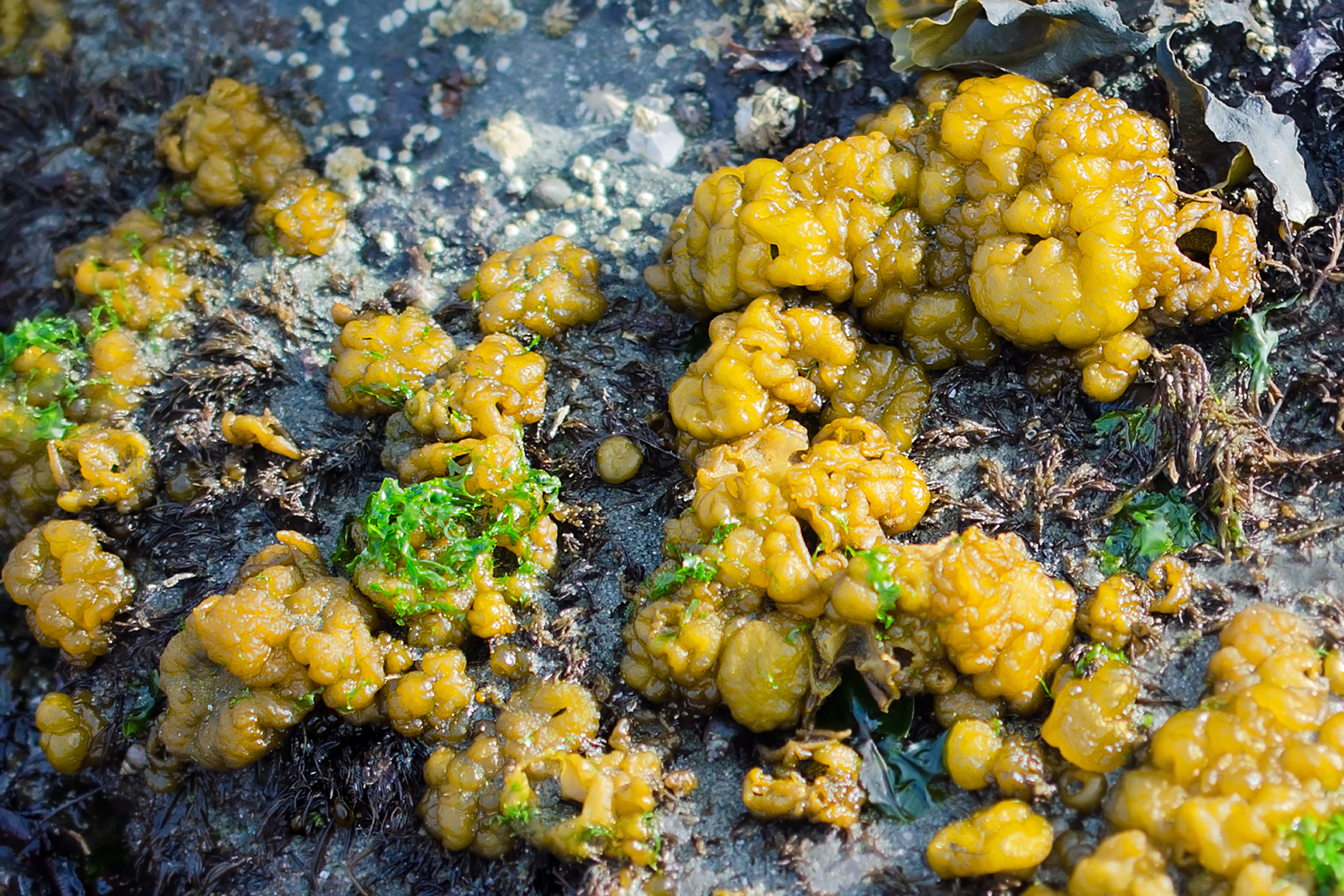
I think this is sea caulifower, Leathesia nana. On sea lettuce.

~~~~~~~~~~~~~~~~~~~~~~~~~~~
Unas pocas algas marinas:

Primera foto, un quelpo Nereocystis luetkeana, muy pequeño. (Crecen hasta 36 metros.)

Segunda foto: Sargazo vejigoso; Fucus distichus. Con "arbusto de belleza", Callithamnion pikeanum.

Me han dejado algo confusa los sargazos locales; vienen en una variedad de formas, delgados, o largos y puntiagudos, o con hojas anchas, hojas planas, o con las puntas infladas, haciendo los globos que los niños se apuran a reventar. Pero en mi enciclopedia encontraba nada más dos especies de sargazo "verdadero". (Fucus sp.,estos tienen un tallo central muy distinta. Otras dos especies, menos común en nuestras costas, son más pequeñas, y no tienen este tallo.)

Hace unos años, los científicos examinaron el ADN de varios de estos, y descubrieron que casi todos son de la misma especie, Fucus distichus. Resulta que es extremadamente variable en forma; parece que esto depende de su habitat.

¿Y las vejigas gordas? Son las estructuras reproductivas de las algas maduras. Así que la de la foto es todavía juvenil.

Tercera foto; la que llamamos coliflor marina, Leathesia nana. Descansa sobre una cama de lechuga marina.

Monday, June 11, 2018

On Willow Point

The beach sometimes looks bare. A sprinkle of sand on sandstone, a few scattered rocks, a smear of sea lettuce, leftover tidewater; not much else.

Willow Point beach, looking towards Quadra Island and, in the distance, the mainland.

But slow down, crouch, look underneath rock overhangs, behind the stones ... the barren beach is full of life and colour.

Purple starfish, clinging to the bottom of a rock. With pink-tipped green anemones for company. And limpets and barnacles, of course.

An assortment of seaweeds. Green sea lettuce, yellowish rockweed, one (or two?) of the many stringy, bushy brown algae. a blob of sea cauliflower, and tasty-looking succulent seaweed, Sarcodiotheca gaudichaudii. (I love that name!)

Sea cauliflower with a garnish of sea lettuce, accompanied by rockweed leaves and brown alga shreds.

Rocks and mounds of brown algae, crawling with hermits and crabs, isopods and snails. Good feeding grounds for a pair of mallards, now leaving their unfinished dinner in haste because of that pesky photographer. (They came back as soon as I walked away.)


Powered By Blogger