Showing posts with label sea lettuce. Show all posts

Tuesday, July 15, 2025

An assortment of rocks

This latest low tide day, I visited a section of beach that I'd never been able to reach before. And there were rocks. So many different rocks! Here are some of them, and I'll leave the critters for tomorrow.

Tide's still going out. In this area, mostly seaweedy rocks.

Coming back an hour later, this was halfway up the beach.

10:40 AM. Starting off, walking down to the edge, on a causeway of rounded "cookie" stones. This is as far as I'd been before.

10:48. Still underwater. An unusually-shaped stone, clean and blue, two hands'-breadth. I saw no others like it.

12:21 PM. On my way back up the beach, at mid-tide level. Oyster-bearing rocks.

Sorry; not in chronological order. 11:20 AM. Getting near the low edge. So many rocks bear these holes; as if a giant had been bouncing on a pogo-stick.

And each hole was a mini tidepool, where mobile animals waited out the dry spell. Here, purple sea stars, an anemone, a hermit, in a hole about 15 cm. across.

Near the top of the intertidal zone, were more of these large "cookies".

And they hold somewhat barren tidepools.

Just another glacial erratic. The barnacle incrustation more or less indicates the usual high tide level.

A first-year Bonaparte's gull. Large flat areas of the lower intertidal zone are covered with slippery sea lettuce.

Ok. There were two reasons I'd never been able to reach this part of the shore before. First, obviously, because I'd never come there when the tide was this low. And secondly; footwear.

The areas that look easiest to walk on; those flat, green spaces, under a cover of pretty sea lettuce; they almost look like mowed lawns. They're not. And they're dangerous. With every step, your foot slides out from under you; it's like the slickest of slick ice.

And some of the bumpy, rocky areas are just as bad; there's the sea lettuce coating on top of rocks that roll out from underfoot. I've fallen a few times, not something I want to repeat.

But this time (why didn't I think of this long ago?) I wore ice cleats on my thrift-store sneakers; those wire and rubber attachments that go on over whatever shoe or boot you wear, advertised as winter gear. (Like these.) And with those on, I could walk normally, everywhere. Yay! I'm thinking now of another beach, one I've avoided before; not any more.

Tomorrow; the critters that live here.

~~~~~~~~~~~~~~~~~

Cuando la marea estaba a su nivel más bajo, el sábado pasado, pude visitar una parte de la playa donde nunca antes había estado. Encontré gran variedad de rocas, todas diferentes. Aquí hay algunas, y dejo los animalitos para mañana.

  1. La marea llega a la mitad de la zona intermareal. Estas rocas luego estaban totalmente expuestas.
  2. Cuando pasé por aquí una hora más tarde, esto estaba a media playa.
  3. Apenas empezando; este "camino" de rocas planas, arenosas cruzaba la zona alta. Hasta aquí yo había llegado antes. 10:40 AM.
  4. Una piedra bajo el agua. No vi ninguna otra parecida. Mide unos 20 cm.
  5. 12:21. Regresando hacia tierra firma ya. Hay muchas piedras cerca de la mitad de la zona como estas, cubiertas de bálanos y ostiones. (Que hasta parecen ser parte de la roca misma.)
  6. Cerca de la zona más baja, muchas rocas llevan estos pocitos; como si un gigante hubiera estado jugando con un palo saltarín.
  7. Y cada pocito se convierte en albergue para animales donde esperan a que regrese el agua. Aqui, estrellas de mar, una anémona, un cangrejo ermitaño.
  8. En la zona superior intermareal, se ven estas "galletas", casi desnudas.
  9. Y en estas, los pocitos intermareales contienen unas pocas algas marinas y caracolitos, Littorina sp.
  10. Otro de esos bloques erráticos glaciares. Donde está cubierto de bálanos la marea alta cubre la roca.
  11. Una gaviota "Bonaparte" en su primer año. Grandes secciones de la zona están cubiertas de lechuga marina, muy resbalosa.

Por dos razones nunca había visitado esta parte de la playa antes. Primeramente, claro, porque nunca llegué cuando la marea estaba tan baja. Y, segundo, no llevaba calzado adecuado.

Esas areas que parecen buenas para caminar; esos espacios planos, verdes, cubiertas de la bella lechuga de mar, que casi parecen céspedes bien cortados, no lo son. Son peligrosas. Con cada paso, tu pie resbala; es como caminar en el hielo más resbaloso posible.

Y hay sitios con rocas pequeñas, rocas redonditas, que son igualmente peligrosos; la lechuga de mar cubre piedras que se rodean bajo tus pies. Me he caído algunas veces; no es algo que quiero repetir.

Pero esta vez (y ¿porqué no se me ocurrió antes?) llevaba tacos de agarre para hielo bajo mis zapatos; un arreglo de alambre y hule que se fija sobre cualquier zapato o bota; los venden como equipo para invierno. (Como estos.) Y con esos puestos, pude caminar como sin nada, en todas partes. ¡Excelente!

Para mañana; las criaturas.

Thursday, May 08, 2025

On the shady side of wet rocks.

So many different beaches; sandy, rocky, seaweedy, stony, steep, slippery, lumpy ... For this low tide day, I chose a smooth, flat, sandy one, for ease of walking. An unfortunate choice. The tide didn't go out far enough to reach the eelgrass beds, where little scuttling and sliding critters would find shelter. The sand reached to the edge of the water, and everything except sand dollars were already sheltering deep in the sand. And the sand dollars were hurrying, as fast as a sand dollar can hurry, to bury themselves.

But there were rocks. Good-sized rocks, mostly standing well apart; glacier droppings. Around each, the current has dug a shallow depression, and on the shaded side, it's business as usual, even at low tide. I went from rock to rock, checking out those tidepools.

From a few metres away, I could see movement; quick, darting dashes for cover; small fish startled perhaps by the vibration I was making in the sand, perhaps by my shadow. Crabs, maybe, heading for the deepest crevice under the rock. When I got to the edge of each pool, nothing was moving. I waited, sometimes, pretending to be another rock. The fish were more patient than I.

Seaweed doesn't hide. And anemones keep fishing as long as there's water.

Algae, red, green, brown. Turkish towel, sea lettuce, and Sargassum.

Burrowing anemones, green and palest pink. And one slow crab.

A salad bowl; Moon snail egg collar, with shredded sea lettuce and red, twiggy algae.

Two plumose anemones hanging from the rock. The water still covers their mouth, so they keep those tentacles spread open.

It's good to see healthy purple starfish again. More sea lettuce, red, bladed algae, and another green anemone.

A silvery plumose anemone, almost entirely out of water, tentacles retracted. Sea lettuce, and small, orange thingies; sponges?

Next: on/under the sand.

~~~~~~~~~~~~~~~~

Tantas playas, de tantos tipos distintos: arena, rocas, piedritas, algas marinas; resbalosas, firmes, inclinadas ... Para este dia de marea baja, escojí una playa arenosa, plana y firme, donde sería fácil de caminar. Una decisión desasertada. La marea no bajó suficientemente como para que alcanzara las areas donde crece la hierba Zostera, donde las criaturas activas pueden encontrar abrigo. Hasta la orilla, se extendió la arena, y todos los residentes, aparte de los dólares de arena, ya se habían escondido de la luz y el aire. Y esos dólares de arena se apuraban, tan rapidamente como un dólar de arena puede apurarse, para desaparecer también.

Pero hubo piedras. Piedras de buen tamaño, bien separadas; desechos de los glaciares. Alrededor, las corrientes han formado depresiones en la arena, y en la sombra, la vida sigue, aun a marea baja. Caminé de una a otra de estas rocas, examinando esas pozas de marea.

Desde una distancia de unos pocos metros, podía ver movimientos rápidos; pececitos tal vez asustados por la vibración de mis pasos, tal vez por mi sombra. O cangrejos, quizás, buscando la grieta más oscura bajo la roca. Cuando llegaba a la orilla de la poza, nada se movía. Esperé algunas veces, imitando la roca. Los peces demonstraban más paciencia que la que tenía yo.

Las algas marinas no se esconden. Y las anémonas siguen buscando alimento mientras haya agua.

  1. Algas marinas roja, verde, marrón. Toalla turquesa, lechuga de mar (Ulva sp.), Sargassum multicum.
  2. Anémonas Anthopleura artemisia, verdes y color de rosa pálida. Y un cangrejo sin apuros.
  3. Ensalada mixta. Un collar de arena, que es una masa de huevos producido por el caracol luna. Con algas verdes (lechuga de mar, Ulva sp.) y ramitas de un alga roja.
  4. Dos anémonas plumosas (Metridium senile) colgadas de una roca. Como el agua todavía les llega a la boca, siguen con los tentáculos abiertos.
  5. ¡Que bueno es ver las estrellas de mar sanas ahora! Ulva sp., un alga roja, y otra anémona verde.
  6. Otra anémona plumosa, esta con los tentáculos retraídos, ya que está fuera del agua. Las cosas anaranjadas pueden ser esponjas.
Para mañana: criaturas en la arena.

Thursday, June 23, 2022

Algae and not

Tide-pooling in the lower intertidal zone; the seaweeds, and seaweed look-alikes:

Masses of sea lettuce, Ulva spp., and faded kelp fronds.

In the upper intertidal zone, I find both of these, the sea lettuce and the kelp, but in pieces, washed up by the waves. Here, the sea lettuce is firmly attached to the rocks. It looks fragile, but pulling on a few blades, I find that not only do they not come loose, they don't break, either.

More sea lettuce, a red bladed alga, some brownish, feathery seaweeds, and I think those are pink branching hydrocorals.

The sea lettuce in the first photo had thin, long blades. This species has wide blades.

There are coralline look-alikes; coral leaf seaweeds, which are algae; the hydrocorals are animals. These have pink branches and whitish tips to each branch.

More of the same. With a purplish green sea urchin.

And another feathery brown algae. With sea lettuce, rockweed, bladed red algae. And a hermit crab.

At the very bottom of the exposed intertidal zone, assorted encrusting species.

It's hard to tell what these are. The pink and yellow bands are probably encrusting sponges. And then again, some could be encrusting bryozoans. The deep red could be more sponges, but Turkish washcloth, a seaweed, also has an encrusting phase. To be sure, you'd have to take a sample and examine it microscopically.

Identification is fun, but it's also a delight just to enjoy the patterns and colours, exposed here, oh, so briefly.

~~~~~~~~~~~~~~~~~~~~~~~~
Explorando en la zona intramareal más baja; algunas algas y cosas que se les parecen.

Foto #1: Grandes cantidades de lechuga marina, Ulva spp., y hojas de kelp, ya blanqueadas por el sol. En la zona intramareal alta, encuentro estos dos, pero en trozos, arrancados y aventados a la playa por las olas. Aquí, la lechuga de mar está bien fija en la roca. Parecen tan frágiles, pero si trato de quitar un manojo de la roca, no solo me resiste, pero ni se rompen las hojas.

Foto #2: Más lechuga de mar, pero de una especie diferente, una alga roja de hojas anchas, algas como pequeños arbustos, y hydrocorales color de rosa (también se conocen como corales falsos). La lechuga de mar en la primera foto tenía hojas largas y delgadas; la de esta foto tiene hojas anchas.

Hay algas que se parecen a estos hydrocorales. Pero los hydrocorales son animales. Tienen las ramas de varios colores y las puntas de las ramas son blancas.

Foto #3: Más de lo mismo. Con un erizo de mar verde, color violeta.

Foto #4: Otra alga en forma de arbusto. Con lechuga de mar, Fucus spp., otra alga roja de hojas anchas, y un cangrejito ermitaño.

Foto #5: En la parte más baja de la zona intramareal expuesta ese dia, una variedad de especies encrustantes.

Es difícil acertar a que especie estos pertenecen. Las manchas color de rosa y amarillas puede ser que sean esponjas encrustantes. Pero es posible que algunas sean briozoos. Las areas color de rojo fuerte también pueden ser esponjas. Pero hay un alga roja, la toallita turca, que tiene una fase encrustante. Para identificar alguno de estos con confianza, habría que tomar una muestra y examinarla bajo una lente fuerte o incluso un microscopio.

Es divertido tratar de indentificar estas cosas, pero también es un placer solamente mirar los diseños y los colores, que fueron expuestos aquí a la luz, por tan poco tiempo.


Monday, April 26, 2021

Too much to see

 It has been said that, "coastal BC has a greater species diversity than anywhere else in North America". (Raincoast Conservation Foundation, in BC’s coastal biodiversity: the highest in North America, an article that completely bypasses marine invertebrates, but does pay attention to seaweeds; "In British Columbia, more than 500 species of macroalgae have been recognized, making up about 4.5 % of the world’s total marine algal species.")

Nowhere is this biodiversity more apparent than on the intertidal plain. With every cautious step at low tide, I crunch the shells of tiny animals, slip on seaweeds pink, red, green, brown and yellow, send critters scuttling and splashing for shelter, or squirting small fountains at my legs as clams and worms retreat deep under the sand. A tidepool is a multi-coloured, multi-textured collage, too varied to be sorted out on the fly.

I am reduced to taking photos at random, hoping something will come into focus on my computer screen.

Tidepool about 2 inches deep; my shadow at the bottom right.

At first glance, examining this photo, I see 9 separate species of seaweed:

  • green sea lettuce
  • red bladed algae; smooth, wide, translucent blades.
  • pink crustose coralline algae, coating stones
  • a green hairy seaweed
  • a red seaweed, with stiff central blades, from which sprout thinner red "leaves"
  • rockweed
  • old eelgrass, with
  • encrusting fuzzy algae along the blades (or these may be hydroids, an animal)
  • yellowish algae coating an old clamshell and a snail (or hermit crab) shell.

But that's not all: under every stone, under every shred of seaweed, crabs and hermits, worms and small fish and assorted isopods and hunting whelks hide from the sunlight, and from my moving shadow. And, of course, hundreds of eggs. Among those not doing so good at hiding, I can see:
  • a burrowing anemone, Anthopleura artemisia,
  • snail shells which may house the original shell, or just as likely, a small hermit crab
  • several limpets
  • and a couple of legs of a kelp crab who thinks he's out of sight.

What looks like a single-culture mass of seaweed turns out to be another collage:

Bad (green) hair day.

In this photo the algae are the green hair, green sea lettuce, and that red-bladed alga. In the background; rockweed and a fuzzy brown seaweed. Snails and barnacles dot the rocks.

And I know I'm missing half of what's there!

~~~~~~~~~~~~~~~~~~~~~~~~~~~

Se ha dicho que —las costas de Colombia Británica contienen una mayor diversidad de especies que la que se presenta en todo lo demás del continente — (del sitio Raincoast Conservation Foundation, en un artículo que olvida por completo el reino de los inveterbrados marinos, pero si nota de las algas marinas, que —en las costas de Colombia Británica se han reconocido más de 500 especies de macroalgas, constituyendo aproximadamente un 4.5 porciento de las especies de algas marinas mundiales.) 

En ninguna parte se nota más esta diversidad de especies que en la zona intramareal. Con cada paso que doy, tan cuidadosamente, aplasto una variedad de animalitos, me resbalo sobre algas marinas rojas, verdes, amarillas, color de rosa o de café, espanto varios animales que se apuran a esconderse bajo las piedras o que, retirándose dentro de la arena, hacen pequeños fuentes que bañan mis piernas. Una poza intramareal hace un "collage" de una multitud de texturas y de colores, tan variado que no se puede capturar a simple vista.

Me veo forzada a sacar fotos al azar, esperando que al verlas en la pantalla, se puedan entender.

La primera foto es de una poza intramareal, más o menos de 4 o 5 cm. de profundidad. 

A primera vista, veo hasta 9 especies de algas marinas:
  • lechuga marina, Ulva spp.
  • una alga roja de hojas anchas, lisas, translúcidas
  • una alga coralina incrustante, color de rosa
  • una alga verde en forma de pelos
  • una alga roja con tallos tiesos, de los que brotan hojas delgadas
  • sargaso vejigoso, Fucus spp.
  • hierba marina Zostera madura, cubierta de
  • una alga encrustante a lo largo de las hojas (o puede ser un hidroide, o sea un animal)
  • una alga amarillenta creciendo en una concha abandonada de una almeja y en un caracol.

¡Pero eso no es todo! Bajo cada piedrita, bajo cada hoja de alga, se esconden cangrejos y ermitaños, gusanos y pescaditos, isópodos variados y bocinas cazadores, fuera de la luz fuerte del sol, y también huyendo de mi sombra. Entre los que no se escondieron perfectamente veo:
  • una anémona, Anthopleura artemisia
  • conchas de caracol marino, que pueden contener los caracoles mismos, o si no, cangrejos ermitaños
  • varias lapas
  • y un par de patas de un cangrejo "kelp" que cree estar bien escondido.

Segunda foto: lo que aparece una masa de una sola alga resulta ser otro collage. Las algas aquí son un pelo verde, lechuga marina verde, y la alga roja de hojas anchas. En el fondo se ven sargaso vejigoso y un alga café. Caracoles y bálanos toman el sol en las piedras.

Y por seguro, mucho se me pasa sin observar.


Saturday, September 26, 2020

The latest style in hats

In the lower intertidal zone, most of the crabs I see are kelp crabs. A few years ago, I noticed that many of them are wearing hats. Green hats, usually.

Kelp crab, on the beach. The hat is made of sea lettuce.


Another one, with a tiny green hat.

A week or so ago, a couple of very small kelp crabs hitched a ride home in some rockweed I had collected for my aquarium critters. I discovered them when I washed the rockweed, and carefully — they were so tiny and looked so fragile! — moved them to the aquarium. Later on, I looked for them, and discovered that the larger one had collected a piece of the rose algae that grows in the tank, and attached it to his head.

I was down on the shore again after a windstorm that had tossed up mountains of seaweeds on the shore. A treat for my critters: I collected two kinds of rockweed, a piece of Turkish towel, then some Turkish washcloth, two varieties of sea lettuce, a red bladed alga, a handful of eelgrass, and a piece of kelp.

As usual, I washed them at home, and planted them in the tank. I checked back an hour later, when I had finished cleaning the pump. And there was the larger of the two small kelp crabs, in plain sight. And now, he had added a piece of green sea lettuce to his red hat.

"Kelly" wearing the latest fashion in headgear.

Central Coast Biodiversity mentions that these crabs attach bits of kelp (but mine has sea lettuce and rose alga) to little hooks just behind their rostrum. CCB says they're saving them to eat later, but Kelly here has been wearing his red cap ever since the first day here.

~~~~~~~~~~~~~~~~~~~~

En la parte baja de la zona entre mareas, los cangrejos que más encuentro son los cangrejos "kelp", Pugettia producta. Hace unos años noté que muchos de ellos llevan una especie de sombrero hecho de alga verde, Ulva sp.

Aquí hay dos fotos tomadas en la playa en 2016.

Hace unas semanas, en un ramo de alga café, llegaron a mi casa dos de estos cangrejos, muy chiquitos. Los encontré mientras lavaba el alga, y los metí en el acuario.

Más tarde, al mirar el tanque, vi que el más grande — aunque sigue siendo bastante pequeño — llevaba un pedazo del alga roja que crece abundantemente en mi acuario.

El otro dia, una tempestad aventó montones de algas y hierbas marinas en la playa, todos rotos y revueltos. Junté una bolsita llena de varias especies para unos antojitos para los residentes del acuario: dos especies de alga café Fucus sp., una hoja de toalla turca, además de otra alga roja, toallita turca, dos variedades de lechuga marina (Ulva sp.), otra alga roja, un manojo de la hierba Zostera, y un pedazo de estipe de kelp.

Todo eso, lo lavé en casa, y luego lo añadí al tanque. Una hora más tarde, vi que el cangrejo kelp ya había arreglado su sombrero, añadiendo un buen pedazo de alga verde al rojo. ¡Muy bonito!

Central Coast Biodiversity menciona que estos cangrejos pegan pedazos del alga "kelp" (pero el mío está usando algas verde y roja) en unos ganchitos que tienen atrés del rostro. CCB dice que los están guardando para comer después, pero mi cangrejito ha estado llevando el sombrero rojo desde su primer día aquí, sin comerlo.


Tuesday, July 23, 2019

Red, white, green, and kelp coloured

A few seaweeds, large and small, wet and dry.

Coming in with the tide; a floating salad of torn sea lettuce, nori, Turkish washcloth, snippets of rockweed, and this glorious red branched seaweed.

In the summer, I see a lot of sun-bleached seaweeds well up on the shore. Most are white; newer ones are pale pink or cream. I don't remember seeing one where the bottom half was pure white, while the top still retains its full red colouring.

Laid out to dry in the sun. Fresh bull kelp.

Kelp is edible, and the floats and long stipes make good pickles, "they" say. Kelp is also very tough; I've tried cutting out a segment, using sharp, broken clamshells; almost impossible. Even the thin end of the stipes are too srong to break until they're half rotted. I must bring a knife to the beach to harvest a piece of the next fresh kelp I find. I'd like to try out that kelp pickle recipe.

Monday, June 11, 2018

On Willow Point

The beach sometimes looks bare. A sprinkle of sand on sandstone, a few scattered rocks, a smear of sea lettuce, leftover tidewater; not much else.

Willow Point beach, looking towards Quadra Island and, in the distance, the mainland.

But slow down, crouch, look underneath rock overhangs, behind the stones ... the barren beach is full of life and colour.

Purple starfish, clinging to the bottom of a rock. With pink-tipped green anemones for company. And limpets and barnacles, of course.

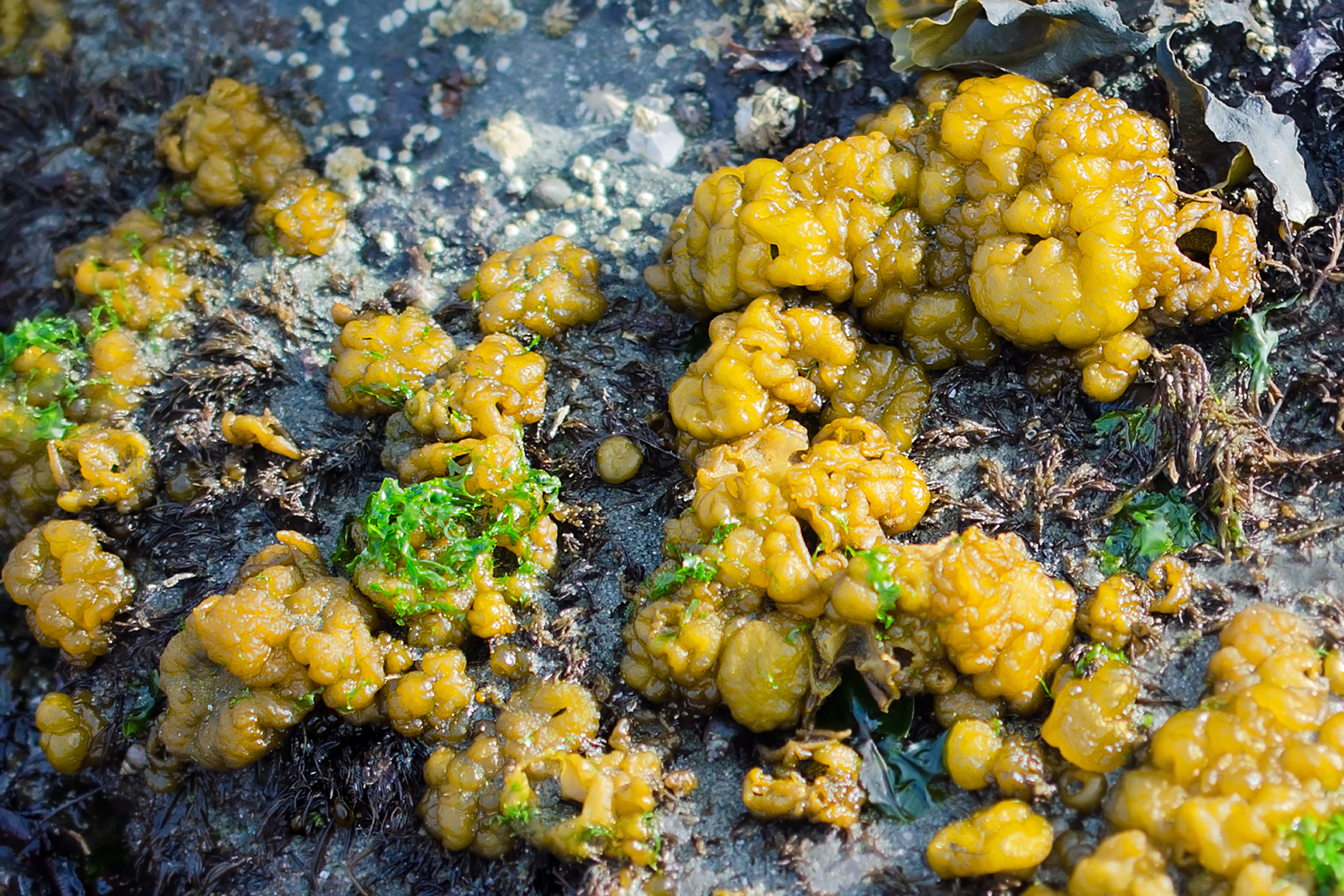
An assortment of seaweeds. Green sea lettuce, yellowish rockweed, one (or two?) of the many stringy, bushy brown algae. a blob of sea cauliflower, and tasty-looking succulent seaweed, Sarcodiotheca gaudichaudii. (I love that name!)

Sea cauliflower with a garnish of sea lettuce, accompanied by rockweed leaves and brown alga shreds.

Rocks and mounds of brown algae, crawling with hermits and crabs, isopods and snails. Good feeding grounds for a pair of mallards, now leaving their unfinished dinner in haste because of that pesky photographer. (They came back as soon as I walked away.)


Thursday, March 12, 2015

Salad greens

Miniature sea lettuce, with salt water dressing. What could be more delicious?

The hermits polished off this patch overnight.


Powered By Blogger