Showing posts with label seaweed. Show all posts

Thursday, April 24, 2025

Seaweed bouquet

I went to Brown's Bay to see what was growing under the marina this spring. This apparent impressionist painting is a community of seaweeds has settled on an underwater pipe, swaying in the current.

Red algae, green sea lettuce, mussel "teeth", and white anemones.

Did you find the mussel "teeth"? Look near the top. They're actually the scalloped edge of the fleshy mantle.

More underwater photos tomorrow.

~~~~~~~~~

Fui a Brown's Bay para ver que está creciendo debajo de los flotadores de la marina esta primavera. Esta foto, que se parece a una pintura impressionista,  en realidad muestra una comunidad de algas marinas que se han adherido a un tubo bajo el agua en movimiento. Se ven aquí algas rojas, algas verdes "lechuga marina", "dientes" de un mejillón, y algunas anémonas blancas.

¿Encontraste los "dientes" del mejillón? Busca cerca del borde superior de la foto. Son los bordes ondulados del manto del animal.

Anémonas y más, mañana.

Saturday, April 19, 2025

North Island spring

It was a beautiful day. I got out early and drove north and north and north, seeing the bright spring colours; all those green glowing lights on the winter's bare branches. The pink catkins of the alders have been eclipsed by the shiny neon-green leaves; the maples have hung out their yellow-flowered racemes; new elderberry and salmonberry leaves brighten the edge of the forest. Snowy mountain peaks play peek-a-boo behind the lower hills, seeming to advance and retreat as the road winds, following the rivers in the valleys.

Down a gravel road, off the main highway, at every turn several robins fly off into the bush to wait until I'm out of sight again.  A squirrel dashes across the road; something chitters at me when I roll down the windows. Where the road ends, in Zeballos, the robins are joined by swallows and crows, maybe a raven.

I turn and head home again, stopping here and there to look at rocks or chase butterflies. Or to balance over a steep bank to look at green, roaring water.

Gravel road. The peaks are in the Haihte range.

Heading west.

Warm day, with ice.

End of the road. Looking back at Zeballos town from the pier.

Really the end of the road. Rock underwater, from the pier.

Double falls, near Fault Creek bridge.

Long view just above the falls, where blue water turns green.

Just a creek, any creek. The road runs alongside.

Next: I stop to look at rocks.

A Skywatch post.
~~~~~~~~~~~~~~~~

Era un dia hermosa. Salí del pueblo en la mañana y me dirigí al norte, más al norte, siempre hacia el norte, mirando los colores vibrantes de la primavera; todas esas lucecitas verdes, resplandescientes sobre las ramas desnudas del invierno. Las candelillas color de rosa de los alisos han dado lugar a las nuevas hojas, verdes neón; de las ramas de los arces cuelgan rácimos de flores amarillas; nuevas hojas de  saúco rojo y salmonberry alegran los bordes del bosque. Cumbres de montañas nevadas juegan a "ahora me ves, ahora no" tras los cerros más bajos, parecen avanzar y retroceder con las curvas del camino, siguiendo los rios a sus pies.

Saliendo de la carretera principal, siguiendo un camino de grava, en cada vuelta varios petirrojos se levantan y van a esconderse entre los arbustos. Una ardilla corre, cruzando mi camino; algo en el bosque está haciendo comentarios cuando bajo la ventana. Donde termina la ruta, en Zeballos, golondrinas y cuervos vuelan, mirando desde arriba a los petirrojos picando la tierra en busca de lombrices.

Finalmente, doy la vuelta y tomo el camino a casa, pero deteniéndome frecuentemente para observar unas rocas o tratar de sacar fotos de mariposas. O para balancearme encima de una roca para mirar aguas verdes, violentas, allá abajo.

  1. Camino de grava. Las montañas pertenecen al grupo Haihte.
  2. Dirigiéndome hacia el oeste.
  3. Un dia caluroso, pero con vistas de hielo.
  4. Donde termina la ruta, en el muelle de Zeballos. Miro hacia atrás, hacia el pueblo.
  5. De veras el final del camino. Una roca debajo del muelle.
  6. Una catarata doble. Cerca del puente Fault Creek.
  7. Extendiéndo la vista más allá del puente, donde el agua azul se torna verde.
  8. Un riachuelo cualquiera. El camino se ve a la izquierda.
Mañana; me detengo para mirar unas rocas.

Un post de Skywatch.

Thursday, June 06, 2024

Baikie Island, un-islanded

The water was lower than I've ever seen it at Baikie Island last week. Under the bridge, the stones were dry; the north arm of the slough held a few small puddles at the far end. At the tip of the island, reaching out towards the main arm of the river, I walked dry-shod across a usually inaccessible creek. Here, the low water exposed seaweeds, just under the surface, normally completely hidden.

Unidentified seaweeds.

These don't look like any of the seaweeds I'm familiar with, the ones on our salt chuck shores. But then, this area is half salt, half fresh water, changing twice daily with the tides. The mud here was too soft for me to dare to wade in to collect a specimen.

The white specks on top are floating willow or cottonwood fluff; I'm not sure about the beige patches.

Playing around on Google maps, I found this view of Baikie Island. 

And last week, most of the water on the left was gone. The seaweeds are in that notch in the tip of the "leaf".

~~~~~~~~~~~~~~~~
En la isla Baikie, casi no había agua cuando estuve allí la semana pasada. Bajo el puente que da a la isla, solamente había piedras secas. En el pantano al norte de la isla, unos charquitos eran todo lo que quedaba del agua. En el extremo de la isla, donde llega a la corriente del rio, pude cruzar lo que normalmente es un riachuelo, ahora sin ni siquiera humedecer los zapatos. Y al final encontré, todavía bajo la superficie del agua, estas algas marinas.

Foto: Tres niveles. Bajo la superficie; las algas. Las cosas flotantes son el "algodón" de los sauces o de los álamos. Y las manchas cafés, no sé que serán.

Estas algas no se parecen a ninguna de las algas familiares de nuestras costas marinas. Pero aquí, el agua varía diariamente entre agua salada y agua fresca, al subir y bajar la marea. No pude tomar una muestra por el lodo; puede ser peligroso.

En Google, encontré esta foto de la isla, mostrando el agua que rodea la isla. La semana pasada, desde el puente y todo el lado a la izquerda era tierra seca. (¿Se podría decir, entonces, que la isla no era una isla en ese momento?)


Tuesday, January 02, 2024

And Part 3: Things that made me happy in 2023

The cat sleeps on the shelf above my computer, a long roll of black fur. From time to time she dangles her tail down in front of my screen and waves it about: a message, "Hey, I'm here, I'm important."

Something to start off my list of things that make me happy in 2024. But first, here's the final installment of the 2023 list.

Moss on old stumps. This one was just a few days ago.

Bull's eye lichen on rocks. Freezing cold, baking hot: they don't care. November, Tyee Spit.

Lazy creeks in dappled sunlight. With rocks. October.

Sunshine highlighting a mass of tossed-up, torn seaweeds. December, Black Creek.

I like explanatory trail signs. This one made me particularly happy. Seen in September.

The sign explains the work being done on the slope above the river and Elk Falls. This had been a paved entrance to the area; now it is being restored as natural habitat. Legend:
  • Step 1: Removal of paved surfaces. 
  • Step 2: ... "Rough and Loose" the soil. 
  • Step 3: Improve future soil quality ... 
  • Step 4: Add trails to provide a safe path for visitors to explore the old-growth forest. 
  • Final phase: Plant over 1700 native plants. (Sword ferns, Vanilla-leaf, Red huckleberry) 
  • For the Future: This restoration will be monitored for years to come. Invasive species (we're looking at you, Himalayan blackberry!) will be removed and supplementary native plants will be planted as needed to maintain healthy growth of this ecosystem.

Distant blue peaks. November, Upper Campbell Lake

An abandoned clamshell on the sand. I like the shaped hinge. December, Black Creek.

And today we had 8 hours and almost 11 whole minutes of daylight, 7 extra minutes since the solstice. That makes me happy, too.

~~~~~~~~~~~~~~
La gatita duerme en el estante detrás de mi computadora, formando un largo taco cubierto de pelo negro. De vez en cuando deja caer su cola en frente de mi pantalla, agitándola como para decirme — Mírame, estoy aquí, soy importante. — Una cosa para empezar mi lista de cosas que me harán feliz en 2024.

Pero primero, este es el episodio final de "cosas que me hicieron feliz en 2023".

  1. Musgos sobre madera vieja. Esta foto es de apenas hace pocos dias.
  2. Liquen Placopsis sp., creciendo sobre una roca en Tyee Spit. Si se congela, si el sol le quema, no le importa. Noviembre.
  3. Un riachuelo tranquilo con el sol filtrado entre los árboles. Y con rocas. Octubre.
  4. El sol alumbra una masa de hierbas marinas rotas y tumbadas en la playa. Diciembre, Black Creek.
  5. Me gustan los letreros que ponen al lado de caminos en el bosque. Este, en particular, me alegró. Describe la obra que llevan a cabo en la ladera que baja al rio. Esta zona tenía un camino pavimentado; cuando la ví, en septiembre, ya no había pavimiento. El texto dice: Primer paso: quitar el pavimiento. Segundo: Revolver y Aflojar la tierra. Tercero: Mejorar la tierra. Cuarto: Construir senderos seguros para los visitantes que vienen a explorar el bosque viejo. La Fase Final: Sembrar más de 17.000 plantas indígenas. (Helecho de hoja perenne, Hoja de Vainilla, Arándano Rojo) Y En el Futuro: La restoración será supervisado en años venideros. Las especies invasoras (Mora de Himalaya, te vemos) serán eliminadas y nuevas plantas nativas se sembrarán cuando sea necesario para mantener la salud de este ecosistema.
  6. Cerros azules en la distancia. Noviembre, Lago Upper Campbell.
  7. La concha de una almeja, abandonada en la arena. Me gustó la forma de la articulación. Diciembre.
Y hoy, el dia fue de 8 horas con casi 11 minutos, 7 minutos más que los del dia del solsticio. Esto también me alegra.


Tuesday, September 20, 2022

Floaters

This was on a shore north of Oyster Bay; the usual; rocks and sea lettuce, sea and sky. And, coming in to shore, a crowd of floaters. Logs, scraps of wood, seaweed (mainly rockweed), sticks and old leaves. And a lonely gull.

Oyster Bay, centre to right.

I wonder: sometimes the water is clear, with maybe one or two distant logs. During spring storms, the waves carry big logs, sweeping them off one shore to deposit on the next. High tides in the fall bring in masses of kelp and eelgrass to build mounds along the top of the intertidal zone. And sometimes, there's all this smaller debris. Why? Where does it come from?

~~~~~~~~~~~~~~~~~~~~~~~~~~
Esta foto muestra la costa al norte de Oyster Bay. Tiene lo de siempre: piedras y algas marinas (en este caso, lechuga de mar, Ulva spp.), mar y cielo. Y aquí, camino a la playa, una multitud de cosas flotantes. Troncones, fragmentos de madera, algas marinas (Sargasso vejigoso por la mayor parte), palitos y hojas viejas. Y una gaviota solitaria.

Me hace pensar. A veces el agua está limpia, no trae nada más que uno que otro troncón en la distancia. Durante las tempestades de primavera, las olas llevan troncos grandes, barriéndolos de una playa para depositarlos en la próxima. Las mareas altas de otoño cargan gran número de quelpos y hierba marina Zostera, que apilan a lo largo de la playa. Y a veces, nos llega toda esta basurita. ¿Porqué será?  ¿De dónde viene?


Thursday, June 23, 2022

Algae and not

Tide-pooling in the lower intertidal zone; the seaweeds, and seaweed look-alikes:
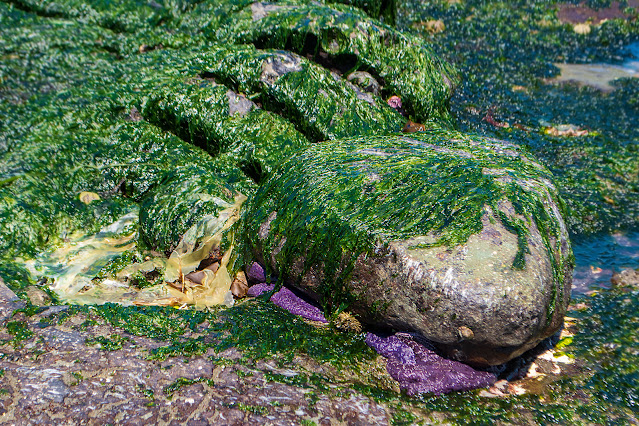
Masses of sea lettuce, Ulva spp., and faded kelp fronds.

In the upper intertidal zone, I find both of these, the sea lettuce and the kelp, but in pieces, washed up by the waves. Here, the sea lettuce is firmly attached to the rocks. It looks fragile, but pulling on a few blades, I find that not only do they not come loose, they don't break, either.
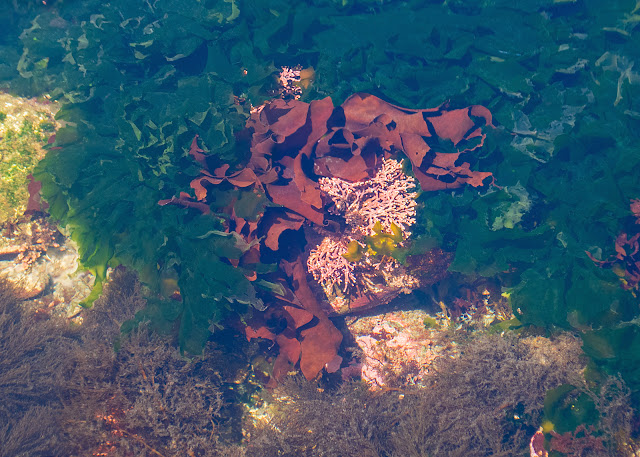
More sea lettuce, a red bladed alga, some brownish, feathery seaweeds, and I think those are pink branching hydrocorals.

The sea lettuce in the first photo had thin, long blades. This species has wide blades.

There are coralline look-alikes; coral leaf seaweeds, which are algae; the hydrocorals are animals. These have pink branches and whitish tips to each branch.

More of the same. With a purplish green sea urchin.

And another feathery brown algae. With sea lettuce, rockweed, bladed red algae. And a hermit crab.

At the very bottom of the exposed intertidal zone, assorted encrusting species.

It's hard to tell what these are. The pink and yellow bands are probably encrusting sponges. And then again, some could be encrusting bryozoans. The deep red could be more sponges, but Turkish washcloth, a seaweed, also has an encrusting phase. To be sure, you'd have to take a sample and examine it microscopically.

Identification is fun, but it's also a delight just to enjoy the patterns and colours, exposed here, oh, so briefly.

~~~~~~~~~~~~~~~~~~~~~~~~
Explorando en la zona intramareal más baja; algunas algas y cosas que se les parecen.

Foto #1: Grandes cantidades de lechuga marina, Ulva spp., y hojas de kelp, ya blanqueadas por el sol. En la zona intramareal alta, encuentro estos dos, pero en trozos, arrancados y aventados a la playa por las olas. Aquí, la lechuga de mar está bien fija en la roca. Parecen tan frágiles, pero si trato de quitar un manojo de la roca, no solo me resiste, pero ni se rompen las hojas.

Foto #2: Más lechuga de mar, pero de una especie diferente, una alga roja de hojas anchas, algas como pequeños arbustos, y hydrocorales color de rosa (también se conocen como corales falsos). La lechuga de mar en la primera foto tenía hojas largas y delgadas; la de esta foto tiene hojas anchas.

Hay algas que se parecen a estos hydrocorales. Pero los hydrocorales son animales. Tienen las ramas de varios colores y las puntas de las ramas son blancas.

Foto #3: Más de lo mismo. Con un erizo de mar verde, color violeta.

Foto #4: Otra alga en forma de arbusto. Con lechuga de mar, Fucus spp., otra alga roja de hojas anchas, y un cangrejito ermitaño.

Foto #5: En la parte más baja de la zona intramareal expuesta ese dia, una variedad de especies encrustantes.

Es difícil acertar a que especie estos pertenecen. Las manchas color de rosa y amarillas puede ser que sean esponjas encrustantes. Pero es posible que algunas sean briozoos. Las areas color de rojo fuerte también pueden ser esponjas. Pero hay un alga roja, la toallita turca, que tiene una fase encrustante. Para identificar alguno de estos con confianza, habría que tomar una muestra y examinarla bajo una lente fuerte o incluso un microscopio.

Es divertido tratar de indentificar estas cosas, pero también es un placer solamente mirar los diseños y los colores, que fueron expuestos aquí a la luz, por tan poco tiempo.


Thursday, October 01, 2020

Black waters

Ma Nature is a messy housekeeper. Breaks things, drops them wherever, never picks up after herself.

Last week we had a smallish storm, with wind and rain. Nothing unusual for this time of year. However, I was down on the shore as soon as the worst was over to see what it had done.

Stories Beach looking south.

The waves had tossed up a long, deep mound of torn and broken seaweed and eelgrass. In one spot there was a knot of bull kelp all tied together, too heavy to budge and too tangled even to liberate one stipe.

As the waves, even tamed as they now were, approached the shore, they picked up more shreds of green stuff and a lot of black ooze.

Bringing in more goodies.

Look at that last wave, on the left. All that last roll was black. The white foam is a dirty yellow.

The mound of torn seaweeds stretches all along the shore along this beach. In spots it is up to a foot or more deep, and several metres wide. Where does it all go? Ma Nature isn't going to pick it up.

With time, it dries out, on top first, and turns a dark, dingy brown. If I step on it, trying to reach the sand lower down, my foot sinks; it squelches. It doesn't smell too good, either.

It doesn't look pretty, but turn over a handful, and a cloud of beachhoppers, small flies, and maybe a wasp or two rise into the air. They've been gorging themselves on rotting seaweed. And the pile has retained enough moisture to protect any small organisms until they work their way down into the sand beneath.

Eventually, it all dries up and blows up to the top of the tide line, and beyond, to fertilize the shore plants.

Trough between the last two waves.

Look at the difference in colour of the waves. Somewhere beneath the gull, the water is shallow enough to scour the sand and carry the mud inshore.

Come to think of it, Ma Nature is doing a pretty good job of cleaning the beach, after all.

~~~~~~~~~~~~~~~~~~~~

La Madre Naturaleza no es una ama de casa dedicada a la limpieza. Rompe cosas, las deja caer donde sea, no se preocupa si ahí se quedan.

La semana pasada hubo una tempestad, no muy fuerte; viento y lluvia, lo normal para esta temporada del año. Cuando se amainó el viento, fui a la playa para ver como había quedado.

Las olas habían aventado montones de algas y hierbas marinas, todas rotas en fragmentos pequeños, a lo largo de la costa. En algunos sitios, está más de un pie de hondo, y varios metros de lo ancho. Había un nudo grande de kelp mayor, todo enredado, tan pesado que no lo pude mover, tan amarrado que no pude liberar ni un tallo del kelp. 

Las olas, al acercarse a la costa, levantaban aún más materia vegetal, y además una buena cantidad de lodo: las olas se volvían negras, la espuma estaba amarilla, un amarillo sucio.

Y ahora, ¿qué le pasa? Mamá Naturaleza no más lo deja allí.

Con el tiempo. se seca, empezando por la parte superior. Se vuelve un color café oscuro, color de lodo. Si lo quiero cruzar para llegar a la arena de la playa, y planto el pie encima, mi zapato se hunde. Y chapotea. No huele tan bien, tampoco.

Pero agarro un puñado de esa masa podrida, y saltan al aire una nube de pulgas de playa, o sea anfípodos que viven arriba de la zona de la marea, muchas moscas chicas, y una que otra avispa, que se han estado comiendo, como glotones, las algas pudrientas. Y mientras, el montón retiene suficiente humedad para permitir a los animalitos atrapados abrirse camino hacia la arena debajo de todo.

Fíjate en el color de la última ola. Se ha levantado los fragmentos de plantas, y también el lodo, lo que la vuelve negra. Todo eso, lo va a depositar en lo más alto de la zona intermareal. Desde allí, cuando ya esté bien seco, se lo lleva el viento para fertilizar a las plantas que bordean la costa.

Ya que lo pienso bien, parece que Mamá Naturaleza si sabe lo que hace.


Wednesday, March 27, 2019

Empty shore?

It looks bare, but it's full of life.

Gulls, rocks, worms, rockweed. And mist.

But the sand is full of worms, and their hopeful feeding tubes.

Walking over this "bare" sand, every few steps, I get sprayed by an invisible resident just under the surface, reacting to the vibration of my steps and retreating quickly to a deeper level.

The stony end of the beach, colour-coded.

The bright green areas are sandstone with maybe half an inch of green algae on top. Brown areas have about an inch of another seaweed; brownish green is rockweed, maybe two inches deep. And the tan areas are sandstone, the only safe place to put down a foot.

The green algae are as slippery as wet ice; the brown algae is worse; it's like wet ice with a coating of slush on top. Rocks roll; they're just loosely scattered on the sandstone. Stepping a bit more confidently on a patch of rockweed - silly me! - I slipped and ended up sitting in a hollow in the rock, which luckily halted my fall before I twisted anything major.

It's not a human-friendly location. But there are tiny fish in every pool, crabs under the rocks, barnacles and limpets and tiny snails everywhere.

Limpet and barnacle community on the sheltered side of a rock.

The underside of the rocks are bursting with life. Here, a large striped whelk, with a little periwinkle on its tip, a dead clam wearing a pair of limpets, assorted seaweeds, barnacles, and everywhere you look closely, more periwinkles. If you look inside that empty clamshell, you may find a surprising assortment of critters; hermits, crabs, worms, amphipods, limpets, you name it. On the deep underside of the rocks, a few starfish cling, and plumose anemones dangle loosely, waiting for the water to return.

Around the drier rocks, a swarm of tiny flies flitted and danced, almost never stopping. (How do they eat, if they never stand still?) Whenever I stopped to look at anything, the flies moved over to circle my head, tickling a bit, but never landing.

I tried to find one stopped to get a better look, but finally gave up and shot several dozen photos of a spot where they were congregating. I caught two of them:

Long legs and it seems that the wings are striped, or spotted.

And maybe a striped abdomen as well.

I don't know what they are. Nor where they go when the tide comes in. Do they sleep on the bare rocks of the breakwater until the water leaves again?


Monday, April 09, 2018

Feather

And red algae.

On rock, liberally fertilized with gull guano.

(I wish the gulls would let me get this close.)

Tuesday, September 19, 2017

Another red alga

This one washed up on the shore of Tyee Spit at high tide.

Single blade with ruffled edges. I'm holding it by a short stipe.

Saturday, April 29, 2017

Beach contrasts

Stories beach at low tide is a wide, sandy stretch, perfect for walking, making sand castles, sunbathing, watching the sky ...

Looking northwest, to the coast mountains.

But this afternoon, I turned south, to the seaweedy, slippery, treacherous rocks. That's where the critters live.

Long dikes mini-hogbacks* of sculpted sandstone, interspersed with fields of melon-sized rocks.

Correction sent to me via Messenger from a geologist friend:

Geologically, the sandstone ledges are strata, not dikes, which would crosscut the layers (by definition), and are usually igneous. Because the sandstone layers are at an angle, they could be called mini-hogbacks or cuestas.

Thanks, Jenny!

That green sea lettuce is slippery. I fell once, in spite of extreme caution. But every stone hides a new community.

Sometimes the rocks seem to have been tossed randomly on a flat sandstone table. By giants.

The sandstone mini-hogbacks hold tidepools well above the low tide level. And there are fish in the pools.

Just out of reach, two harlequin duck couples stand watching me.

And yes, there were critters, new and old. And a few mysteries. That's for tomorrow.

A Skywatch post.


Friday, October 07, 2016

Gaudy noodles

I've been collecting water and goodies for my aquarium all summer from a peaceful beach; a barricade of logs, a bit of gravel, a stony strip, and acres of sand in a protected bay. The water is clear, the wading easy. And the top of the rising tide brings in fresh sea lettuce and eelgrass, salad and exercise equipment for my critters combined.

Now, as the sunlight fades and the storms increase, the offerings cast up on shore have changed. Turkish towel and kelp lose their grip and are swept inland, along with rockweed bladders and sheets of red algae. I'm finding oyster shells, picked clean, and crushed crab carapaces; in the summer, these would have washed ashore whole.

A couple of days ago, the waves brought in a generous helping of red noodles.

Red noodle salad on a carved bark plate.

Succulent seaweed, Sarcodiotheca gaudichaudii. (Love that name!) As found.

Also in this photo: eelgrass strips, sea lettuce, rockweed, red algae sheets, Turkish towel, a curly-edged purplish kelp, and a branched, brown seaweed.

I brought home a handful, cleaned it, and floated it in a white tray for a better look.

Still looks good enough to eat.

Detail of knobby section of plant. Reproductive structures, maybe?

They say it's edible, but my hermits looked it over briefly and turned up their collective noses at it. So I didn't try it, either.

Saturday, October 24, 2015

Pink, fading to white

I picked up a small handful of "fake" coral on the beach. It grows lower down in the intertidal zone, and only fragments are tossed up by the tide, then, since they are fragile, they crumble to powdery chalk quickly. Half of my handful disintegrated on the way home, but a few branches survived.

Coralline algae, in water. The green stuff is green algae, growing on the branches.

These look like coral, but are actually a seaweed, one of the red algae. They collect calcium carbonate from the seawater, and incorporate it into their cells, where it becomes almost an exterior "shell". This seems to serve to protect them from algae eaters, from snails to crabs and hermits.

 Only a few species of mollusk, such as the whitecap limpet or the lined chiton feed on coralline algae.  (From U. of Oregon)

It's a red algae, but the calcium whitens it, turning it pink while it's alive. As it dies, the colour bleaches out until only the white chalk remains.

Dry, on a little ceramic plate. The pink is already fading.

Tuesday, July 07, 2015

Pink hair

Occasionally, wading in the eelgrass beds, I see what looks like a swirl of delicate pink lace floating by; finery that, bought in a store, would have a label saying, "Handwash only, with care."

They're remarkably resilient; I caught a double handful, tossed it in my bag, threw a couple of heavy clamshells and a tangle of eelgrass on top, and hauled it from pillar to post around the beach. It made the trip home intact, with not a shred torn off.

Filamentous red algae, with mussels, snail, and at least one skeleton shrimp. Can you find it?

Collected fresh like this, before they've been tossed up on the beach and sun-dried, they're home to hundreds of small critters. Skeleton shrimp are usually the first I see, mostly because they keep dancing. Then there are tiny black dots that under the microscope turn out to be baby snails and mussels. And each thread of the lace is surrounded with fine hairs, and a swarm of zippy copepods, and in season, jiggling crab or hermit zoea, trying to dodge the skeleton shrimp.

And then there's the seaweed itself:

Dotted-line branches. With passengers.

Zooming in.

My Encyclopedia tells me that there are maybe 60 or more species of these filamentous red algae along our coast, usually under 6 inches long.

Most are difficult to identify without the aid of a microscope.

Filamentous algae are made up of rows of single cells, in some species forming long threads, in others, branching. Each cell has a double wall; the outer ring contains the pigment that gives it the red colouring, phycoerithrin, masking the clorophyll that converts sunlight to sugars.

These are large cells; think of those snails crawling up and down the threads; multi-celled critters, with a complex anatomy, each total smaller than one cell of the algae.


Powered By Blogger