I saw it first on Google Maps. A bare spot, looking like something left after the logging crews were done, but with a label: Sundew Bog. I looked it up;
This is the "Sundew Bog" near Strathcona Park Lodge on Vancouver Island. The lodge built a boardwalk years ago so you could walk out into the bog and explore the area. (Canadian Geographic Photoclub)
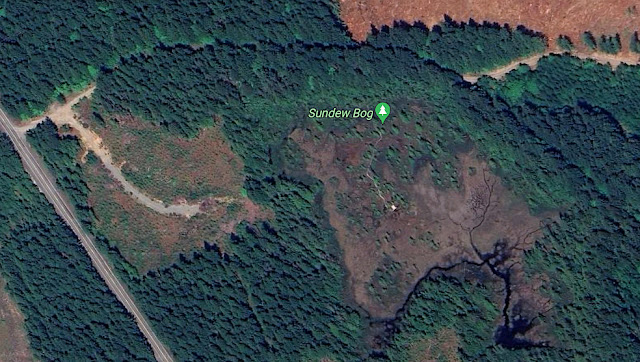 |
| Google satellite view, with the boardwalk ending in a viewing platform. |
It was raining at home, but the sun would be shining mid-island; I went looking for the bog. I wouldn't have found it if I hadn't first followed the highway in Google street view; the road in looks like any one of hundreds of logging roads, and the only sign said "GRH 900".
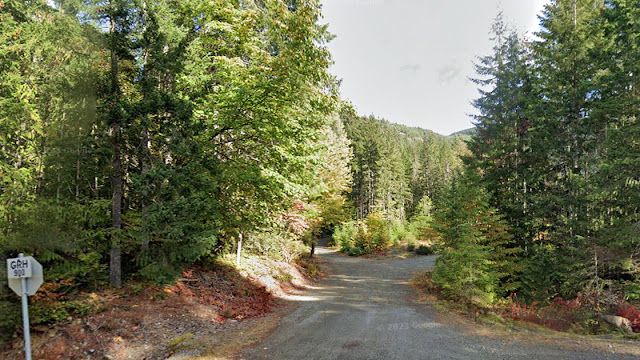 |
| More from Google; street view. The road to the bog goes to the left. |
The gravel road winds up into the forest. After dodging some impressive potholes, at a little distance from this road, I saw the sign:
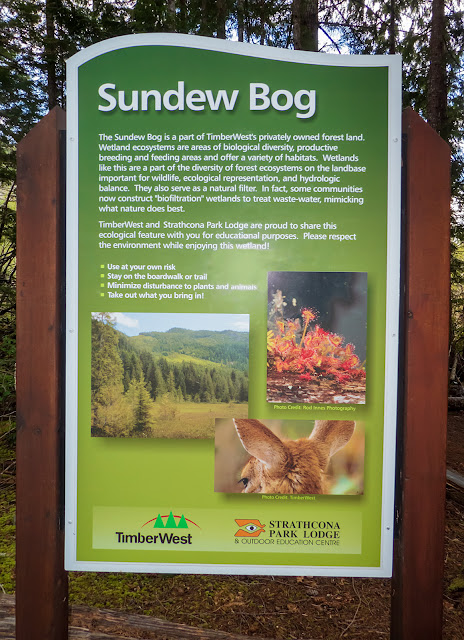 |
| Should have been out beside the highway. |
Partial text: "The Sundew Bog is a part of TimberWest's privately owned forest land. Wetland ecosystems are areas of biological diversity, productive breeding and feeding areas, and offer a variety of habitats."
A very skimpy trail through the trees led me to the beginning of a rustic boardwalk made of odd lengths of plank, some almost rotted through: walk carefully!
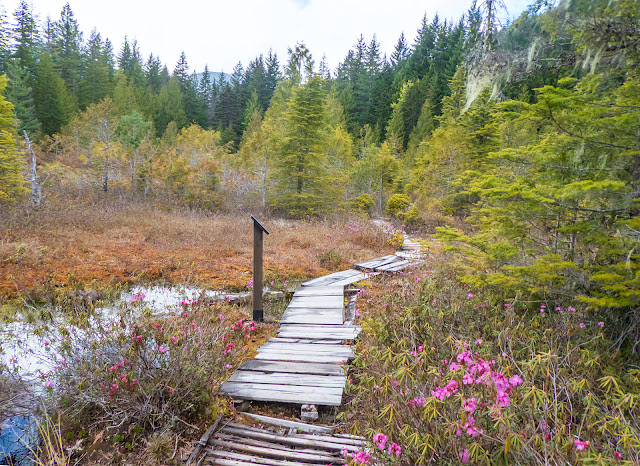 |
Brown mosses and Western bog-laurel grow with their roots in water.
|
There are signs at intervals beside the boardwalk; this one tells us what to look for here.
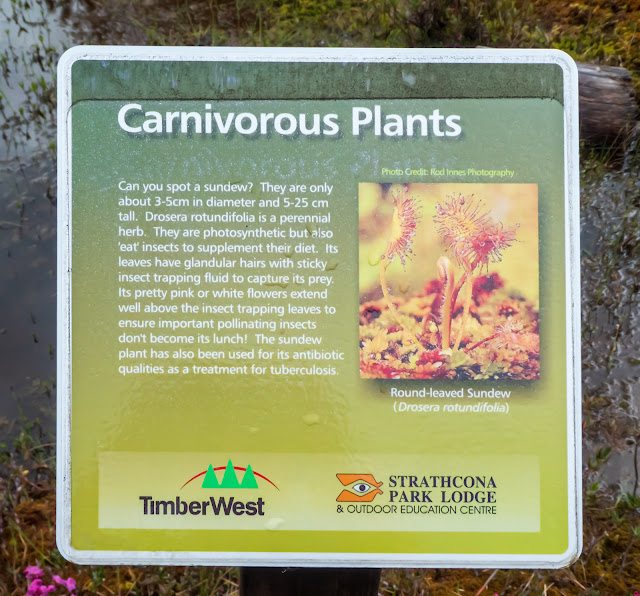 |
| Round-leaved Sundew info and photo. |
Text: Carnivorous Plants
Can you spot a sundew? They are only about 3-5cm. in diameter and 5-25 cm tall. Drosera rotundifolia is a perennial herb. They are photosynthetic but also "eat" insects to supplement their diet. Its leaves have glandular hairs with sticky insect-trapping fluid to capture its prey. Its pretty pink or white flowers extend well above the insect-trapping leaves to ensure important pollinating insects don't become its lunch! The sundew plant has also been used for its antibiotic qualities as a treatment for tuberculosis.
There were flowers, the bright pink bog-laurels, the white Indian plums, and at the edge of the forest, Red-osier dogwoods. The water table is just below the top of the mosses; every depression makes a shallow pond. It looks like frog country. And in the summer, dragonfly habitat.
But I didn't see any sundews. Back home, I looked them up; they flower from June to September. So I'll be back in June.
There was more, but I'll leave that for tomorrow.
~~~~~~~~~~~~
Lo vi por primera vez en las mapas de Google. Una zona desnuda, al aparecer otro de los sitios abandonados después de la tala de árboles, pero tenía un letrero: Ciénaga de Rocíos del Sol. Lo busqué en el internet:
Esta es la Ciénaga de Rocíos del Sol cerca de Strathcona Park Lodge en la isla de Vancouver. La hostería construyó un paseo de madera hace años para que pudieras entrar a la ciénaga y explorar el sitio. (Canadian Geographic Photoclub)
Fotos:
1. La vista por satélite en Google. Se ve el paseo de madera y una plataforma de observación.
En casa llovía, pero habría sol en el centro de la isla. Fui en búsqueda de la ciénaga. Pero no la habría encontrado si no hubiera seguido la carretera en Google "Street View"; el camino de entrada se parece a cualquiera de los caminos de los forasteros, y el único letrero dice: "GRH 900".
2. Google street view del sitio. El camino a la ciénaga es el a la izquierda.
El camino de grava sube al bosque. Después de unos baches y piedras alarmantes, vi este letrero dentro del bosque:
3. Texto: La Ciénaga de Rocíos del Sol es parte de los terrenos privados de TimberWest. Los ecosistemas de humedales son zonas de diversidad biológica, areas productivas para reproducción y alimentación, ofreciendo una variedad de hábitats.
Un senderito apenas visible entre el bosque me llevó al principio del paseo de madera; un paseo hecho con tablas de varios tamaños, algunos ya medio podridos; ¡hay que caminar con cuidado!
4. Y aquí está. Musgos color café y los arbustos de Kalmia microphylla crecen con las raices en el agua.
5. Hay letreros al lado del paseo. Este nos informa de lo que debemos estar buscando aquí:
Texto: Plantas Carnívoras ¿Puedes encontrar un rocío del sol? Miden solamente aproximadamente de 3 a 5 cm. de diámetro y de 5 a 25 cm. de altura. Drosera rotundifolia es una hierba perenne. Son fotosintéticas pero también "comen" insectos para complementar su dieta. Las hojas llevan tentáculos glandulares con secreciones pegajosas que atrapan los insectos que son su presa. Las flores bellas, blancas o color de rosa, se extienden bien por encima de las hojas atrapadoras de insectos para asegurar que los insectos importantes que llevan a cabo la obra de polinizarlas no llegan a convertirse en almuerzo. La planta rocío del sol también se ha usado a razón de sus calidades antibióticas, como un tratamiento para la tuberculosis.
Hay flores: Kalmia microphylla, con sus flores color de rosa intenso, las flores blancas de Oemleria cerasiformis, y al borde del bosque, de Cornus stolonifera. El agua llega hasta apenas bajo la superficie de los musgos; donde hay alguna depresión del terreno, se forma charcos. Parece sitio para ranas. Y en el verano, para las libélulas.
Pero no vi ningún rocío del sol. En casa de nuevo, regresé a Google: estas plantas florecen desde junio hasta septiembre. Así que regresaré en un par de meses.
Hay más, pero lo dejo para mañana.


