Showing posts with label upper intertidal zone. Show all posts

Sunday, April 30, 2023

Under a blue sky

 Just a rocky, sandy, seaweedy, barnacly, watery beach.

Stories Beach.

The water to the right is runoff from the land; rain and snow returning home. It's a centimetre deep, or maybe 2 in spots; usually not enough to reach into my shoes. Where it flows, the tidepools alternate twice daily from salt water to freshwater; a challenging environment for anemones and crabs and other beach residents.

~~~~~~~~~~~~~~~
Una playa con todo: arena, piedras, agua, bálanos, algas marinas verdes y rojas. Lo azul al lado derecho es agua que baja desde tierra firma; la lluvia y la nieve camino a casa. Apenas cubre uno o dos centímetros, no suficiente como para meterse dentro de mis zapatos. Donde fluye, los pozos intramareales cambian dos veces diarias entre agua salada y agua fresca. Es un ambiente con retos para las anémonas, los cangrejos, y los otros organismos que aquí viven.


Monday, April 09, 2018

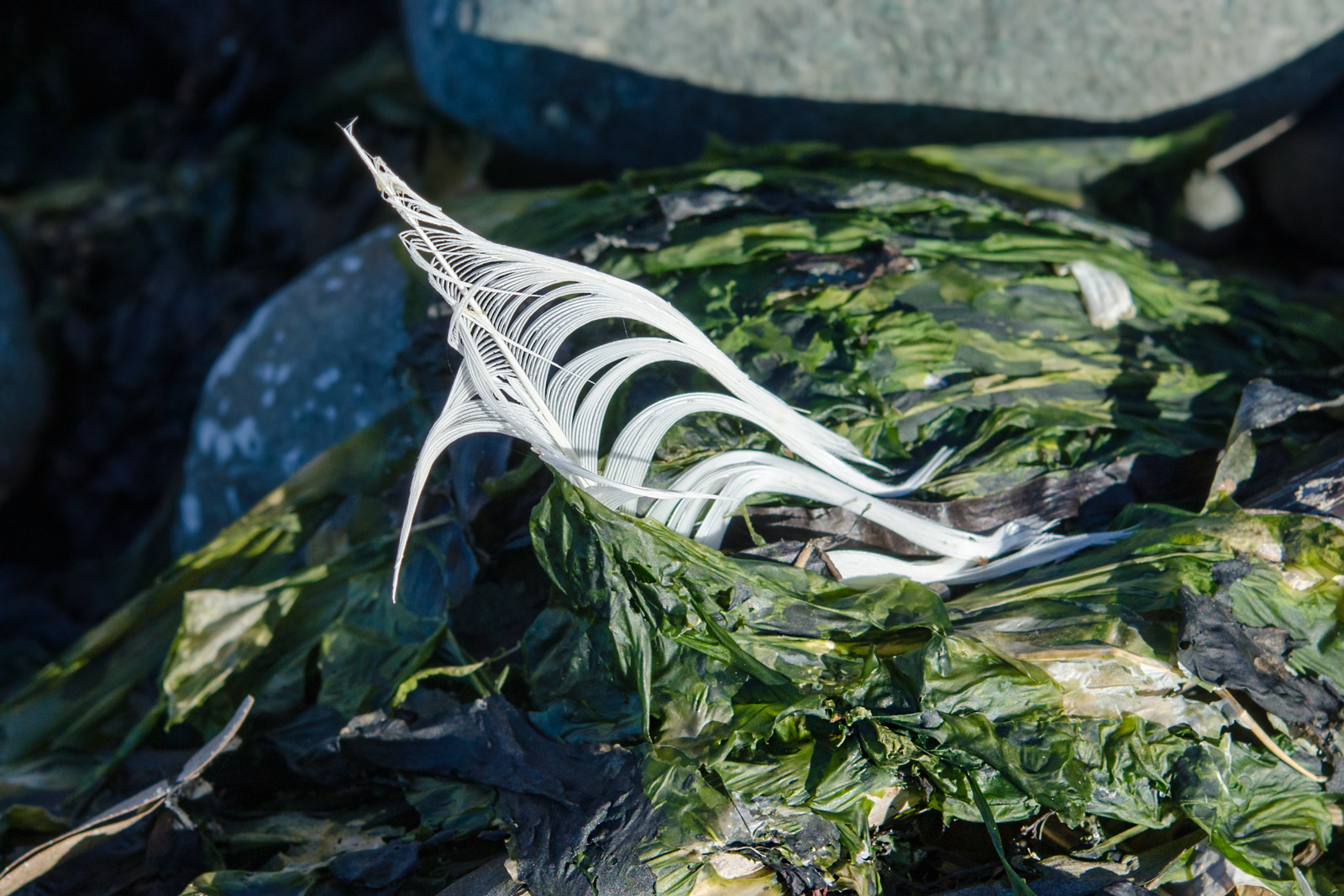
Feather

And red algae.

On rock, liberally fertilized with gull guano.

(I wish the gulls would let me get this close.)

Monday, October 09, 2017

On the upper, upper beach

When I arrive at a beach, at almost any beach along our coastline, I face a series of tasks before I reach the intertidal zone. First, I have to find a passageway through the weed barrier, often infested with blackberry and other difficult plants. Then follows a scramble or climb across driftwood logs piled higgledy-piggledy at the top of the winter storm reach. Then there are rocks, sometimes small and shifty, sometimes large.  And then, the rotting eelgrass/seaweed belt.

I dislike this blue-black strip, sometimes as wide as a street; it may be dry on top, but it could be up to a foot deep, and wet, with no indication to warn me of random deep spots. My feet sink, releasing a foul odor. Flies and sometimes wasps buzz around me; the wasps follow me until I reach bare stones again. And it stinks; did I say that? It stinks of rotting vegetation, and sometimes of unidentifiable putrid carcases. I may have stepped onto or into one.

I reach the stones, rolling underfoot, but at least dry and clean. Then there's a second, narrow, line of dead seaweeds and other detritus, the leftovers of the latest high tide. That's fine; it smells of sea; if it's wet and slippery, I can just step over it.

Finally, the beach. If the tide is low, I can start exploring.

Last visit, the rising tide forced me back to the stretch between the dead seaweed belts. And I found it full of interest.

Eagle feathers. Everywhere, there are feathers.

Probably a gull feather.

Another feather. There are always more feathers.

A scrap of red coralline seaweed.

Jingle shell. This clam look-alike, or "rock oyster" (but it's not an oyster, either) has a hole in the lower shell. Byssal threads grow through this opening to attach the mollusk to a rock.

The lower (jingle) shell is thin and shiny. Tied with other jingles, it makes a nice, jingly wind chime.

Purple shore crab molt. At this level of the intertidal zone, there are no live crabs to be found, but their leftovers are scattered everywhere.

Another one, a male.

Tunnels in a strip of bark.

More tunnels, in a small piece of driftwood.

Another feather. The pale seaweed has been sun-bleached before it dried.

Two feathers, and dried eelgrass, toasted to blue-black. Sea lettuce retains its green colour until it disintegrates.

Bedraggled feather, wrapped in dried sea lettuce.

A rocky fish.

And there's always, always styrofoam. I filled my bag with a fair collection of it, a plastic water bottle, and a beer can. At least, I get a refund on the beer can.

And sho' 'nuff, there was a rotting carcasse! In the next post.

Saturday, March 25, 2017

A wormy post

Marine biologists count some 67,290 species of sea worms. (I checked each wormy page on this site and added them up.) And with millions - trillions - of individuals of the more prolific species, no wonder I find worms everywhere I look!

These were waiting out the low tide in the shelter of loose rocks on the Tyee Spit shore.

Shiny, multicoloured polychaete

I find these in the sand underneath the rocks, rarely on a rock or stone. They are shy and quick; mostly, if I look first at the rock, then at the sand, all I see is the last few segments of the worm squirming down underground. The only way to get a photo is to hold the camera ready and aimed, then lift the rock.

Their mouths vary depending on their diet, since the group includes predators, herbivores, filter feeders, scavengers, and parasites. Most have a pair of jaws and a pharynx that can be quickly turned inside out, allowing the worm to grab food and pull it into the mouth. (MESA)

There are 12,000 species of polychaetes. My encyclopedia lists 44 more or less free-living polychaetes in the Pacific Northwest.

A Mud nemertean, Paranemertes peregrina, and something green in a long tube.

Paranemertes, aka the Wandering ribbon worm, or the Restless worm, is easy to identify. It's a long ribbon, up to 25 cm. long, with a purple back and a creamy belly, usually found wandering alone, searching for its dinner: other worms, even worms much larger than itself.

On contact with nereid prey, P. peregrina pulls its head back and everts its light-colored proboscis, which wraps around the prey.  The prey is soon paralyzed, ...  P. peregrina then swallows the nereid.  After feeding it follows its own slime trail back to its burrow.  It eats about one prey worm per day ... (WallaWalla.edu)

I can't identify the green worm in the long tube, other than to guess that it's another ribbon worm.

A typical squirm of green ribbon worms, Emplectonema gracile. And a lone, brown flatworm.

The green ribbon worms are gregarious; where you find one, there are probably several more entwined with it. It eats barnacles, mostly the small acorn barnacles, slithering into cracks or the open mouth of the barnacle, using a poisonous needle-like stylet* to paralyze its prey. (That isn't going anywhere, anyways, but you never know.)

The flatworm also eats barnacles, and is so thin and flexible that it seems sometimes to be simply a brownish coating on the barnacle it's attacking.

In this photo, I've been puzzling over a perfect circle in the bottom of an empty barnacle shell. (Just above the flatworm.) It looks like the edge of one of those finger cots that I use instead of bandaids. A short worm, maybe? A mini Ouroboros?

*Photo of the stylet, here, at the bottom of the page, Row 1, on the right.

Friday, October 07, 2016

Gaudy noodles

I've been collecting water and goodies for my aquarium all summer from a peaceful beach; a barricade of logs, a bit of gravel, a stony strip, and acres of sand in a protected bay. The water is clear, the wading easy. And the top of the rising tide brings in fresh sea lettuce and eelgrass, salad and exercise equipment for my critters combined.

Now, as the sunlight fades and the storms increase, the offerings cast up on shore have changed. Turkish towel and kelp lose their grip and are swept inland, along with rockweed bladders and sheets of red algae. I'm finding oyster shells, picked clean, and crushed crab carapaces; in the summer, these would have washed ashore whole.

A couple of days ago, the waves brought in a generous helping of red noodles.

Red noodle salad on a carved bark plate.

Succulent seaweed, Sarcodiotheca gaudichaudii. (Love that name!) As found.

Also in this photo: eelgrass strips, sea lettuce, rockweed, red algae sheets, Turkish towel, a curly-edged purplish kelp, and a branched, brown seaweed.

I brought home a handful, cleaned it, and floated it in a white tray for a better look.

Still looks good enough to eat.

Detail of knobby section of plant. Reproductive structures, maybe?

They say it's edible, but my hermits looked it over briefly and turned up their collective noses at it. So I didn't try it, either.

Saturday, June 04, 2016

Thursday, June 02, 2016

Name this hermit

Many of the beaches on the Campbell River coastline have a base of sandstone, with rocks and stones and glacial erratics scattered or piled on top. Lifting the rocks sometimes uncovers a hard, smooth, pavement-like surface. Crabs and small fish hide in the crevices in the sandstone; anemones drill small holes. But the rest of the beach fauna heads for softer spots, larger cracks, where they can burrow in comfort.

I removed a few rocks and scraped at the sandstone until I found a crack, then dug down. Not far; an inch or two, and I'd hit pavement again. I found three tiny clams and disturbed a swimmer, probably an isopod. Nothing more, except the snails, crabs, and hermits that don't mind hard floors.

When the water had cleared a bit, I took a few photos, hoping to find something too small to see there on the beach. But the camera found no worms, no soft critters, no sea urchins. Just one tiny hermit crab.

A hermit that I haven't been able to identify.

Hermit, as found. I've cleaned up the background a bit; the water was still full of debris. And I deleted garbage floating over the shell. But the hermit is untouched, except for lighting.

This hermit was in a shell about 1/4 inch long. He has greenish banded antennae, red/brown eye stalks, with a white vertical stripe, red "flags" with a white base. His pincers are dark, with whitish stripes. I think the white stripes on either side of his head are on his "shoulders". And the eyes seem to be patterned in a spiral or a double circle.

I've spent the evening searching for a match. The little greenmark hermit, often seen on these beaches, has red, unbanded antennae; the hairy has those green antennae, but he's a dull brown or green everywhere else, except for blue spots on his knees.  I've looked at every one in the BC E-Fauna gallery and read descriptions; none are like this guy.

Compare to a couple of typical small hermits from my tank:

A young hairy hermit, Pagurus hirsutiusculus. As he grows older (and much bigger than the hermit above), his colours will darken to olive green or dark brown. If he eats too much red algae, he might take on a pinkish glow. Never red. The eyes are oval, with a dark centre.  His "flags" (sensory antennules) have a hint of orange and blue at the tip. He does have the green or brown banded antennae.

These I've never been able to identify reliably. Pale, banded antennae, orange and white legs. A very small hermit. They may darken to black and white. Not red.

Does anyone recognize this? Is he just another colour morph of the hairy hermit, maybe?


Wednesday, June 01, 2016

By the billions

Barnacles. On some beaches, the rocks are covered with the critters. Sometimes they're like a dusting of sugar over the whole area; sometimes they're sprinkled on larger stones only. Sometimes they're a thick layer, half an inch or more deep, half eaten by gulls.

I'm always conscious, walking over these stones, of the myriads of tiny lives I'm crunching underfoot. I try to walk lightly, as if that makes any difference when you're a quarter of an inch tall and I'm an Alice in Wonderland mile high. I try to step mainly on smooth stones, when they're available. But I know my passage down the beach is marked by dead and dying crab food. (Sorry, little guys!)

Sitting on a mostly bare rock, watching a tide pool, waiting for the little leggy beasties to forget my shadow and come out of hiding, I turned the camera on the closest barnacle communities.

Barnacled rocks, upper intertidal zone, Rotary Beach.

Barnacles on a stick. Common acorn barnacles.

Barnacles on yellow goop*. Small, smaller, smallest.

Multi-generational community. Grandfather barnacles, one dead and gone. Medium- and junior-sized barnacles, pure white. And the newest youngsters, tiny brown ovals, settling in. (For an idea of the sizes, the snails are about a quarter of an inch long, or less.)

*goop. Technical term, meaning soft, unidentifiable stuff. Could be eggs, could be algae, could be sponge, could be seaweed. Could be a mix.


Tuesday, September 09, 2014

Reconsidering

A couple of years ago, faced with snail egg capsules and an infant snail found with them, I tentatively identified them (with help from commenters here) as one of the rock snails, aka murex snails or Muricidae. I thought they were probably Trophonopsis orpheus, or another of the trophons. These prey on barnacles or mussels and other bivalves, and seemed to match some barnacle-eaters I'd had previously in the aquarium.

The hatchling, only a few millimetres long.

There were problems with the id; some references called it a subtidal snail, living at depths up to 180 feet. But I had found these in the upper intertidal zone. In Marine Life of the Pacific Northwest, it was the only rock snail that matched the snails I found, but again, it was supposed to be subtidal.

So every time I find another of these, or mention them, I spend some time reviewing the websites and books, looking for a closer match, a snail that fits everything I'm seeing in my tank.

And now, having the egg cases at hand, and confirming that these snails do, in fact, lay these eggs, I think I've been mistaken; that they are no trophons, after all.

Look at these egg cases. (Copyrighted, so you'll have to go there to see them. Here's the page; scroll to the second species.)

Now look at these, from my tank.

Tillie's eggs. A good match.

These are from the Leafy Hornmouth, Ceratostoma foliatum. This is another Muricid (rock or murex snail) that lives in the intertidal zone, but almost all the photos I find are of the full-grown adults; in these, the ribs are prominent, "leafy". The younger ones are like those in my tank.

This is fairly common to find intertidally.  The juveniles exhibit crosshatch sculpturing.  The axial ribs grow to large flares as it matures.  The adults may be plain white to purplish and may be striped.  At the base of the aperture there is a projecting tooth.  It lays a distinctive egg case. (From PNWSC.)

The Wallawalla.edu page adds more details: the siphonal tube of the Leafy Hornmouth is closed along its length, opening again at the tip. And the foot is a mottled cream colour.

(The siphonal canal of Trophonopsis is open.)

This is the youngest one in my tank, still quite small. The siphonal canal is completely fused along its length. The tooth is only visible from this angle as a slightly whiter spot. The shell is white with purplish stripes.

Here's the tooth, looking from the side.

Tillie, laying her eggs. The siphonal canal is closed, the tooth is near the entrance to the canal, and the flesh is a mottled creamy colour.

Down at the beach this afternoon, just below the high tide line, I was turning over rocks, looking at flatworms and a variety of eggs and egg cases. On one stone, I found several clumps of freshly-laid egg cases to match the ones at home. And there were the snails; some laying eggs, some eating barnacles. I turned each one over. Every one had the closed siphonal canal and the tooth.

Snail on rock, stony section of upper intertidal zone, Boundary Bay.

One snail in my tank looks like these, (but cleaner) but is much smaller. And its siphonal canal is open. It has no tooth. It's the oddball. Or it's too young to have developed yet. We'll see.

But. There's always a but.

On the Wallawalla.edu page, I see this:
Depth Range:  Low intertidal zone and subtidal to 60 m.
Habitat:  Found on rocky faces near barnacles and bivalves.  Avoids sand and mud. Most common in areas of strong surf ...
So I'm still not totally convinced; maybe other snails have the same egg cases, the same tooth, and the closed canal. I want to see if Mike and Tillie and their companion develop those big leafy wings as they grow larger. I'll keep on studying the reference sites and books until then.

What do you think?


Saturday, May 10, 2014

Billions and billions

Boundary Bay was in a quiet mood when we dropped in a couple of days ago. The tide was partway out, and didn't seem to be either coming or going. Though the sunshine was bright, there was a chilly wind, and the beach was almost deserted. A couple of boats were tied high and dry on the sand. There were no paddle boarders, no dog walkers, barely even any birds. Sand, stones, seaweed, and water; that was all there was to see.

Looking back towards Burnaby. One wader.

It all depends on your perspective. That beach is crowded, almost to capacity. A few hundred people, a dozen dogs, some flocks of birds; what are they but a passing trick of the weather to the billions and billions of living creatures that call it home.

From our usual parking spot at the Beach Grove boat launch, we walked south, towards the US border. Underfoot, on the sand, snails and hermits were making tracks.

Popular resting spot.
The stones in this section, where the currents are not too strong, so that even the small pebbles don't roll around like they do on the White Rock beach, are all coated with barnacles. In more agitated waters,barnacle babies may settle on any surface, but they don't survive unless their new home stays put.

Sea lettuce, about two inches deep, so very green, a super-concentrated springtime yellow-green. In the background, barnacle-laden stones, and another boat launch, covered in green scum.

Near the border, a couple of old logs broke the monotony of sand and stones. A small city, divided into residential districts: on the outer surfaces, sea lettuce, barnacles and mussels; in the dark crevices, more mussels, dotted with tiny white barnacles, and teeming masses of hermits in mudsnail shells; underneath, where the water stays even at low tide, the mudsnails, tiny crabs, and amphipods.

Near the top of the larger log. Medium-sized barnacles, and polka-dotted blue mussels. The dots are tinier barnacles.

Smiling stump. The flash revealed a thick coating of critters in the rotted centre.

Back at the boat ramp, I sat on the clean cement to examine a nearby rock.

Small barnacles, tiny hermit crabs (3), 3 snails, patches of egg mass, species unidentified, a flatworm, and under and around it all tiny, pinhead barnacles. The babies that wouldn't survive rolling.

Another look at those hermits, barely visible peeking out of their little shells, periwinkle and nassa.

A flatworm. There were many on this rock. At the bottom, tar spot seaweed, and a green worm.

More tar spot seaweed, a flatworm family, and that two-toned worm. It's a green ribbon worm, Emplectonema gracile. It eats mainly barnacles.

About that tar spot seaweed. It is an encrusting phase of the pretty Turkish towel that I bring home for my hermit crabs to climb on. In this phase, it coats rocks, and looks like tar or black oil. In this stage it is producing spores. As a red blade, it produces gametes (sperm and eggs).

Mastocarpus papillatus is an interesting seaweed species with two distinct lifecycle phases.  It has a long-lived "tetrasporophyte" phase, which looks like a crust or dried tar spot on rocks, with colors ranging from reddish-brown to black.  Each year, a new "gametophyte" phase grows from the "tar spot", known in some areas as "Turkish washcloth". . . . The female plants are covered with papillae - short, bumpy or nipple-like outgrowths which are the sites of fertilization.  . . . The male gametophyte has no papillae, is yellowish to light pink or light rose, and has a thinner blade.  The spore producing tar spot phase of Mastocarpus papillatus is a slow growing, long lived perennial (one source estimates up to 90 years).  The female and male bladed gametophyte phase dies back every year leaving just the encrusting "tar spot".   . . .  It grows on rocks, it can undergo considerable desiccation, and can withstand high temperatures.
From Seaweed Industry Association.


Tuesday, September 24, 2013

Good news!

Two years ago, in November of 2011, polluted water from the White Rock beach killed my aquarium. A month later, we found a zone of the beach that was basically dead, too.
There were no crabs under any of the rocks I flipped. No hermit crabs. No snails. No limpets. No worms. A few of the higher intertidal amphipods that always swarm on the bottom of these rocks. Just a few.
I walked west, flipping a few more rocks after every couple of steps. Nothing was alive but the amphipods.
We've been back, off and on. The view is always beautiful, but so often, I flip stones and find nothing. With time, even the barnacles were all dead. The rocky west end stunk of a cannery in summer; a long-dead fishy odour. I was beginning to dread walking that direction.

Last week, we headed that way again. It had been a while. And the beach is back! It smells fresh and salty, as it should. I flipped rocks and disturbed whole communities of hermit crabs, hairies, grainy hands, and those little orange ones I can't identify. Shore crabs scuttled away to hide, or stood their ground, menacing me with their mighty half-inch pincers, according to their various personalities. Big eelgrass isopods slept on the bottoms of stones; polychaete worms burrowed into the sand away from the light. The stones were dotted with pinhead snails, probably periwinkles.

I collected a bit of eelgrass for my critters in the tank. Washing them off at home, I found tiny limpets. One blade held at least 10, plus a raft of spiral tubeworms.

And the barnacles and mussels are growing back.

Detail of a stone top.

And flatworms! I'd never seen so many at one time before. Every stone held a few; on some stones, every barnacle seemed to have a flatworm oozing around it.

I count 7 flatworms on this corner of a rock. I don't know if they're the same species or not. Since their bodies are semi-transparent, whatever they've been eating changes their colour and pattern.

Not all the ooze on that stone is flatworm. The more shapeless and patternless blobs seem to be some sort of sponge.

And I've never seen these anemones anywhere but near the American border on the Tsawwassen beach. I didn't see them when I took the photos, but at home, counting flatworms, I noticed quite a few. And two came home on three barnacly stones I brought to feed my one predatory snail.


Orange-striped anemones. Five here, plus one flatworm that I can see. This corner of the photo was blurry, and I've sharpened the anemones to make them stand out.

We walked quite a distance west from the end of the park. I flipped stones at intervals all the way. Every stone harboured a thriving community.

I am so relieved! Life on the edge is tougher than it looks.


Powered By Blogger