Showing posts with label purple shore crab. Show all posts

Wednesday, April 22, 2026

Courageous crab (and two not so brave).

The tide was low and the sun was shining. I went to the beach. There I met these three crabs.

Large red rock crab, Cancer productus. 

He was hiding, not moving, as far under a rock as he could jam himself. I touched his cheliped gently; he moved it a few millimetres. Alive, then. Watching me with one eye.

Mid-sized red rock crab.

This one saw me coming and ran away. Even though he was already well camouflaged with sand on his carapace and a piece of sea lettuce pasted to his back. Not taking any risks, though.

Tiny purple shore crab, Hemigrapsus nudus.

I never would have seen this little guy if he hadn't come up to challenge me. He held that pose while I approached, while I took his photo, while I walked away until I was out of sight. Valiant  little critter!

More intertidal finds tomorrow; it was a productive beach visit, and I'm still processing the photos.

~~~~~~~~~~~~~~~
La marea estaba bien baja y hacía sol. Fui a la playa, y allí encontré estos tres cangrejos.

    1. Un cangrejo rojo de roca, Cancer productus

Este cangrejo grande estaba escondido, sin moverse, a lo más que podía introducirse bajo una piedra. Toqué levemente un quelípedo y lo arrimó unos cuantos milímetros. Vivía, entonces. Y me miraba con un solo ojo.

    2. Otro cangrejo rojo de roca, este de tamaño mediano.

Este cangrejo me vió venir y se echó a correr. Eso, aunque ya estaba bien protegido, con arena sobre el carapacio y una hoja de alga marina en el trasero como camuflaje. ¡No iba a correr ningún riesgo, de todas maneras!

    3. Un cangrejito costero morado, Hemigrapsus nudus.

Nunca habría visto este cangrejito si no hubiera salido para retarme. Mantuvo esa postura mientras me acercaba, mientras le sacaba la foto, y hasta que me había alejado tanto que no lo podía ver. ¡Criatura valiente!

Mañana subo más criaturas de la zona intermareal; era una visita muy productiva, y todavía estoy procesando las fotos.


Sunday, March 08, 2026

Critter leftovers

I caught another low tide in daylight hours, without rain!, a couple of days ago. 

(I grumble at the poor scheduling of low tides all winter, as if there were someone in charge. But it's all in the numbers. We get one lowish tide every day, and one slight dip. And they come approximately 25 hours apart, so they always show up an hour later than the day before. Then remembering that we only get 8 hours of daylight in the winter, and you need 2 hours to get to the bottom of the intertidal zone and back before the water catches you, that leaves only one week every month available for exploring. And it's usually raining that week. Shouldn't grumble, then; the tide table people are doing the best they can. And anyhow, we're up to 11 hours in a day now. Summer's coming!)

Anyhow, I found some ex-critters at Oyster Bay.

Tunnels made by burrowing shipworms, Bankia setacea.

Not a worm, though; the "worm" is a clam. A long, worm-shaped clam with its shell carried in front of its mouth. It doesn't hide inside like "normal" clams; the shells are too tiny. Instead, it uses them to scrape away the wood, which it eats. As it goes along, it secretes shell material to line the walls of its tunnel; the white lines in the photo.

Anatomy of the shipworm. From Andrew Han, OHSU.

The shipworm log was on the dunes just above the tide line. Down on the beach, there were crabs. Or crab molts, anyhow.

Cheliped of a Dungeness crab. 

The well-worn shield of a kelp crab.

This was just at the top of the intertidal zone, where all the old seaweed mixes with dried vegetation from the land. In this spot, there were dozens of these kelp crab molts, all equally worn. Made me wonder; do they go in for group molts? Or is it a calendar thing?
Adult crab populations tend to molt simultaneously, females in the spring, males in the late summer.  (Oregon Coastal Crabbing Facebook post.)
So these were all females, it seems.

Long pincers of a female kelp crab.

And a solitary purple shore crab molt.
~~~~~~~~~~~~~

Otra vez pude visitar una playa anteayer.  La marea baja nos tocó durante el dia, y no llovía.¡Perfecto!

(Me quejo todo el invierno porque las mareas están mal programadas. Como si hubiera alguna persona encargada. Pero es cosa de números. Nos toca una marea baja por dia — la otra apenas baja un poquitito — y caen cada 25 horas, aproximadamente, cada una una hora más tarde que la del dia anterior. Y como los dias invernales son de apenas 8 horas, y se necesitan 2 horas si piensas ir hasta la orilla y regresar antes de que te agarre el agua, eso nos deja solamente una semana por mes para explorar en la playa. Y casi siempre está lloviendo esa semana. Pero es cosa de números, y no hay de que quejarme. Y además, ahora tenemos 11 horas de luz cada dia. ¡El verano está en camino!)

Bueno, encontré algunos animalitos en Oyster Bay. Sus huellas, por lo menos.

    1. Túneles en la madera hechos por un molusco bivalvo, Bankia setacea.

Aquí les damos el nombre de "gusano de barco". Pero no son gusanos, son almejas. Es una almeja extendida en forma de gusano que lleva su concha, muy pequeña, en frente de la boca. No se esconde adentro, como una  almeja "normal"; las conchas son minúsculas. Las usa, en cambio, para raspar la madera que le sirve de alimento. Mientras se adelanta, secreta sustancias para cubrir de concha las paredes de su túnel. Estas son las partes blancas en la foto.

    2. La anatomía de Bankia setacea. De Andrew Han, OHSU.

Este tronco estaba en las dunas en la zona alta intermareal. Más abajo, en la playa, había cangrejos. O por lo menos, las mudas de los cangrejos.
   
    3. Un quelípedo de un cangrejo Dungeness, Metacarcinus magister.
    
    4. El caparazón, muy desgastado, de un cangrejo quelpo, Pugettia producta.

Este estaba en la parte más alta de la zona intermareal, donde algas marinas viejas y secas se mezclan con hierbas de las dunas. En este sitio, había varias docenas de estas mudas de cangrejo quelpo, todas igualmente desgastadas. Me hizo preguntar; ¿es cosa que hacen estos cangrejos, mudarse en compañía? ¿O es algo que ver con la fecha?
Las poblaciones de cangrejos adultos acostumbran mudarse simultaneamente, las hembras en la primavera, y los machos al fin del verano.  (Oregon Coastal Crabbing Facebook post.)
Parece, entonces, que todas estas eran hembras.

5. Quelípodos largos de un cangrejo quelpo, hembra.

6. Y la muda de un cangrejito morado solitario, Hemigrapsus nudus.

Wednesday, July 03, 2024

That kind of day

It all started back at the highway, when I saw the Rock Bay sign and said, "Why not?" And now the road had led me to another sign: arrows pointing ahead, behind, and one down the hill into the bush. "Little Bear Bay," it read. Why not? It was that kind of day.

The last time I was here, that bit of road was nerve-wracking. A steep hill, a bumpy track coated with slippery mud, no room for evasive manoeuvres. But again, why not? At least now, everything was dry. And it wasn't bad at all; only once did the car slide a bit. And there was the bay. And a rocky beach, at low tide.

Rocks, rocks, rocks. And on and around those rocks, feisty little rock-dwellers. And besides, rocks that looked alive. More or less.

Limpets and barnacles.

Several of the limpets were slightly lifted off the rock, as if they heard (smelled, felt?) the tide coming in and were preparing to start looking for lunch. When I touched them, lightly, they clamped themselves down to the stone again.

One of the almost-alive rocks. He's been sitting on the shore so long, a tree is growing out of his shoulder. A Vancouver Island sphinx?

Gotcha!

Crabs and snails.

These are purple shore crabs. These ones are not so very purple, but the species is recognizable by the purplish dots on their pincers and legs. And by the smooth upper legs. The green shore crab, Hemigrapsus oregonensis, is a look-alike, but they have hairy legs, which aid in swimming. The purples have only a few hairs near the tips of the legs, hence their Latin name, H. nudus: nude.

This little guy saw me and immediately challenged me to a duel.

The snail is a checkered periwinkle, Littorina succulata. He's a bit far down the beach for his species; they drown if they're in water too long. He'll probably hurry up to the shore as soon as the tide reaches him. Marine snails can travel faster than land snails; he'll make it in time.

Next: dessert in the bush.

~~~~~~~~~~~~~~~
Todo empezó allá en la carretera, cuando vi la salida hacia Rock Bay y me dije — ¿Y porqué no? Y ahora el camino me había traído a mirar otro poste con sus flechas, apuntando adelante, atrás, y bajando un declive hasta perderse entre el bosque. "Little Bear Bay" estaba escrito en esa flecha. Y de nuevo: ¿Porqué no? Un dia para seguir el capricho del momento.

La última vez que tomé ese camino, ese tramo de camino era de crisparte los nervios: Un declive empinado, una ruta pedregosa cubierta con lodo resbaloso, y sin espacio para hacer maniobras delicadas. Pero, ¿porqué no? Por lo menos, ahora todo está seco. Y no fue tan espeluznante, después de todo; solamente una vez se me deslizó el coche, y eso muy poco. Y llegué a la bahía. Y a una playa rocosa, con la marea baja.

Piedras, piedras, piedras. Y encima y debajo de esas piedras, una comunidad de animalitos valientes. Y además, rocas que parecían ser seres vivientes.
  1. Lapas y bálanos. Algunas de las lapas se habían levantado un poco sobre la superficie de la roca, como si oían (o olían, o sentían las vibraciones de) la marea que ya venía subiendo, y como que se preparaban para salir aprisa a buscar su alimento. Cuando les toqué, muy levemente, de inmediato se apegaban firmes a la roca.
  2. Una de las rocas casi vivas. Pero ha estado esperando allí tanto tiempo que le ha crecido un árbol en el hombro. ¿Sería la Esfinge de la Isla?
  3. ¡La atrapé! — dice el tronco.
  4. Cangrejos y caracoles marinos. Estos son los cangrejos costeros morados; no tan morados como la mayoría, pero se conoce la especie por los puntitos morados en los quelípodos y las patas. Y por la escasez de pelos en las patas. El cangrejo verde costero, Hemigrapsus oregonensis, es muy peludo, y esas patas peludas le ayudan a nadar. En cambio, estos, que aparte de eso son casi idénticos, solamente tienen algunos pelos en los extremos de las patas; por eso llevan el nombre científico de H. nudus, el cangrejo desnudo. 
  5. Otro cangrejo, que en cuanto me vió me retó a un duelo. El caracolito es una Littorina succulata, un cangrejo de las zonas altas de las playas; aquí fuera de su zona. Estos caracoles se ahogan si permanecen por largo tiempo bajo el agua. Probablemente cuando la marea le toca, se apresurá a subir a terreno menos peligroso. Estos caracoles marinos se deslizan más rápido que los caracoles terrestres; llegará a tiempo.
Mañana, un postre cosechado en el bosque.


Wednesday, August 31, 2022

Caught my eye

Study in contrasts; a sun-bleached shore crab molt among beach pebbles.

The purple shore crab, Hemigrapsus nudus, as shown by the polka-dotted pincers.

The other common shore crab native to these shores, the Hemigrapsus oregonensis, is similar in size, colour, shape, and habitat (mostly intertidal), but is missing these spots. And he has hairy legs.

~~~~~~~~~~~~~~~~~~~~~~~~~~~
Una muda de un cangrejito costero morado, Hemigrapsus nudus, haciendo contraste con las piedras de la zona intramareal.

Se le conoce por los lunares color morado (en la vida; aquí se ve blanqueado por el sol) en los quelípedos.

El otro cangrejo costero nativo a estas costas es el costero verde, H. oregonensis; es muy parecido con lo que respeta al tamaño, color, forma, y su habitat, la zona intramareal primeramente. Pero al verde le faltan los lunares. Y tiene las patas peludas.


Monday, October 09, 2017

On the upper, upper beach

When I arrive at a beach, at almost any beach along our coastline, I face a series of tasks before I reach the intertidal zone. First, I have to find a passageway through the weed barrier, often infested with blackberry and other difficult plants. Then follows a scramble or climb across driftwood logs piled higgledy-piggledy at the top of the winter storm reach. Then there are rocks, sometimes small and shifty, sometimes large.  And then, the rotting eelgrass/seaweed belt.

I dislike this blue-black strip, sometimes as wide as a street; it may be dry on top, but it could be up to a foot deep, and wet, with no indication to warn me of random deep spots. My feet sink, releasing a foul odor. Flies and sometimes wasps buzz around me; the wasps follow me until I reach bare stones again. And it stinks; did I say that? It stinks of rotting vegetation, and sometimes of unidentifiable putrid carcases. I may have stepped onto or into one.

I reach the stones, rolling underfoot, but at least dry and clean. Then there's a second, narrow, line of dead seaweeds and other detritus, the leftovers of the latest high tide. That's fine; it smells of sea; if it's wet and slippery, I can just step over it.

Finally, the beach. If the tide is low, I can start exploring.

Last visit, the rising tide forced me back to the stretch between the dead seaweed belts. And I found it full of interest.

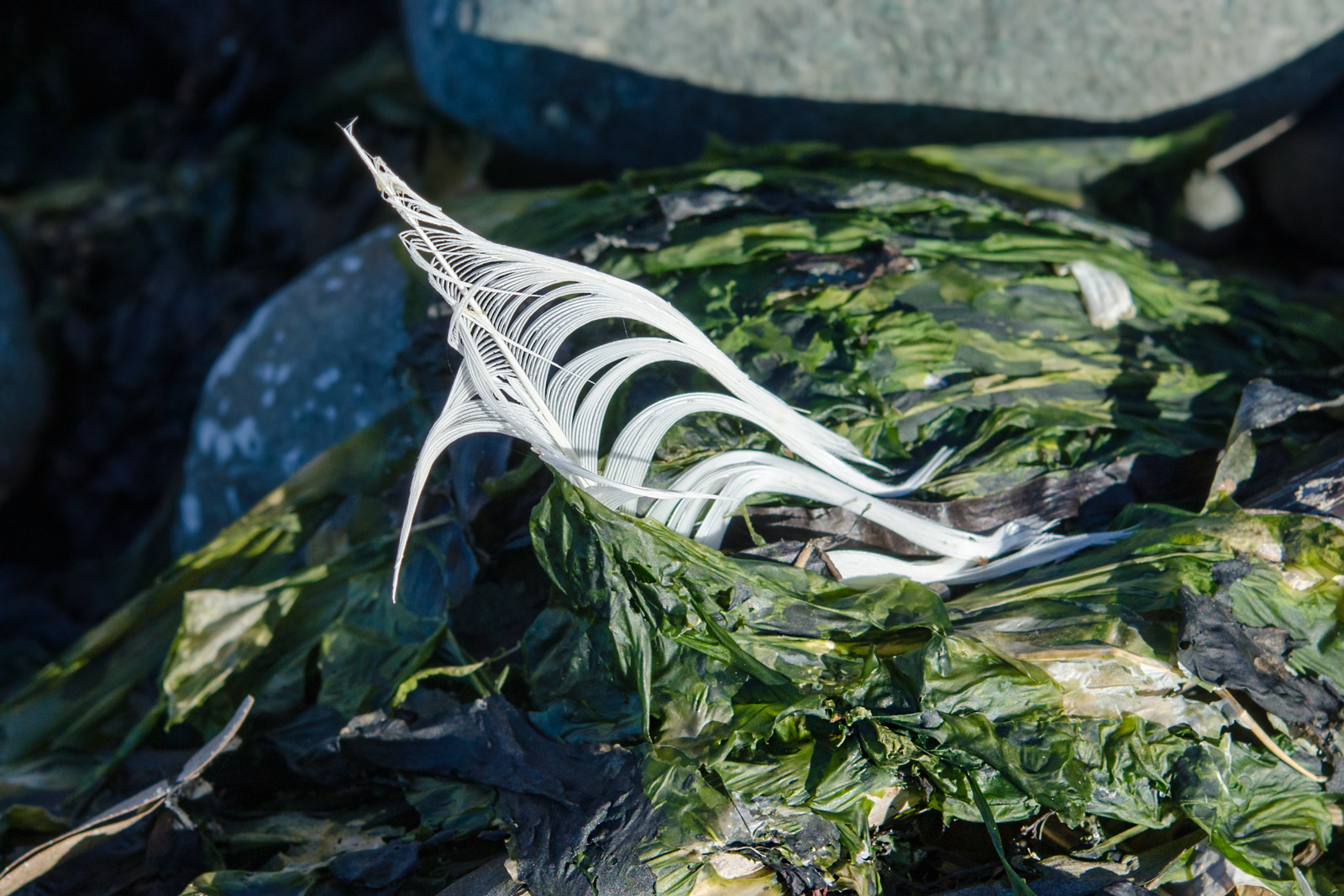
Eagle feathers. Everywhere, there are feathers.

Probably a gull feather.

Another feather. There are always more feathers.

A scrap of red coralline seaweed.

Jingle shell. This clam look-alike, or "rock oyster" (but it's not an oyster, either) has a hole in the lower shell. Byssal threads grow through this opening to attach the mollusk to a rock.

The lower (jingle) shell is thin and shiny. Tied with other jingles, it makes a nice, jingly wind chime.

Purple shore crab molt. At this level of the intertidal zone, there are no live crabs to be found, but their leftovers are scattered everywhere.

Another one, a male.

Tunnels in a strip of bark.

More tunnels, in a small piece of driftwood.

Another feather. The pale seaweed has been sun-bleached before it dried.

Two feathers, and dried eelgrass, toasted to blue-black. Sea lettuce retains its green colour until it disintegrates.

Bedraggled feather, wrapped in dried sea lettuce.

A rocky fish.

And there's always, always styrofoam. I filled my bag with a fair collection of it, a plastic water bottle, and a beer can. At least, I get a refund on the beer can.

And sho' 'nuff, there was a rotting carcasse! In the next post.

Monday, June 27, 2016

When purple is green

When they're babies, purple shore crabs come in all colours from creamy yellow to green to red or even bluish. Most adults are purple or green.

Green shore crabs are mostly in shades of green, although some are dark red or purple. Otherwise, they look like purple shore crabs and live under the same rocks. It's usually easy to tell them apart, though, because the purples have polka-dotted pincers. The greens have plain pincers.

But then, there are the colour morphs. Some purple shore crabs are all over green, and they don't wear polka dots.

Green purple shore crab with a cracked carapace.

(I don't know how she got hurt, or how old the injury is. One of my students, a 9-year-old boy, brought her to me as is. He says that's how he found her. She was quite lively, in spite of the damage.)

So how do I know she's a purple? Because green shore crabs have hairy legs; purples are "nude". Their Latin name is Hemigrapsus nudus.

Side view. Clean-shaven legs.

She only stayed on my hand for a few seconds, then she scrambled off and dropped into the rocks. But before she went into hiding, she stopped to warn me off:

"Go home, huge monster!"

... thereby showing me her green, non-polka-dotted pincers.

These crabs lose pincers and legs with no noticeable disruption of their lives. The cracked carapace won't heal, but at next molt, she'll have a nice, new one; she should be ok.


Monday, February 15, 2016

Sparkly green eyes

Most of the small crabs on the upper intertidal reaches of Boundary Bay were green shore crabs. They were not always green; they can be any colour from white to purple.

Here, on the Campbell River beaches, so far, I have seen mostly purple shore crabs, like this one:

Young purple shore crab, Hemigrapsus nudus.

Since the greens can be purple, and some of the purples are green, they are hard to distinguish at first glance. But the purples have those pretty red or purple polka dots on their pincer arms; the greens don't.

And this one has sparkly green eyes, to boot. Handsome, isn't he?

Tuesday, October 08, 2013

Toasted crab

The summer sun either bleaches or blackens most things that have finished out their days on the beach. The purple shore crab is an exception; his colours become even more vivid as they bake than when he was running about. This crab molt almost looks alive.

Crab, drift log, and black eelgrass remains.

There's still a hint of green in the hinge of his pincer.

Thursday, August 15, 2013

Little Miss Attitude

A small purple shore crab climbed to the top of the water pump and sat there, with just her toes in the water, watching me. Watching me watching her.

The pump is slippery, and vibrating, so she's braced against the back wall.

Next stop: the top of the tank, two inches above, and Freedom! Sorry, little one. The lid's on tight.

Monday, June 17, 2013

Green eyed monster

I never realized before that purple shore crabs have green eyes.

Purple shore crab, Boundary Bay.

This was a big crab, as shore crabs go, totally unafraid of me, not even bothering to threaten me as I prodded him into better light. Big enough to defend himself against anything on that beach, he's completely confident of his invulnerability. But watch out for gulls, Professor Plum; your weapons don't intimidate them!

Perhaps because of his size, I was also able to see the hinges on his legs and pincers; they're green, too.

Tuesday, September 18, 2012

Hunger is the best spice

Another Campbell River post

On a beach at the south end of the Campbell River Rotary seawalk, there is a tidewater pool, which looks artificial; a square dredged out of the stony beach, with not much to say for itself as yet. We walked out to the far side of this at low tide. The scenery, looking out across the water to Quadra Island, was beautiful, as always. But the beach was mostly clean rocks, with nothing much living underneath, not even seaweed.

Dry rocks and tiny barnacle shells

Periwinkle snails gather just above the water line.

It was difficult walking on the loose stones, and Laurie's injured leg was bothering him by the time we got to the water's edge, so he sat on a rock and I entertained myself looking for interesting stones. At the edge of a small tide pool - grey rocks, grey stones, grey rocks - I noticed a half-dried, rotting kelp stipe, balanced on the stones. The tide was coming in, and as it reached the kelp, purple shore crabs began to crawl out from between the rocks to attack the kelp, which they began eating hungrily.

Not much else to eat on this beach.

As the water rose, more and more crabs appeared. The first arrivals fought off the newcomers, often knocking them back down into the water. Occasionally, three or more would be struggling together, legs and pincers intertwined.

I've seen crab fights before, usually over some choice bit of fish, but never over dry kelp.

I count 14 in this photo, of a small section of the kelp.

The green crab at the right is also a purple shore crab.

Green shore crabs (aka,  Oregon shore crabs) may be many colours, usually green, white, or grey. The purples are usually purple, sometimes green. I have a white one in the aquarium. They are distinguishable, sometimes, by the polka-dotted pincers (see the one near the left on the photo above) and by their hairless legs; the green shore crabs are hairy. (Here's a green and white green shore crab; notice the hairy legs.)

Powered By Blogger