Showing posts with label green shore crab. Show all posts

Sunday, August 10, 2025

Stones and shells and hiding hermits

That low-tide beach at Little Bear Bay is stony, for the most part; with a grand mix of stones of varied colours and textures. And the more stones there are in any spot, the more beasties it harbours. And the harder it is to find them, except for the spunky little crabs, who are only too happy to challenge intruders to a battle.

The common Green Shore crab. And, if you look closely, there are at least 4 hermit crabs and a half-dozen limpets in the photo. Probably more.

Hermit crabs in periwinkle shells.

I looked at hundreds of these hermits, all in the tiny periwinkle shells, almost all of them tightly rolled up, sleeping while the tide was out. And they were almost all in dark shades of grey, even black, so that they blended in with the shells they're using. I think they're just a dark colour variant of the Hairy hermits, maybe more suited to this beach with so little seaweed cover.
 
This one woke up and scrambled off the rock.

Yes, it's a Hairy hermit; white tips to the olive-green chelipeds, blue knees.

Rockweed isopod, Idotea wosnesenski, with a gaggle of hermits.

Another, with hermits and barnacles on the large rocks at the top of the beach. The red colouring is an alga.

A tiny red crab daring me to come closer. The long snail is a Dire whelk, Lirabuccinum dirum.

Where the sand is clean individual clumps of rockweed lie attached to stones.

Sandscape, mostly because I liked that green  and black stone. Hermits and another Dire whelk.

Red algae, and a white crab, a juvenile Green Shore crab.

~~~~~~~~~~~
La playa en la bahía Little Bear con la marea baja, está casi toda cubierta de piedras, con una mezcla bastante variada de colores y texturas. Y entre más piedras haya en un lugar, más animalitos se encuentran allí. Y más difícil es descubrirlos, aparte de los cangrejitos tan valientes, que siempre están listos para ofrecer batalla a cualquier invasor.
  1. Un cangrejo costero verde, Hemigrapsus oregonensis. Y, si buscas entre las piedras, por lo menos unos 4 ermitaños y media docena de lapas.
  2. Ermitaños en conchas de bígaros (Littorina sitkana).  Examiné cientos de estos ermitañitos, todos llevando las conchas de bígaros, casi todos bien enrollados, durmiendo mientras la marea los había dejado expuestos al aire. Y casi todos venían en colores oscuros, gris o hasta negro, de manera que se desaparecían entre las conchas que usaban. Creo que son un variante oscuro del ermitaño Pagurus hirsutiusculus,  tal vez mejor adaptados a la vida en esta playa que tiene muy pocas algas marinas.
  3. Uno que se despertó y se echó a correr.
  4. Tiene el color pardo y el extremo blanco de los quelípodos y las "rodillas" azules característicos de P. hirsutiusculus.
  5. El isópodo Idotea wosnesenski, con un grupo de ermitaños.
  6. Otro, este en las rocas grandes en la zona superior intermareal. Con bálanos y ermitaños.
  7. Un cangrejito rojo, retándome a acercarme. El caracol es un Lirabuccinum dirum.
  8. Donde la arena está limpia y casi sin piedras, allí las algas pardas, Fucus sp., crecen fijadas en piedras individuales.
  9. Varias cosas, piedras, ermitaños, otra bocina.
  10. Algas rojas y un cangrejito blanco.


Wednesday, August 31, 2022

Caught my eye

Study in contrasts; a sun-bleached shore crab molt among beach pebbles.

The purple shore crab, Hemigrapsus nudus, as shown by the polka-dotted pincers.

The other common shore crab native to these shores, the Hemigrapsus oregonensis, is similar in size, colour, shape, and habitat (mostly intertidal), but is missing these spots. And he has hairy legs.

~~~~~~~~~~~~~~~~~~~~~~~~~~~
Una muda de un cangrejito costero morado, Hemigrapsus nudus, haciendo contraste con las piedras de la zona intramareal.

Se le conoce por los lunares color morado (en la vida; aquí se ve blanqueado por el sol) en los quelípedos.

El otro cangrejo costero nativo a estas costas es el costero verde, H. oregonensis; es muy parecido con lo que respeta al tamaño, color, forma, y su habitat, la zona intramareal primeramente. Pero al verde le faltan los lunares. Y tiene las patas peludas.


Sunday, May 08, 2022

All the colours of the rainbow

Bright colours, wild and tame, from flowers to critters: I'm tidying up the "to be posted later" folder, making space for May's findings.

New grass just leaping up from under the moss.

Bleeding heart in a pot at home.

Big-leaf maple flowers

I don't know what this is, or how it got into my garden. But I love the colours.

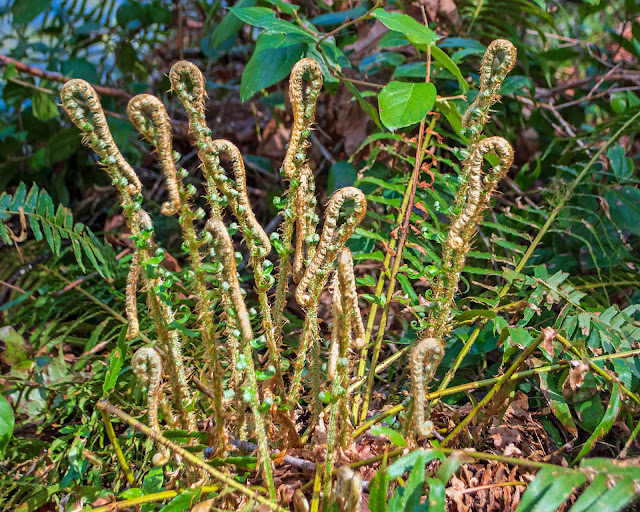
This year's new evergreen fern fronds, unrolling.

Coiled pre-fronds.

And now, the critters:

Green shore crab, with dried shrimp treat.

Close-up of the underside of a sea urchin; tube feet with cog-wheel tips, mouth, spines, and the red seaweed the urchin has decorated itself with.

Pale blues, and yellow legs. A greater yellow-legs, Tringa melanoleuca.

~~~~~~~~~~~~~~~~~~~~~~~~~~~~
Una variedad de colores brillantes, domésticos y salvajes, desde plantas a bichos: estoy organizando mi folder del mes de abril, haciendo espacio para lo que encuentro en este mes de mayo.

Fotos:
  1. Un brote nuevecito de pasto, recién surgido de debajo del musgo.
  2. Corazón sangrante, en mi jardín.
  3. Las flores del arce de hoja grande.
  4. Esta flor apareció en mi jardín, no sé de donde, ni que es.
  5. Los helechos de hoja perenne se empiezan a desdoblar.
  6. Y debajo, unas hojas todavía están enrollados.
  7. Y ahora, los animales: aquí un cangrejo verde, Hemigrapsus oregonensis.
  8. Viendo muy de cerca un erizo de mar verde; se ven aquí sus espinas, sus pies ambulacrales, con sus extremos en forma de ruedita dentada, la boca, y el alga roja con que se adorna.
  9. Azul claro del agua, y patas amarillas: un chorlo mayor, Tringa melanoleuca.


Saturday, May 01, 2021

One blue eye

 Primero de mayo. International Day of the Worker, in many places. May Day: a spring festival. Or May 1st, International Sunflower Guerilla Gardening Day. Or a bunch of peoples' birthdays. Or; it's up to you ...

Here, this year, it's going to be low, low tide day. (Well, yesterday the tide was a bit lower, but it was rainy and cold, so it didn't count. They say the sun will shine today.)

Meanwhile, here's a crab who doesn't have to deal with low tides any more.

Green shore crab, Hemigrapsus oregonensis, male

~~~~~~~~~~~~~~~~~~~~~~~~~~~~

Primero de mayo, el dia internacional del obrero, en muchos lugares. O una fiesta de primavera. O puede ser el dia internacional de jardineros guerrilleros. O el cumpleaños de una bola de gente. O lo que quieras.

Aquí, este año será el dia de la marea bajísima. (Bueno, ayer la marea bajó un tantito más, pero estaba lloviendo y hacía frio, así que no cuenta. Hoy, dicen, el sol va a salir.)

Mientras, aquí hay un cangrejo que no se preocupa por las mareas bajas, ya que vive en el acuario.

Sunday, December 06, 2020

Crab vs crab

 Kelp crabs are different.

Kelp crab juvenile, Pugettia producta

They have the same basic structure as the common crabs and hermit crabs we see on our shores; eyes on stalks, mini-antennae, assorted mouth structures, "teeth" on the carapace (crabs), 10 legs, of which two bear pincers. But the kelp crab's pincers are long and thin. They look fragile, but can deliver a good pinch. And they don't waste time waving their big pincers threateningly, like a shore crab; they act. Pick one up by mistake, and feel the sharp nip immediately.

"Normal" (meaning those that populate our beaches here) crabs mainly walk around with their belly to the ground. Kelp crabs stand upright, nose upturned.

"Normal" crabs dig burrows and hide underneath things. Kelp crabs, so far as I can see, do not. They hang around, upright, in the algae.

Kelp crabs wear a  hat. The one in my aquarium usually carries California rose seaweed, but sometimes decorates it with a bit of sea lettuce.

Kelp crab in the rose algae bush. He measures 2 cm. across the carapace. An adult male may grow up to about 9 cm. Plus a lot of leg.

My crabs and hermit crabs are always busy, digging, climbing, racing around, arguing, turning over shells, re-arranging the landscaping, eating. So far, the kelp crab spends most of his time lounging in the shrubbery. He comes out when I feed the others their shrimp pellets, grabs one, and returns to his patch of algae to eat in peace.

These crabs are algae eaters in the spring and summer, eating mainly brown algae such as kelp and rockweed. (They wear kelp colours, too, which makes them almost invisible.) When the winter tears up the kelp beds, they turn to eating small organisms, such as barnacles and mussels. And, of course, my shrimp pellets. My shore crabs eat anything, at any time. They're scavengers.

Green shore crab, Hemigrapsus oregonensis, just an infant. About 1/2 cm across the carapace.

~~~~~~~~~~~~~~~~~~~~~~~~~~~~~~~

El cangrejo de alga roja norteño: una comparación con los cangrejos verdes y los ermitaños de nuestras costas.

El cangrejo kelp posee las características usuales de los cangrejos y ermitaños: ojos pendunculados, antenas pequeñas, un buen grupo de estructuras bucales, "dientes" en la parte frontal del caparazón (en los cangrejos), 10 patas, de las cuales 2 llevan pinzas. Pero las pinzas del cangrejo kelp son largas y delgadas. Parecen frágiles, pero son fuertes y pueden dar un buen pellizco, bastante doloroso. Y no se pierden el tiempo, como lo hacen los cangrejos costeños, mostrando lo grande y fuerte que son sus tenazas, tratando de espantar al enemigo; estos cangrejos kelp actúan de inmediato. Levanta un puño de alga que contiene uno de ellos, y ya te atacó.

Los cangrejos "normales" (bueno, normales aquí en nuestras playas) caminan con el abdomen en tierra. Los cangrejos kelp se paran con la cara en alto.

Los cangrejos "normales' excavan hoyos y se esconden debajo de rocas y conchas. Los cangrejos kelp no excavan. Según veo, se la pasan arriba, entre las algas.

Los cangrejos kelp llevan sombreros hechos de alga. El mío usa el alga rosa californica, pero a veces la decora con trozos de lechuga marina.

Mis cangrejos y cangrejos ermitaños siempre están ocupados. Excavan, trepan, se pelean, echan carreras, voltean conchas y piedras, arreglan la decoración del terreno, buscan comida. El cangrejo kelp flojea, descansando entre sus algas, sin moverse. Cuando les doy de comer sus bocaditos de camarón, se baja para agarrar uno, y pronto regresa a su puesto para comer tranquilamente.

Estos cangrejos comen algas en el verano, principalmente las algas rojas como kelp, pero cuando el invierno destruye sus plantaciones, se alimentan por mientras de animales pequeños como los bálanos y mejillones. Parece que mis bocados de camarón sirven también. Los cangrejos costeños locales comen de todo, en cualquier temporada. 

Monday, April 06, 2020

Little blue eyes

Crabs are busy little creatures; always in motion, digging, rearranging the landscaping, flipping oysters twice their size, climbing, teasing the anemones, sifting sand. Or just running in circles, getting their daily workout. In between times, they come to the glass wall and watch me.

Young green shore crab, Hemigrapsus oregonensis, watching me.

And climbing the seaweed, but still keeping an eye on me.

~~~~~~~~~~~~~~~~~

Los cangrejos son muy activos, muy trabajadores. Siempre están haciendo algo; excavando hoyos, moviendo piedras y conchas, volteando ostiones el doble de su tamaño, molestando a las anémonas, revolviendo la arena. O dando vueltas y vueltas, como para mantenerse en condición. Y muchas veces, se acercan a la pared de vidrio para mirarme, para ver lo que estoy haciendo.

Este es una cangreja verde costeña jovencita.

Friday, January 24, 2020

Busy scene

(Text in Spanish at the bottom: el texto en español sigue al pie de la página.)

The little periwinkle snails are hard workers. They scrape away the algae from the walls, from the oyster shells, from the eelgrass, and the filter intake. Here's one cleaning up the shell of a young hermit crab.

Hairy hermit, Pagurus hirsutiusculus, still very small. They lose their orange colour as they grow. 

Most of my crabs are quite small, but there's one huge one (huge by shore crab standards anyhow). His pincers are wide and powerful. The snail shell above, on the right shows what he can do; he breaks the shell of a live snail to get at the meat. He is otherwise not aggressive; everybody else gets out of his way; nobody challenges him.

But  nothing goes to waste. An orange-striped green anemone has set up shop in the abandoned snail shell.

Plumose anemone, Metridium senile, surrounded by seaweeds (Pacific rose, Turkish towel, eelgrass, a fragment of sea lettuce) and broken shells. 

~~~~~~~~~~~~~~

Los caracolillos trabajan constantemente. Raspan el algae de la pared, de las conchas en el piso, de las algas marinas, y hasta de la tubería del filtro. Aquí en la primera foto, uno se ocupa limpiando la concha usada por un cangrejito ermitaño.

El beneficiario es un ermitaño peludo, Pagurus hirsutiusculus, todavía muy joven. Al crecer, pierden el color anaranjado.

La mayoría de mis cangrejos son pequeños, pero uno es grande, enorme según el tamaño normal de su especie, Hemigrapsus oregonensis. Sus pinzas son grandes y fuertes. En la foto del cangrejo ermitaño, la conchita rota al lado derecho sirve como muestra de su actividad. Con las pinzas, aprieta la concha de mar hasta romperla, para comerse la carne.

Aparte de eso, no molesta a los demás habitantes del aquario; nadie le hace frente.

En el agua, nada se desperdicia. Una anémona (Diadumene lineata) se ha instalado en la concha rota donde está protegida pero expuesta a la corriente que le trae sus alimentos.

En la segunda foto aparece la anémona emplumada (Metridium senile) rodeada de algas marítimas: rosa pacífica, toalla turka, lechuga marina, y una hoja de Zostera marina.


Wednesday, October 23, 2019

Stack of hungry beasties

And in the tank this week:

Crab, snails, snail food.

The big shell is a large leafy hornmouth, Ceratostoma foliatum, old and battered. I don't know what made me bring him home when I found him tossed up well above the tide line, instead of walking him back down to the water. Now I'm busy bringing him large barnacles to keep him fed. He won't eat the little ones; only steak dinners for him!  Here, he's on an old clam shell that still has a half-dozen surviving barnacles.

A couple of black patches are smaller snails, eating algae on the hornmouth's shell. And a channelled nassa, Nassarius fossatus, is thinking of boring through into the juicy hornmouth meat. (He gave up by the next morning; now he's wandering about looking for something not quite so thick.)

On top of the stack, the largest of my green shore crabs, a male close to the maximum size for his species. Always, always, hungry.

Tuesday, August 06, 2019

Meanwhile, back in the tank ...

I've been too busy; travelling, running errands, catching up on paperwork (a form of procrastination to put off dealing with more challenging paperwork), gardening; all the things I do during a "lazy" summer. Sometime, weeks ago, I took a break and sat down by the aquarium to visit the hermits. And forgot to post the photos.

So here they are. Hermits and a crab.

Poor crabby. He must have tangled with one of the larger crabs, probably trying to hold onto his supper. He's lost a pincer. Luckily, he's got plenty of legs and mouthparts that can serve as spoons and forks, and the next molt, he'll get his pincer back.

Deep in the tank, colours are muted. It's like seeing through a light fog. Here, a hairy hermit looks back at me from her perch on Pacific rose seaweed growing on a stiff red alga. Pacific rose can grow from fragments left after it has been weeded out. I tear out whole handfuls every time I change the water.

A grainy hand hermit with colourful algae decorating his shell..

One of the tiny orange hermits in a brand-new shell. The seaweed here is broken, half-rotted rockweed. Good eating, the hermits say.

Grainy hand hermit (left) and small hairy hermit (right) on eelgrass.

Wednesday, July 24, 2019

Bubbles

Little green shore crab, bubbling at me.

In the shadows, assorted whelks, periwinkles, and hermit crabs in periwinkle shells. Also another tiny crab in a clamshell.

The tide was very low, and I've got a pile of photos of critters to process, including one that was a lifer for me. Coming up tomorrow.

Friday, June 28, 2019

Of stones and crabs

When I go out without a fixed end point, I usually go north or west, away from the cities and the noise, the road crews and the traffic. This Wednesday I decided to break the pattern and head south. I didn't know where I was going; somewhere beyond Comox, 45 minutes to the south of my place; somewhere between the Comox valley and Union Bay, probably.

I'd barely gotten to Royston when I saw the sign: Royston Seaside Trail. Destination found. I drove to several spots along the trail, going down to the shore in each spot. The tide was low and going out; I walked to the water's edge in each location.

The setting. Royston is on the far side of a bay with Comox and Courtenay on the other two sides.

The shore is flat and stony; there was no sand, some mud. Very slippery mud. After three steps, it slithered away underfoot and almost threw me. I moved back to the rocks.

The stones here are hard, angular, sharp-edged, firmly glued to the underlying mud. And everywhere I looked, tiny crabs were scuttling about, sometimes stopping to threaten me.

It was low tide, and the sun was hot, so I was surprised to see so many crabs out in the heat; usually they find shelter under stones or seaweed when the water goes away. Not here; maybe because the stones are so solidly embedded, maybe because there was almost no seaweed, except for a few patches of bright green stringy algae and the occasional lonely rockweed.

In an area with rounder rocks, a green shore crab finds a bit of shade.

This poisonous-green algae formed mats here and there. Possibly Urospora pencilliformis.

I collected a stone with barnacles for my snails at home, and wrapped it in some of the green algae; the crabs and hermits would appreciate it. Before I wrapped it, though, I shook out the seaweed, scattering tiny snails and crabs. Still, a dozen miniature shore crabs somehow made it home unobserved. They're in my tank now; I'll have to return some of them (the ones I can catch) back to the shore.

There were crabs everywhere. In this patch, I can see at least 6 crabs; more will be hidden under the rockweed and hair algae.

The other residents of the shore seem to be mostly barnacles and snails, and a few oysters. I looked, but found no worms, no anemones, no tiny swimmers. And surprisingly, no hermit crabs, which are usually in abundance where there are many snails to provide shells.

This crab molt probably came from lower in the intertidal zone. A young Dungeness crab, Cancer magister.

Another Dungeness crab, this one underwater. So clear the water!


There were a few patches of sandstone like what we find around Campbell River.

The trail website suggests that many of the rocks on this beach are not original to the site.

Starting in 1911, steam locomotives hauled logs from logging camps throughout the Comox Valley to the Royston log dump. ... Where it approaches Hilton Road, the railway grade was constructed in the intertidal area. From the end of Chinook Road, a mile long wharf extended into the water.  Logs were tipped off the wharf until the early 1950s when the railway stopped running. ... The wharf was taken down and replaced by a breakwater in the 1950s. ... The rocks that can be seen within the intertidal area during low tides most likely originate from the fill material placed to construct the railway grade. (Royston Seaside Trail website)

More rocks, the breakwater, and - what's that?

About those rusting hulks, tomorrow.


Friday, April 19, 2019

Big, crabby family

Another of my green shore crabs is in berry. And this time, she consented to a photo session, showing off her brood under a bright light.

Hemigrapsus oregonensis, in berry.

A female green shore crab may carry up to 11,00 eggs; the average is around 4,500. That's a lot of babies! And she takes good care of them fanning them and picking out bits of dirt (with those huge pincers!) and pumping water around them. They are protected by a feathery "blanket" along the edges of the abdominal plate, and held in place, as well, by those spiky pleopods visible on the right side here.

The eggs move into a second stage of growth while still in the egg. I think these are second-stage: look at the next photo. You can see their eyes! (Click for a larger size photo.)

Looking out at the big world.

I doubt that any of these will survive after they hatch as zoeae; the tank doesn't contain their usual predators, such as jellyfish, but the pump substitutes quite efficiently. But you never know; A couple of the crabs now in my aquarium grew up from babyhood here.

Sunday, March 03, 2019

Rejected!

Sometimes she's just not in the mood ...

Attempted mate guarding

When crabs mate, the male (in this case, the little guy on the bottom) grabs his chosen female and holds on until she is ready. But they have to arrange themselves abdominal plate to abdominal plate, and Big Mama here is not cooperating.

The struggle. She is trying to break his hold; he's trying to move around to her belly.

9 minutes of wrestling later, she's got her feet back on the ground, and shrugs him off. Bye, chico!

I was too late with the camera to capture a successful mating a couple of weeks ago. Both my male green shore crabs are tiny; both females are twice their size, but it doesn't seem to matter, as long as the male is mature.

I checked this morning. Both females are in berry. That explains her reluctance this time; he misjudged his cues.


Friday, April 27, 2018

Maternity ward

Shore crabs are busy little critters. They dig holes under rocks and shells, lifting huge (for them) rocks aside in the process. They re-arrange the landscaping in my aquarium. They pester the anemones and roll the hermits out of their way. Occasionally, they go jogging.

I had taken a big male back to the beach, exiled because he was bullying everyone else in the tank. And then the female, left alone, went mad. She ran around and around the aquarium, scraping at the walls as if she were trying to find an exit. She tried to climb the walls, standing on tiptoe and reaching, reaching for the top. She never gave up. Day after day, she ran.

I found a small male at the beach and brought him home. She attacked him on sight. I realized why a couple of days later when he came up to my light at the wall and I saw his purple polka-dotted pincers. He's a purple shore crab; she's a green.

I found a green male and brought him home. She settled down immediately and went back to weight-lifting oysters and barnacled rocks; normal crab behaviour.

And then one day last week, she came to the glass to show off her new brood. She was carrying a belly-full of eggs.

"Look what I've got!" Photo taken the 24th; it took a few days to catch her in a decent light.

Showing off.

This is why female crabs have wide abdominal plates. They need to provide housing for thousands of babies. The males' abdominal plates are narrow and pointed.

The structures at the sides, the feathery pleopods, serve as anchor points and safety gates.

She grooms these babies constantly, opening and shutting her abdomen to provide a scrubbing current, picking away at them with those giant chelipeds, clearing out debris. Motherhood is hard work!

They're getting quite big already.

The female's rounded abdominal flap can carry more than 10,000 eggs at once. (Biodiversity of the Central Coast)

Yesterday, the night of the 25th, she came to the glass wall again.

"Hi!"

And now the eggs have eyes!

Looking out at the world from the shelter of Mommy's tummy.

Zooming in ...

Tiny cuties!

This morning, Ma crab greeted me when I turned on the lights. She's slim again. The babies are gone, out swimming in the current.

I don't expect to have 10,000 crabs in the tank. Many will get lost in the filter, others will be eaten quickly. The anemones all looked quite perky this morning, after their crabby breakfast.

Maybe one or two will escape the voracious filter and the reaching anemones, hide under the sand, or on the backside of one of the seaweeds, and show up one of these days, a pinhead crab on her way to adulthood.

Powered By Blogger