Showing posts with label snails. Show all posts

Thursday, March 02, 2023

Sisters under the shell

I was a minute too late. I had come to add ice to my aquarium, and saw a pair of periwinkle snails doing what pairs of snails do, on the glass wall where I would have a chance of a photo. I was too late; by the time I got back with the camera, they were going their separate ways, each trailing a blobby string of mucus.

I followed the larger of the two, then, as he ambled over to inspect a limpet; there is always a good meal of algae on the roof of a limpet.

"Hello, little limpet. Mind if I look for algae on your shell?"

And then he munched his way over the limpet, mouth working busily. And over the other side. She (sex assigned for convenience) didn't mind at all, and kept on eating as if nothing was weighing her down, nothing dragging her off the glass.

"Thanks!"

Watching the two of them, both scraping away at the glass with their rasping radulae, both waving a pair of tentacles with small eyespots at the base, both moving along on their whitish feet (the snail going faster now, but the limpet can keep up if she wants to); if it weren't for the shape of their shells, they could be brothers. Or sistren.

Scene at the bottom of the tank. Snails eating a slice of kelp.

~~~~~~~~~~~~~~
Llegué tarde. Iba a añadir hielo al acuario, cuando vi una pareja de caracoles acoplados. Pero cuando regresé (corriendo) con la cámara, ya se habían separado e iban en direcciones opuestas, cada uno trayendo consigo un hilo de moco.

Seguí al más grande, mientras se deslizó sin prisa hasta donde una lapa estaba comiendo alga en la pared. Siempre hay alga en la concha de una lapa, más que lo que el caracol hallaba en el vidrio.

Fotos:

#1: El caracol y la lapa. Le dice — ¿Me permites cosechar las algas en tu concha?

Y se montó a la lapa, y se veía como se movía su boca, limpiando la concha de la lapa. Y luego cruzó al otro lado y siguió su camino, todavía raspando el vidrio. A la lapa no le importó; siguió comiendo como si no sintiera el peso del caracol, como si no se le hiciera difícil seguir pegado a la pared.

#2: Los dos separados ahora.

Mirando los dos, ambos raspando el vidrio con sus rádulas, los dos agitando sus dos tentáculos con los ojitos en la base, ambos deslizándose sobre sus patas únicas blancas (el caracol se movía más rapidamente por el momento, pero la lapa le puede alcanzar si tiene ganas): si no fuera por la forma de sus conchas, se podría decir que eran hermanos. O hermanas.

#3: Una escena al fondo del acuario. Caracoles comiendo una rebanada de quelpo.


Sunday, February 26, 2023

Pondering sand patterns

I watch where I step on the beach these days; I don't want to crush innocent critters just going about their business, not expecting a big foot to come crashing down.

So I noticed these patterns in the sand.

Wave patterns. And a snail trail. (A bit below the nose of the sleeping rock.)

The waves leave different patterns on every beach and on separate sections of the same beach; some smooth, some rippled, some deeply furrowed, like these.

Smooth sand and great blue heron tracks.

The great blue heron has 4 large toes, 3 pointing forward, one behind. The longest toe is the leading one, in the centre-front. The hind toe is shorter. So why does the footprint show a long hind toe mark? Does he put down that toe first, then drag it forward before the others make contact? I'll have to watch the next heron's gait to see.

Herons have a tiny bit of webbing between the toes, near the centre. It doesn't show in the tracks.

Gull tracks, coming and going.

Gulls have the 4 toes, but the hind one is just a stub. They also have webbed feet, but their tracks don't show this. Mallard tracks do. Mallards are slightly heavier (1,000 - 1,300 gm.) than our common glaucous-winged gull (900 -1,000 gm.) ; is  that the reason, or is it that they're more flat-footed than gulls?

And this is sand, too: old, old sand, turned to stone.

Sandstone ripples.

The ripples here intrigued me. They're not wave patterns, but rather a series of layers, each eroded back to show the layer beneath. Yearly deposits of sand, maybe. Or was the sand laid down over much longer times? Periodic flooding events, maybe?

But one thing more: look at all those pockmarks, the little holes in the rock. They're jam-packed full of snails.

Sitka periwinkles. Hundreds of periwinkles. 

And all the sandstone rocks around, every single one, is peppered with these tiny snails. Millions upon millions of snails in a short length of beach. Careful where you put your feet!

~~~~~~~~~~~~~~
Me fijo bien donde pongo los pies en la playa; no quiero machucar ninguna criatura inocente que anda atendiendo a sus propios negocios sin esperar que un pie gigante le venga encima.

Y me llamaron la atención estos diseños hechos en la arena.

Foto #1: Canales formados por las ondas. Y una huella de un caracolito marino. (Mira un poco abajo de la nariz de esa roca durmiente.) Las ondas hacen diseños distintos en cada playa y hasta en diferentes partes de una misma playa. Algunas arenas son lisas, otras con onditas, otras con canales como estos.

Foto #2: Las huellas de una garza azul en la arena lisa. La garza azul tiene 4 dedos; 3 en frente, uno atrás. El dedo más largo es el del centro en frente. El dedo trasero es más corto. ¿Porqué entonces en la huella que deja el dedo trasero se ve mucho más largo? ¿Será que baja primero ese dedo, lo arrastra por un momento antes de bajar la pata por completo? Tendré que observar como camina la próxima garza que encuentro.

Las garzas tienen las patas palmeadas, pero solo un poco en el centro, y no se nota en las huellas.

Foto #3: Huellas de gaviota. Las gaviotas también tienen cuatro dedos, pero el trasero es muy corto y no llega al suelo. También tienen las patas palmeadas, pero esto no deja huellas. Los patos mallard sí dejan lo palmeado bien marcado. Tal vez sea porque los patos pesan un poquito más (1,000 a 1,300 gm para los patos, 900 a 1,000 para las gaviotas) o porque los patos bajan la pata con más fuerza. ¡Tantas preguntas!

Foto #4: Y esto también es arena, arena muy vieja; piedra arenisca. Las ondulaciones no son diseños causados por las ondas. Más bien son una serie de capas, cada una dejando a la vista la de abajo. Depósitos anuales de arena, tal vez. O tal vez tomó más tiempo, como si fuera por inundaciones periódicos. 

Una cosa más: mira esos pocitos en la piedra. Están llenos de caracoles.

Foto #5: Caracoles Sitka littorine. Cientos de caracoles.

Y cada piedra arenisca en toda la playa, todas están cubiertas de estos caracoles. Millones y millones de caracolitos en un tramito corto de la playa. ¡Fíjate bien donde pongas los pies!


Thursday, July 25, 2019

Colours under rocks

What a difference a few metres make! I've been on this beach (Willow Point), flipping rocks at low tide before, but this time, the tide was the lowest I've seen it. The last time, I saw crabs and small snails and hermit crabs and barnacles. Not much else. This time, every rock had a diverse community on the underside.

Wosnesenski's isopods, multi-coloured snails, limpets, a tiny, tiny clam, barnacles, spiral tube worms, unidentified eggs, and a possible red chiton.

I was chasing Wosnesenski's isopods; they're big and visible, but very fast, very motivated to get back underneath a stone. None of them stop to challenge me, like a shore crab will.

"I'm going to pinch you and crunch your shell! No matter how big you are!"

(Aside: what's that weird thing under the clamshell on the upper left?)

Wosnesenski's isopod (Pentidotea wosnesenskii) stubby isopod (Gnorinmosphaeroma oregonensis -the name is longer than the beastie), and red chiton.

This isopod ran away, as they do, but exposed a stubby isopod and a red blob, which the camera saw better than I did. Stubby isopods are small, at most 1 cm long, usually less.

Stubbies. I think there are two of them, stacked. Two flatworms and their eggs, a barnacle, and a small, red chiton.

Chitons are fairly common in the lower intertidal zone. So far, I've seen the giant Pacific chiton (up to 14 inches; the ones I've seen were between 5 and 6 inches long), the beautiful red-lined chiton, the woody (to 8 cm), the mossy (10 cm), and some hairy species, so buried under their overgrowth of algae that they were unidentifiable. But I hadn't seen one so small, and so red. I don't know the species; none of the 30 species in my encyclopedia seem to match.

A more usual find; a woody chiton, still very small.


Wednesday, July 24, 2019

Bubbles

Little green shore crab, bubbling at me.

In the shadows, assorted whelks, periwinkles, and hermit crabs in periwinkle shells. Also another tiny crab in a clamshell.

The tide was very low, and I've got a pile of photos of critters to process, including one that was a lifer for me. Coming up tomorrow.

Thursday, October 22, 2015

Worth a second look

The shore around the artificial tidal pool looked sterile. Dead, grey rocks, dead, grey stones, and dead, greyed logs. Nothing more. At least, so it seemed until I stopped to look more closely.

Where the tide had just retreated, the still wet stones were dotted with tiny snails. Around the dry stones, there were none.  I sat on a handy stone and started to dig down, moving one stone at a time, cautiously. And down between the top layer of stones, where there was shade and dampness, I found snails aplenty.

Pair of snails on wet stone. And the stones aren't all that grey, after all. Not while they're wet.

Snail on dry hand, checking to see if it's safe to travel. He decided it wasn't.

Digging down further, to where the stones were like oddly-shaped peas, and quite wet, I started to find small crabs.

Escaping, ready to take a daredevil leap into space. (I put him down gently, instead.)

"Smiles". A different crab, less frantic. They're green shore crabs. All of the ones I saw were in these darker tones.

Besides the crabs and snails, one species of each, I found several small limpets who declined having their photo taken. No worms or flatworms, only one barnacle, a brave little soul colonizing new territory.

Later, skirting the pool, I noticed movement, and stooped to watch a pair of hermits, the male dragging the female around, then stopping to mate with her, briefly. And then, "Thank you, ma'am," and he dropped her and hurried away.

"So long!" The female is curled up inside her shell, recovering. The rainbow colours on the male's shell and body are from the sunlight on the water they're in. (About 4 inches deep.)

The female, having an exciting day. They're grainy hand hermits, with blue polka dots on the pincers, and red/orange antennae and eyes.

I only saw this one small clump of seaweed, probably brought in with the latest tide.

Friday, October 12, 2012

Miraculous patterns

... Or at least, patterns on Miracle Beach.

Periwinkles on a rock

Driftwood face

Driftwood swirls and sand

Flowing water and seaweeds

Stoneface I

Stoneface II

Miracle Beach, Vancouver Island, August.

Saturday, April 21, 2012

Collecting the eggs

"The time has come, the walrus said ..."  to put together what I've learned about my mystery critters.

A group removed from the clamshell

A single capsule

I was confused by these, but Brine Queen gave me the clues I needed. These are egg cases of an intertidal snail, and the tiny one seen near the exit at the top of one was probably a hatchling.

It's very tiny, but looks like a trophon, possibly Boreotrophon orpheus. At maturity, it would be about an inch long. This one is only a few millimetres.

We narrowed the family of snails down to Muricidae, the rock snails, or murex snails. These are predatory snails, and include our common whelks, and the trophons, like the ones that ate their way through my aquarium a year or so ago.
Muricids lay eggs in protective corneous capsules the size and shape of which vary with the species. Out of these capsules the crawling juveniles, or more rarely planktonic larvae, hatch. (From Wikipedia)

There was an adult whelk in the clamshell. It wasn't the egg layer, though.

Websites or books that include photos of egg capsules along with the adult snails are few and far between, but we found a few similar to the clamshell sample. None were quite a match.

We have often seen the egg cases of the common whelk, the dogwinkle.

Whelk eggs, found on the White Rock beach last spring.

Several snails that occur locally have the curved, "winged" shape: the Oregon triton,

Image from WallaWalla.edu

the Leafy hornmouth,

From Asnailsodyssey, with whelk eggs on the left.


Pteropurpura trialata (this is from California; I don't know if it comes this far north),

From Wikipedia

These are all similar, and obviously related, but they are more pointed than ours. And I have never seen any of these snails around here. So I'm tentatively sticking with the corded trophon, B. orpheus.

In this context, this afternoon we were back on the same beach, at low tide. We didn't go as far out as we had when I found the clamshell, but close. Among the trillions of mud snails, I found a different one, another Muricid:

A sculptured rocksnail, Ocinebrina interfossa, almost adult size. 

Bottom side, showing orange flesh.

This is the first of these that I have seen. Another species to look for, and someday, to find eggs for.


Tuesday, November 01, 2011

Cold weather babies

Looking under fallen, rained-on, rotting maple leaves for tiny flies to feed tinier spiders, I found a couple of snails instead:

This was the big one. 4 millimeters, eyes to back bumper.

And this pupa or egg case, under 2 mm. across, was sandwiched between two leaves. (This was four days ago; I looked at it again tonight, and the casing seems to have thinned, and I can see segments inside. I think it's a pupa. I hope it hatches.)

Almost flying-saucer shaped, then. Now it's longer, and brown at the tip. 

And the spiders got three miniature golden flies or wasps.

I'm still working on evil mussels. Story tomorrow, I think.

Thursday, September 29, 2011

Slow recovery, part one

It's been three months since the miniature oil spill that killed most of the animals in my aquarium. A long, hot, difficult three months.

For those that didn't see the original post, here's the story, in brief: air-borne pollution from a construction site next door covered the water, first in my outdoor seaweed bowl, and then in my marine invertebrates aquarium inside, under an open window. Most of the animals died that first week, leaving me with a few crabs and snails, two brain-damaged shrimp and a handful of sick hermits; these last all died by the second week.

The green shore crabs survived, but not without side effects; one big male lost both pincers, the day after he'd molted. The invasive mud snails were fine, as were the little predatory nassas and most of the barnacles. And my big wandering plumose anemone opened for business again.
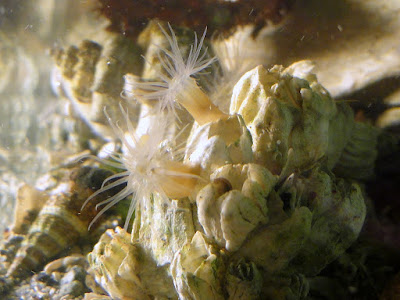
Community pre-disaster. Small anemones, snails, barnacles and an amphipod.

Since then, I've been silent, at least as far as aquarium blogging goes. I could have tossed the whole thing and started over, putting my few animals into a fresh tank, but I wanted to learn what goes into a recovery in the wild. And just as it is in the ocean, where oil spills take years to clean up, healing my small tank became a long, slow process, with tiny improvements and discouraging setbacks.

The first imperative was to clean the water. This is easier in a small aquarium than in the ocean, of course. A few water changes, each time replacing half the water and cleaning the filter, should have been enough. The tank looked clean, and the crabs and snails went about their business cheerfully. But any animal that came along for the ride in fresh seaweed died in the first few days. I scrubbed the walls of the tank and changed the water again, to no effect.

Female shore crab, pre-disaster.

The maimed crab molted. With the fresh molt, he had regenerated his pincers; they were smaller, less powerful than the originals, but he looked good.

And the very next day, when I fed him, he showed up with no pincers and missing two legs. The smallest of the crabs molted, as well, and lost a pincer the next day. Something was wrong.

One of the last photos of my grainy hand hermit, before the tank was poisoned.

This time, I emptied the tank, scrubbed the walls, and removed the deep sand from the bottom. Once it was out of the water, I could smell it; a rank, chemical smell. There were no small animals alive in it, as there normally are. I dumped the whole lot, and set up the tank with only a dusting of clean, broken shells underfoot.*

All but one of the tiny anemones were gone, but the big one was still there, although she** spent most of her days closed in and hunkered down into a flat plate on the glass. To clean the glass properly, I would have to convince her to move.

Some species of hermits encourage anemones to attach themselves to the hermit's shell, boosting the hermit's weaponry and camouflage. The hermit nudges at the base of the anemone until it detaches from its chosen site, then he holds her gently against his shell until she glues herself down there.

I imitated a hermit. I pushed softly at the base of the anemone with the back of a fingernail. After a while, she let go and drifted to the bottom. I collected her and put her in a plastic bowl to wait until the tank was fresh and clean. When all was ready, I leaned on her again, then moved her back into the tank, down on the bottom with the clean shells. She attached herself, and after a bit of sulking, opened up to feed again. At least something was working!

Small snail, today, eating algae off the glass. The pink circle is the mouth, with the scraping radula.

So that was done. After a couple of weeks with no more deaths, I added a few handfuls of pebbles to the bottom, and began to bring in new snails and amphipods; the snails to keep the algae down, the amphipods to feed the anemone. Things looked good, and I brought home a bag of sand; the crabs and snails dug in happily within minutes. The amphipods started to breed.

Amphipods love these crevices in an old barnacle shell.

But there are other pollutants. Our problems weren't over. The anemone's story continues tomorrow.

*It's a pity we can't do that in the ocean.
** These anemones start out as males, and become females later on. I assume this one is old enough to be a "she".


Friday, August 26, 2011

Purple crabs, pink stones, and periwinkles

On Sliammon beach:

Shore crabs, probably purple, so dark the polka-dots barely show.

Most of the crabs we saw this trip, on several Sunshine Coast shores, were much darker than the shore crabs we find at home. The snails looked about the same.

And I'm still only halfway through Day Two, with more wharf photos, the rest of the Sliammon story and the evening sky to go.

Sunday, July 24, 2011

Half-wild harvest

Oregon grape grows wild in this area. We allow a few shrubs to grow in the garden; it's an attractive plant, with evergreen leaves, thick and prickly like holly leaves. Dropped leaves turn a brilliant red, very pretty. In the spring, the shrub bears bright yellow flowers, which produce small purple berries in the summer.

Fallen leaf


The berries are ripening up nicely; I tasted one this evening. It was a bit sour, but palatable. Maybe I'll make some jelly; it's good alone or made up half-and-half with blackberries or salal.

Meanwhile, the birds and the snails are getting their share:


Green berry, ripe purple berries, half-eaten berries, showing the two seeds inside. And a hungry snail.

Another snail, sleeping off a heavy breakfast.

Tuesday, February 16, 2010

Out to lunch

I caught this little periwinkle on his lunch break:


Checkered periwinkle, Littorina scutulata.

There are about a dozen of these in my aquarium, some barely a pinhead across, some full-sized, like this one. Most probably hitchhiked in on a handful of seaweed or eelgrass.

These snails live in the upper intertidal zone, more out of the water than in it. They can even drown if they stay underwater too long. But they are more versatile than most of the intertidal critters; they tolerate dry rocks, salt water, and even fresh water, for brief periods.

In my tank, they hang around the lip, just above the water level. Sometimes, one works his way out from under the lid, and rolls off the tank. I have found them several feet away, on the carpet, dry and sealed up tightly. One tiny, tiny snail was under a cushion on a chair; I have no idea how long it had been there. It was so dry, the shell was grey and rough-looking. I dropped it in the tank, and it woke up, stretched, and started the journey up to the lip again.

Every so often, they head down, like this one, looking for a meal of algae, which they scrape off the glass. In the photo, the big white circle is the base of the foot; the smaller circle, in front, is the mouth. Look closely, and you can see a hint of the radula, like a tongue with teeth on it.

Update: Click on through and read Christopher Taylor's comment. Astounding!

Saturday, October 10, 2009

A trio of snail shells

I've been sorting photos for the last couple of days. What to store keep, what to load to Flickr or Facebook, or share on the blog, what to dump? Decisions, decisions ...

I found these photos of some of my favourite shells.


Snail, probably from my son's collection -- Mexico, Central America, maybe.


Source unknown. It has the feel and texture of ancient clay pottery. About 1 inch tall.


Underside, showing central well.


Looking down through the spiral of a moon snail with a broken tip.


Moon snail, for reference. handful-sized. From BC, probably.

Time to quit for the night. My eyes are burning. G'night!
.
Powered By Blogger