Mid-April. A warm day, sunny and almost windless. I should have been in the garden, getting the bean patch ready for planting. Instead, I went to Little Bear Bay. Glad I did.
The southernmost end of Johnstone Strait, coming down from the northern tip of the island. Just around the point at the right, it joins the Discovery Passage, which goes on down to Campbell River, where it becomes the Georgia Strait. A good spot to watch for orcas.
The mouth of Pye Creek; on the far shore, there's a fish hatchery.
The beach is rocky in the upper intertidal zone. Here, three limpets and a periwinkle snail wait for the water to rise again. Most of these rocks have limpets on the underside.
A very colourful rock. The red stuff is an alga. I knocked the snail off by mistake; here I've replaced him, but upside-down; he's now lifting his operculum, preparing to flip himself over.
Rockweed. And rocks, to go with.
The shady side of this stone was crowded, the rest bare. A limpet, umpteen periwinkles (Litttorina sitkana), barnacles, stubby isopods, and a gelatinous mass; the snails' eggs.
More rockweed, on a small sandy area.
Another periwinkle, feeding on red alga.
Canada geese in the creek.
It was so quiet that I heard this little boat long before it came around the rocky point.
I'll be back. At low tide, I hope.
~~~~~~~~~~~~~~~
Un dia asoleado a mediados de abril. Aproveché el calorcito para visitar la Bahía de los Ositos, Little Bear Bay.
Este es el punto donde el Estrecho Johnstone, que viene bajando desde el extremo norteño de la isla, se une al Pasaje Discovery (Descubrimiento). Y el Pasaje baja hasta Campbell River; desde allí se llama el Estrecho Georgia, llegando hasta Victoria al sur. Es un buen sitio para observar las orcas.
Donde desemboca el Riachuelo Pye. Hay un criadero de peces en el bosque.
Lapas y un caracol Littorina sitkana en una piedra. Aquí debajo de casi todas las piedras hay lapas escondidas.
Una piedra con muchos colores. La masa roja es un alga. Al tocar el caracolito, le hice caer; aquí lo he vuelto a acomodar en su piedra, pero boca arriba. Ahora está alzando su opérculo, preparándose para volverse concha arriba.
Alga marina, Fucus sp. En inglés la llamamos hierba de rocas. Aquí con rocas verdaderas.
Donde había sombra en esta piedra, estaba llena de animalitos. Hay una lapa, mucos caracolitos Littorina sitkana, bálanos, isópodos Gnorimosphaeroma oregonensis, y una masa gelatinosa de los huevos de los caracoles.
Más alga parda.
Otro caracolito comiendo algas rojas.
Gansos canadá, en la boca del riachuelo.
Había tal silencio, que oía este barquito por un buen rato antes de que entrara al estrecho.
Where the Campbell River reaches the salt chuck, it opens out into a series of sloughs and mudflats, prime fishing and dabbling sites for waterfowl and seals. At the outer end, Tyee Spit forms a long, flat barrier, leaving only a narrow exit to the Strait. Its shores are stony; clean, round stones, without seaweeds or shell remnants. The currents are strong here, just south of the exit from Seymour Narrows, where they reach up to 15 knots (28 km/h), and then compete here with the outflow from the river. The water is salt, then fresh, then salt as the tide rises and falls. A challenging environment for little sea creatures. I have never seen a crab here; there are no marine snails, no barnacles.
Yesterday the tide was lower than I'd ever seen it here. On the inner side of the spit, down by water's edge, larger rocks, placed there to support a bird lookout, had barnacles and bits of green alga. I walked down to look. And turned over a chunk of old cement.
The community underneath looked like those tiniest snails that cover the rocks on other beaches, but these were dancing.
Stubby isopods, Gnorimosphaeroma oregonensis. The name is bigger than a half dozen of these.
Stubby isopods roll into a ball when they're disturbed, like the pill bugs in my garden.* The babies, rolled up, may be only 1 mm. in diameter; little, round grains of sand. A big male, stretched out, can reach up to 1 cm. The ones in this group are smaller; all females.
It's spring; party time, time to find mates and start the next generation. For the stubby isopods, that means sex changes and harems. The baby isopod hatches as a female. She becomes a member of a harem "owned" by one male, produces one brood, then begins a series of molts which transforms her into a male, ready to find his own harem of immature, smaller females. If the harem's male is removed, or dies, the dominant female in the group becomes a male to take his place.
Zooming in.
Mature stubbies have 7 pairs of legs; the babies only have 6. That's all I can count on any of these. They have compound eyes, visible on a few in this photo.
Years ago, I made a video of a baby, 1 mm. long:
I carefully replaced the rock in the same position. And the tide was coming in.
*New word: conglobate: to roll up into a ball.
~~~~~~~~~~~~~
Donde el rio Campbell llega al oceano, se extiende, formando lagunas y pantanos, un sitio ideal para aves acuáticas y, donde llega la marea, para focas. En el extremo la lengua de tierra Tyee encierra todo, dejando solo una salida angosta hacia el mar. Las costas de esta lengua son de piedra limpia, sin algas marinas ni restos de conchas. Aquí los corrientes son fuertes; justo al norte el agua sale del estrecho Seymour a unos 15 millas náuticas por hora, y aquí en la boca del rio, se duplica. El agua es salada, luego dulce, luego salada ... según sube y baja la marea. Es un habitat algo difícil para las criaturitas marinas. Aquí no he visto nunca un cangrejo; no hay caracoles marinos, no hay bálanos.
Ayer la marea estaba la más baja que he visto en este sitio. En el lado interior de la lengua de tierra, el lado que da al rio, unas piedras grandes, colocadas para sostener un puesto de observación de aves, llevaban bálanos y algas verdes. Bajé al borde del agua para mirarlas. Y allí levanté un pedazo viejo de cemento.
Las criaturas que se encontraban abajo de ese cemento se parecían a los caracolitos miniaturos que cubren las rocas en otras playas isleñas. Pero éstos bailaban.
Los isóopodos cortos se hacen una bolita cuando se sienten en peligro, al igual que las cochinillas en mi jardín. Los bebitos, hechos bola, pueden medir solamente 1 mm de diámetro, mientras que un macho grande puede extenderse hasta 1 cm. Los isópodos en este grupo son más chicos; todas son hembras.
Escribí, en 2011, sobre unos que encontré en la playa de White Rock:
Estamos en primavera; temporada de fiestas, dias para buscar pareja y empezar la nueva generación. Para los isópodos cortos, eso incluye harenes y cambios de sexo. El isópodo infantil nace como hembra. Forma parte de un harén controlado por un macho, produce una cría, y luego empieza una serie de mudas que la transforma en macho, lista para buscar su propio harén de hembras. Si se pierde, o si se muere el macho de un harén, la hembra más fuerte se transforma en macho para desarrollar su función.
Foto: viendo más de cerca.
Los isópodos adultos tienen 7 pares de patas; los juveniles solo tienen 6. En esta foto solamente veo 6 animales con 6 pares. Tienen ojos compuestso, visibles en algunos en la foto.
Video: hace años hice este video de un isópodo que medía alrededor de 1 mm.
Después de sacar unas fotos, volví el pedazo de cemento a su sitio cuidadosamente. Y venía subiendo la marea. Todo estaba bien en su mundito.
For a few minutes, I looked at the mud between and under yesterday's rocks. It's busy down there:
From a distance, it just looks like brownish mud. Looking down at your feet, it's home to millions of pink-tipped green anemones. When the tide comes in, they'll all wake up and wave their pink tentacles above the surface of the mud.
I flipped a stone and found this iridescent polychaete worm. Also present: stubby isopods, mussels, barnacles, and a few crabs that scuttled away quickly. One didn't quite make it out of range. See it?
More stubby isopods, Gnorimosphaeroma oregonensis, and one large rockweed isopod, Idotea wosnesenskii. Names larger than the animals themselves.
That mud is slippery! I went down on my back, had to roll over in the mud to find something to grab and pull myself up. No harm done (a bit of a bruised tailbone is all), but this next photo was taken quickly while I hurried, dripping mud, back to the car. I should have, will later, stopped to look more closely.
Little black, sharp protrusions on the surface of the mud turned out to be the tips of an under-mud colony of mussels.
Watching it all, impassive:
Gull on a weedy rock.
~~~~~~~~~~~~~
Por algunos minutos, me detuve a mirar el lodo entre y debajo de las rocas que mostré ayer.
El lodo, a primera vista, parece sin interés, pero mirando directamente para abajo, se nota que está densamente poblado con millones de anémonas "Anthopleura elegantissima". Cuando sube la marea otra vez, cada una extenderá sus tentáculos color de rosa por encima de la superficie del lodo.
Volteé una piedra y encontré debajo este anélido poliqueto de colores iridiscentes. También presentes: isopodos "chaparros", mejillones, bálanos, y unos cangrejos que se apuraron a esconderse. Uno no logró desaparecer completamente. ¿Lo ves?
Más isopodos "chaparros' y un gran isopodo "Wosnesenski". Los pequeños isopodos llevan el nombre científico, "Gnorimosphaeroma oregonensis", un nombre mucho más largo que el animal.
¡Ese lodo es resbaloso! Terminé cayéndome sobre la espalda en el lodo. No hubo daño, aparte de un moretón en donde no se ve, pero tuve que revolcarme en el lodo para encontrar algo sólido para ayudarme a ponerme otra vez de pie. Así que la foto que sigue fue tomada sin cuidado, aprisa, mientras me apuraba, escurriendo lodo, para regresar al coche. Debería haberme detenido para investigar lo que veía. Otro día será.
Se veía en la superficie del lodo un grupo de lineas agudas, negras. Al mirarlas más de cerca, descubrí que eran mejillones, escondidos bajo el lodo, con solo las puntas al agua. Nunca había notado esto antes.
Y finalmente, una gaviota, mirando todo impasivamente.
Another couple of photos from old storage. These were tiny critters from the aquarium, back in 2010. I had removed them to a plastic lid to look at them.
And here's a critter with two (or is it three?) heads.
Three stubby isopods, and one miniature hermit.
Hermits don't seem to mind having stuff piled on top. This little guy is carrying two stubbies.
Stubby isopods: about 6 mm. long. Their scientific name, Gnorimosphaeroma oregonensis, is 'way longer than they are.
The hermit, out from under the isopods. And a mussel, reaching out.
Mussels "walk" by extending a long foot, grabbing, and contracting the foot, reaching, grabbing, shrinking, over and over. It's a slow process, but they're not really in a hurry. Once they've found a good spot, they'll tie themselves down and stay put.
~~~~~~~~~~~~~~~~~~~~~~~
Estas son otras fotos que se habían quedado sin procesar, desde el año 2010. Son animalitos del acuario; los había puesto en una tapa de plástico para observarlos.
En la primera foto, aparece un animal con dos cabezas. O no; son tres criaturas amontonadas. Encima, un par de isópodos "chaparritos", Gnorimosphaeroma oregonensis. Y abajo, un cangrejo ermitaño, muy pequeño. Los isópodos miden 6 mm. o menos.
En la segunda foto aparece también un mejillón miniaturo, con su "pie" extendido. Los mejillones caminan extendiéndo ese pie, agarrándose de lo que toquen, contrayendo el pie, jalando el cuerpo hacia el nuevo punto de contacto. Muy lento, pero los mejillones no tienen prisa. Para la mayor parte de su vida, se van a quedar atados en un solo sitio. No necesitan buscar comida; filtran el aqua que los baña.
What a difference a few metres make! I've been on this beach (Willow Point), flipping rocks at low tide before, but this time, the tide was the lowest I've seen it. The last time, I saw crabs and small snails and hermit crabs and barnacles. Not much else. This time, every rock had a diverse community on the underside.
Wosnesenski's isopods, multi-coloured snails, limpets, a tiny, tiny clam, barnacles, spiral tube worms, unidentified eggs, and a possible red chiton.
I was chasing Wosnesenski's isopods; they're big and visible, but very fast, very motivated to get back underneath a stone. None of them stop to challenge me, like a shore crab will.
"I'm going to pinch you and crunch your shell! No matter how big you are!"
(Aside: what's that weird thing under the clamshell on the upper left?)
This isopod ran away, as they do, but exposed a stubby isopod and a red blob, which the camera saw better than I did. Stubby isopods are small, at most 1 cm long, usually less.
Stubbies. I think there are two of them, stacked. Two flatworms and their eggs, a barnacle, and a small, red chiton.
Chitons are fairly common in the lower intertidal zone. So far, I've seen the giant Pacific chiton (up to 14 inches; the ones I've seen were between 5 and 6 inches long), the beautiful red-lined chiton, the woody (to 8 cm), the mossy (10 cm), and some hairy species, so buried under their overgrowth of algae that they were unidentifiable. But I hadn't seen one so small, and so red. I don't know the species; none of the 30 species in my encyclopedia seem to match.
A more usual find; a woody chiton, still very small.
Isopods: the name means "same legs". Because their 7 pairs are all more or less the same, as compared to the hermits and crabs, whose "legs" can be anything from huge claws to rudimentary grabbers and tiny brooms.
The stubby isopods hang out in large groups, hidden away out of the glare of sunlight. When I turned over this stone, several dozen scrambled for cover. A handful rolled up into balls and rolled away. These few opted for pretending to be part of the rock. The largest are about 1 cm long.
Isopod females carry their young internally until they are ready to join the crowd. They do not have a swimming larval stage, like crabs do. The tiniest ones in this group of stubbies are youngsters, mostly female. After they reach adulthood and raise a family, they become males, large enough to compete for smaller females.
Wosnesenski's isopod. 4 times the size of a large stubby.
Crustaceans molt. We're used to seeing the remains of a crab molt on the beach; the upper carapace, sometimes with legs and lungs still attached. Hermit crabs back out of their hardened upper body shells, dragging the eyes and legs after themselves. I find their empty exoskeletons floating near the bottom of my tank, look around, and find a new-looking, clean, and slightly larger hermit, often in a new, larger shell.
The isopods are the only crustaceans that molt in two stages; first, they squirm out of the rear section, then later, back out of the front, eyes, antennae and all.
As adults, isopods differ from other crustaceans in that moulting occurs in two stages known as "biphasic moulting". First they shed the exoskeleton from the posterior part of their body and later shed the anterior part. (Wikipedia)
Crabs and hermits and other hard-covered invertebrates mate in the brief interim between the molt and the hardening of the new exo-skeleton. Isopods mate in between the two half molts.
(It always makes sense to re-read Wikipedia articles: I often notice things I had missed on an earlier read. This time, I noticed the line about molting, then searched Google on isopod molting and found out about the mating strategy.)
Long-armed brittle star, Amphiodia occidentalis. Aka snaky-armed brittle star. Disturbed in sand or mud, they stretch out and twist out of sight, gone in seconds. In my hand, they curl and twist into a knot. This one hadn't decided whether to go left or right.
Green sea urchin, Strongylocentrotus droebachiensis. (That name's a bit of a tongue-twister, isn't it?) Topside. Those spines are in constant motion.
When I was a kid, someone told me that sea urchins were good to eat. You just broke one in half, and ate it, raw, on the half-test. With a spoon.
I had to try it. I brought home a green sea urchin from the beach, cracked it down the middle, and tasted it. Not bad. I took another bite, and another. And while I spooned out that first half, the second half walked itself across the counter and dropped to the floor.
That did it. I apologized to the urchin and returned it to the beach. I never ate another.
Sea urchin underside, showing the mouth.
Mouth open, showing off his five teeth.
Blobby shape-shifters:
Pink-tipped green anemone, Anthopleura elegantissima, half-way between the ball form and the flower shape.
Compact and round:
Probably a stubby isopod, Gnorimosphaeroma oregonensis. Also a shape-shifter; they curl up into a ball and roll away when I touch them.
All of these were in the mid-tidal zone, 50th parallel north.
A medium-size grainy hand hermit, Pagurus granosimanus.
These hermits like a shell 'way too big for them. It seems impractical; all that weight and bulk to haul up the blades of eelgrass, but they persist. They don't seem to mind a tumble or three.
Look inside the shell; his small fourth leg, the one he uses to hold the shell in place, is visible.
Orange lined anemone, Haliplanella lineata, on vegetarian snail.
I brought this anemone home on a small stone. Within hours, it had packed up and left. I found it a few days later on the back of the big abalone shell, and a day later, inside the lip. A few days later, after more moves, it met this snail. The snail travels around the walls, down into the sand, up a wall again, eating algae. And the anemone, finally, is content to stay put and let the snail do the chauffering.
Stubby isopod, Gnorimosphaeroma oregonensis*, on a blade of eelgrass
A bunch of these, at least 30, came home on the eelgrass I brought for the hermits. Most of them are very tiny, barely little specks that alternately swim and crawl. When I try to capture one, it rolls up into a tight ball, like a pillbug does. This is one of the larger ones.
*His name is bigger than he is.
Val, growing bigger every day. Last I measured, her tentacles were 4 cm. long.
And she's another wanderer, more of a homebody than the snail rider, but never content to stay in the same corner for too long. Now she's at the far back of the aquarium, making me almost stand on my head to get a good look at her.
Barnacles and snails
Not even the barnacles stay put around here. Sure, they're glued firmly to their base, but in this case, the base is the empty shell of a larger barnacle, and it rolls about as the snails and hermits walk over it or the current takes it. On the beach, they wouldn't survive; they'd be tossed up on shore to dry, or eaten by a passing fish. In the aquarium the only thing they need to fear is Val, and the pump is set so that the current sweeps them away from her.
We finally made it down to a beach for a short walk this morning, at low tide. Stories Beach is flat, and even the rocky areas are easy walking; we were able to explore a few tide pools before Laurie's leg gave out.
Under a couple of rocks, we discovered these multicoloured Stubby isopods:
Stubbies and Vosnesenski's isopods (the big green ones)
Stubbies and a worm with a red spinal line
Polychaete worms, with Stubbies. Look at this full size to appreciate the iridescent greens and blues of the worm.
Each visit to the beach turns up a new mix of critters and plants to investigate. This Wednesday, we arrived at the White Rock beach just after high tide, a low high; there was plenty of barnacle-covered stony beach to keep us busy.
Stubby isopods like to hang out where the salinity is low. On this beach, that means around the openings of the culverts bringing runoff from the steep south slope of the town. Usually there are a few there, crawling around the tiny barnacles and mussels on the bottom side of the rocks.
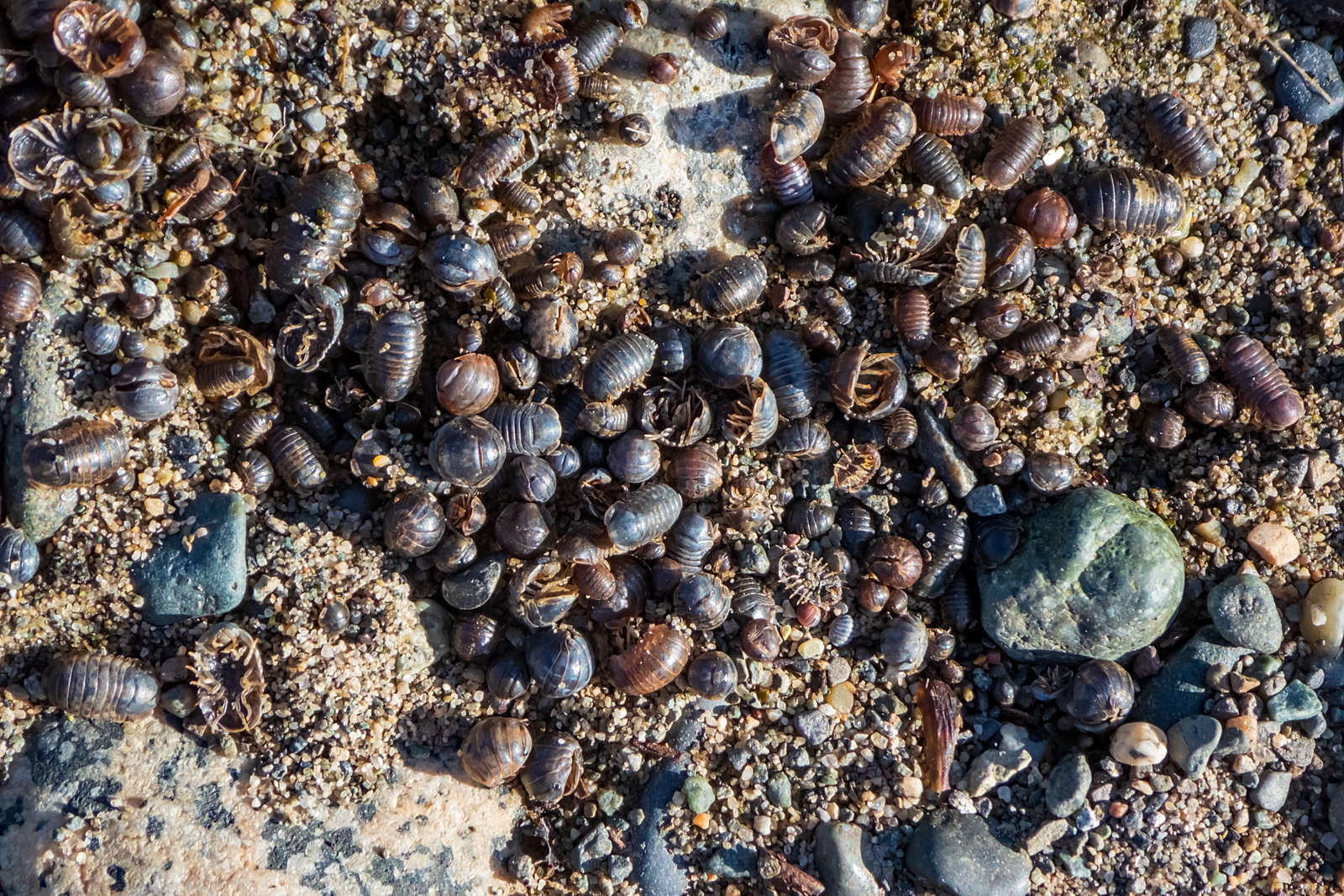
This time, they were everywhere, in great numbers. Every stone I turned over had a busy colony.
Stubby isopods, aka Oregon pillbug, Gnorimosphaeroma oregonense. Look closely; the eyes are visible, mostly on the pale brown ones.
These isopods are very similar to the woodbugs (aka pillbugs, woodlice, roly-polies, etc.) that feed in our gardens. They grow to about 1/2 inch long at maturity, although most of the ones we saw were the smaller harem females. Like the land-based pillbugs, they roll up in a tight little ball if they are disturbed. Just brushing them off a stone will do it; they land rolling.
Pillbug "pill" on the barnacles, lower right.
It's spring; party time, time to find mates and start the next generation. For the stubby isopods, that means sex changes and harems. The baby isopod hatches as a female. She becomes a member of a harem "owned" by one male, produces one brood, then begins a series of molts which transforms her into a male, ready to find his own harem of immature, smaller females. If the harem's male is removed, or dies, the dominant female in the group becomes a male to take his place.
(Most other crustaceans that switch sexes have a reverse pattern; the immatures are male, and they become female at maturity.)
The spring population explosion will not last; crabs and hermit crabs love a snack of unrolled isopod. Like the tides, life on the beach ebbs and flows.