Showing posts with label forgotten photos. Show all posts

Sunday, August 22, 2021

Forgotten eight

Stuck at home, doing a bit of housekeeping, decluttering the photo files, I found these forgotten plants.

Poppy in a friend's garden, June.

Elderberry flowers, along the highway north, April.

Hosta leaf after a rain, in my garden, July.

Unidentified red berries and leaves, Roberts Lake, May of last year.

Update: from the comments, this is Barberry, Berberis thunbergii or B. vulgaris.

Daisies, Buttle Lake, June.

Fern tip, by the highway north, May.

Fireweed, Mount Washington, July.

White rhododendron, Paradise Meadows, July.

And my knee has improved enough that I might possibly be able to get out to a shoreline tomorrow. I hope!

~~~~~~~~~~~~~~~~~~~~~~~~~~~~~~~


Encerrada en casa, me ocupé en organizar los archivos de fotos en la computadora. Encontré estas plantas olvidadas.

  1. Amapola en el jardín de una amiga, en junio.
  2. Saúco rojo, al lado de la carretera hacia el norte, en abril.
  3. Hoja de una hosta en mi jardín después de la lluvia, en julio.
  4. Unas frutillas rojas sin identificar, en Lago Roberts, mayo del año pasado.
  5. Margaritas al lado de Buttle Lake, en junio.
  6. La punta de un helecho desenrollándose al lado de la carretera hacia el norte, en mayo.
  7. Epilobio en el monte Washinton, en julio.
  8. Rododenro blanco, Las Praderas Paraíso, en julio.
Y mi rodilla sigue mejorando; creo que posiblemente, espero, podré salir de casa para ver el mar mañana. Ojalá.

Wednesday, April 29, 2020

Hydroid eater

The problem with digital cameras is that they are too easy. And too cheap. Well, not the camera itself, those are never cheap, but the photos are. I go out for a walk and come home with 300 photos to sort. With film, each film had only 24 photos, and each one had to be developed in a lab, and each one cost a fair amount; we couldn't just click, click, click, without thinking. So a day or two after we'd taken our photos, we sat down and looked them over; there were never more than 20 or so "good" ones, and only one or two would really be worth keeping.

When there are 300, even if half are duplicates, and another quarter are horrible, there are still 50 or more to look over carefully and to process. No wonder some get left behind to check out "tomorrow". Which of course, means 10 years down the line.

I found this one in a batch from 2010; photos of hydroids, almost microscopic hairy plant-like animals growing on eelgrass. On one of the branches, a sea slug was feeding.

Tiny nudibranch, lower left.

The lumpy, greenish appendages along the back are the cerata. They contain branches of the digestive tract, and the colour depends on what they are eating. Sometimes they contain stinging cells; the nudis are soft and look tasty; the stingers are there to discourage predators.

Towards the front there are two upright rhinopores, which dectect odors. The eyes (two tiny dots) are rudimentary, and probably distinguish only light and darkness. The two appendages in front are oral tentacles; more sensory organs, for taste and smell, and only the nudis know what else.

Most of the nudibranchs I've seen are between one and two inches long. Here's one that hitchhiked a ride to my tank, back in 2015.

The opalescent nudibranch, Hermissenda crassicornis. About 1 inch long.

Here you can see the cerata (Hermi has many), the rhinopores, and the oral tentacles in front.

~~~~~~~~~~~

El problema con las cámaras modernas, digitales, es que son tan fáciles de usar, y baratas también. Bueno, las cámaras no son baratas, pero las fotos que sacan sí lo son. Salgo a caminar y regreso con 300 fotos para revisar.

Con las cámaras antiguas, de película, cada rollo tenía solamente unas 24 fotos disponibles, y esas se tenían que mandar al laboratorio, que nunca salía barato. No hacíamos "click" sin pensarlo antes.

Y luego recogíamos nuestras fotos, unas 20 que el laboratorio había decidido que eran buenas. Y no lo eran; nos quedábamos con una o dos.

Ahora, con 300 de un solo paseo, aunque la mitad son dobles, y otra cuarta parte son horribles, todavía me quedan cincuenta o más fotos para revisar. Y resulta que muchas se dejan para procesar "mañana". Tal mañana puede no aparecer por 10 años o más.

Encontré esta en un grupo de fotos de hidroides, animales que parecen plantas miniaturas (casi como pelos), sacadas en 2010. En una de las ramas, descubrí un nudibranquio. (También se les llama babosa de mar, en inglés.)

Véase la primera foto: las ramas verdes en la espalda se llaman cerata, y contienen el sistema digestivo, lo que les da el color. También pueden contener células venenosas: los nudis son suavecitos y muchos animales los quisieran comer, si no fuera por esa protección.

Hacia adelante, se erigen dos "rinoporos", que sirven para percibir los olores. dos ojos (apenas visibles) que pueden distinguir la luz de la oscuridad y no mucho más, y en frente hay dos tentáculos bucales, para probar sabores, olores, y solo los nudis saben qué más.

La segunda foto es de un nudi mucho más grande que vino a pasar algún tiempo en mi acuario. Es el nudibranquio opalescente, Hermissenda crassicornis, y mide más o menos 2 centímetros de largo. Aquí se ven claramente las ceratas, de las cuales, "Hermi" tiene muchas, los rinoporos, y los tentáculos bucales en frente.

Tuesday, April 28, 2020

Double header

Another couple of photos from old storage. These were tiny critters from the aquarium, back in 2010. I had removed them to a plastic lid to look at them.

And here's a critter with two (or is it three?) heads.

Three stubby isopods, and one miniature hermit.

Hermits don't seem to mind having stuff piled on top. This little guy is carrying two stubbies.

Stubby isopods: about 6 mm. long. Their scientific name, Gnorimosphaeroma oregonensis, is 'way longer than they are.

The hermit, out from under the isopods. And a mussel, reaching out.

Mussels "walk" by extending a long foot, grabbing, and contracting the foot, reaching, grabbing, shrinking, over and over. It's a slow process, but they're not really in a hurry. Once they've found a good spot, they'll tie themselves down and stay put.

~~~~~~~~~~~~~~~~~~~~~~~

Estas son otras fotos que se habían quedado sin procesar, desde el año 2010. Son animalitos del acuario; los había puesto en una tapa de plástico para observarlos.

En la primera foto, aparece un animal con dos cabezas. O no; son tres criaturas amontonadas. Encima, un par de isópodos "chaparritos", Gnorimosphaeroma oregonensis. Y abajo, un cangrejo ermitaño, muy pequeño. Los isópodos miden 6 mm. o menos.

En la segunda foto aparece también un mejillón miniaturo, con su "pie" extendido. Los mejillones caminan extendiéndo ese pie, agarrándose de lo que toquen, contrayendo el pie, jalando el cuerpo hacia el nuevo punto de contacto. Muy lento, pero los mejillones no tienen prisa. Para la mayor parte de su vida, se van a quedar atados en un solo sitio. No necesitan buscar comida; filtran el aqua que los baña.


Saturday, April 18, 2020

Spring on the hard drive

It's April and my hyacinths are perfuming the entryway, the tulips are almost ready to open, the forsythia is dropping yellow petals on the lawn, and the first hairy cat's ear (grrrr!) has dug itself in. (And I dug it out.) There are bluebells on the way, and mock orange, and Dutchman's breeches. I've been out cleaning up, trimming the hydrangea and weeding around the hollyhocks. Ah, spring!

And on my hard drive, I've been sorting spring flowers from years gone by. Here are a few of them; most I'd never finished processing.

Indian plum, aka osoberry. A welcome native.

Humble wood violets.

Back in 2009, in a patch of blackberry canes and nettles at Terra Nova, we found these snowflake flowers.

Leucojum sp.

The site had been, long ago, a homestead; there were daffodils and old fruit trees. These had been in someone's garden before the blackberries moved in.

Aka dewdrop

Lily of the valley. From my old garden in Delta.

Half hidden in the shade at the edge of the woods at Woodhus Creek, vanillaleaf in bloom. The flowers don't last long, but the drying leaves are fragrant all summer.

And it wouldn't be spring without crocuses, would it?

~~~~~~~~~~~~~~~~

Ya estamos a medio abril, y mis jacintos están derramando su perfume frente a mi puerta. Los tulipanes tienen grandes botones, rojos y amarillos; la forsitia cubre el pasto de pétalos amarillos; y las primeras "orejas peludas de gato", una hierba invasiva y nociva, se han establecido en el césped. (Y ya las arranqué.) Hay campanillas, naranja falsa (Philadelphus sp.), y Dicentra, todavía sin flores. He estado podando las hortensias, sacando hierbas malas de entre las malvas locas, y haciendo limpieza general. ¡Ah, la primavera!

Y regresando a la casa y la computadora, he estado revisando fotos viejas de flores primaverales. Aquí hay algunas que encontré, casi todas del mes de abril, pero en años anteriores.

1. Oemleria cerasiformes, llamada Ciruela India, o también frutilla de osos.
2. Violeta nativa
3. y 4.  Encontramos esta planta bajo un lío de zarzamora. Se llama "copo de nieve".
5. Lirio del valle, de mi jardín en Delta.
6. "Hoja de vainilla", una planta nativa del bosque. Las flores caen pronto, pero las hojas siguen aromáticas todo el verano.
7. Y no hay primavera sin crocus.


Thursday, December 05, 2019

Bee and pale flowers.

A few more of my stored photos: These are from a couple of springs ago, growing on the museum lawns.

Unidentified Brassica, unidentified bee.

This one is developing its siliques.

I think I put these photos aside because I was stumped, trying to identify them without looking at the basal leaves or the rest of the plant. Foolish of me.

Wednesday, April 09, 2014

Blood-red eyes, and fly babies

Sorting photos from last year, I found several folders of still-unprocessed raw files. I've been plowing through these, and struck gold:

6 legs and 1000 eyes. (Or thereabouts.)

Syrphid, or hover fly.

These are from last July. In a later folder, of tiny critters holed up under rotting maple leaves, waiting out the cold snap, I found the next generation.

These are such pretty flies, but the larvae don't have any of the appeal of the adults. My photos are fuzzy; the larva was sopping wet, and I hadn't even seen it on the leaf until I was processing the photos. But I've looked them up on BugGuide and other places, and they don't get any better looking.

Spiky, splotchy, segemented larva. Eats aphids. Even in winter.

We're looking at it from the rear. Those pointed tubes at the back are its spiracles, or breathing tubes.

More discoveries to come...

Saturday, November 30, 2013

A gift for Little Momma

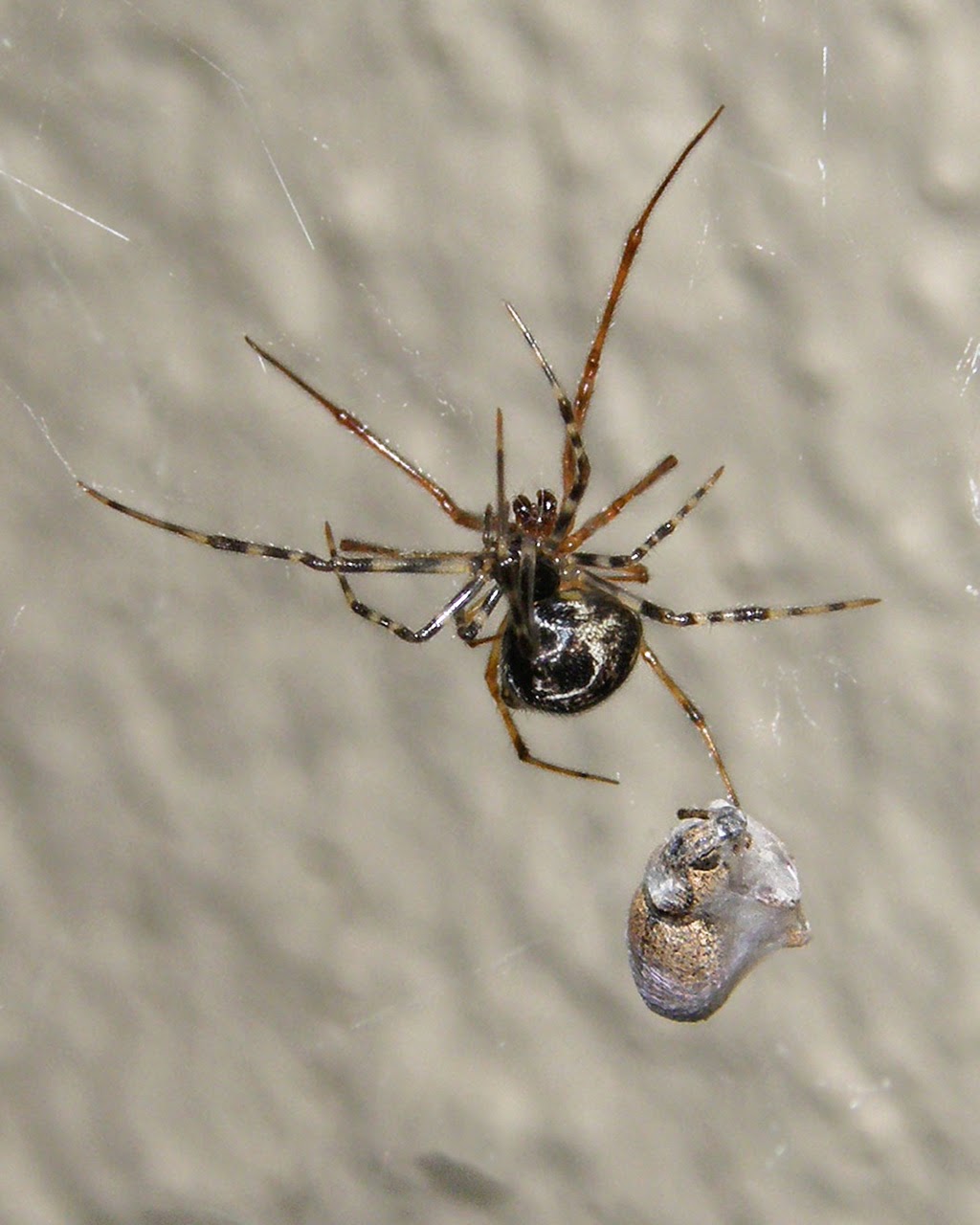
Sorting old photos, I came across a file of spider shots that I'd put aside "to deal with later", and then forgot about. They showed a pair of American house spiders, Parasteatoda tepidariorum, grandkids of the one I'd been tracking since 2007, still living in the same corner.

I obviously hadn't looked closely at them, back in 2009. I did today. Look what I'd missed!

Day 1, afternoon. Female in her skimpy web at the bottom, male visitor (suitor) at the top left. The fat, "boxing glove" pedipalps identify him as a mature male.

Day 2, 5:48 PM. He approaches with a gift, a silk-wrapped weevil.

Will she accept the gift? If not, she may eat him instead.

Yes! "Thank you very much; this is delicious!"

5:49 P.M. 16 legs. They're mating. He's on the far side; you can still see his pedipalps. She's not letting go of the weevil, though.

5:50 Success! He's impregnated her, and escaped uneaten. She's busy.

5:55 He rests, she eats.

And the next day:

Day 3, 5:07 P.M. She's finished with the weevil, but he's brought her a gift-wrapped bug.

And from what I remember, they raised a healthy brood of spiderlings, several egg sacs worth.

Powered By Blogger