Showing posts with label American house spider. Show all posts

Sunday, August 14, 2022

On the job

"Hello there, pretty spider," I said. "Thanks for guarding the hose for me."

And she turned her back on me.

Parasteatoda tepidariorum, the American house spider.

Fang, though, was more forthcoming:

Giant house spider, Eratigena duellica, patrolling the kitchen, keeping out the flies.

Shy or not, they do a good job. Thanks, girls!

~~~~~~~~~~~~~~~~~~~~~~~~

"Hola, arañita linda," le dije. "¡Gracias por ayudarme a proteger la manguera!"

Y se dió vuelta y me presentó la espalda.

Foto: Parasteatoda tepidariorum, la araña casera americana.

Pero "Fang" (colmillos) era menos tímida.

Foto: Eratigena duellica, la araña gigante casera, cuidándome la cocina, manteniéndola libre de moscas.

Tímidas o extrovertidas, hacen buen trabajo. Se lo agradezco.

Tuesday, September 07, 2021

Welcome visitors

 Trying to decide which are my favourite spiders; house and garden edition.

These, I think, are my favourites. Cross spider, Araneus diadematus. Such pretty patterns! And gorgeous webs! In the carport.

No, these are my favourites. Egg case of American house spider, Parasteatoda tepidariorum. Patient parents. Lawn and garden clipping bag.

No, actually, I think these are my favourite spiders.Giant house spider youngster, Tegenaria gigantea. Speedy security guard. On my bedroom wall.


Or maybe it's this one, so fragile-lookiing, so elegant! Cellar spider, Pholcus phalangoides. In a corner of my bedroom, with family everywhere, inside and outside.

But then there are the jumpers, who haven't been visiting lately, but I'm always glad to see them. And the wolves. And the crab spiders. And ...

I give up. They're all wonderful.

~~~~~~~~~~~~~~~~~~~~~~~~~~
Tratando de decidir cual de todas las arañas que me visitan son mis favoritas. Estas, las de la casa y el jardín.

  1. ¿Estas? Araneus diadematus. Porque son tan bonitas, y hacen telarañas muy lindas. Esta está en la cochera.
  2. O estas. Parasteatoda tepidariorum. Araña casera americana. Tan pacientes con sus crias. Este es un saco de sus huevos, en la bolsa de desechos del jardín.
  3. O no, estas son las favoritas.Tegenaria gigantea. Araña casera gigante. Guardianes de la casa. Este es un jovencito en la pared de mi recámara.
  4. No, mejor son estas. Pholcus phalangoides. Una araña fólcida. ¡Tan elegantes, y parecen (pero no son) tan frágiles! Esta espera su presa en una esquina; sus familiares están por todas partes, adentro y afuera.
Pero se me olvidan las saltarines, las cuales no han venido a visitar recientemente, pero siempre son bienvenidas. O las arañas lobo. O las arañas cangrejo. O ...

Me rindo. Me encantan todas.


Friday, August 09, 2019

Full pantry

A couple of weeks ago, in a dark corner at the entrance to my carport, I noticed a tangly web, filling the whole corner. With a tiny spider near the centre. And an egg case she was guarding.

She's a common house spider, Parasteatoda tepidariorum, a good fly and moth catcher.

She catches more than flies, though. Last week, she had the leftovers from her latest meal hanging in the web.

Unidentified spider, probably Tegenaria domestica. Three times or more the size of his captor, not counting those long legs. Meals for a week!

How she does it: she stings the joints in his legs, where he has a flexible membrane rather than the hard exoskeleton, over and over, darting in and backing off before he can catch her. She knows her web; he doesn't, and gets stuck on the glue she avoids.

Spiders extend their legs using hydraulics, rather than muscles, as we do. To run, they increase the pressure in the cephalothorax (the head/upper body section), sending blood down the legs. Small muscles then return the liquid to the body, returning the legs to the relaxed position. So a shot of paralyzing poison to the legs soon invades the whole body. (From a previous post: see the entire story, "Unequal match: the sad story of Fang", here.)

When I found it, she had eaten her fill, and cleaned up most of the web she used to tie him up, leaving a bit holding that one leg. She eats the leftover web, too; spiders recycle.

The egg sac was empty yesterday, and no spiderlings were in sight. I swept up the corner and the messy web. I'm sure it will be back in a day or two.

Wednesday, November 07, 2018

Spider search

It was the tail end of Arachtober, and I was running out of spider photos. Oyster Bay seemed a good place to look for a new candidate. I stopped first, to look at the trees in their glorious late fall outfits.

From the meadow, looking back at the parking lot.

Then on to snoop in the corners and crevices.

First find: a cherry-faced meadowhawk. On the parking lot fence.

Under the eaves of the public washroom (centre, top photo); a tightly-wrapped cocoon.

I found one of these cocoons on my doorstep four years ago. I kept it in a container for a month, and a wasp emerged. BugGuide identified it as a parasitoid wasp, but the cocoon would have belonged to the larva of a caterpillar. I couldn't reach this one to capture it; I may go back with some long-handled tool.

Also on the washroom: a house spider with her four egg cases. Too small, too high above my head for an Arachtober photo.

And finally, on the pilings by the shore, a running reddish and black spider. Mission accomplished.


Saturday, November 30, 2013

A gift for Little Momma

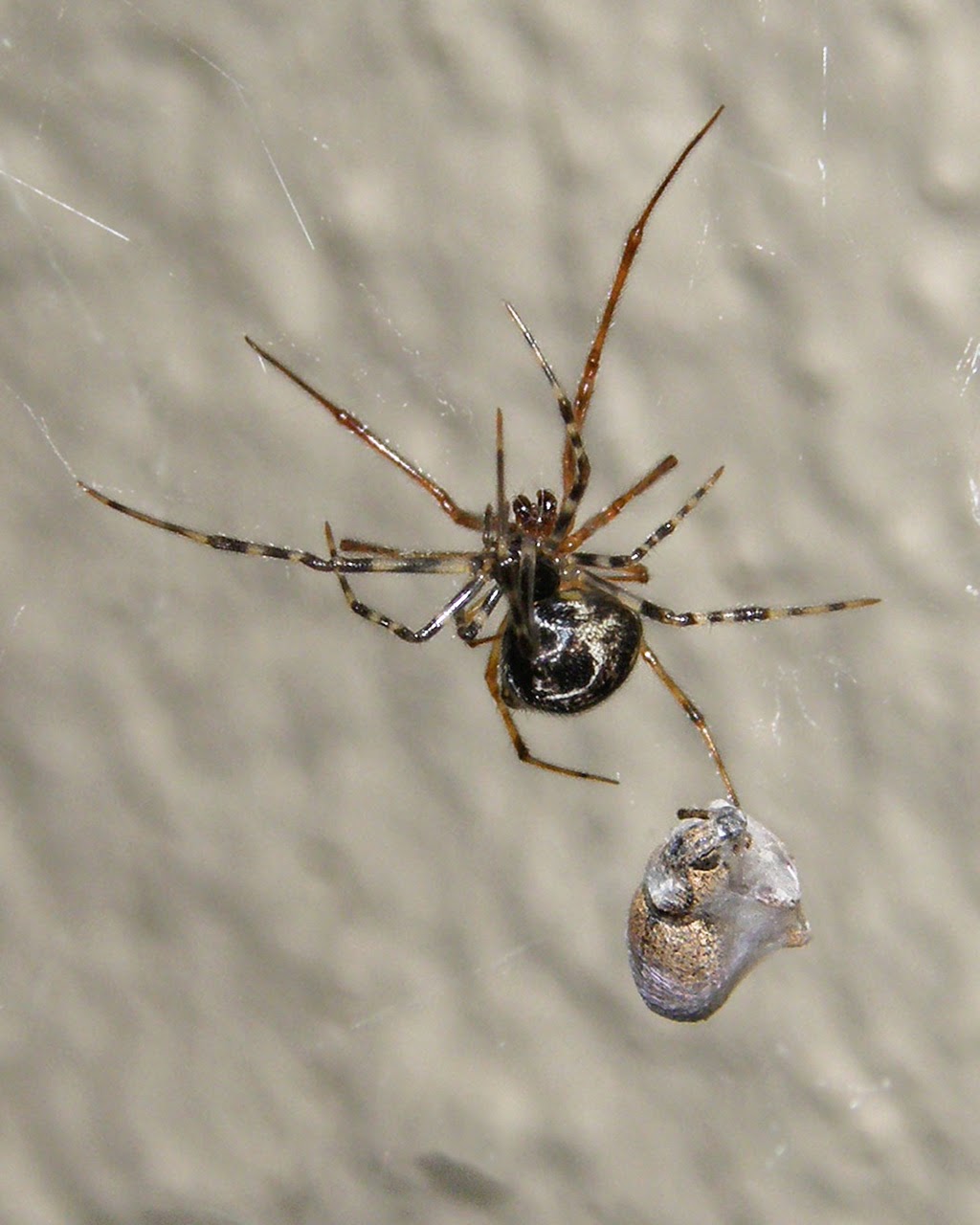
Sorting old photos, I came across a file of spider shots that I'd put aside "to deal with later", and then forgot about. They showed a pair of American house spiders, Parasteatoda tepidariorum, grandkids of the one I'd been tracking since 2007, still living in the same corner.

I obviously hadn't looked closely at them, back in 2009. I did today. Look what I'd missed!

Day 1, afternoon. Female in her skimpy web at the bottom, male visitor (suitor) at the top left. The fat, "boxing glove" pedipalps identify him as a mature male.

Day 2, 5:48 PM. He approaches with a gift, a silk-wrapped weevil.

Will she accept the gift? If not, she may eat him instead.

Yes! "Thank you very much; this is delicious!"

5:49 P.M. 16 legs. They're mating. He's on the far side; you can still see his pedipalps. She's not letting go of the weevil, though.

5:50 Success! He's impregnated her, and escaped uneaten. She's busy.

5:55 He rests, she eats.

And the next day:

Day 3, 5:07 P.M. She's finished with the weevil, but he's brought her a gift-wrapped bug.

And from what I remember, they raised a healthy brood of spiderlings, several egg sacs worth.

Powered By Blogger