Showing posts with label tegenaria. Show all posts

Tuesday, September 07, 2021

Welcome visitors

 Trying to decide which are my favourite spiders; house and garden edition.

These, I think, are my favourites. Cross spider, Araneus diadematus. Such pretty patterns! And gorgeous webs! In the carport.

No, these are my favourites. Egg case of American house spider, Parasteatoda tepidariorum. Patient parents. Lawn and garden clipping bag.

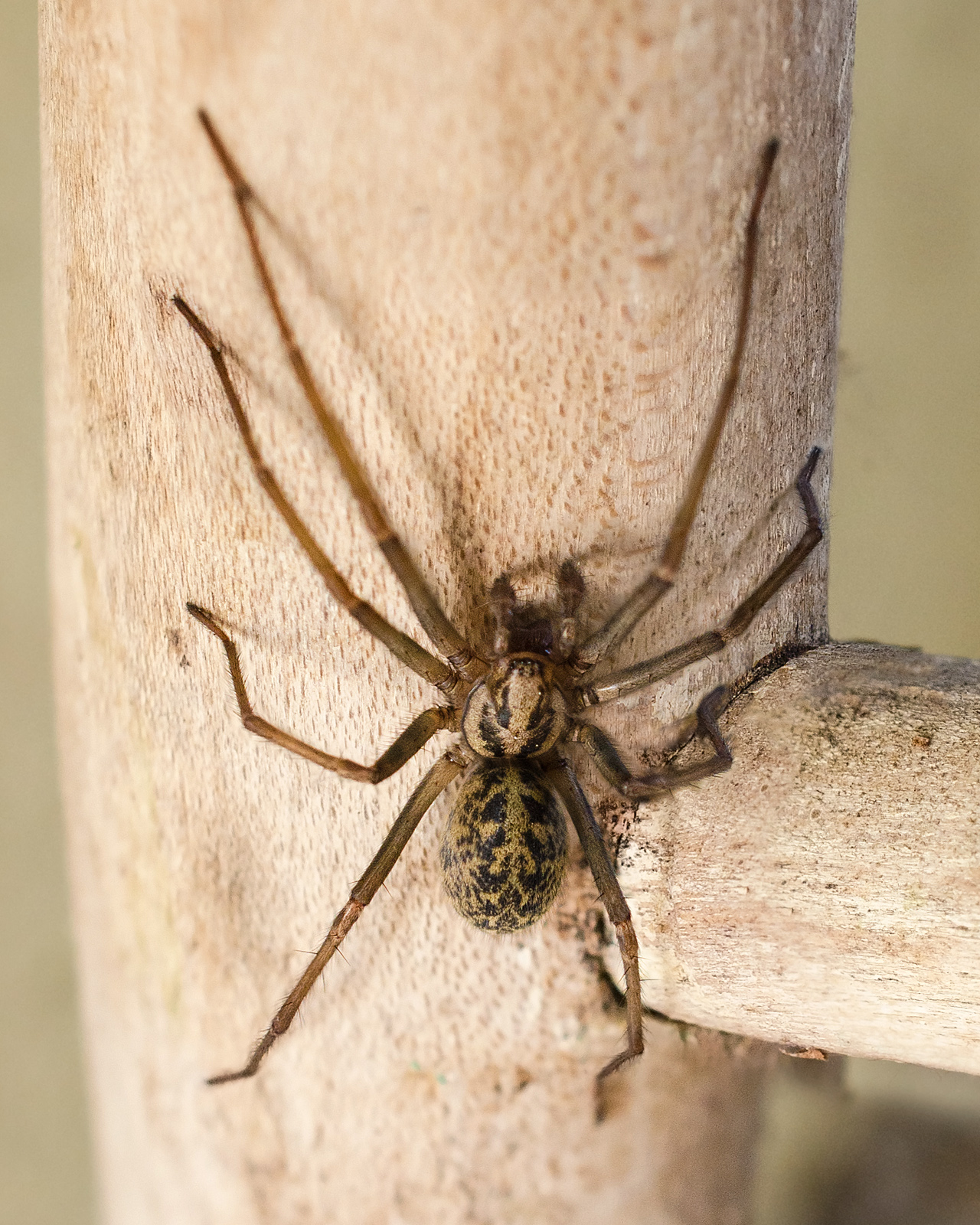
No, actually, I think these are my favourite spiders.Giant house spider youngster, Tegenaria gigantea. Speedy security guard. On my bedroom wall.


Or maybe it's this one, so fragile-lookiing, so elegant! Cellar spider, Pholcus phalangoides. In a corner of my bedroom, with family everywhere, inside and outside.

But then there are the jumpers, who haven't been visiting lately, but I'm always glad to see them. And the wolves. And the crab spiders. And ...

I give up. They're all wonderful.

~~~~~~~~~~~~~~~~~~~~~~~~~~
Tratando de decidir cual de todas las arañas que me visitan son mis favoritas. Estas, las de la casa y el jardín.

  1. ¿Estas? Araneus diadematus. Porque son tan bonitas, y hacen telarañas muy lindas. Esta está en la cochera.
  2. O estas. Parasteatoda tepidariorum. Araña casera americana. Tan pacientes con sus crias. Este es un saco de sus huevos, en la bolsa de desechos del jardín.
  3. O no, estas son las favoritas.Tegenaria gigantea. Araña casera gigante. Guardianes de la casa. Este es un jovencito en la pared de mi recámara.
  4. No, mejor son estas. Pholcus phalangoides. Una araña fólcida. ¡Tan elegantes, y parecen (pero no son) tan frágiles! Esta espera su presa en una esquina; sus familiares están por todas partes, adentro y afuera.
Pero se me olvidan las saltarines, las cuales no han venido a visitar recientemente, pero siempre son bienvenidas. O las arañas lobo. O las arañas cangrejo. O ...

Me rindo. Me encantan todas.


Tuesday, August 28, 2018

Morning visitor

Why it's never a good idea to leave dishes in the kitchen sink overnight. Because in the morning, you'll have to chase this guy around and under dirty dishes.

Sowbug hunter, in a clean, dry sink.

I gave him a dishrag to help him climb up the slippery walls, and he showed his appreciation by posing for me.

He's just under 2 inches, toe to toe.

Tegenaria domestica, again. Harmless, except to sowbugs.

Sunday, August 26, 2018

Thursday, July 12, 2018

And a few more spiders

They're exploding all over! Up in the corners, young cellar spiders hang, leggily. Miniature males, species unknown, prowl the walls looking for fat females. (Wrong place, guys! The girls are just outside the window.)

And at ground level, the big hunting spiders guard the fort against sowbugs and stray cobweb spiders.

A big male, on the leg of a garden chair. (I disturbed his cozy hiding place under my yard waste bag.)

And another, in the house, at the edge of her messy web on the bottom of a Mexican shopping bag.

Look at that web again. In the frass, there's the remains of her last molt, down in the right-hand corner; the leftovers from another spider meal; half a sowbug, all the juices sucked out; and something squarish that I can't identify. A beetle, maybe?

These spiders are difficult to identify. There are three similar species, and the rules for identification have changed. I think these are Eratigena agrestis, but then again ...

Years ago, they were called Tegenaria. Worried about the bad name some of them have, I wrote a post listing some of the differences between the species, here. But since then, they've been re-classified as Eratigena, an interesting name because it is an anagram of the letters of Tegenaria.

From BugGuide, on the Giant House spider, Eratigena duellica:

This spider (like its relatives T. domestica and E. agrestis) was imported from Europe into the ports of the Pacific Northwest. The first known N. American record was from Vancouver Island in 1929. It did not reach Seattle until 1960. 
The greater European house spider (E. duellica) is not dangerous to people. Some people may be intimidated by their size as male legspans can reach 4 inches (100 mm). However, Rod Crawford has never known one to bite a human (though they certainly could if they tried); they are so docile he uses them as hands-on demonstrators for school children. 
The Hobo Spider (E. agrestis) is often confused with this spider. If you are unsure of the exact species, just be mindful of this confusion, and use caution when dealing with the spider. (See E. agrestis for more information about the hobo spider). 
The presence of giant house spiders is a deterrent to the establishment of hobo spiders indoors. It out-competes and displaces the hobo spider indoors and male giant house spiders often kill male hobo spiders (without necessarily eating them)!

So it's still wise to keep my distance from these spiders. Unless I can measure the legs; they look the same as the harmless giant, and are about the same size, except for those long legs. And if E. agrestis bites, it could be a bit of a problem.

This little guy's no problem at all:

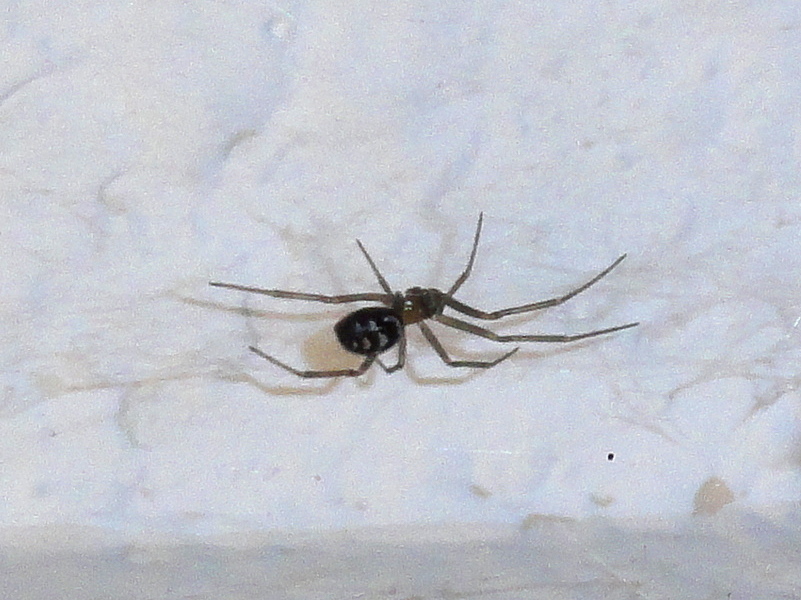
High on the wall, out of the hunter's range, a tiny yellow and tan spider, stopping for a rest. It's so far to where the girls are!

Wednesday, April 08, 2015

Good provider

Laurie was always on the lookout for good spiders for me. And even though he's gone now, he left me well provided for. Cleaning out his gardening supplies this afternoon, I found some of them.

A nice little fat steatoda on a plastic bin.

And a good sized tegenaria on a 2x6.

I only had the little pocket camera nearby; I hadn't thought of spiders before I started work. And by the time I'd run to get the big camera, the critters had all gone into hiding. When I do his garden tool chest, next, I'll start work with the good camera within reach.

Sunday, June 26, 2011

Spider sampler

We've been finding spiders these days, everywhere we go. Some are new to me; others are old friends. Here's an assortment:

One of the ubiquitous cross spiders, Araneus diadematus, outside our door, in his tattered web.

These spiders are often very pretty.

Nieta, my resident American house spider, Parasteatoda tepidariorum. She's getting fat. I expect to see eggs any day now.

A tiny male, hanging out near Nieta's web in hopes of love. Or at least not being eaten before they mate.

Another of  the web builders. Probably Hibana sp.

A very small, fast spider, unidentified. Philodromus dispar. Thanks, BugGuide!

This one's smaller still; 3 mm nose to tail. Round from the top view, flat from the side. Very alert; good eyesight. Unidentified.

Another unidentified spider. Makes skimpy webs along walls, ceilings. This one was far above my head.

Zebra jumping spider, Salticus scenicus.

And a different jumper, on a blackberry leaf in White Rock. I couldn't identify this one. BugGuide has 9000 jumping spiders. I gave up half-way through.

A wolf spider, Arctosa perita, on the sand at Centennial Beach.

A big Tegenaria ran out of a planter box I was carrying. I didn't get a photo; I screamed and tossed the box onto the ground, and the spider escaped. I somehow can't get rid of that reflex, a leftover from ancient trauma. The story is here; Sleeping with tarantulas.

Tuesday, August 04, 2009

Spiders, spider lunch, and a beetle too big.

Where there are moths, there are also spiders. Well-fed spiders. At the Stonewater on the Sunshine Coast, they are large and fat, their colours are bright and their webs full.


The cross spider, Aranea diadematus, digesting breakfast. One of many.


A smaller cross spider, showing off her bright coat.


Parasteatoda tepidariorum, the American house spider. (aka Achaearanea t...) Look at that round belly!


An unhappy Tegenaria. Grumpy, because I had just stolen his lunch.


A baby cross spider with an unidentified snack.

And this was (supposed to be) lunch for the Tegenaria. I untangled it from the web and set it free.


A Flower Longhorn beetle, Ortholeptura valida. Well over an inch long, not counting the antennae.


Another Longhorn, from Campbell River. Look at the shape of the compound eye; not quite rounded, and notched on the front end.

I found this next Longhorn a bit farther north, at the Saltery Bay ferry landing. I saw it through the window of the terminal office, and asked permission to go in and take a few photos. It's almost two inches long, solid, slow-moving, and harmless; the officer on duty was leaving it to make its way across the floor undisturbed.


Huge Longhorn beetle, Tragosoma depsarium.


I got right down on the floor with it, and it stuck out its mouthparts at me.

I couldn't find much information on this beetle, other than that it is a Holartic species, on the endangered list or extinct in parts of Europe, because it lives on decaying conifer wood in undisturbed forests. (How many of those can be found, these days? Even here in BC?) BugGuide has a few photos, one taken in Golden, BC, another across the border in Washington.

.

Thursday, April 23, 2009

At home in the garden

It was Earth Day. And I spent most of it up to my elbows in the stuff. Earth.

First, I re-potted and trimmed all but one of my houseplants. Then I moved outside, and repotted most of the outside container plants, divided the hostas, transplanted some of the London Pride*, trimmed the evergreens, ripped out a mountain of moss, top-dressed the second half of the garden with manure, and repositioned a wire fence.

A pleasant, contemplative day; I love digging in the dirt!

For the smaller hostas, I decided to use a planter box that had spent the winter upside-down in a dry spot. When I flipped it over, I found it full of spider webs. I brushed some away, and a big Tegenaria rushed out.


Tegenaria domestica, probably.


Good view of the row of eyes.

Several clumps of frass hung in the box; I fished this one out to examine it.


Frass

I thought I could identify what she's been eating, but other than that ridged thing, which I think is the remains of a woodbug, nothing there is identifiable. Yet it all came from her food, since nothing could fall into her cozy upside-down house; it all walked or slithered or crawled in through the cracks between the boards. She's quite a tidy housekeeper, and ties up her garbage and hangs it out to dry well away from her nest area.

There's always the worry, with these; is she a hobo spider, T. agrestis? Does she bite, is she aggressive, is she venomous? I went back to check my list of identifying marks from last year.

Let's see: I didn't get a look at the underside, nor the top of the cephalothorax. But she has dark rings around her legs, and pointy pedipalps. She's not a hobo; no need to evict her.

I put the box back where I found it, and found another planter for my hostas.

*This (the London Pride link) was from my previous blog. Reading it over, I found a few posts that I think are worth reposting on this blog, starting with my "Shade garden" series, since we're in planting season again.

.

Tuesday, April 21, 2009

To spin or not to spin

I will never catch up. Ever.

I've got half a dozen bugs in bottles and boxes on my desk, waiting to be blogged about; my extra hard drive is full of folders labelled, "Blog these"; I've got bookmarks, books, lists of links; the garden is growing, the bees are visiting ...

I need a week, just now and then, with 9 30-hour days in it. Please?

Or I can just get a move on. Starting with a batch of spiders.

1. I flipped a rock today. On the bottom, I found this large web:


Spider web. With average-sized dried maple leaf for comparison.

I didn't want to disturb the spider inside, but I did get a bit of her in one photo; there's a fat, round, brown and black spider body visible just under the centre, and the tip of a couple of legs on the left side.


2. On the rhododendrons along the walk, the pretty cross spiders are setting up shop. They're still very tiny; barely bright dots where the sun hits them.


Araneus diadematus.

They all, without exception, arrange their round web in front of the vegetation, and sit motionless in the centre, always with their topside facing out, head down.

3. I found this Philodromus dispar in my hallway, captured him, and photographed him in the viewing tin. He (his pedipalp has a thick, blobby end, which identifies him as male) didn't appreciate the attention, but frantically ran around and around, looking to escape, so I quickly let him go, beside the door to the outside, leaving him to make the choice; outside or inside. He chose inside.

I saw him later, roaming in the bathroom. The next day, he was on a lamp in the living room, and later on the wall over my desk. He doesn't make a web. He's a hunter, looking for a mate, probably.


Black and white running crab spider. Always recognizable, because he's lost one of his pedipalps.

4. And this is my Brownie, lurking in her jar:


Steatoda bipunctata

She makes a messy web, with lines going every which way, some sticky, some to be used as paths or signalling threads. She hangs upside-down, after the manner of a house spider, but chooses different spots according to her whim of the moment. Usually, she is under some sort of shelter; a leaf or a clump of frass. Here, she is under the thick stem of a dried leaf.

When a woodbug (her favourite food) falls into the web, she springs into action. But instead of heading directly to the bug, she climbs to the top of a thread, then angles down to reach the bug from overhead. She bites it, then ties it up with silk, using her back legs to manipulate the threads. Once it's tied up, she drags it off, and hides it under another leaf to eat later on.

5. I found this big spider on a garden wall in Tsawwassen:


Large hunter, Tegenaria sp.

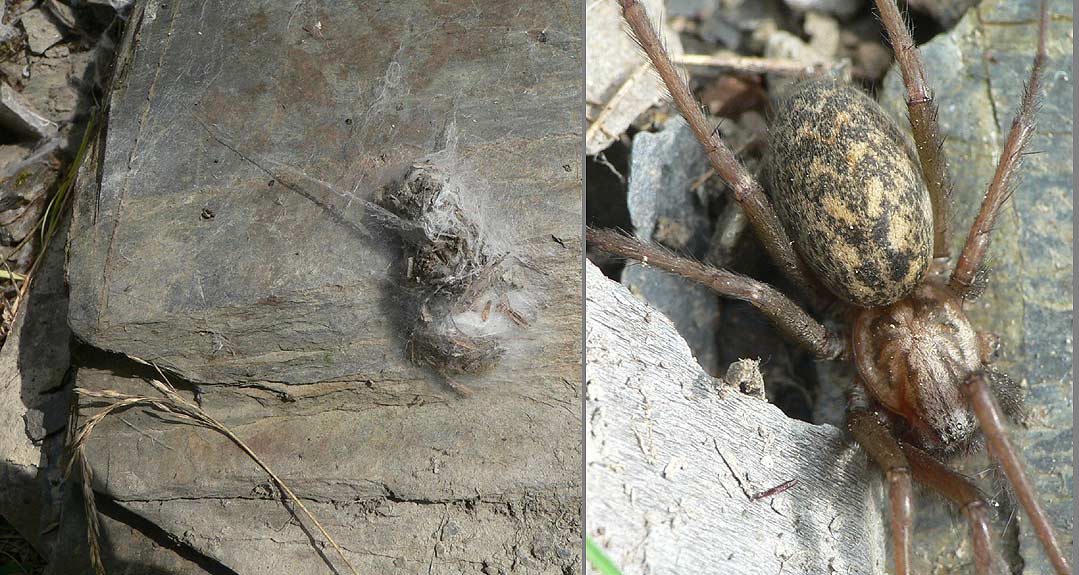
Tegenarias are web spiders, but I often see them laying in wait under a bit of shelter, without a web. This one was under the overhang of the top of the wall. A couple of feet away, I found an egg mass, probably hers. You can see the individual eggs under their blanket of webbing. (Photos of egg sacs of other Tegenarias, here and here.)


Spider egg mass.

6. This is a jumping spider that I have never seen before. The usual jumpers I see are those zebra-striped ones. This was a bit bigger, a lot more curious; he kept dancing around, trying to get a good look at the camera.


See those headlight eyes! No fly can sneak by, unobserved! I have seen a jumping spider leap almost 4 inches to catch a fly in mid-air. No web is needed.


Jumper. Side view. Eyes on the top of his head. Handy.

And for a change of scenery, here's a corner of my garden.


I didn't see any spiders on this plant.

.

Saturday, March 08, 2008

Identifying Tegenaria

We rearranged the potted plants in the back patio yesterday, and I took the opportunity to clean out the corners. In one of them, against the house wall and behind a stored board, where it would be warm and dry, I found a pair of spiders.

The large one, probably more experienced, disappeared down a hole within seconds. The tiny one tried to pretend she* wasn't there. Even though I brought the camera to within an inch of her, she didn't twitch. She stayed put while I swept down the wall, detouring around her, and didn't leave until I had gone to put away the broom.

So I got a few photos.

tegenaria
With flash.

tegenaria spider
With a desk lamp; softer light, and allowing for a closer approach.

It's a Tegenaria. Which may or not mean trouble. Tegenaria agrestis, the "hobo spider", has been long accused of aggressive behaviour and dangerous bites, which can turn tissue necrotic or cause allergic reactions. But T. domestica or T. duellica (gigantea) may be harmless.

Which is she? It is impossible to be sure without a microscope. BugGuide says,
The actual spider (not a photo) needs to be examined by an expert for a definite identification.
From a link on that page, though, I found a useful article; "How to identify (or misidentify) the hobo spider". How to tell if your spider is NOT a hobo. Just what I needed!

If the spider has any of the following, it is NOT T. agrestis. And probably not dangerous:
  1. Spots on the sternum.

    I couldn't check this, since I didn't capture the spider.

  2. Distinct stripes on the cephalothorax.

    Let me see... The cephalothorax (head-chest) is the front section. Very definite stripes down the back. (photo 1.) Not a hobo.

  3. Dark rings around the legs.

    Black and brown striped legs. Not a hobo.

  4. Shiny dark orange legs with no hair.

    Photo 2. Dull legs, with some hair. Not a hobo.

  5. Long, pointy palps (Two "grabbers" in front of the eyes).

    I didn't get a look at the palps.
So that's a relief. By the size (not enormous), I would guess these are probably T. domestica.

Now this one, on the other hand:

tegenaria
Broken marks on cephalothorax, not definite stripes. (See photo below) No spots on legs. Hairy, though. Blunt palps, I think.


Compare her with this one, positively identified as a hobo, on BugGuide:


I found her in about the same spot, last June. And it seems possible that she was a hobo. Next time, I'll capture any I find, carefully, flip it over, and examine the sternum, too.

For now, I shake out my back door shoes every time I put them on, and keep gardening gloves handy. I don't want hobo bites on my toes or fingers.

~~~~~~~~~~~~~~~~~
* She, because the palps, what I could see of them, seem to be of uniform thickness. Male spiders carry heavy, bulbous palps.
.
Powered By Blogger