Elk Falls is a roaring, foaming waterfall, at the bottom of the Campbell River canyon. Not a high fall, as falls go; the free-falling, plunge section of the falls is only 89 feet (27 metres), but still, it's an impressive sight and sound from a platform on the opposite side of the river.
Top end of the falls. The gorge is too narrow, the platform too close to get a photo of the whole falls.
The view from this lower platform, going backwards, up-river:
Bare rock, once washed by the much wider river; now a major part of the flow has been re-directed to the turbines, to provide electrical power to a large part of Vancouver Island.
And moving the gaze up-river again:
Still waters, barely seeming to move.
From the suspension bridge above, the bottom of the falls is visible, although through high (over my head,) daunting chain-link fencing. I took photos of the fence, instead:
Shy jumping spider and top of fence.
First huckleberry of the year. I ate it afterwards; it was sweet, but not too sweet.
On the way back up, near the top of the canyon, the fence is less forbidding. With snooty robin, who disapproved of my presence on his trail.
And at the top, beside the parking lot, the fence is temporary. And protects a young deer from traffic.
I've been following this little jumper around with the camera for days. When I took this, he was visiting my bedside table; now he's on my dresser.
He's tipped back, gluing a tracking webline to the book.
Jumpers are not cobweb builders, but they do travel at the end of a silk line, which enables them to drop and dangle off a "cliff" or the edge of my bedside table, in this case. They also make themselves safe spaces, silk shelters under leaves or the loose bark of a tree. One (not the bookworm) has build himself a hammock in the corner of my ceiling today and appears to be resting there.
It's been a while since I've been to Tyee Spit, mostly because there's no shade, and this summer has been hot. But suddenly, it's wet and cold; time to go looking for mushrooms. Tyee Spit is a good place for them.
And for watching the light over the water. I walked the shore a couple of hours before sundown, facing the dying light.
Stumps along the shore
Distant loon. The shore plants are broom (grrrr!), Oregon grape, and blackberry.
Just grass
More shore "weeds"
Turning to face away from the light. The tail end of the Spit from a new viewing platform. Grey weather, but it's not raining, for now.
Today's spider for Arachtober is a pensive jumper.
A pair of red and black jumping spiders were patrolling the wall outside my window in the late afternoon. Like all jumpers, they were very active, and it was difficult to get near without trampling my flower bed.
Phidippus sp., probably P. johnsoni, possibly female. A large spider, almost 1 cm. long
This one, slightly smaller, may be a male.
If these are Phidippus johnsoni, the female will have a black stripe down her back, while the male's back is almost entirely red.
Double selfie in PJ's headlight eyes.
The fangs have a greenish sheen; I tried to get a decent look at them, but neither of the two wanted to cooperate. I know where to look for them now, so I'll try again another day.
He was tiny, so small that at first I thought he was just a crumb on the countertop. But then he turned to look at me.
"Who are you, and are you good to eat?"
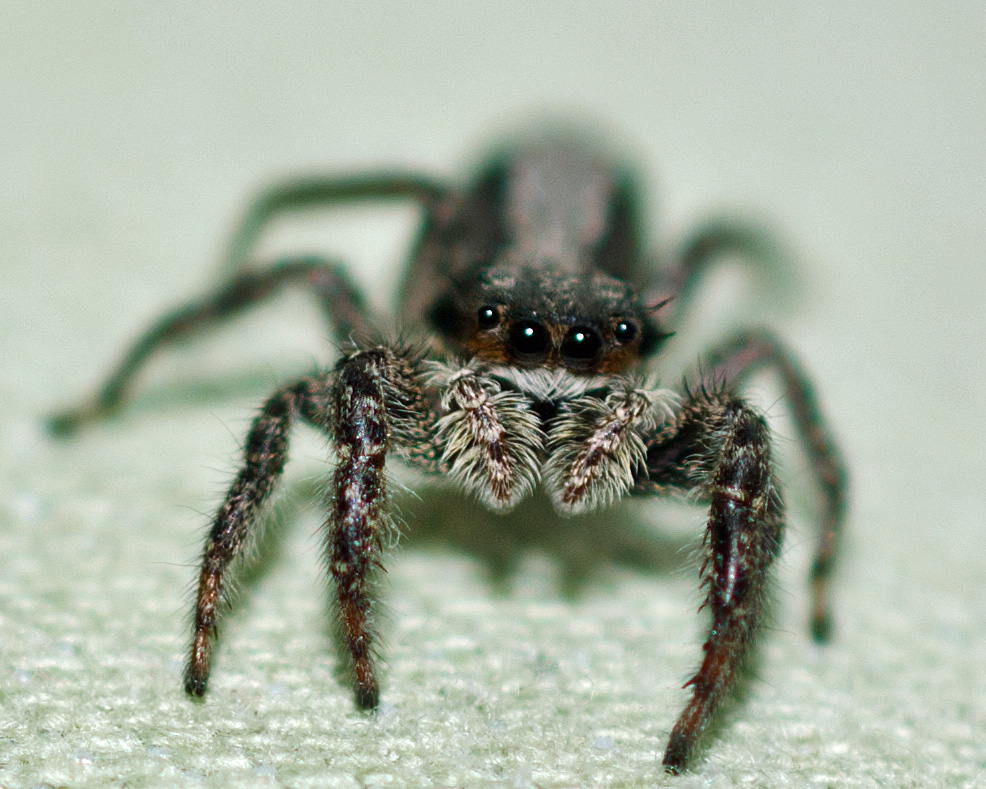
Look at those eyes! In the first photo, you can see deep into their depths.
Jumping spiders have excellent vision; with those headlight eyes, they can see colour and distance, probably better than I do, although over a much more limited area. And then, there are all those other eyes, so useful! Every human parent should be asking for a few of these! There are four side-facing eyes, and a pair that looks straight backward. They don't see as well as the front pair, but they can detect motion and shadow, so that little Salty, here, saw me as soon as I moved in his direction.
I found an article on Wired by Gwen Pearson, Spider Vision Made Clear, describing the movement and focusing of a jumping spider's eyes, and including this video, where the head is transparent, and the inner workings are visible. Watch:
The movement you’re seeing in the video is the front eye tubes and the muscles that adjust and point them. There’s a second lens at the end of the tube, and unlike the outer lens it’s flexible. Basically, jumping spiders have built themselves two little telescopes. By adjusting the angle and shape of the inner lens, the spiders can focus and zoom in on what they are looking at. (Gwen Pearson, Wired)
Diagram of a Salticid eye, from the fabulously named paper, “‘Eight-legged cats’ and how they see”. Illustration: Fair Use; OA primary research
Salty watched my camera lens for a while; that one big, black eye! What monster was looking through it? And then he decided it wasn't going to leap or do anything but shine lights in his eyes, and it wasn't edible, anyhow, so he turned his back on it and went about his business. Watching me behind him all the time, I'm sure.
Look what I found in my bed when I made it this morning!
The largest jumping spider I've ever seen.
Yikes, again!
On my pillow. Facing the camera, checking me out.
Now she's* on my headboard. Hairy fangs, with skinnier hairy pedipalps in front of them.
She's longer and thinner than the jumpers I've seen around here before.
Watching me still, with the eyes in the back of her head.
*I'm assuming she's female because of the thin pedipalps.
I don't know if she shared the bed with me, or if she came in through the window while I had breakfast. I captured her, and carried her a long way away from that window before I released her.
How far do jumpers travel? I'm sleeping with the window closed tonight, even if I'm suffocating.
In a mass of tiny pink flowers at the Secret Garden, I surprised a pretty jumping spider:
Unidentified flowers.
Jumper*, turned to look at my camera lens cover, dangling on its cord. I couldn't get him** to look at the lens.
I love how the pink flowers are reflected in his shiny skin.
More reflections.
Some of the buds have a spider-head look about them, too. Pink jumping spiders!
If a prey insect sees different colours than we do, does the spider just blend in to his surroundings? I wonder.
*By the markings on his back (white forward border, two dots, upside-down V, two more dots), he's a Phidippus audax, the Bold jumper. But all the ones I see on BugGuide are on the east side of the continent. Most of the Bold jumpers have green fangs; I didn't get a chance to see his.
UPDATE: I found him in one of my books; his range is listed as "Throughout North America".
**I never got to see this spider head on, so I don't know if it's male or female. But I don't like "it" for a critter with a mind of its own, so I choose whichever comes to mind first.
I'm still sorting photos. I keep running across files that I had put aside for later, and then forgotten. I've started a list to be processed and posted; some are from as far back as 2009.
I found this tiny spider on a rock this afternoon, in a photo series from 2012:
"Hey! Who are you? And no, you can't have any of my lunch! Scram!"
Did she know she had such a large, threatening shadow? I doubt it, because when I came a bit closer, she dropped her meal and jumped back to assess the situation. I stopped moving, and she came right back to pick up where she left off.
"Better grab it quick or that nasty one-eye will take it. She can go catch her own. I'm not sharing!"
Looks like her meal was another spider, or maybe a small harvestman. She was welcome to it.
This zebra jumper was waiting for us on the wall by the door the other day.
An active little critter, constantly turning to get a better view of the camera.
And around the corner, on an Oregon grape, I found this red-brown jumping spider.
A smaller spider, even more alert, jumping from leaf to leaf to bud, checking me out.
I noticed, browsing through BugGuide once again, how many people described their jumpers as "cute". It was the word I had used, to myself, about this second spider. Smaller than the zebras I see more often, and very interested in my camera, staring it down. I think it's the big "headlight" eyes, too big for the spider's tiny face, that we find appealing.
But I was trying to get a look at the other six eyes. The jumping spider has the two big eyes at center front, then two smaller forward-facing eyes beside them.
Typical arrangement of Jumping spider eyes. From BugGuide.
The other four eyes are on the side and top of the cephalothorax, the combination head/chest of a spider. These eyes are much smaller, and often very hard to see. On the zebra at the top, I can pick out three of them; on the brownish spider, only one gleaming red eye is visible.
These eyes don't have the acute vision that the big eyes do, but they do pick out motion, which is why you can't sneak up on a jumper from behind; she'll immediately turn to stare you in the face.