Showing posts with label BugGuide. Show all posts

Tuesday, September 24, 2024

Fungus among us, she said

 A month ago I posted photos of some red and green aphids that I found on my lemon balm; I had sent them in to BugGuide for an id; were they two different species? I asked. 

The answer: probably nymphs, immature stages on the way to becoming adults, possibly potato aphids, Macrosiphum euphorbiae.

The aphids, red and green.

Today I received an update and a correction:

The red aphids are infected with an entomopathogenic fungus, they are the same species as the green specimens though. Unfortunately these are nymphs which are tough to ID on their own because they have not yet fully developed the characters used for ID, which are based on adults.

Definitely not Macrosiphum euphorbiae though, the siphunculi (tailpipes) look a little swollen, and that is not a character M. euphorbiae has. Looking at the species that occur on Melissa officinalis, maybe Myzus ornatus. (Natalie Hernandez, BugGuide)

So I googled entomopathogenic fungi. "Entomo-" refers to insects, all insects, including the aphids. The Wikipedia entry starts off with a photo of an aphid, then a wasp. Other links led me to research papers on these fungi in aphids, which confirmed what I found on Wikipedia.

These fungi usually attach to the external body surface of insects in the form of microscopic spores ... these spores germinate, grow as hyphae and colonize the insect's cuticle; which they bore through ...Then, the fungal cells proliferate in the host body cavity ... After some time the insect is usually killed ... and new propagules (spores) are formed in or on the insect if environmental conditions are again right. (Wikipedia)
The photo on Wikipedia, and several other photos I found show the aphid covered in a fuzz of  sporulating fungus. And BugGuide has a section under Aphids titled "Killed by Fungus", with another aphid completely obliterated by fuzz.

Poor beasties!

~~~~~~~~~~~~~~~
Hace un mes subí fotos de unos áfidos rojos y verdes que había encontrado en el toronjil en mi jardín; las había enviado a BugGuide para ver si los podían identificar. Pregunté: ¿Los áfidos verdes, son inmaduros, o de otra especie distinta? La respuesta: probablemente son ninfas, áfidos inmaduros. Y estos adultos posiblemente sean áfidos de las papas, Macrosiphun euphorbiae.

Hoy recibí esta respuesta, amplificando y corrigiendo esos datos.

Los áfidos rojos han sido infectados con un hongo entomopatogénico, aunque son de la misma especie de los espécimenes verdes. Desafortunadamente son ninfas, los cuales son difíciles de identificar por separado porque todavía no han desarrollado las características que usamos para su identificación, basadas en los adultos.

Pero definitivamente no son Macrosiphum euphorbiae, los sifinculi (los cornículos) se ven algo inflados, que no es una característica de M. euphorbiae. ... Possiblemente sean Myzus ornatus. (Natalie Hernandez, BugGuide)

 Entonces busqué  "hongos entomopatogénicos". El prefijo "Entomo-" se refiere a los insectos, todos los insectos, incluyendo, claro, los áfidos. El artículo en Wikipedia empieza con una foto de un áfido, y luego con una avispa. Otros enlaces me llevaron a reportes sobre estos hongos en los áfidos, que confirmaban lo que vi en Wikipedia.

Estos hongos normalmente se adhieren a la superficie exterior de los insectos, en la forma de esporas microscópicas. ... Las esporas germinan, desarrollan hifas, colonizan y perforan el exoesqueleto del insecto. ... Luego las células del hongo llenan el cuerpo del huésped ... Después de un tiempo usualmente el insecto muere ... y nuevas esporas se forman dentro o encima del insecto, siendo favorables las condiciones ambientales. (Wikipedia)
La foto en Wikipedia y varias otras fotos que encontré muestran el áfido cubierto con una pelusa hecha de cuerpos fructíferos del hongo. Y BugGuide hasta tiene una categoría con el título "Muerto por hongos", con una foto de otro áfido totalmente envuelto en esa pelusa.

¡Pobres bichitos!

Saturday, August 17, 2024

Of cornicles and lace

Beasties Project, continued. A two-fer, today.

Aphids:

Red and green aphids.

I sent these in to BugGuide, with a question: Are the green aphids immatures, or a different species of aphids? The answer: probably nymphs, immature stages on the way to becoming adults. And the adults here are possibly potato aphidsMacrosiphum euphorbiae. They feed on a huge variety of plants; these were on my lemon balm, but may have been feeding before on the scarlet runner beans or the sweet peas, or any of the weeds that persist in infesting my patch.

Adult and youngster.

Oh, the rabbit holes I fall down! I see Macrosiphum euphorbiae, and here we go. Whee! Macrosiphum translates as Big Siphon, referring to those two tubes on the sides of the end of the abdomen. Tubes, or siphons; but BugGuide calls them siphunculi, and looking that up for a definition, I got cornicles. As in, all aphids have cornicles; that is how you can distinguish them from nymphs of some other insects. The potato aphids have very long cornicles.

Got it. So the cornicles are important, but what do they do? I had heard that they excrete sweet honeydew, and that is why the ants farm them, but it's always good to double check. And no, that was what was thought before, but more recent studies show a different purpose.

Smaller aphid, on yarrow. Same day, probably an early stage. The cornicles are barely visible.
It’s now understood that this second liquid actually contains lipids, hemolymph and a substance called an alarm pheromone. (TheBugChicks)
The pheromone in question, E-β-farnesene, warns other aphids that a predator is nearby.
An aphid only produces E-β-farnesene after it’s been attacked.  Once that pheromone is released, any aphid within detection distance will stop feeding and walk or fall of the leaf it’s on.  In species with long cornicles, (like the potato aphid) the aphids will flex their abdomens and smear the pheromone onto the predator in the moments before death.  This action ensures that wherever the predator goes on the plant, the other aphids know before it even arrives!  It’s totally sneaky.  This behavior allows the other aphids in the cluster more time to escape predation. (TheBugChicks)
And here's a predator: a lacewing.

Brown lacewing, subfamily Hemerobiinae 

What big eyes you have, Lacey!

The lacewings, both the greens (of which some are brown) and the browns (which may turn green with age) are predators. And both larvae and adults indulge. Their favourite food is aphids.

They hunt from dusk to dawn, and on cool days. This one turned up at my desk at 9 in the morning. After a successful night among my flowers, I hope.

~~~~~~~~~~~~~~~~~~
Seguimos con el Proyecto Bichitos. Dos criaturas hoy.

Los áfidos. También se les llama pulgones.

Fotos: #1, 2. Áfidos, rojos y verdes, adultos e inmaduros.

Envié estas fotos a BugGuide, con la pregunta: ¿Los áfidos verdes, son inmaduros, o de otra especie distinta? La respuesta: probablemente son ninfas, áfidos inmaduros. Y estos adultos posiblemente sean áfidos de las papas, Macrosiphun euphorbiae. Se alimentan de una gran variedad de plantas; estos estaban en las hojas de toronjil, pero bien pueden haber estado antes en mis plantas de frijol escarlata, o en los guisantes de olor o en cualquiera de las hierbas malas que llegan a invadir mi jardín.

¡Qué fácil se me hace desviarme! Veo el nombre científico, Macrosiphum, y ya perdí el camino. Macrosiphum se traduce como Sifón Grande, y se refiere a esos dos tubos que salen a ambos lados del extremo del abdomen del áfido. Son tubitos, pero BugGuide los llama siphunculi. Buscando la definición de esa palabra, me llevó a los cornículos. Todos los áfidos tienen cornículos; de esta manera se puede distinguirlos de las ninfas de algunos otros insectos. Los áfidos de las papas tienen cornículos muy largos.

Todo muy claro. Pero, ¿de qué sirven los cornículos? Había oido antes que secretan el melazo tan dulce, la razón por la cual las hormigas los cultivan, pero siempre vale la pena volver a investigar. Y resulta que eso es lo que pensaban antes, pero estudios más recientes descubren un propósito distinto.

Foto #3: Un pulgón más chico, probablemente más joven. En aquilea sp..
Ahora se entiende que este segundo líquido contiene lípidos, hemolinfa, y una sustancia llamada una feromona de alarma. (TheBugChicks)
La feromona referida, E-β-farnesene, sirve de advertencia para otros áfido que un predador se encuentra cerca del grupo.
Un áfido solamente produce E-β-farnesene después de que ha sido atacado.  Una vez producida esa feromona, cualquier áfido dentro de una distancia que permite detectarla dejará de comer y caminará o se dejará caer de la hoja donde se encuentra. En especies con córniculos largos (como el áfido de las papas), los áfidos doblarán sus abdómenes y untarán el predador con la feromona en los momentos antes de morir. Esto asegura que dondequiera que vaya el predador sobre la planta, los otros áfidos lo sabrán ¡antes de que llegue! Completamente tramposo. Esta forma de actuar les da más tiempo para escapar al predador a los otros áfidos. (TheBugChicks)
Y aquí hay uno de esos predadores: una crisopa parda.

Fotos #4, 5: Crisopa parda, con sus alas como encaje y sus ojos grandes.

Las crisopas, tanto las verdes (de las cuales algunas son pardas) y las pardas (que pueden volverse verde al madurar) son todas predadoras. Y tanto las larvas como los adultos así se alimentan. Su comida favorita es un áfido.

Cazan de noche, desde el crepúsculo hasta el amanecer, y también en dias frescas. Esta llegó a mi escritorio a las 9 de la mañana. Después de una noche exitosa entre mis flores, espero.


Sunday, August 11, 2024

Of bumblebees and SuperGlue

Moving right along with the Beasties Project. Three critters sent in to BugGuide, three spiders ready for Arachtober, bees driving me crazy ...

This one, I think, is a yellow-faced bumblebee.

Bombus vosnesenskii. I'm pretty sure.

I searched for this on iNaturalist; all the bee observations I looked at around my home were of this species. A new one for me.
Bombus vosnesenskii, the yellow-faced bumblebee, is ... native to the west coast of North America, ... from British Columbia to Baja California. It is the most abundant species of bee in this range.
Historically, Bombus occidentalis, the so-called "western bumble bee" was the most common species, ... but diseases ... brought coastal populations of B. occidentallis to the brink of extinction, and B. vosnesenskii has filled the gap. (Wikipedia)
They make their nests underground, usually in a burrow already dug for them, or another naturally-produced hole. They forage on a large variety of plants, often travelling long distances to find the varied diet they prefer. And they start work in early spring, and go on until after the first frost in the fall.

I asked; How far is a "long distance" for a bumblebee? How far does B. vosnesenkii fly to find her favourite flowers?

No specific answers for this bee, but this: I found a study where researchers had attached radio transmitters to bumblebees (not B. v.) and followed them on foot and in small airplanes to see where and how far they went on their daily foraging. The transmitters weighed half of the bees' weight, or more. Then they found that the poor bees only travelled half as far as their colony mates! (Surprised?)
Collected individuals were fitted with small (200 mg) radio transmitters ... on the dorsal upper abdomen using minute amounts of a combination of eyelash adhesive ... and superglue. (PlosOne)
Ok. Useful information, for beekeepers and their kin, but I had to laugh. And weep for the burdened beasties.

Anyhow. The maximum distance flown by these bumblebees was almost 16 km., the typical distance was about 7 km. And the bees loaded down with transmitters flew up to 2.5 km. Poor little bees!

I still don't know how far Bombus vosnesenskii flies.

~~~~~~~~~~~~~~~~~~
El Proyecto Bichitos sigue en marcha: tres animalitos referidos a BugGuide para su identificación, tress arañas listas para Arachtober, y las abejas y abejorros rompiéndome la cabeza como acostumbran ...

Foto: Esta, creo es un Abejorro de Cara Amarilla, Bombus vosnesenskii. Estoy casi segura.

Busqué este abejorro en iNaturalist, y de las múltiples observaciones cerca de mi casa, todas las que examiné eran de esta especie. Una especie hasta ahora que no conocía.

Bombus vosnesenskii, el Abejorro de Cara Amarilla, es ... nativo de la costa del Pacífico de Norteamérica ..., desde Colombia Británica hasta Baja California. Es la especie de abejorro más abundante en esta región.
En tiempos anteriores, Bombus occidentalis, el llamado abejorro "occidental" era la especie más común, pero una enfermedad ... trajo las poblaciones de B. occidentales al peligro de extinción, B. vosnesenskii ha llenado el vacío que dejaron. (Wikipedia)
Hacen sus nidos en la tierra, normalmente en un hoyo dejado por otro animal, como por ejemplo los roedores, o por otras causas naturales. Polinizan una gran variedad de plantas, muchas veces viajando por grandes distancias para lograr una dieta variada. Y empiezan a trabajar en principios de la primavera, continuando hasta después de la primera helada en el otoño.

Pregunté: ¿Cuánto es "una grande distancia" para un abejorro? ¿Qué distancia es que vuela un B. vosnesenskii para hallar sus flores favoritas?

Y no encontré respuesta específicas para este abejorro. Pero hubo esto:

Encontré un estudio donde los científicos habían adherido pequeños radiotransmisores a unos abejorros (pero no eran B. v.) y los siguieron (a pie y en avioneta) para ver a donde y cuan lejos iban en su búsqueda diaria. Los radiotransmisores pesaban la mitad, o más) del peso del animalito. Y descubrieron que los pobres bichitos viajaban ¡la mitad de lo que hacían sus compañeros de colonia! (Que sorpresa, ¿no?)
Se equiparon los individuos escogidos con pequeños (200 mg.) radiotransmisores ... en el dorso superior del abdomen, usando cantidades mínimas de una combinación de adhesivo para pestañas y SuperGlue. (PlosOne)
Bueno, eso será información útil para los apicultores y sus colegas, pero me hizo reir. Y lamentar un poco: ¡Pobres criaturitas!

Referente a mi pregunta: la distancia máxima que volaban los abejorros fue alrededor de 16 km., la distancia típica fue cerca de 7 km. Y los pobrecitos equipados con radiotransmisores apenas volaron unos 2.5 km. 

Y con todo eso, no supe cuanto vuela un Bombus vosnesenskii.

Tuesday, August 23, 2022

Naming my moth

BugGuide has 427,968 photos of adult moths. I just scrolled through the first 2,000 of them, looking for a match to today's moth or one of yesterday's pair. I found two to match this one, both just south of here, in Washington, both identified only as Lepidoptera. One had been labelled "unknown"; the other was a bit more specific — a "beige" moth.

So I get to give this one any name I want. "Lion's mane moth" sounds about right.

Top view.

Side view. Big eyes!

He was sleeping on the carpet this morning, and let me measure him; he's 2 cm., forehead fuzz to the fringe on his wings.

~~~~~~~~~~~~~~~~~~~~~~~~~~~~~~~~~~~

El sitio BugGuide tiene 427.968 fotos de palomas (mariposas nocturnas) adultas. Acabo de examinar las primeras 2 mil, buscando una que correspondía a la de hoy, o a una de las de ayer. Encontré dos igual que esta, las dos un poco al sur de la isla, en el estado de Washington, las dos identificadas solamente como lepidópteros. A una le habían puesto el calificativo de "desconocida"; para la otra, con un poco más ambición, le llamaron "beige".

Así que me toca darle a esta el nombre que más me parece justo. Creo que le voy a llamar la paloma "melena de león".

Fotos: la paloma, vista desde arriba y desde un lado.

Hoy dormía en el piso y me permitió medirla; mide 2 cm. desde las plumas en la frente hasta el fleco de las alas.


Friday, January 28, 2022

Drinking larva

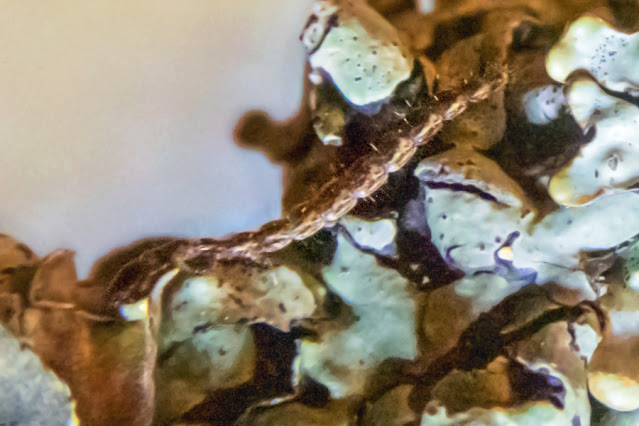
I thought I had examined them thoroughly. The lichens on twigs that I made into an arrangement in a vase. Nothing there but wood and lichen, or so I thought.

Looking at them again yesterday, I saw movement. Something running, something fast and curvy. I took many photos of the place where it had just been.

Caught it! Blurry, but it's there. Long, prickly beastie.

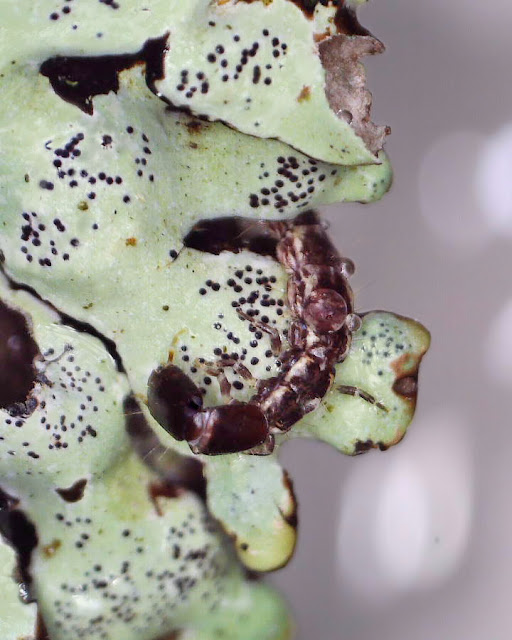
I gave up and went back to the planned operation; I sprayed the lichen down with de-chlorinated water. And the little runner stopped to take a drink. I even managed to get him under the microscope before he ran away again.

Square head, short antennae, 6 legs on the first segments. The round ball is a droplet of water.

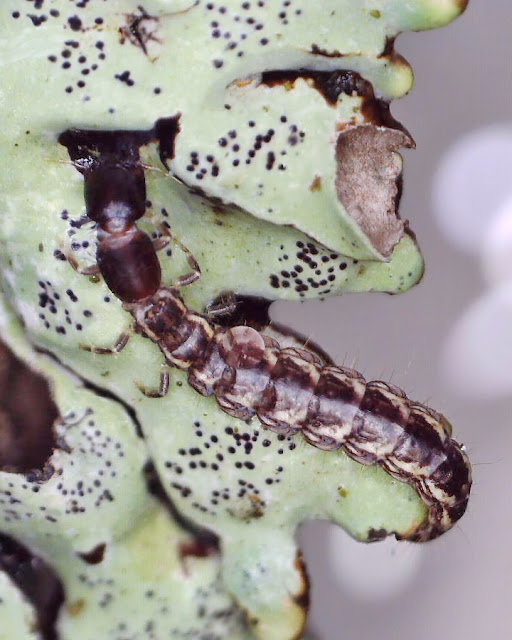
Nicely patterned tail segments, dragged along; no legs here.

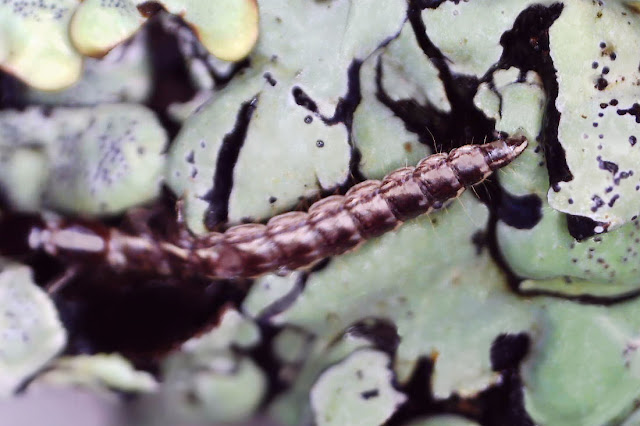
And, drink finished, he's off and running again. I count 12 body segments, besides the head.

I looked at a zillion larvae on BugGuide, and I think he's probably a rove beetle youngster. I've sent photos in to BugGuide; they will know.

UPDATE: BugGuide has moved the photos to Snakefly larvae.

~~~~~~~~~~~~~~~~~~~~~~
Creí que los había examinado bien; los líquenes en las ramitas de abeto de Douglas que había arreglado en un vaso. No había nada más que la madera y las hojas de liquen, pensaba.

Examinándolos otra vez ayer, vi algo que se movía. Algo que corría, algo con curvas sinuosas, y que tenía mucha prisa. Saqué muchas fotos del lugar donde había estado un instante previo.

Primera foto: por fin lo capturé. Una foto borrosa, pero ahí está. Largo y con espinas.

Me di por vencida y regresé al plan anterior, de ver como respondía el liquen al agua. Rocié la ramita con agua declorada. Y el bichito correlón se detuvo para beber. Hasta tuve tiempo de colocarlo bajo el microscopio antes de que se pusiera a correr otra vez.

Segunda foto: La cabeza es grande y algo cuadrada; tiene 6 patas en los primeros segmentos. La bola redonda es una gota de agua.

Tercera foto: diseño de los segmentos de la cola. Pesada y larga, pero sin patas; la arrastra tras si.

Cuarta foto: ya terminó de beber, y empieza otra vez a correr. Cuento 12 segmentos del cuerpo, la cabeza aparte.

Miré gran número de fotos en BugGuide, y creo que este probablemente sea la larva de un estafilínido. Les envié unas fotos a los expertos en BugGuide; ellos podrán identificarla con más certeza.

Y ahora, BugGuide ha puesto las fotos en la categoría de los rafidiópteros.

Monday, August 17, 2020

Pearly everlasting and pointy beetles

It's the season for pearly everlastings. They're blooming on every sunny roadside. I picked a bouquet for the winter; the flowers stay white and yellow even dry. One clump held a swarm of tiny beetles.

Pearly everlasting, Anaphalis margaritacea, with beetles.

I have spent a couple of hours skimming through about 3,000 photos of sap beetles on BugGuide, without finding a match. I've sent them the photo; maybe someone will recognize them.

In my Bugs of BC guide, the one that looks closest is a sap beetle, the so-called "beer beetle", but I don't see the 4 red spots that it would be wearing. And the beer beetles like fermented fruit, not necessarily flowers. So I'm still in the dark.

*UPDATE. Sara Rall, in the comments, gave me a name: they're tumbling beetles, in the genus Mordella. She gives me a link, and I found more on BugGuide (for example), in this general area. So that's it. Thanks, Sara!

~~~~~~~~~~~~~~~

Es la temporada para las flores "perla perpetua"; ahora alumbran cada margen asoleado del camino,  Recogí un ramo para alegrar mi casa en el invierno: las flores secas mantienen su color fresco, blanco y amarillo, todo el año.

Unas plantas traían estos escarabajos miniaturos. Me he pasado varias horas revisando fotos en BugGuide, tratando de identificarlos, sin mucha suerte. Les mandé mi foto. Tal vez alguien los reconocerá.

En mi guía "Bugs of BC", hay un escarabajo algo parecido, el dicho "escarabajo de cerveza", pero éste tiene cuatro puntos rojos muy evidentes. Y les gusta la fruta fermentada (y la cerveza), las flores no tanto. Así que me quedo con la duda.

¡YA LO TENEMOS! Es un escarabajo de los Mordella, los "escarabajos revolcadores".


Sunday, September 29, 2019

Midnight visitor

I rolled over in bed, and there on my pillow, a tiny moth was resting. I rolled out and went for the camera.

A caddisfly, not a moth.

 I've sent its photo in to BugGuide and to INaturalist.

(Updated: on INaturalist, it's been identified as a caddisfly.

Sunday, August 18, 2019

Not a spider

So it wasn't a spider after all. I posted a photo of a spider look-alike a few days ago.

This little guy, about 3 mm. long, on gumweed.

I counted 8 legs, but I sent it in to BugGuide, and they count 6 legs and two antennae, which makes it not an arachnid.*

Ken Wolgemuth, on BugGuide, says it is "an aphid of some sort."

Interesting: I've seen many black aphids, but always in a mass covering stems and leaves of a whole plant. I've never seen (that I knew of) one out for a walk on his own.

Now this, I know for sure, is a spider:

Fat house spider, Steatoda, probably bipunctata, probably female. On the wall above my desk.

*Update: not 6 legs and 2 antennae; they're 6 legs and 2 "corniculi, a pair of tubes that come off the back of an aphid's abdomen," as Christopher Taylor tells me in the comments. He adds that they may be used to release chemical compounds.


From WikipediaThe cornicle (or siphuncule) is one of a pair of small upright backward-pointing tubes found on the dorsal side of the 5th or 6th abdominal segments of aphids. They are sometimes mistaken for cerci. They are no more than pores in some species.
These abdominal tubes exude droplets of a quick-hardening defensive fluid containing triacylglycerols called cornicle wax.
Thank you, Christopher!

Thursday, July 12, 2018

And a few more spiders

They're exploding all over! Up in the corners, young cellar spiders hang, leggily. Miniature males, species unknown, prowl the walls looking for fat females. (Wrong place, guys! The girls are just outside the window.)

And at ground level, the big hunting spiders guard the fort against sowbugs and stray cobweb spiders.

A big male, on the leg of a garden chair. (I disturbed his cozy hiding place under my yard waste bag.)

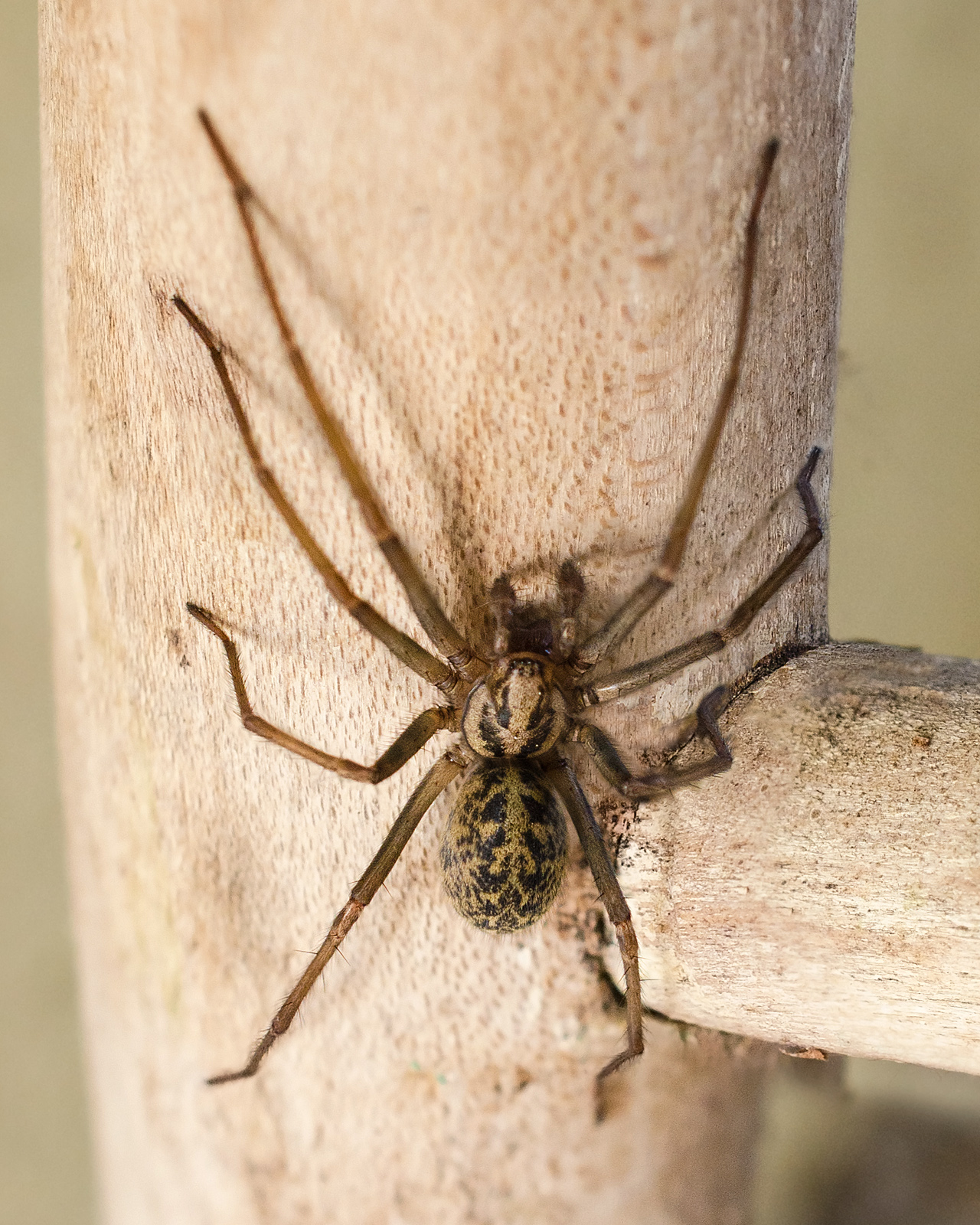
And another, in the house, at the edge of her messy web on the bottom of a Mexican shopping bag.

Look at that web again. In the frass, there's the remains of her last molt, down in the right-hand corner; the leftovers from another spider meal; half a sowbug, all the juices sucked out; and something squarish that I can't identify. A beetle, maybe?

These spiders are difficult to identify. There are three similar species, and the rules for identification have changed. I think these are Eratigena agrestis, but then again ...

Years ago, they were called Tegenaria. Worried about the bad name some of them have, I wrote a post listing some of the differences between the species, here. But since then, they've been re-classified as Eratigena, an interesting name because it is an anagram of the letters of Tegenaria.

From BugGuide, on the Giant House spider, Eratigena duellica:

This spider (like its relatives T. domestica and E. agrestis) was imported from Europe into the ports of the Pacific Northwest. The first known N. American record was from Vancouver Island in 1929. It did not reach Seattle until 1960. 
The greater European house spider (E. duellica) is not dangerous to people. Some people may be intimidated by their size as male legspans can reach 4 inches (100 mm). However, Rod Crawford has never known one to bite a human (though they certainly could if they tried); they are so docile he uses them as hands-on demonstrators for school children. 
The Hobo Spider (E. agrestis) is often confused with this spider. If you are unsure of the exact species, just be mindful of this confusion, and use caution when dealing with the spider. (See E. agrestis for more information about the hobo spider). 
The presence of giant house spiders is a deterrent to the establishment of hobo spiders indoors. It out-competes and displaces the hobo spider indoors and male giant house spiders often kill male hobo spiders (without necessarily eating them)!

So it's still wise to keep my distance from these spiders. Unless I can measure the legs; they look the same as the harmless giant, and are about the same size, except for those long legs. And if E. agrestis bites, it could be a bit of a problem.

This little guy's no problem at all:

High on the wall, out of the hunter's range, a tiny yellow and tan spider, stopping for a rest. It's so far to where the girls are!

Sunday, July 08, 2018

Morning visitor

I found this moth sleeping on my pillow in the morning.


Such a beautiful feather coat!

And headdress!

I protected her from the cat in a plastic container, and she seemed to want to dance.

"Swing to the right"

She's one of the owlet moths, but I don't recognize the pattern on her wings, so I've sent her in to BugGuide for an ID.

Update: She's a Pickerelweed Borer moth, Bellura densa.

Sunday, June 22, 2014

Ni

A black and brown moth was sleeping on the air intake of the roof of our front door. I spent a busy half hour standing on an unsteady chair, reaching as high as I could and taking photos, to the great entertainment of a stream of inquisitive passers-by. And with all that, I forgot to measure the beastie, so when I was preparing a photo to send to BugGuide, I had to go out in the middle of the night to measure the space where it had been. Luckily, no-one was around at that hour; a bit of street theatre is ok, but a return engagement is too much.

The moth was well worth the effort. I'd never seen one like this before.

Cabbage looper moth, Trichoplusia ni.

It has quite an elaborate hairdo, with two tall tufts (they look to me like bat ears) at the back of the head, and then a smaller tuft of feathers a bit further back. Combined with the complicated pattern of the wings, it must make the moth almost invisible as it sleeps through the daylight hours, as long as it chooses the right spot; this air intake was not advisable.

At first, when I saw the name on BugGuide, Trichoplusia ni, I thought it was a typo; what sort of name is ni? Wikipedia explains:

The name derives from the forewing marking, which resembles the lowercase Greek letter ni.

And the lowercase Greek letter ni looks like a v. The mark has also been described as an open-ended 8; it depends on which moth you're looking at; each one is slightly different.

The caterpillar of this moth is a garden and farm pest. It makes big holes in the leaves of cabbages and other brassicas, of course, but will also take :

... leaves of a wide variety of plants, including beets, cabbage, carnation, cotton, kale, lettuce, nasturtium, parsley, peas, potato, soybeans, spinach, tomato. (Texas A&M)

It's a pale green caterpillar that walks in a series of loops, like an inchworm. We'll be watching for them on Laurie's lupins and my nasturtiums.


Saturday, April 12, 2014

Grey-eyed dragonfly

Another lost photo: I must have put this dragonfly aside to send in to BugGuide, and filed it in the wrong folder, along with kitten and baby photos. It's from 'way back in May of 2008, found in Queen's Park, New Westminster, and taken with my little Canon point-and-shoot, then cropped close.

Interestingly patterned abdomen and cat-like backwards "nose".

I couldn't find this in my bug books, nor on BugGuide. Still can't, after a couple of hours of searching tonight. It's unusual, with those bright colours of the abdomen, and the pale grey eyes.

I'll have to follow through on my original plan, and send it to BugGuide. They'll know.


Saturday, March 16, 2013

White collared moth

It looks like the mothing season has begun here. (About time!) We've begun to see those little flighty Indian meal moths here and there, and tonight, this one was sleeping on the curtain behind my desk.

White head, white collar, fringed wings. 1/4 inch long.

I don't remember seeing one like this before; even from a distance, that white collar was startlingly bright. The two little dots at the front are the tips of two curved, up-turned "horns".

I can't identify it, and after looking at 2000 photos on BugGuide, I checked the last page of their images. There are 4108 pages, at 25 photos each page! That's 102,700 photos of moths. I gave up.

I've submitted it to them, but I don't have much hope of an ID. With so many moths, who can come close to knowing them all? But then again, they have surprised me before.

UPDATE: 6 hours later; They've done it again! It's the White-shouldered House Moth, Endrosis sarcitrellla. Amazing people!

And thanks, Troy!


Wednesday, October 10, 2012

A well-behaved midge.

I thought this was a crane fly. A very small one, very green, but it was shaped like a crane fly; long abdomen, long legs, inflated thorax, big eyes, two wings and halteres.

Very green.

I sent it in to BugGuide. Where it was promptly identified as a midge.

I thought midges were small and black, and lived to bite me. This one is large, for a midge; I didn't get a chance to measure him, but they run from about 1/2 to 3/4 of a centimetre. And he doesn't bite.

Wonderful antennae! They identify him as a male.

He's a male, one of the Chironomini tribe, a relative of the mosquitoes, cousin to the no-see-ums that pester us around sunset, prettier than all of them.

I took his photos and went home for a ruler, When I got back, he was gone, probably looking for a mate. If he finds her, she will lay her eggs in water somewhere, which will be difficult to find since it hasn't rained here for ages. I wish them well.


Thursday, February 09, 2012

Stripy nymph

Isn't he a cutie?

Found inside a cattail head.

I've sent this one and an adult in to BugGuide and will post their verdict later.
*Update: it's Chilacis typhae, the bulrush bug.

My "To blog" folder is full, and I'm getting 'way behind. I think I must do a everything-but-the-kitchen-sink post in the next day or two. Bugs and birds and shape-shifting spiders, skies, mountains, you-name-it, crammed in higgledy-piggledy. You have been warned!


Wednesday, February 03, 2010

Red-eye special

No, not that kind of red-eye. These are supposed to be red.

Bug season is upon us. Today's catch around the house:

  1. One Indian meal moth larva. Found in the bird seed. Fed to the Xysticus spider from the sprig of fir. Yum!
  2. One carpet beetle. First of the year, by the open window. Video taken, to be processed later.
  3. One springtail, a long, thin one this time. Measured and photographed. To be sent to BugGuide for ID.
  4. One unidentified egg packet. (At least, that's what I think it is.) Set aside for monitoring.
  5. Umpteen Mexican chile beetles, many dead adults, one very much alive adult, many live larvae. To be photographed tomorrow.
It's early in the year for this, I think, but it is unseasonably warm. Look for a bunch of buggy posts in the near future.

And I'm behind on posting the January crop. Which included this luscious yellow wasp:


Torymid wasp, probably Megastigmus, female.

I found her mate on a kitchen wall a month ago; she turned up in the bird seed a couple of days later. She is barely 3 mm. long, not counting that long ovipositor at the end.

There was some discussion on BugGuide as to the species, but if she is a Megastigmus, although her relatives are parasitic, and she's classified under "Parasitic Apocrita", she lays her eggs inside seeds instead of inside other insects. My bird seed, to be precise.

The name refers to the spots on the wings:


Stigmata?

There's not much more to say about her, but I liked these photos:


Top of the head, and red, red eyes


As curious about me as I am about her.

And now, I've detained you long enough; if you haven't been there already, go on over to Beetles in the Bush for the 47th edition of Circus of the Spineless. A stunningly beautiful nudibranch, ironclad snails, samurai crabs, and that's just for starters!

Monday, October 26, 2009

Search tip, discovered by accident

This is a first. Not the beetle; I'm sure I've seen these around. But never before have I found what I was looking for on BugGuide in a matter of seconds.


A Minute Brown Scavenger Beetle (Latridiidae), probably Melanophthalma. With a grain of coarse sugar.


I usually put some descriptor in the search box; "tiny brown beetle", for example. And BugGuide takes its time, and gives me thousands of brown or black beetles, and a few things that aren't beetles at all. This time, I used the size: "beetle 2mm". And the match to mine came up immediately, on the first lot of photos.

Something to remember for next time.
.
Powered By Blogger