Showing posts with label aphids. Show all posts

Tuesday, June 09, 2026

The cutest mini-bug

I had collected leaves and stems of the Angelica to help with an id, and had found leaping mini-bugs on them. And there were a couple of beetles, out of focus on the flowers, too. So I went out and collected leaves of several of my flowering plants. This cute leafhopper hopped off the lemon balm leaves.

On my desk. 3 mm. long. Tentatively id'd as Eupteryx melissae, the Banded Sage Hopper.

And on columbine leaves:

Clusters of aphids.

And then I went spider hunting and was surprised to find ... no, I'll leave it for tomorrow.

~~~~~~~~~~~~~~~

Había cortado hojas y tallos de las flores de Angélica para poder identificar la planta, y de allí varios insectos minaturos saltaron, perdiéndose antes de que pudiera examinarlos. También vi escarabajos en mis fotos, estos mal enfocados. Pues fue a juntar hojas de algunas de mis plantas con flores. Este lindo saltahojas estaba en una hoja de la menta de limón, Melissa officinalis.

    1.  as Eupteryx melissae, Saltahojas (o chicharrita) de la salvia. Mide 3 mm. 

    2. Y en las hojas de las columbinas, había muchos grupos de áfidos.

Y luego fui en busca de arañas y encontré algo sorprendente. Pero eso lo dejo para mañana.

Tuesday, September 24, 2024

Fungus among us, she said

 A month ago I posted photos of some red and green aphids that I found on my lemon balm; I had sent them in to BugGuide for an id; were they two different species? I asked. 

The answer: probably nymphs, immature stages on the way to becoming adults, possibly potato aphids, Macrosiphum euphorbiae.

The aphids, red and green.

Today I received an update and a correction:

The red aphids are infected with an entomopathogenic fungus, they are the same species as the green specimens though. Unfortunately these are nymphs which are tough to ID on their own because they have not yet fully developed the characters used for ID, which are based on adults.

Definitely not Macrosiphum euphorbiae though, the siphunculi (tailpipes) look a little swollen, and that is not a character M. euphorbiae has. Looking at the species that occur on Melissa officinalis, maybe Myzus ornatus. (Natalie Hernandez, BugGuide)

So I googled entomopathogenic fungi. "Entomo-" refers to insects, all insects, including the aphids. The Wikipedia entry starts off with a photo of an aphid, then a wasp. Other links led me to research papers on these fungi in aphids, which confirmed what I found on Wikipedia.

These fungi usually attach to the external body surface of insects in the form of microscopic spores ... these spores germinate, grow as hyphae and colonize the insect's cuticle; which they bore through ...Then, the fungal cells proliferate in the host body cavity ... After some time the insect is usually killed ... and new propagules (spores) are formed in or on the insect if environmental conditions are again right. (Wikipedia)
The photo on Wikipedia, and several other photos I found show the aphid covered in a fuzz of  sporulating fungus. And BugGuide has a section under Aphids titled "Killed by Fungus", with another aphid completely obliterated by fuzz.

Poor beasties!

~~~~~~~~~~~~~~~
Hace un mes subí fotos de unos áfidos rojos y verdes que había encontrado en el toronjil en mi jardín; las había enviado a BugGuide para ver si los podían identificar. Pregunté: ¿Los áfidos verdes, son inmaduros, o de otra especie distinta? La respuesta: probablemente son ninfas, áfidos inmaduros. Y estos adultos posiblemente sean áfidos de las papas, Macrosiphun euphorbiae.

Hoy recibí esta respuesta, amplificando y corrigiendo esos datos.

Los áfidos rojos han sido infectados con un hongo entomopatogénico, aunque son de la misma especie de los espécimenes verdes. Desafortunadamente son ninfas, los cuales son difíciles de identificar por separado porque todavía no han desarrollado las características que usamos para su identificación, basadas en los adultos.

Pero definitivamente no son Macrosiphum euphorbiae, los sifinculi (los cornículos) se ven algo inflados, que no es una característica de M. euphorbiae. ... Possiblemente sean Myzus ornatus. (Natalie Hernandez, BugGuide)

 Entonces busqué  "hongos entomopatogénicos". El prefijo "Entomo-" se refiere a los insectos, todos los insectos, incluyendo, claro, los áfidos. El artículo en Wikipedia empieza con una foto de un áfido, y luego con una avispa. Otros enlaces me llevaron a reportes sobre estos hongos en los áfidos, que confirmaban lo que vi en Wikipedia.

Estos hongos normalmente se adhieren a la superficie exterior de los insectos, en la forma de esporas microscópicas. ... Las esporas germinan, desarrollan hifas, colonizan y perforan el exoesqueleto del insecto. ... Luego las células del hongo llenan el cuerpo del huésped ... Después de un tiempo usualmente el insecto muere ... y nuevas esporas se forman dentro o encima del insecto, siendo favorables las condiciones ambientales. (Wikipedia)
La foto en Wikipedia y varias otras fotos que encontré muestran el áfido cubierto con una pelusa hecha de cuerpos fructíferos del hongo. Y BugGuide hasta tiene una categoría con el título "Muerto por hongos", con una foto de otro áfido totalmente envuelto en esa pelusa.

¡Pobres bichitos!

Saturday, August 17, 2024

Of cornicles and lace

Beasties Project, continued. A two-fer, today.

Aphids:

Red and green aphids.

I sent these in to BugGuide, with a question: Are the green aphids immatures, or a different species of aphids? The answer: probably nymphs, immature stages on the way to becoming adults. And the adults here are possibly potato aphidsMacrosiphum euphorbiae. They feed on a huge variety of plants; these were on my lemon balm, but may have been feeding before on the scarlet runner beans or the sweet peas, or any of the weeds that persist in infesting my patch.

Adult and youngster.

Oh, the rabbit holes I fall down! I see Macrosiphum euphorbiae, and here we go. Whee! Macrosiphum translates as Big Siphon, referring to those two tubes on the sides of the end of the abdomen. Tubes, or siphons; but BugGuide calls them siphunculi, and looking that up for a definition, I got cornicles. As in, all aphids have cornicles; that is how you can distinguish them from nymphs of some other insects. The potato aphids have very long cornicles.

Got it. So the cornicles are important, but what do they do? I had heard that they excrete sweet honeydew, and that is why the ants farm them, but it's always good to double check. And no, that was what was thought before, but more recent studies show a different purpose.

Smaller aphid, on yarrow. Same day, probably an early stage. The cornicles are barely visible.
It’s now understood that this second liquid actually contains lipids, hemolymph and a substance called an alarm pheromone. (TheBugChicks)
The pheromone in question, E-β-farnesene, warns other aphids that a predator is nearby.
An aphid only produces E-β-farnesene after it’s been attacked.  Once that pheromone is released, any aphid within detection distance will stop feeding and walk or fall of the leaf it’s on.  In species with long cornicles, (like the potato aphid) the aphids will flex their abdomens and smear the pheromone onto the predator in the moments before death.  This action ensures that wherever the predator goes on the plant, the other aphids know before it even arrives!  It’s totally sneaky.  This behavior allows the other aphids in the cluster more time to escape predation. (TheBugChicks)
And here's a predator: a lacewing.

Brown lacewing, subfamily Hemerobiinae 

What big eyes you have, Lacey!

The lacewings, both the greens (of which some are brown) and the browns (which may turn green with age) are predators. And both larvae and adults indulge. Their favourite food is aphids.

They hunt from dusk to dawn, and on cool days. This one turned up at my desk at 9 in the morning. After a successful night among my flowers, I hope.

~~~~~~~~~~~~~~~~~~
Seguimos con el Proyecto Bichitos. Dos criaturas hoy.

Los áfidos. También se les llama pulgones.

Fotos: #1, 2. Áfidos, rojos y verdes, adultos e inmaduros.

Envié estas fotos a BugGuide, con la pregunta: ¿Los áfidos verdes, son inmaduros, o de otra especie distinta? La respuesta: probablemente son ninfas, áfidos inmaduros. Y estos adultos posiblemente sean áfidos de las papas, Macrosiphun euphorbiae. Se alimentan de una gran variedad de plantas; estos estaban en las hojas de toronjil, pero bien pueden haber estado antes en mis plantas de frijol escarlata, o en los guisantes de olor o en cualquiera de las hierbas malas que llegan a invadir mi jardín.

¡Qué fácil se me hace desviarme! Veo el nombre científico, Macrosiphum, y ya perdí el camino. Macrosiphum se traduce como Sifón Grande, y se refiere a esos dos tubos que salen a ambos lados del extremo del abdomen del áfido. Son tubitos, pero BugGuide los llama siphunculi. Buscando la definición de esa palabra, me llevó a los cornículos. Todos los áfidos tienen cornículos; de esta manera se puede distinguirlos de las ninfas de algunos otros insectos. Los áfidos de las papas tienen cornículos muy largos.

Todo muy claro. Pero, ¿de qué sirven los cornículos? Había oido antes que secretan el melazo tan dulce, la razón por la cual las hormigas los cultivan, pero siempre vale la pena volver a investigar. Y resulta que eso es lo que pensaban antes, pero estudios más recientes descubren un propósito distinto.

Foto #3: Un pulgón más chico, probablemente más joven. En aquilea sp..
Ahora se entiende que este segundo líquido contiene lípidos, hemolinfa, y una sustancia llamada una feromona de alarma. (TheBugChicks)
La feromona referida, E-β-farnesene, sirve de advertencia para otros áfido que un predador se encuentra cerca del grupo.
Un áfido solamente produce E-β-farnesene después de que ha sido atacado.  Una vez producida esa feromona, cualquier áfido dentro de una distancia que permite detectarla dejará de comer y caminará o se dejará caer de la hoja donde se encuentra. En especies con córniculos largos (como el áfido de las papas), los áfidos doblarán sus abdómenes y untarán el predador con la feromona en los momentos antes de morir. Esto asegura que dondequiera que vaya el predador sobre la planta, los otros áfidos lo sabrán ¡antes de que llegue! Completamente tramposo. Esta forma de actuar les da más tiempo para escapar al predador a los otros áfidos. (TheBugChicks)
Y aquí hay uno de esos predadores: una crisopa parda.

Fotos #4, 5: Crisopa parda, con sus alas como encaje y sus ojos grandes.

Las crisopas, tanto las verdes (de las cuales algunas son pardas) y las pardas (que pueden volverse verde al madurar) son todas predadoras. Y tanto las larvas como los adultos así se alimentan. Su comida favorita es un áfido.

Cazan de noche, desde el crepúsculo hasta el amanecer, y también en dias frescas. Esta llegó a mi escritorio a las 9 de la mañana. Después de una noche exitosa entre mis flores, espero.


Saturday, June 01, 2024

Petals like crumpled paper.

 Thimbleberry flowers. Just thimbleberries.

Rubus parviflorus

Well, not quite "just" thimbleberries. These ones are harbouring two tiny beetles.

Zoom in.

And these ones are feeding a whole tribe of white and green aphids. There's a tiny spider in the centre of the flower on the left, probably waiting for the midges that followed me down the trail.

I spent a lot of time on the island chasing bees; now I have a ton of photos to sort. Mostly not bees. Will they never stand still for a minute?

~~~~~~~~~~~~~~~~

Las flores de thimbleberry, Rubus parviflorus. Solamente flores, nada más.

Mentí. Siempre hay algo más. En la primera foto, hay dos escarabajitos escondidos bajo los estambres. Y en la segunda, toda una tribu de áfidos verdes y blancos, además hay una arañita en el centro de la flor a la izquierda, esperando atrapar uno de los mosquitos que me seguían en el camino. (En español, todos se llaman mosquitos, tanto los grandecitos que nos pican como los moscos tan pequeñitos que llamamos "midges" o "no-see-ums", este último nombre se puede traducir como "no se ven".Estos forman nubes en espacios abiertos.)

Pasé gran rato en la isla persiguiendo las abejas, y ahora tengo un montón de fotos para revisar. Por la mayor parte, no son fotos de abejas; ¿porqué no se pueden detener ni por un minutito?

Saturday, October 16, 2021

Balm on a rainy night

 So it rains. And blows. And rains. And storms. And rains some more. And I've caught a cold and don't dare go out and get myself wet and chilled. Last night, in desperation, I went out in the rain and ripped up a couple of plants of lemon balm, which grows wild beside my carport. I filled a vase with wet lemon balm; it even still had a few flowers.

Lemon balm flowers, Melissa oficinalis. From base to tip, 8 mm.

I was hoping to find something alive on the plant, maybe even a spider for Arachtober. And yes, there was a slug.

Tiny slug, 1cm long.

And a bunch of green aphids. This one fell off, but I coaxed her back onto a leaf.

There were no spiders, but a miniature harvestman was hiding behind a leaf.

5mm long, with a stripe down her back.

Heading for a better hiding spot.

Bye!

I got up this morning and checked the vase. Neither the slug nor the harvestman is anywhere to be found. The aphids were still there.

(And now, do I have a tiny slug wandering around my kitchen? Or eating my house plants? When he shows up, he's going out into the rain again.)

~~~~~~~~~~~~~~~~
Pues llueve. Y sopla un viento fuerte. Y llueve. Y hay tempestad. Y llueve aun más. Y a mí me ha pegado una gripa y no me atrevo a salir a empaparme con agua fria. Anoche, ya harta de mis cuatro paredes, salí en la lluvia y arranqué unas plantas del toronjil (hoja de limón) que siempre crece cerca de la puerta.

Llené un frasco con ramas del toronjil. Todavía tenía unas cuantas flores.

Fotos:

  1. La flor de toronjil. De la base al punto de los pétalos mide 8 mm.
  2. Una babosa chiquitita, de un cm. de largo.
  3. Un áfido verde; había varios. Este se había caído; luego le acerqué una hoja y volvió a subir.
  4. Esperaba alguna araña para el grupo de Arachtober, pero en su lugar, hallé este opilón escondido tras una hoja. Mide 5 mm de cola a cabeza. No medí las patas.
  5. Aquí se trata de esconder de nuevo.
  6. —¡Adiós! — me dice.
Me levanté esta mañana y examiné el toronjil de nuevo. Ni la babosa ni el opilón se pueden ver. Pero siguen allí los áfidos.

(Y ahora, ¿tengo una babosa dando vueltas en mi cocina? ¿O se está comiendo mis plantas caseras? Cuando la encuentro, se irá afuera a la lluvia otra vez.)


Monday, August 30, 2021

Billions and billions and billions

 Aphids. They're a pest. They make plants sticky and spoil the looks of flower bouquets. They drop honeydew on lawns. They attract ants. In large numbers, they suck the sap out of new plant growth. Otherwise, they're mostly harmless, but no-one seems to like them much.

But they can be interesting. And cute, too.

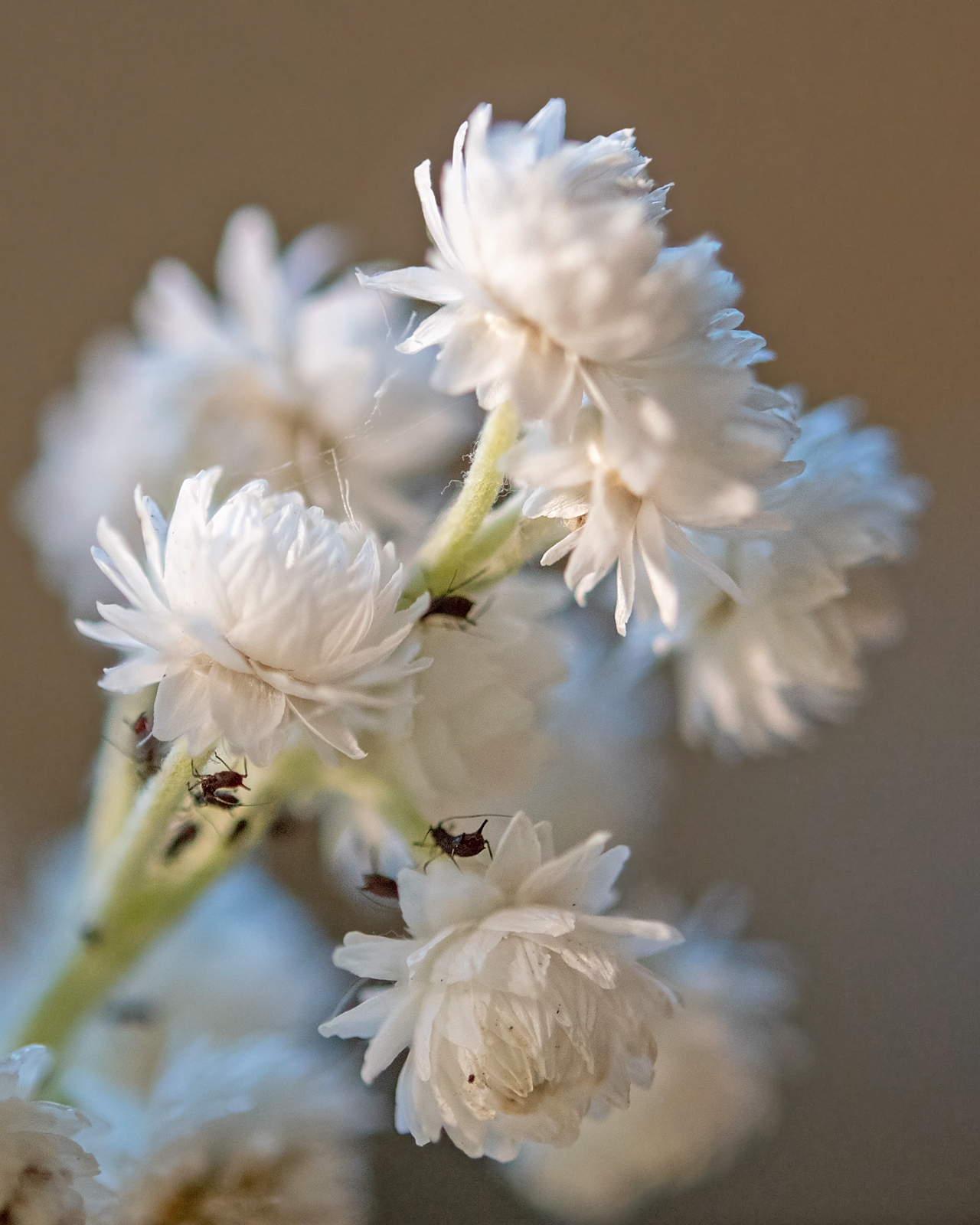
A handful of pearly everlasting gathered for winter blooms from the shores of Upper Campbell Lake came home with its cargo of blackish aphids.

Busy little beasties.

The two projections, called siphunculi or cornicles, near the rear are unique to aphids. They're tubes that exude a quick-hardening defensive fluid, cornicle wax.

Most of these aphids will be females. Some will be pregnant with their daughters and granddaughters.

Aphids have been known to have what is called telescoping generations. With telescoping generations the female aphid will have a daughter within her who is already parthenogenetically producing its own daughter at the same time. (McGill university page)
While the weather is warm, aphid females go on producing generations of daughters. When the weather turns cold and food becomes scarce, males are born; both males and females born at this time may have wings. They mate and the females lay eggs which will hatch in the spring.

Some species of cabbage aphids (like Brevicoryne brassicae) reproduce rapidly during the summer. They are all females, and can produce up to 41 generations of offspring. If no aphids had died during the summer, there would be more than one and a half billion billion billion aphids (1.5 x 10²) by the end of the season. (McGill)
Yikes!

All wingless still. The weather has been warm.

What yoga position is this?

~~~~~~~~~~~~~~~~~~~~~~
Los áfidos. Pulgones, les llamamos. Son una plaga. Vuelven las plantas pegajosas y arruinan la belleza de nuestros arreglos florales. Depositan melazo en el césped. Atraen a las hormigas. Cuando son muchos, impiden el crecimiento de las flores y fruta. Aparte de esto, no son muy dañinos, pero nadie parece tenerlos afecto.

Pero pueden ser interesantes. Y chistosos, también.

En un manojo de perlado eterno que traía a casa desde la orilla del lago Upper Campbell para hacer bouquets para el invierno, había una familia de áfidos oscuros.

Fotos: perlado eterno con sus áfidos.

Los dos apéndices hacia el posterior del insecto, que se llaman sifúnculos o cornículos, son una característica única de los áfidos. Son tubos que exudan un líquido defensivo que se endurece rápidamente, o sea cera de cornículos.

La mayoría (tal vez todos) de estos áfidos son hembras. Algunas están embarazadas. Con sus hijas y sus nietas. (Las hijas, todavía sin nacer, ya llevan adentro sus propias hijas.)

Los áfidos tienen lo que se han llamado generaciones telescópicas. Con una generación telescópica el áfido hembra traerá adentro una hembra en proceso de desarrollo, la cual también está produciendo partenogénicamente su propia hija al mismo tiempo. (de McGill U.)
Mientras el clima permanece caluroso, las hembras siguen produciendo hijas. Cuando llega el otoño y las dias de frío, nacerán áfidos machos; también tanto las hembras como los machos pueden tener alas. Se aparean y las hembras ponen sus huevos, que eclosionarán en la primavera.

Algunas especies de áfidos que viven en la col (repollo), como por ejemplo Brevicoryne brassicae, se multiplican rápidamente en el verano. Todas son hembras, y pueden producir hasta 41 generaciones de hijas. Si no se hubieran muerto ninguna durante el verano, habría más de 1.5 x 10²⁷ (15 con 26 ceros) de áfidos al final de la temporada. (McGill)

:O


Monday, May 21, 2018

Fat aphids

Every rose has its critter.

Native wild rose, and well-fed aphids, sleeping it off on a leaf.

If you look closely, there are a round, fat, very fat, short-legged beastie and a pointy-nosed critter (a fly or a weevil?) and a couple more half-hidden insects, all foraging for pollen among the stamens of the rose. So tiny! The largest no bigger than the heads of the aphids!

So  busy, so happy (after the manner of insect happiness), so intelligent, smart enough to go out and find a good rose, "knowing" its pollen will be good to eat. Sure, not as smart as you or me, but amazing, nevertheless, if you think about it.

We underestimate the brilliance of the tiny things.

Wednesday, November 29, 2017

Cold-weather aphid

In all the cold weather, most of my garden has shrivelled and shrunk. The nasturtiums are a smear in the mud, the hydrangea rattles pale brown heads in the wind. Only the alyssum still blooms, draped over the wall, scorning the rain that tries to grind it into the cement.

And the invasive (but still tolerated for its scented leaves) lemon balm, cut down to the ground a month ago, has sprouted new leafy stalks. I cut them down again and brought a handful in to make tea. But they turned out to be a home for aphids, and the whole kit and kaboodle ended up in a glass of water, growing under my window.*

Lemon balm leaves and aphid, on my kitchen counter

The plant is used to attract bees to make honey. It is also grown and sold as an ornamental plant. The essential oil is used as a perfume ingredient, but the plant has other culinary and medicinal uses. Lemon balm is used in some toothpastes. ... as a flavouring in ice cream and herbal teas, both hot and iced, often in combination with other herbs such as spearmint. It is ... also paired with fruit dishes or candies. Additionally, it can be used in fish dishes and is the main ingredient in lemon balm pesto. (From Wikipedia)

*I am too soft-hearted for my own good, sometimes.

And tonight, the evergreens are all glittering with new frost. Proper winter weather, finally!

Wednesday, August 23, 2017

Opportunists

I love pearly everlastings. Every summer, I collect a fresh handful to dry for winter flowers; they last all winter, and on into the next year, as white and delicate as they were the day they were picked.

Western pearly everlasting, Anaphalis margaritacea

The plant is another of the asters; the "flower" is a cluster of tiny, yellow flowers, in a showy head of papery bracts. The flowers fade, but the bracts persist until next year's crop pushes them aside.

Each flower head is about 1/4 inch across.

I made a mistake this year. I always hang the fresh plants stem up in a dry place until the yellow flowers and the leaves are dry. Last week, I was in a rush, and plopped the whole handful into a vase where a broken hollyhock stem was being cared for. Then I forgot all about it.

When I looked at them again yesterday, the sap was still running. And the stems were covered in fat, dark aphids.

Where did they come from? I'm sure there were none when I brought them home.

When host plant quality becomes poor or conditions become crowded, some aphid species produce winged offspring, "alates", that can disperse to other food sources. (Wikipedia)

Oh. So they may have flown in. Or ...

From KULeuven

(Text: "Did you know? In one season, just one aphid could produce over 600 billion descendants. During their asexual reproduction, the aphids give birth to live young instead of laying eggs. These young already contain their own young, meaning that an aphid gives not only birth to their children, but also their grandchildren.")

They were born here. And they're just getting started!

One aphid, showing off her siphunculi.

Most aphids have a pair of cornicles (or "siphunculi"), abdominal tubes through which they exude droplets of a quick-hardening defensive fluid containing triacylglycerols, called cornicle wax. (Wikipedia, again.)

These aphids are probably in the genus Uroleucon.


Saturday, July 13, 2013

Of ladybugs and linden trees

The linden tree seems to be a little late this year. Or perhaps it's the aphids that are running behind schedule. It wasn't until this week that the tree started to wake up. And yesterday, I found the first ladybugs. Not the first to arrive, since some have pupated already, and at least one larva is in his last instar. Maybe they started in the top of the tree, where the sun shines almost all day.

On the leaves that I could reach, I found aphids producing honey, ants eating the honey, ladybug larvae eating the aphids, assorted wasps, including those bright orange ones, looking for a place to lay eggs, a very pretty fly all spiffed up in red eyes and blue back, who left when I touched his branch. And the adult ladybugs, supervising everything.

Aphids, full-grown, early instar, and an abandoned molted skin.

These are the  Eucallipterus tiliae, the Linden or Lime-tree Aphid. Their population will increase as the summer goes on, until every leaf has its little mob. The mature ones (see the photo above) feed on the thick veins of the leaf, where the sap flows freely. The youngsters, with much smaller feeding stylets, are restricted to the tender areas between veins.

They produce more honey than the ants can eat, so it "rains" onto the grass below the tree. The first year I noticed them, the grass was black with mould, growing on the honey. Since then, I've made sure to wash off the grass well every day or so; last year, there was no mould. None this year, so far, but we're in early days yet.

Adult, Harmonia axyridis, a 19-spotter with a mostly white pronotum. I love those shiny eyes!

Another adult, with smaller spots.

One of the ladybugs had a mostly black pronotum, although it was the same species; it had the "W" clearly marked on the front. I wanted his photo, but he was not in the mood. He ran, and I chased him, from one leaf to another, to the main branch, me getting stickier by the minute, he getting angrier, I think, because he finally dropped onto my arm. "Yay!", I thought, "Now I've got him where I can see him."

And then the little bug bit me, and flew away, muttering imprecations as he went.

The pupas don't run, and they don't bite.

The frills are the old larval skin, shed as he pupated, and glued to the leaf at his tail end. Silky threads hold him down. I'm wondering how he manages to anchor those threads, encased as he is. I'll have to watch another one pupate to see.

And I have no idea what this next thing is. It's too small, and the wrong shape, to be an abandoned ladybug pupa. There is no larval skin, and the ladybug splits her pupa down the back, leaving a black thing standing upright.

It looks as if there is a hole in the front end, where the adult insect emerged. Whether that was the original inhabitant, or a wasp that had parasitized it, I can't tell.

What is this?

Next: a weird fly in my kitchen.

Monday, December 31, 2012

2012 critter sampler

December 31st! Already? I'm still doing end-of-summer catch-up!

Alex Wild is curating "Best of 2012" science and nature shots on Scientific American. I was reminded, again, by BugGeek, who posted her collection. Beautiful shots; I've seen them all before, and will review them again tomorrow. Not tonight, because it's hard to blog when you're green with envy.

I looked over my photos, picking out the favourites, not to submit, but just as a year-end summary. And there were too many! I cut them down to just critters; still too many, and I kept remembering more. But I've finally trimmed the list down to a dozen favourite critters, not without difficulty.

Here's the collection: Critters only:

Ant nest uncovered, with the adults rushing to drag the larvae down the holes, out of sight.

Aphid in a moss forest

Caterpillar in morning sunlight

Garden snail, feeding on glass.

Grainy hand hermit, in human hand

Harvestman volunteer

I had trouble choosing my favourite of all the spiders. I have to smile at this fat mama, who does NOT like lime and pepper chips.

Life's an adventure. Hermit crab in aquarium.

Lazy moth in jar lid and morning sunshine.

Spider #2 Long-jawed orb weaver, on hosta leaf.

This was an exciting find; a molting ghost shrimp.

Ok, I give up; I can't choose just one or two spiders! Spider # 3, Ozyptila, the spider-eater's spider eater.

Spider #4, Mother toting her eggs.

Would have been #12, if I hadn't snuck a couple of extra spiders in there. Plume moth on outside wall.

And tomorrow is 2013! I never thought we'd get here. May it be a good year, the best year so far, for all of us!

Monday, December 03, 2012

Another aphid ...

And this one is orange!

Found on miniature rose, indoors.

I've seen green aphids, creamy aphids, black aphids around here. This is the first orange one.

Monday, November 19, 2012

In a clump of moss

Seven years ago, my daughter gave me a miniature iron birdbath, suitable for a miniature succulent. I left it in a corner until I could buy a plant for it, but when I looked next, it had a lush, green mound of native moss growing, so I let it be. The moss grew there happily until this very dry summer, when it turned brown, shrivelled, and finally blew away in a lump when the fall winds came. It came to rest behind some plant pots and I left it again, until I do the final fall clean-up in the garden.

I noticed it again today; it was full size and bright green again.

I brought it in to look it over in the light. It's in full leaf, and the fruiting bodies are standing tall above it. And climbing on a stem was a bright, white spark.

Sporophytes on red stalks. With the light spots, they look like long-necked, long-beaked birds.

A mini-aphid. With the flash, it was pure, burnt-out white; here I am using the flash at 1/16 normal strength, with a diffuser added.

It has something clinging to one antenna. The two up-pointing "tails" are  little tubes, called siphunuculi. They may help with defense.

Heading down into the moss jungle.

Rear view.

The moss (and aphid) is now outside again. Tomorrow, I'll replant it in the birdbath.

Powered By Blogger