Showing posts with label insect photography. Show all posts

Monday, May 26, 2014

Rainy day companions, naughty and nice

Laurie brought me a big, black ground beetle, and a medium brown spider. And it was raining, so I dropped everything and set up my bug photo booth.

The beetle was having none of it. He escaped three times, refused the nice, damp bark I'd found for him, turned up his nose at the leaf, knocked over the plastic box I tried to contain him in, kept his back to the camera, and kept running, running, running.

I got one semi-decent photo.

Catching his breath between escape attempts.

The spider, though, what a little sweetie! She sat on my paper towel and stared at the camera. When I turned the towel to get a side view, she stretched her legs a bit, then sat there, where I'd put her. If she could have, she'd have smiled. Does showing off your humunguous fangs count as a smile?

Twinkly eyes and hairy fangs

Side view. Composite photo, because she was too long for all of her to be in focus.

When I was done, I put them both outside, near the door out of the rain. The beetle, ornery critter that he is, just sat there for half an hour. Ma Fangs took off running and was out of sight in an instant. Things to do, places to go.

Thanks for your time, Ma Fangs!

Monday, November 19, 2012

In a clump of moss

Seven years ago, my daughter gave me a miniature iron birdbath, suitable for a miniature succulent. I left it in a corner until I could buy a plant for it, but when I looked next, it had a lush, green mound of native moss growing, so I let it be. The moss grew there happily until this very dry summer, when it turned brown, shrivelled, and finally blew away in a lump when the fall winds came. It came to rest behind some plant pots and I left it again, until I do the final fall clean-up in the garden.

I noticed it again today; it was full size and bright green again.

I brought it in to look it over in the light. It's in full leaf, and the fruiting bodies are standing tall above it. And climbing on a stem was a bright, white spark.

Sporophytes on red stalks. With the light spots, they look like long-necked, long-beaked birds.

A mini-aphid. With the flash, it was pure, burnt-out white; here I am using the flash at 1/16 normal strength, with a diffuser added.

It has something clinging to one antenna. The two up-pointing "tails" are  little tubes, called siphunuculi. They may help with defense.

Heading down into the moss jungle.

Rear view.

The moss (and aphid) is now outside again. Tomorrow, I'll replant it in the birdbath.

Friday, November 02, 2012

Testing a new flash attachment

I have two flashes, hand-me-downs from my daughter, that fit the old Olympus camera. But I couldn't get them into the shoe on the little Nikon I'm using, until today; the problem was an almost invisible second adjusting ring. Once I found it, half a turn did the trick. I spent the rest of the afternoon and evening testing the smaller flash out. (The big one is about three times the size of the camera, and twice its weight. It will work with a tripod, but live bugs and hermit crabs don't stay put that well.)

With a macro lens attached to the camera (even my little homemade item), the on-camera flash creates a dark shadow that covers the creature I'm focusing on. The extra angle on the new flash, five inches above the lens, makes a big difference. And I modified my light box to a light cone, to redirect the light. Then I took over a hundred test shots of a wasp that I caught months ago, and couldn't get any decent photos of.

A few sample shots:

Unidentified wasp, 1.5 cm long. Very dusty and dessicated, but not too damaged.

I love those yellow and black, curly antennae!

Zooming in. No depth of field at this range.

I haven't identified this, nor did I send any photos to BugGuide when it was new; my photos were just black on black, with no distinguishing features. I'll send in these, see what they say.

Tomorrow, we're going to Tsawwassen for a pottery sale. It will be Laurie's first outing since his fall. I hope the sun shines!

Saturday, January 07, 2012

Untangling a crumpled fly

Laurie brought me a miniature fly that he found in the sink. It was difficult to capture, and didn't survive. By the time I got it, it was all crumpled up, and shedding bits.

I've spent the better part of two afternoons and nights preparing photos for BugGuide; shooting, sorting, selecting, cleaning up, resizing, renaming. And then deciding they're not good enough, and starting another shooting session. My eyes are burnt out, and applying for personal time off.

I soaked the fly in hand sanitizer to soften it*, and photographed it between two sheets of glass in the goop. Most of the photos were totally unusable, but by putting the light behind it, and off to the side, I got a few shots passable for identification purposes. I hope.

It was just too bad that all my sheets of available glass were so badly scratched; I spent hours removing scratches and pretty bubbles of air stuck in the goop from the background. I left the ones in and between the legs of the fly itself.

This photo is the only one of hundreds that showed the halteres clearly. They're a different shape than I expected.

Silhouette, showing venation of the wings. The fly is 4.5 mm long.

And now I'm too tired to finish the job by filling in the BugGuide forms. I'm going to bed. There's always tomorrow.

*I used a variation of Dragonfly Woman's method. I didn't heat the sanitizer long enough, hence the air bubbles visible inside the legs and the ones I had to remove from the background.

Wednesday, December 21, 2011

A comfortable moth

In a discussion on The Bug Geek's blog, about our attempts to photograph lively insects, sometimes "cheating" by cooling them in the fridge or with ice packs to slow them down (which I resort to almost always), Ted MacRae wrote, "I’ve yet to take (or see) a photo of an insect that has been cooled (by whatever means) that doesn’t somehow look “off.”"

I've been thinking about that. So when Laurie brought me another small moth, I decided to keep it comfortable at room temperature.

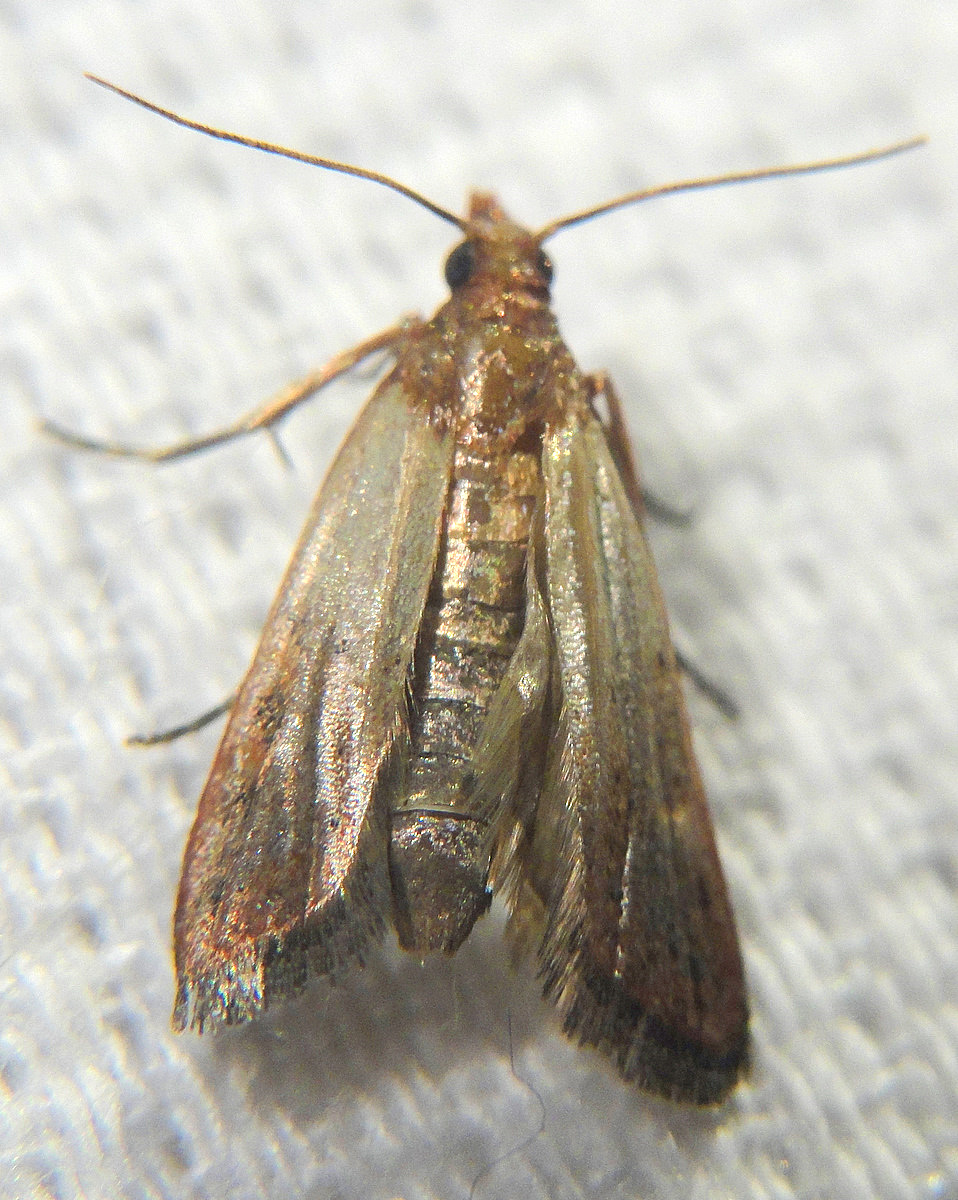
Found in a bag of bird seed.

The moth was very small, smaller than the usual bird seed moths I see, a dull greyish tan, with brown and yellowish accents. I left him loose on my desk, after a brief resting period under a pill bottle to calm him down. As he walked around, slowly, spending a bit of time grooming himself, I followed with the camera.  He didn't seem to notice, but after a bit, he wandered off to the edge and flew away.

The colour seems different depending on the angle of the light.

I was surprised by the photos; his colours show up much more vividly than I had expected. Was it because he is warm enough? Does a cold insect get pale, like we would do?

Quite a shiny little critter.

The discussion also touched on the substrate; a natural substrate may work better, both as a natural background, and as a way to keep the insect feeling comfortable. I had used the white cloth to set my camera's white balance, and the moth walked onto it from my desk, so we went with that. Next time, maybe I'll use a layer of bird seed for these moths, since that's where they show up.

And patience. Or "brutal persistence," as Ted put it. Very important. I can do that, usually. But an unfettered insect, with the use of his wings; can he be patient? Not this guy: it was barely three minutes from the time I took the first photo before he'd had enough, and flew away.


Sunday, November 27, 2011

A quick game of hide and seek

Laurie found an earwig for me. I chilled her* in the fridge, and photographed her on an ice pack. Not good enough.

First photo, while she was still sleepy.

A few seconds later, awake and cleaning her antennae, preparing to run.

A couple of stretches, and she took off running, out of sight in a second. I couldn't find her anywhere, so I put away the camera, the lights, and the ice pack. When that was done, she sauntered out from under the computer. Grrrrr!

I put her in a flat plastic container and tried again.

A brief pause to look at the camera. Then back to running, taking shelter under scratches on the plastic.

I gave up. She's been sent out to play in the rain.
*The forceps (cerci) are unequal in length in the males. Earwig female forceps are (more or less) straight-sided, whereas male forceps are strongly curved (caliper-like) and larger. (From here. My addition, in italics.)

Friday, June 10, 2011

How to stop a weevil in its tracks

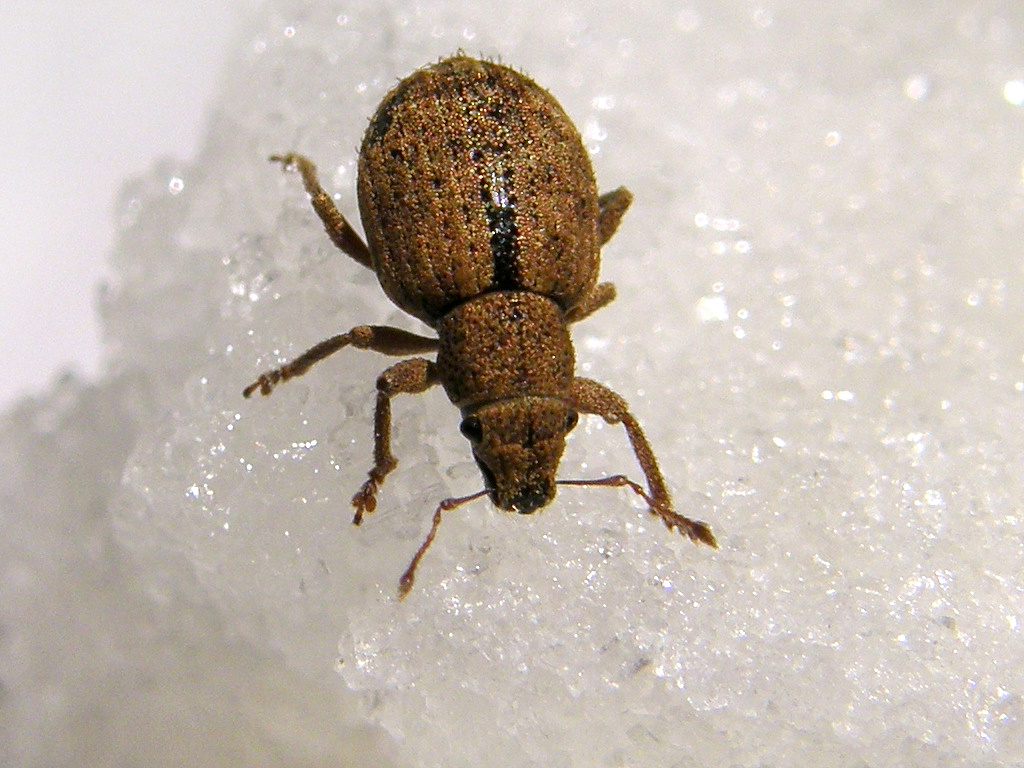
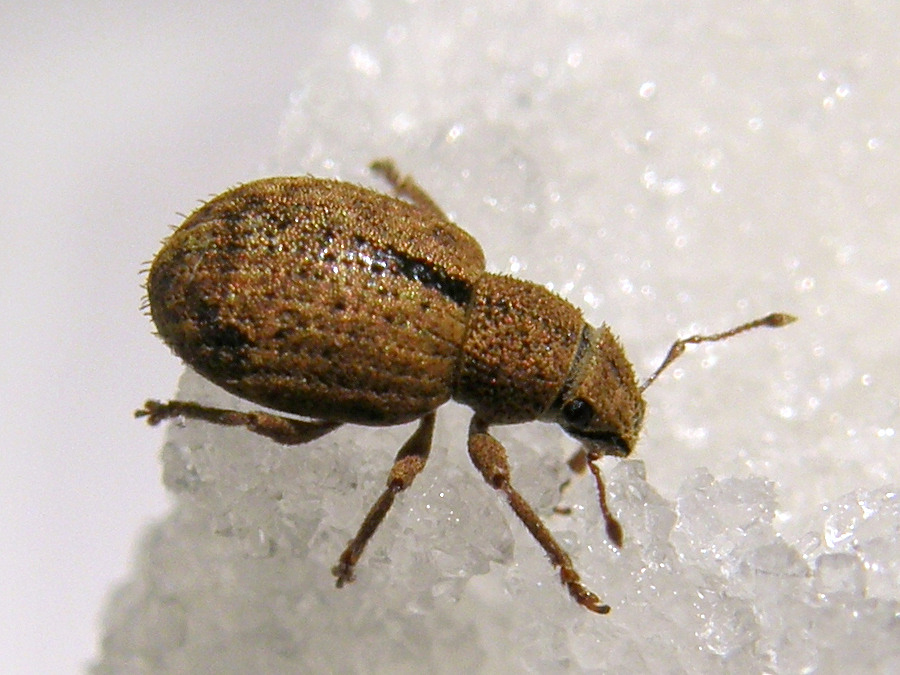
I discovered a new trick yesterday. I found a very small weevil on my countertop, and tried to get his photo. He kept moving, and turning his back on me, changing direction if I thought I would anticipate him ... hopeless. I tempted him with strawberries, to no avail. I was going for a few grains of sugar, and saw the sugar cubes. I dampened one, just a bit, and gave it to him. Just the thing! He clambered up, checked out the corners, and settled down to load up on carbs.

"This tastes better than your old strawberries!"

Staying put.

I took all the photos I wanted. He never attempted to leave. He stayed there while I went about my business, and was still there half an hour later. And the sugar cube is easy to turn or move into better light. It makes a decent background, too; not too busy, not too white.

I'll have to try this with ants.
Powered By Blogger